Works › The Mariale: Questions on “Missus est”
Volume 37 · pp. 261–262
Question 176. How does she comprehend in herself the blessing given to Asher?
A marker with ≈ is an approximate page boundary, placed by measure of the text; the page photographs remain the authority. In the paired views, clicking a page marker brings that page into view.
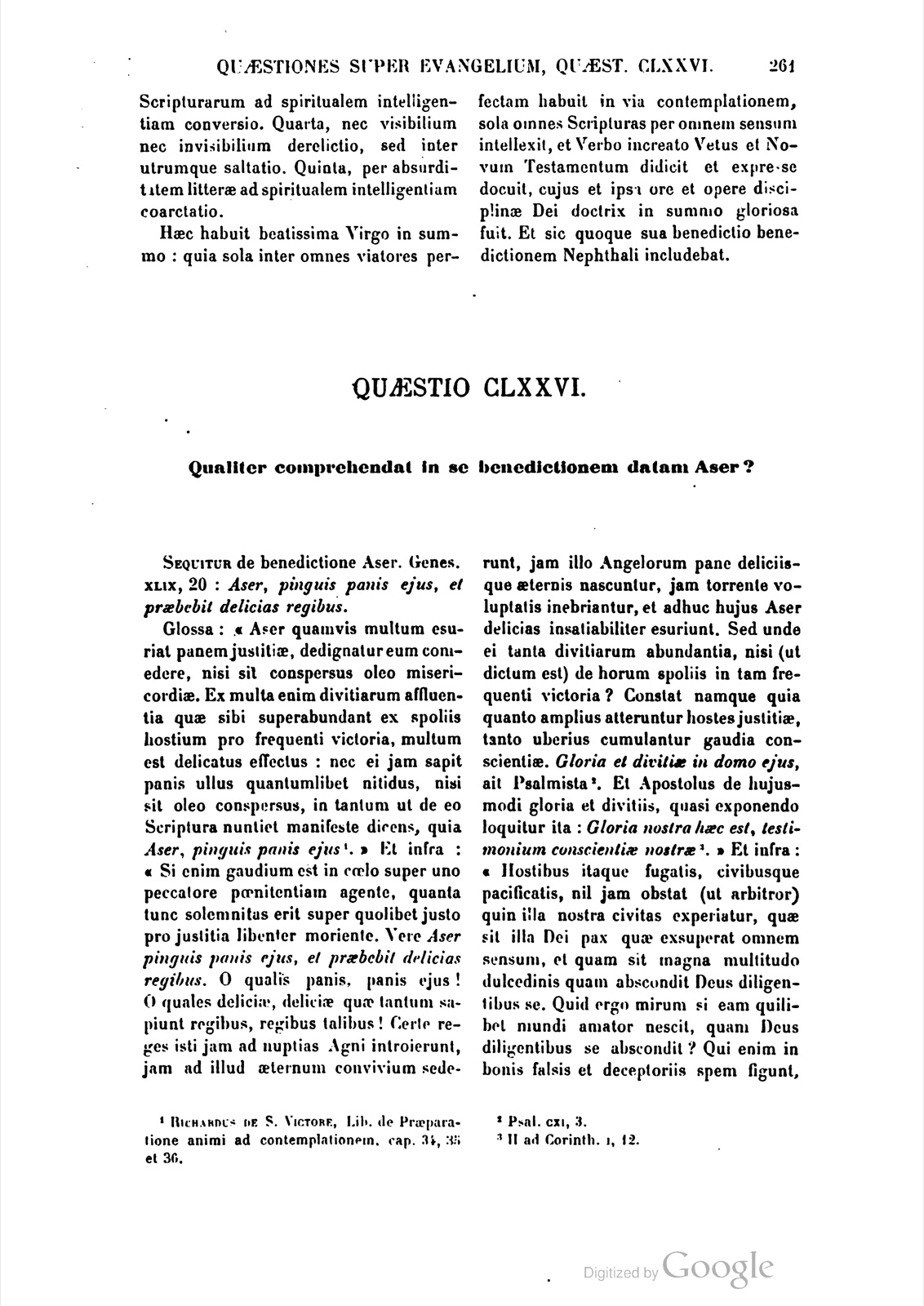
QUAESTIO CLXXVI. Qualiter comprehendat in se benedictionem datam Aser?
Sequitur de benedictione Aser. Genes. XLIX, 20: Aser, pinguis panis ejus, et praebebit delicias regibus.
Glossa: « Aser quamvis multum esuriat panem justitiae, dedignatur eum comedere, nisi sit conspersus oleo misericordiae. Ex multa enim divitiarum affluentia quae sibi superabundant ex spoliis hostium pro frequenti victoria, multum est delicatus effectus: nec ei jam sapit panis ullus quantumlibet nitidus, nisi sit oleo conspersus, in tantum ut de eo Scriptura nuntiet manifeste dicens, quia Aser, pinguis panis ejus 1. » Et infra: « Si enim gaudium est in caelo super uno peccatore paenitentiam agente, quanta tunc solemnitas erit super quolibet justo pro justitia libenter moriente. Vere Aser pinguis panis ejus, et praebebit delicias regibus. O qualis panis, panis ejus! O quales deliciae, deliciae quae tantum sapiunt regibus, regibus talibus! Certe reges isti jam ad nuptias Agni introierunt, jam ad illud aeternum convivium sederunt, jam illo Angelorum pane deliciisque aeternis nascuntur, jam torrente voluptatis inebriantur, et adhuc hujus Aser delicias insatiabiliter esuriunt. Sed unde ei tanta divitiarum abundantia, nisi (ut dictum est) de horum spoliis in tam frequenti victoria? Constat namque quia quanto amplius atteruntur hostes justitiae, tanto uberius cumulantur gaudia conscientiae. Gloria et divitiae in domo ejus, ait Psalmista 2. Et Apostolus de hujusmodi gloria et divitiis, quasi exponendo loquitur ita: Gloria nostra haec est, testimonium conscientiae nostrae 3. » Et infra: « Hostibus itaque fugatis, civibusque pacificatis, nil jam obstat (ut arbitror) quin illa nostra civitas experiatur, quae sit illa Dei pax quae exsuperat omnem sensum, et quam sit magna multitudo dulcedinis quam abscondit Deus diligentibus se. Quid ergo mirum si eam quilibet mundi amator nescit, quam Deus diligentibus se abscondit? Qui enim in bonis falsis et deceptoriis spem figunt, quae sint vera bona invenire non possunt: unde est quod dicunt: Quis ostendit nobis bona 4? Est enim manna absconditum et nisi gustantibus omnino incognitum. Mens enim quae in laude hominum delectatur, quid sit internum gaudium experiri non meretur. »
QUESTION 176. How does she comprehend in herself the blessing given to Asher?
There follows concerning the blessing of Asher. Genesis 49:20: Asher, his bread is fat, and he will provide delights for kings.
The Gloss says: “Although Asher hungers greatly for the bread of justice, he disdains to eat it unless it has been sprinkled with the oil of mercy. For from the great abundance of riches which overflow for him from the spoils of enemies because of frequent victory, he has been made very delicate; nor does any bread, however bright, now taste good to him unless it has been sprinkled with oil, so much so that Scripture clearly announces concerning him, saying that Asher, his bread is fat 1.” And below: “For if there is joy in heaven over one sinner doing penance, how great then will be the solemnity over any just person freely dying for justice. Truly Asher, his bread is fat, and he will provide delights for kings. O what sort of bread, his bread! O what sorts of delights, delights which taste so much to kings, to such kings! Certainly these kings have already entered into the wedding-feast of the Lamb, have already sat down at that eternal banquet, are already born by that bread of Angels and eternal delights, are already made drunk by the torrent of pleasure, and still they insatiably hunger for the delights of this Asher. But whence does he have such abundance of riches, unless, as was said, from the spoils of these enemies in so frequent a victory? For it is agreed that the more the enemies of justice are worn down, the more abundantly the joys of conscience are heaped up. Glory and riches are in his house, says the Psalmist 2. And the Apostle, as if explaining this kind of glory and riches, speaks thus: This is our glory, the testimony of our conscience 3.” And below: “Therefore when the enemies have been put to flight and the citizens pacified, nothing now prevents, as I think, our city from experiencing what that peace of God is which surpasses every sense, and how great is the multitude of sweetness which God has hidden for those who love him. What wonder then if any lover of the world does not know that sweetness which God has hidden for those who love him? For those who set hope on false and deceptive goods cannot find what true goods are; whence it is that they say: Who shows us good things 4? For it is hidden manna and wholly unknown except to those tasting it. For the mind which delights in the praise of human beings does not deserve to experience what inward joy is.”
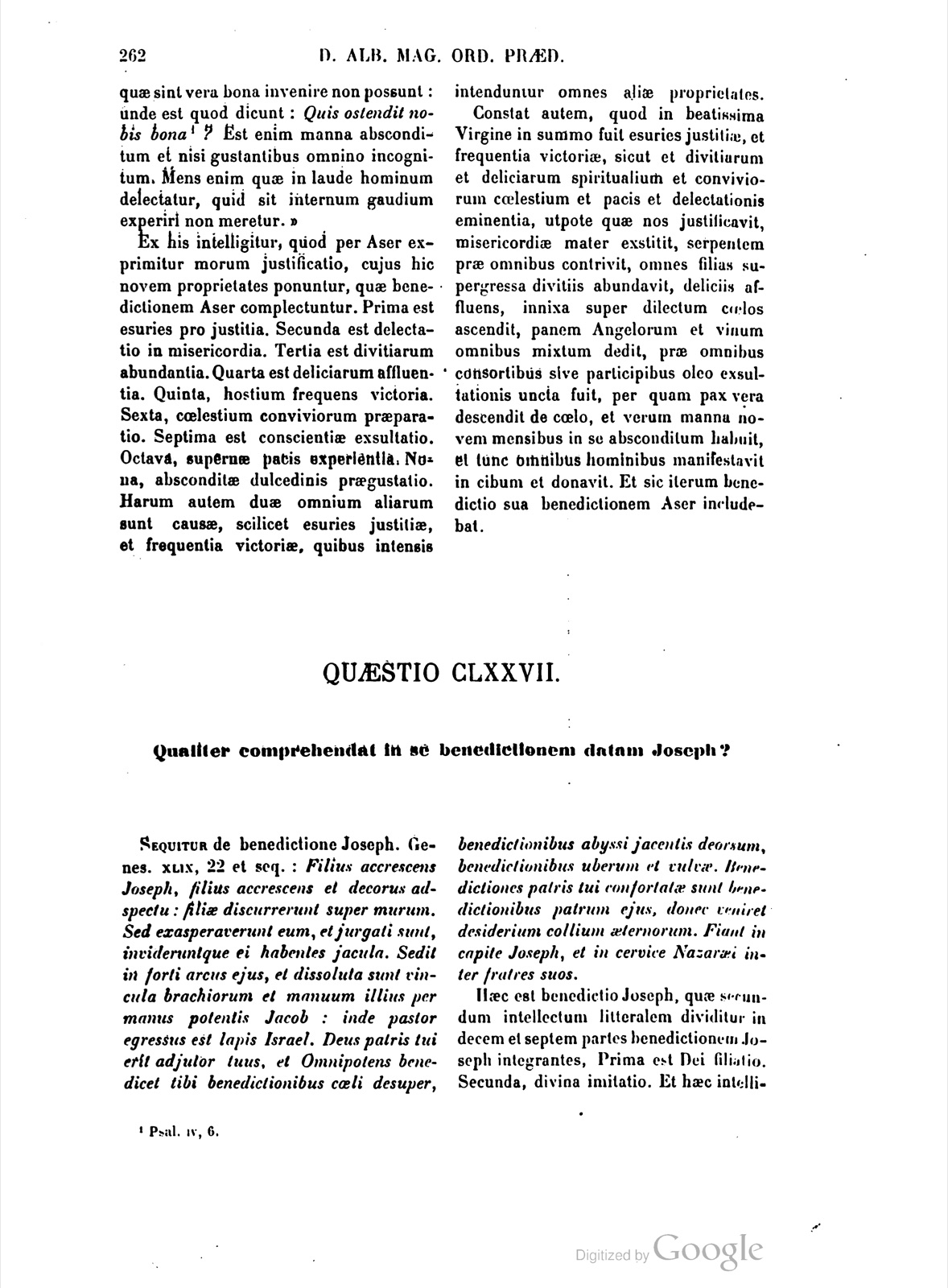
Ex his intelligitur, quod per Aser exprimitur morum justificatio, cujus hic novem proprietates ponuntur, quae benedictionem Aser complectuntur. Prima est esuries pro justitia. Secunda est delectatio in misericordia. Tertia est divitiarum abundantia. Quarta est deliciarum affluentia. Quinta, hostium frequens victoria. Sexta, caelestium conviviorum praeparatio. Septima est conscientiae exsultatio. Octava, supernae pacis experientia. Nona, absconditae dulcedinis praegustatio. Harum autem duae omnium aliarum sunt causae, scilicet esuries justitiae, et frequentia victoriae, quibus intensis intenduntur omnes aliae proprietates.
Constat autem, quod in beatissima Virgine in summo fuit esuries justitiae, et frequentia victoriae, sicut et divitiarum et deliciarum spiritualium et conviviorum caelestium et pacis et delectationis eminentia, utpote quae nos justificavit, misericordiae mater exstitit, serpentem prae omnibus contrivit, omnes filias supergressa divitiis abundavit, deliciis affluens, innixa super dilectum caelos ascendit, panem Angelorum et vinum omnibus mixtum dedit, prae omnibus consortibus sive participibus oleo exsultationis uncta fuit, per quam pax vera descendit de caelo, et verum manna novem mensibus in se absconditum habuit, et tunc omnibus hominibus manifestavit in cibum et donavit. Et sic iterum benedictio sua benedictionem Aser includebat.
From these things it is understood that through Asher the justification of morals is expressed, of which nine properties are posited here, which embrace the blessing of Asher. The first is hunger for justice. The second is delight in mercy. The third is abundance of riches. The fourth is an affluence of delights. The fifth, frequent victory over enemies. The sixth, preparation of heavenly banquets. The seventh is exultation of conscience. The eighth, experience of supernal peace. The ninth, a foretaste of hidden sweetness. Of these, two are the causes of all the others, namely hunger for justice and frequency of victory; when these are intensified, all the other properties are intensified.
But it is agreed that in the most blessed Virgin there was hunger for justice in the highest degree, and frequency of victory, as also eminence of riches and spiritual delights and heavenly banquets and peace and delectation, as one who justified us, existed as mother of mercy, crushed the serpent before all, surpassed all daughters and abounded in riches, overflowing with delights, leaning upon her beloved ascended into the heavens, gave to all the bread of Angels and mixed wine, was anointed with the oil of exultation before all companions or sharers, through whom true peace descended from heaven, and had the true manna hidden in herself for nine months, and then manifested and gave it to all human beings for food. And thus again her blessing included the blessing of Asher.
Notes
- Richard of Saint Victor, Book on the Preparation of the Soul for Contemplation, chapters 34, 35, and 36. (Richardus de S. Victore, Lib. de Praeparatione animi ad contemplationem, cap. 34, 35 et 36.) ↩
- Psalm 111:3. (Psal. CXI, 3.) ↩
- 2 Corinthians 1:12. (II ad Corinth. I, 12.) ↩
- Psalm 4:6. (Psal. IV, 6.) ↩
If a page does not appear, its photograph has not been uploaded yet.