Works › The Mariale: Questions on “Missus est”
Volume 37 · pp. 254–255
Question 170. How does this blessing comprehend in itself the other blessings by which Jacob blessed his sons with their individual proper blessings? And first concerning the blessing of Judah.
A marker with ≈ is an approximate page boundary, placed by measure of the text; the page photographs remain the authority. In the paired views, clicking a page marker brings that page into view.
QUAESTIO CLXX. Qualiter ista benedictio comprehendat in se alias benedictiones quibus Jacob filiis suis singulis benedictionibus propriis benedixit? Et primo de benedictione Judae.
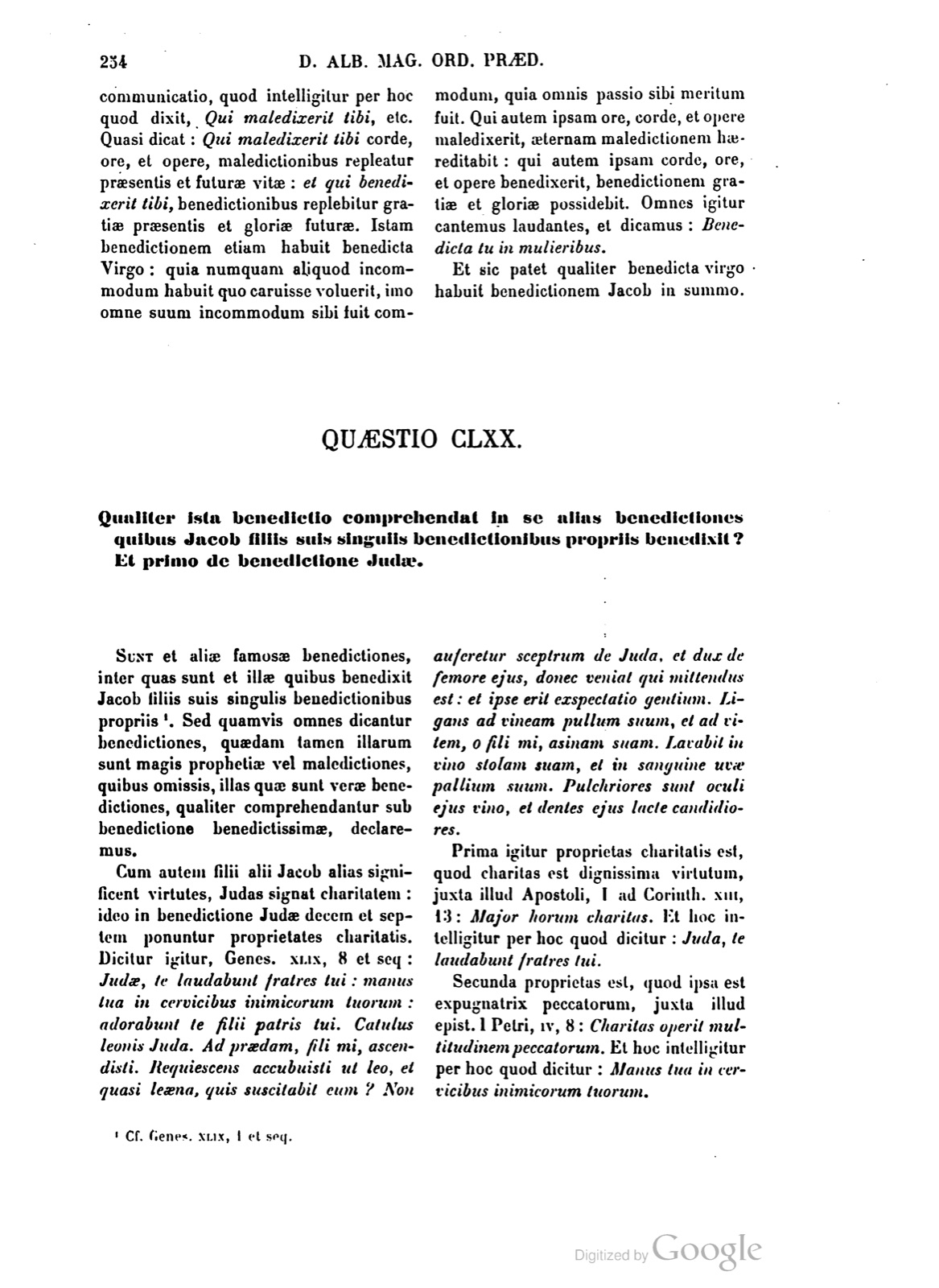
Sunt et aliae famosae benedictiones, inter quas sunt et illae quibus benedixit Jacob filiis suis singulis benedictionibus propriis 1. Sed quamvis omnes dicantur benedictiones, quaedam tamen illarum sunt magis prophetiae vel maledictiones, quibus omissis, illas quae sunt verae benedictiones, qualiter comprehendantur sub benedictione benedictissimae, declaremus.
Cum autem filii alii Jacob alias significent virtutes, Judas signat charitatem: ideo in benedictione Judae decem et septem ponuntur proprietates charitatis. Dicitur igitur, Genes. XLIX, 8 et seq.: Juda, te laudabunt fratres tui: manus tua in cervicibus inimicorum tuorum: adorabunt te filii patris tui. Catulus leonis Juda. Ad praedam, fili mi, ascendisti. Requiescens accubuisti ut leo, et quasi leaena, quis suscitabit eum? Non auferetur sceptrum de Juda, et dux de femore ejus, donec veniat qui mittendus est: et ipse erit exspectatio gentium. Ligans ad vineam pullum suum, et ad vitem, o fili mi, asinam suam. Lavabit in vino stolam suam, et in sanguine uvae pallium suum. Pulchriores sunt oculi ejus vino, et dentes ejus lacte candidiores.
Prima igitur proprietas charitatis est, quod charitas est dignissima virtutum, juxta illud Apostoli, I ad Corinth. XIII, 13: Major horum charitas. Et hoc intelligitur per hoc quod dicitur: Juda, te laudabunt fratres tui.
Secunda proprietas est, quod ipsa est expugnatrix peccatorum, juxta illud epist. I Petri, IV, 8: Charitas operit multitudinem peccatorum. Et hoc intelligitur per hoc quod dicitur: Manus tua in cervicibus inimicorum tuorum.
Tertia proprietas est, quod dat virtutibus esse, id est, essentiam virtutum. Et hoc intelligitur per hoc quod dicitur: Adorabunt te filii patris tui.
Quarta est, quod est amatrix arduorum. Et hoc intelligitur per hoc quod dicitur: Catulus leonis Juda.
Quinta est, quod est exspoliatrix daemonum. Quod intelligitur per hoc quod dicitur: Ad praedam, fili mi, ascendisti.
Sexta est, quod est victrix passionum. Quod intelligitur per hoc quod dicitur: Requiescens.
Septima est, quod est superatrix tentationum. Quod intelligitur per hoc quod dicitur: Accubuisti ut leo.
Octava est, quod facit pro dilecto animam ponere. Quod intelligitur per hoc quod dicitur: Et quasi leaena.
QUESTION 170. How does this blessing comprehend in itself the other blessings by which Jacob blessed his sons with their individual proper blessings? And first concerning the blessing of Judah.
There are also other famous blessings, among which are those by which Jacob blessed his sons with their individual proper blessings 1. But although all are called blessings, nevertheless some of them are rather prophecies or curses. Leaving these aside, let us declare how those which are true blessings are comprehended under the blessing of the most blessed one.
Now since the other sons of Jacob signify other virtues, Judah signifies charity; therefore in the blessing of Judah seventeen properties of charity are posited. Therefore it is said in Genesis 49:8 and following: Judah, your brothers will praise you; your hand will be on the necks of your enemies; the sons of your father will adore you. Judah is a lion's whelp. To the prey, my son, you have gone up. Resting, you have lain down as a lion, and as a lioness; who will rouse him? The scepter will not be taken away from Judah, nor a leader from his thigh, until he comes who is to be sent; and he will be the expectation of the nations. Binding his colt to the vineyard, and to the vine, O my son, his she-ass. He will wash his robe in wine, and his mantle in the blood of the grape. His eyes are more beautiful than wine, and his teeth whiter than milk.
Therefore the first property of charity is that charity is the most worthy of the virtues, according to that word of the Apostle, 1 Corinthians 13:13: The greater of these is charity. And this is understood through what is said: Judah, your brothers will praise you.
The second property is that it is the assailant of sins, according to that word of the first epistle of Peter 4:8: Charity covers a multitude of sins. And this is understood through what is said: Your hand on the necks of your enemies.
The third property is that it gives being to virtues, that is, the essence of virtues. And this is understood through what is said: The sons of your father will adore you.
The fourth is that it is a lover of arduous things. And this is understood through what is said: Judah is a lion's whelp.
The fifth is that it strips demons. This is understood through what is said: To the prey, my son, you have gone up.
The sixth is that it is victor over the passions. This is understood through what is said: Resting.
The seventh is that it overcomes temptations. This is understood through what is said: You have lain down as a lion.
The eighth is that it makes one lay down one's soul for the beloved. This is understood through what is said: And as a lioness.
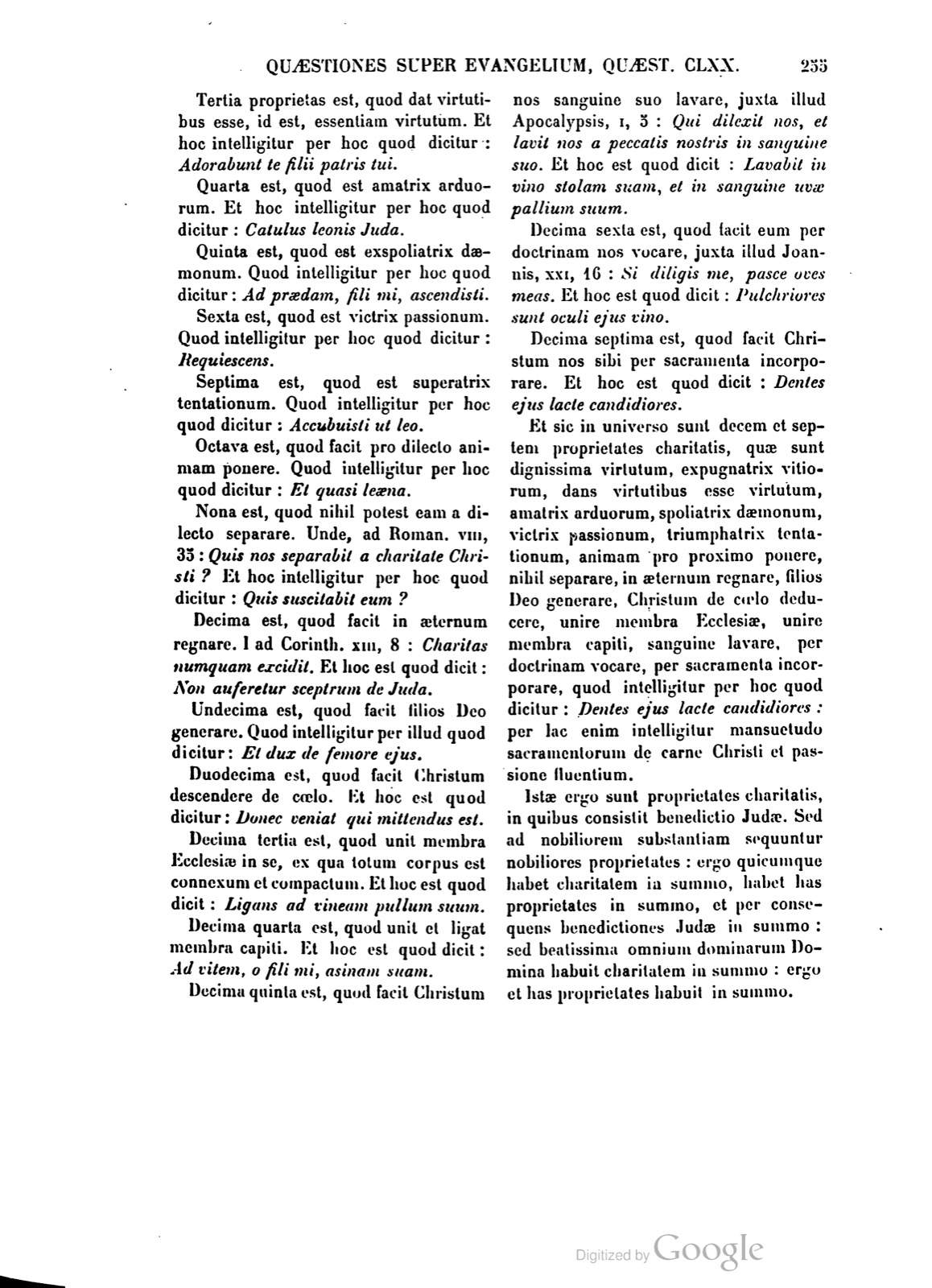
Nona est, quod nihil potest eam a dilecto separare. Unde, ad Roman. VIII, 35: Quis nos separabit a charitate Christi? Et hoc intelligitur per hoc quod dicitur: Quis suscitabit eum?
Decima est, quod facit in aeternum regnare. I ad Corinth. XIII, 8: Charitas numquam excidit. Et hoc est quod dicit: Non auferetur sceptrum de Juda.
Undecima est, quod facit filios Deo generare. Quod intelligitur per illud quod dicitur: Et dux de femore ejus.
Duodecima est, quod facit Christum descendere de caelo. Et hoc est quod dicitur: Donec veniat qui mittendus est.
Decima tertia est, quod unit membra Ecclesiae in se, ex qua totum corpus est connexum et compactum. Et hoc est quod dicit: Ligans ad vineam pullum suum.
Decima quarta est, quod unit et ligat membra capiti. Et hoc est quod dicit: Ad vitem, o fili mi, asinam suam.
Decima quinta est, quod facit Christum nos sanguine suo lavare, juxta illud Apocalypsis, I, 5: Qui dilexit nos, et lavit nos a peccatis nostris in sanguine suo. Et hoc est quod dicit: Lavabit in vino stolam suam, et in sanguine uvae pallium suum.
Decima sexta est, quod facit eum per doctrinam nos vocare, juxta illud Joannis, XXI, 16: Si diligis me, pasce oves meas. Et hoc est quod dicit: Pulchriores sunt oculi ejus vino.
Decima septima est, quod facit Christum nos sibi per sacramenta incorporare. Et hoc est quod dicit: Dentes ejus lacte candidiores.
Et sic in universo sunt decem et septem proprietates charitatis, quae sunt dignissima virtutum, expugnatrix vitiorum, dans virtutibus esse virtutum, amatrix arduorum, spoliatrix daemonum, victrix passionum, triumphatrix tentationum, animam pro proximo ponere, nihil separare, in aeternum regnare, filios Deo generare, Christum de caelo deducere, unire membra Ecclesiae, unire membra capiti, sanguine lavare, per doctrinam vocare, per sacramenta incorporare, quod intelligitur per hoc quod dicitur: Dentes ejus lacte candidiores: per lac enim intelligitur mansuetudo sacramentorum de carne Christi et passione fluentium.
Istae ergo sunt proprietates charitatis, in quibus consistit benedictio Judae. Sed ad nobiliorem substantiam sequuntur nobiliores proprietates: ergo quicumque habet charitatem in summo, habet has proprietates in summo, et per consequens benedictiones Judae in summo: sed beatissima omnium dominarum Domina habuit charitatem in summo: ergo et has proprietates habuit in summo.
The ninth is that nothing can separate it from the beloved. Whence, Romans 8:35: Who will separate us from the charity of Christ? And this is understood through what is said: Who will rouse him?
The tenth is that it makes one reign forever. 1 Corinthians 13:8: Charity never falls away. And this is what he says: The scepter will not be taken away from Judah.
The eleventh is that it makes one generate sons for God. This is understood through what is said: And a leader from his thigh.
The twelfth is that it makes Christ descend from heaven. And this is what is said: Until he comes who is to be sent.
The thirteenth is that it unites the members of the Church in itself, from which the whole body is joined and compacted. And this is what he says: Binding his colt to the vineyard.
The fourteenth is that it unites and binds the members to the head. And this is what he says: To the vine, O my son, his she-ass.
The fifteenth is that it makes Christ wash us with his blood, according to that word of Apocalypse 1:5: Who loved us and washed us from our sins in his blood. And this is what he says: He will wash his robe in wine and his mantle in the blood of the grape.
The sixteenth is that it makes him call us through teaching, according to that word of John 21:16: If you love me, feed my sheep. And this is what he says: His eyes are more beautiful than wine.
The seventeenth is that it makes Christ incorporate us into himself through the sacraments. And this is what he says: His teeth whiter than milk.
And thus in all there are seventeen properties of charity, which are: the most worthy of the virtues; assailant of vices; giving to virtues the being of virtues; lover of arduous things; stripper of demons; victor over passions; triumpher over temptations; laying down the soul for one's neighbor; allowing nothing to separate; reigning forever; generating sons for God; bringing Christ down from heaven; uniting the members of the Church; uniting the members to the head; washing with blood; calling through teaching; incorporating through the sacraments. This is understood through what is said: His teeth whiter than milk; for through milk is understood the gentleness of the sacraments flowing from the flesh and passion of Christ.
Therefore these are the properties of charity, in which the blessing of Judah consists. But nobler properties follow upon a nobler substance. Therefore whoever has charity in the highest degree has these properties in the highest degree, and consequently has the blessings of Judah in the highest degree. But the most blessed Lady of all ladies had charity in the highest degree; therefore she also had these properties in the highest degree.
Notes
- Compare Genesis 49:1 and following. (Cf. Genes. XLIX, 1 et seq.) ↩
If a page does not appear, its photograph has not been uploaded yet.