Works › The Mariale: Questions on “Missus est”
Volume 37 · pp. 256–257
Question 171. How does she comprehend in herself the blessing given to Zebulun?
A marker with ≈ is an approximate page boundary, placed by measure of the text; the page photographs remain the authority. In the paired views, clicking a page marker brings that page into view.
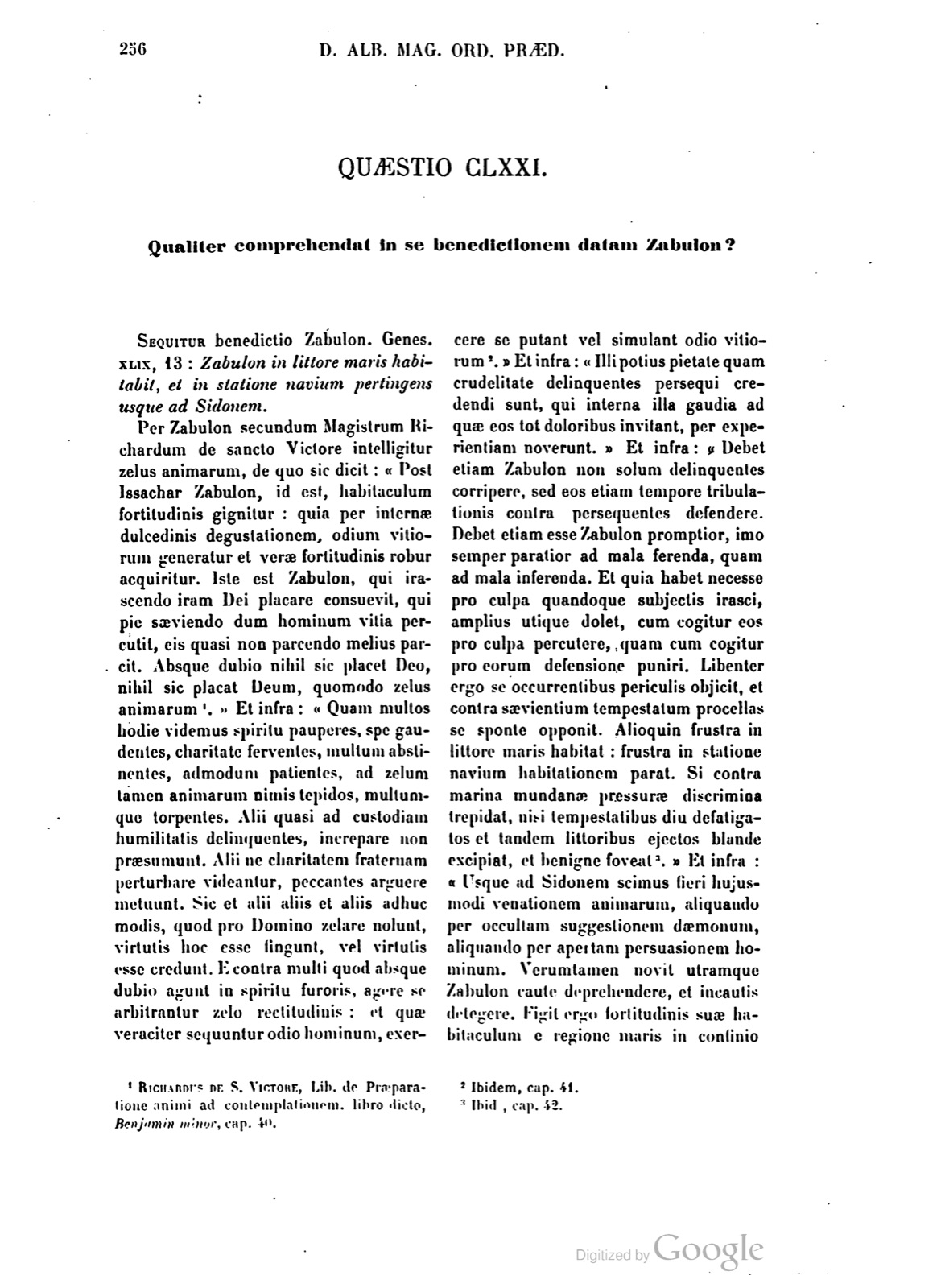
QUAESTIO CLXXI. Qualiter comprehendat in se benedictionem datam Zabulon?
Sequitur benedictio Zabulon. Genes. XLIX, 13: Zabulon in littore maris habitabit, et in statione navium pertingens usque ad Sidonem.
Per Zabulon secundum Magistrum Richardum de sancto Victore intelligitur zelus animarum, de quo sic dicit: « Post Issachar Zabulon, id est, habitaculum fortitudinis gignitur: quia per internae dulcedinis degustationem, odium vitiorum generatur et verae fortitudinis robur acquiritur. Iste est Zabulon, qui irascendo iram Dei placare consuevit, qui pie saeviendo dum hominum vitia percutit, eis quasi non parcendo melius parcit. Absque dubio nihil sic placet Deo, nihil sic placat Deum, quomodo zelus animarum 1. » Et infra: « Quam multos hodie videmus spiritu pauperes, spe gaudentes, charitate ferventes, multum abstinentes, admodum patientes, ad zelum tamen animarum nimis tepidos, multumque torpentes. Alii quasi ad custodiam humilitatis delinquentes, increpare non praesumunt. Alii ne charitatem fraternam perturbare videantur, peccantes arguere metuunt. Sic et alii aliis et aliis adhuc modis, quod pro Domino zelare nolunt, virtutis hoc esse fingunt, vel virtutis esse credunt. E contra multi quod absque dubio agunt in spiritu furoris, agere se arbitrantur zelo rectitudinis: et quae veraciter sequuntur odio hominum, exercere se putant vel simulant odio vitiorum 2. » Et infra: « Illi potius pietate quam crudelitate delinquentes persequi credendi sunt, qui interna illa gaudia ad quae eos tot doloribus invitant, per experientiam noverunt. » Et infra: « Debet etiam Zabulon non solum delinquentes corripere, sed eos etiam tempore tribulationis contra persequentes defendere. Debet etiam esse Zabulon promptior, imo semper paratior ad mala ferenda, quam ad mala inferenda. Et quia habet necesse pro culpa quandoque subjectis irasci, amplius utique dolet, cum cogitur eos pro culpa percutere, quam cum cogitur pro eorum defensione puniri. Libenter ergo se occurrentibus periculis objicit, et contra saevientium tempestatum procellas se sponte opponit. Alioquin frustra in littore maris habitat: frustra in statione navium habitationem parat. Si contra marina mundanae pressurae discrimina trepidat, nisi tempestatibus diu defatigatos et tandem littoribus ejectos blande excipiat, et benigne foveat 3. » Et infra: « Usque ad Sidonem scimus fieri hujusmodi venationem animarum, aliquando per occultam suggestionem daemonum, aliquando per apertam persuasionem hominum. Verumtamen novit utramque Zabulon caute deprehendere, et incautis detegere. Figit ergo fortitudinis suae habitaculum e regione maris in confinio Sidonis, ut hinc vigilet contra saevitiam persequentium, illinc contra fraudulentiam insidiantium 4. » Et infra 5: « Nescio si potest homo aliquid a Deo in vita majus accipere: ignoro an possit hac gratia interim majorem aliquam Deus homini conferre, quam ut ejus ministerio perversi homines in melius mutentur, ut de filiis diaboli filii Dei efficiantur. An forte cuiquam magis videbitur esse mortuos suscitare? Ergone majus erit suscitare carnem iterum morituram, quam animam in aeternum victuram? Ergone majus erit carnem revocare ad gaudia mundi, quam animae restituere gaudia caeli? O qualis dos, quanta dignitas, talem gratiam a Deo accipere! Non debuit Dei sponsa a sponso suo dotem aliam accipere, non decuit caelestem sponsum sponsae suae dotem aliam donare, quam ut per adoptionis gratiam possit multos Deo filios gignere, et de filiis irae filiisque gehennae, regni caelestis haeredes adscribere. Merito ergo Zabulon nato exclamat mater ejus Lia: Ditavit me Deus dote bona 6. »
QUESTION 171. How does she comprehend in herself the blessing given to Zebulun?
The blessing of Zebulun follows. Genesis 49:13: Zebulun will dwell on the shore of the sea, and in the station of ships, reaching as far as Sidon.
By Zebulun, according to Master Richard of Saint Victor, zeal for souls is understood; concerning this he speaks thus: “After Issachar, Zebulun, that is, the dwelling-place of fortitude, is born, because through the tasting of inward sweetness, hatred of vices is generated and the strength of true fortitude is acquired. This is Zebulun, who by being angry is accustomed to placate the anger of God, who, by piously raging while he strikes human vices, by as it were not sparing them spares them better. Without doubt nothing so pleases God, nothing so placates God, as zeal for souls 1.” And below: “How many do we see today poor in spirit, rejoicing in hope, fervent in charity, much abstaining, exceedingly patient, yet too lukewarm for zeal for souls, and greatly sluggish. Some, as if for the guarding of humility, do not presume to rebuke delinquents. Others, lest they seem to disturb brotherly charity, fear to accuse sinners. Thus others also, in other and still other ways, pretend that what they are unwilling to be zealous for on behalf of the Lord is a matter of virtue, or believe it to be a matter of virtue. On the contrary, many suppose that what they without doubt do in the spirit of fury, they do by zeal for rectitude; and what they truly pursue from hatred of human beings, they think or pretend that they practice from hatred of vices 2.” And below: “Those are to be believed to pursue delinquents by piety rather than cruelty, who know by experience those inward joys to which they invite them by so many pains.” And below: “Zebulun ought also not only to correct delinquents, but also in time of tribulation to defend them against persecutors. Zebulun ought also to be readier, indeed always more prepared, to endure evils than to inflict evils. And because it is necessary for him sometimes to be angry at subjects because of fault, he certainly grieves more when he is compelled to strike them because of fault than when he is compelled to be punished in their defense. Therefore he gladly casts himself before dangers that occur, and of his own accord sets himself against the storms of raging tempests. Otherwise he dwells in vain on the shore of the sea; in vain he prepares a dwelling in the station of ships, if he trembles before the maritime dangers of worldly oppression, unless he gently receives those long wearied by tempests and finally cast onto the shores, and kindly cherishes them 3.” And below: “We know that this sort of hunting of souls is done as far as Sidon, sometimes through the hidden suggestion of demons, sometimes through the open persuasion of human beings. Nevertheless Zebulun knows how cautiously to detect both and disclose them to the incautious. Therefore he fixes the dwelling-place of his fortitude over against the sea on the border of Sidon, so that from this side he may keep watch against the savagery of persecutors, and from that side against the fraudulence of those plotting ambush 4.” And below 5: “I do not know if a human being can receive anything greater from God in life; I am ignorant whether God can meanwhile confer any greater grace upon a human being than that through his ministry perverse human beings are changed for the better, so that from sons of the devil they may be made sons of God. Or perhaps will it seem to anyone greater to raise the dead? Therefore will it be greater to raise flesh that is to die again than a soul that is to live eternally? Therefore will it be greater to recall flesh to the joys of the world than to restore to the soul the joys of heaven? O what a dowry, how great a dignity, to receive such grace from God! The spouse of God ought not to have received any other dowry from her spouse; it was not fitting for the heavenly bridegroom to give any other dowry to his spouse than that through the grace of adoption she could beget many sons for God, and enroll sons of wrath and sons of gehenna as heirs of the heavenly kingdom. Therefore, when Zebulun was born, his mother Leah rightly cries out: God has endowed me with a good dowry 6.”
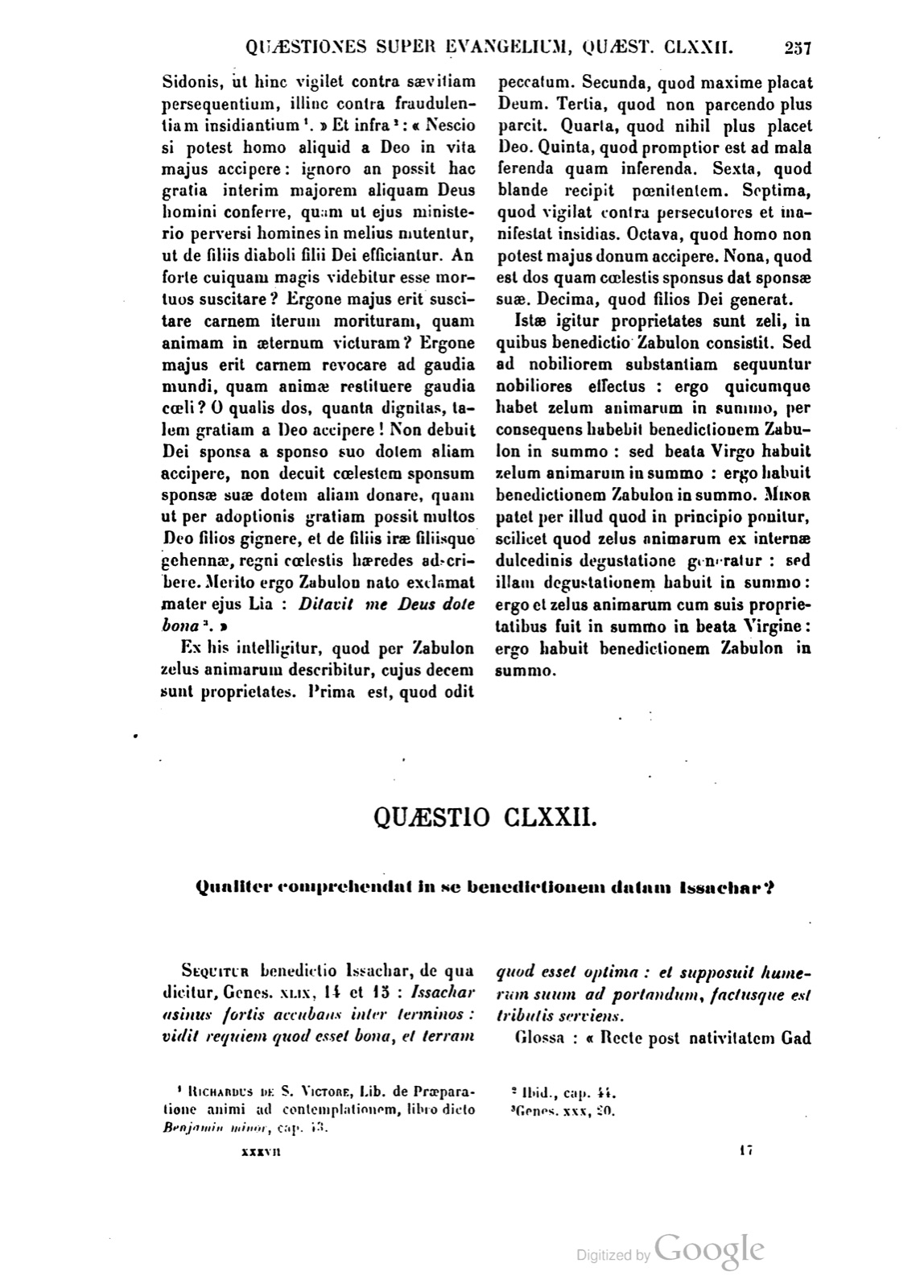
Ex his intelligitur, quod per Zabulon zelus animarum describitur, cujus decem sunt proprietates. Prima est, quod odit peccatum. Secunda, quod maxime placat Deum. Tertia, quod non parcendo plus parcit. Quarta, quod nihil plus placet Deo. Quinta, quod promptior est ad mala ferenda quam inferenda. Sexta, quod blande recipit paenitentem. Septima, quod vigilat contra persecutores et manifestat insidias. Octava, quod homo non potest majus donum accipere. Nona, quod est dos quam caelestis sponsus dat sponsae suae. Decima, quod filios Dei generat.
Istae igitur proprietates sunt zeli, in quibus benedictio Zabulon consistit. Sed ad nobiliorem substantiam sequuntur nobiliores effectus: ergo quicumque habet zelum animarum in summo, per consequens habebit benedictionem Zabulon in summo: sed beata Virgo habuit zelum animarum in summo: ergo habuit benedictionem Zabulon in summo. Minor patet per illud quod in principio ponitur, scilicet quod zelus animarum ex internae dulcedinis degustatione generatur: sed illam degustationem habuit in summo: ergo et zelus animarum cum suis proprietatibus fuit in summo in beata Virgine: ergo habuit benedictionem Zabulon in summo.
From these things it is understood that through Zebulun zeal for souls is described, of which there are ten properties. The first is that it hates sin. The second, that it placates God most greatly. The third, that by not sparing it spares more. The fourth, that nothing pleases God more. The fifth, that it is readier to endure evils than to inflict them. The sixth, that it gently receives the penitent. The seventh, that it watches against persecutors and makes manifest ambushes. The eighth, that a human being cannot receive a greater gift. The ninth, that it is the dowry which the heavenly bridegroom gives to his bride. The tenth, that it generates sons of God.
Therefore these are the properties of zeal, in which the blessing of Zebulun consists. But nobler effects follow upon a nobler substance. Therefore whoever has zeal for souls in the highest degree will consequently have the blessing of Zebulun in the highest degree. But the blessed Virgin had zeal for souls in the highest degree; therefore she had the blessing of Zebulun in the highest degree. The minor is clear through what is posited at the beginning, namely that zeal for souls is generated from the tasting of inward sweetness. But she had that tasting in the highest degree; therefore zeal for souls with its properties was also in the highest degree in the blessed Virgin; therefore she had the blessing of Zebulun in the highest degree.
Notes
- Richard of Saint Victor, Book on the Preparation of the Soul for Contemplation, in the book called Benjamin Minor, chapter 40. (Richardus de S. Victore, Lib. de Praeparatione animi ad contemplationem, libro dicto Benjamin minor, cap. 40.) ↩
- In the same place, chapter 41. (Ibidem, cap. 41.) ↩
- In the same work, chapter 42. (Ibid., cap. 42.) ↩
- Richard of Saint Victor, Book on the Preparation of the Soul for Contemplation, in the book called Benjamin Minor, chapter 43. (Richardus de S. Victore, Lib. de Praeparatione animi ad contemplationem, libro dicto Benjamin minor, cap. 43.) ↩
- In the same work, chapter 44. (Ibid., cap. 44.) ↩
- Genesis 30:20. (Genes. XXX, 20.) ↩
If a page does not appear, its photograph has not been uploaded yet.