Works › The Mariale: Questions on “Missus est”
Volume 37 · pp. 253–254
Question 169. How does this blessing comprehend in itself the blessing by which Isaac blessed Jacob?
A marker with ≈ is an approximate page boundary, placed by measure of the text; the page photographs remain the authority. In the paired views, clicking a page marker brings that page into view.
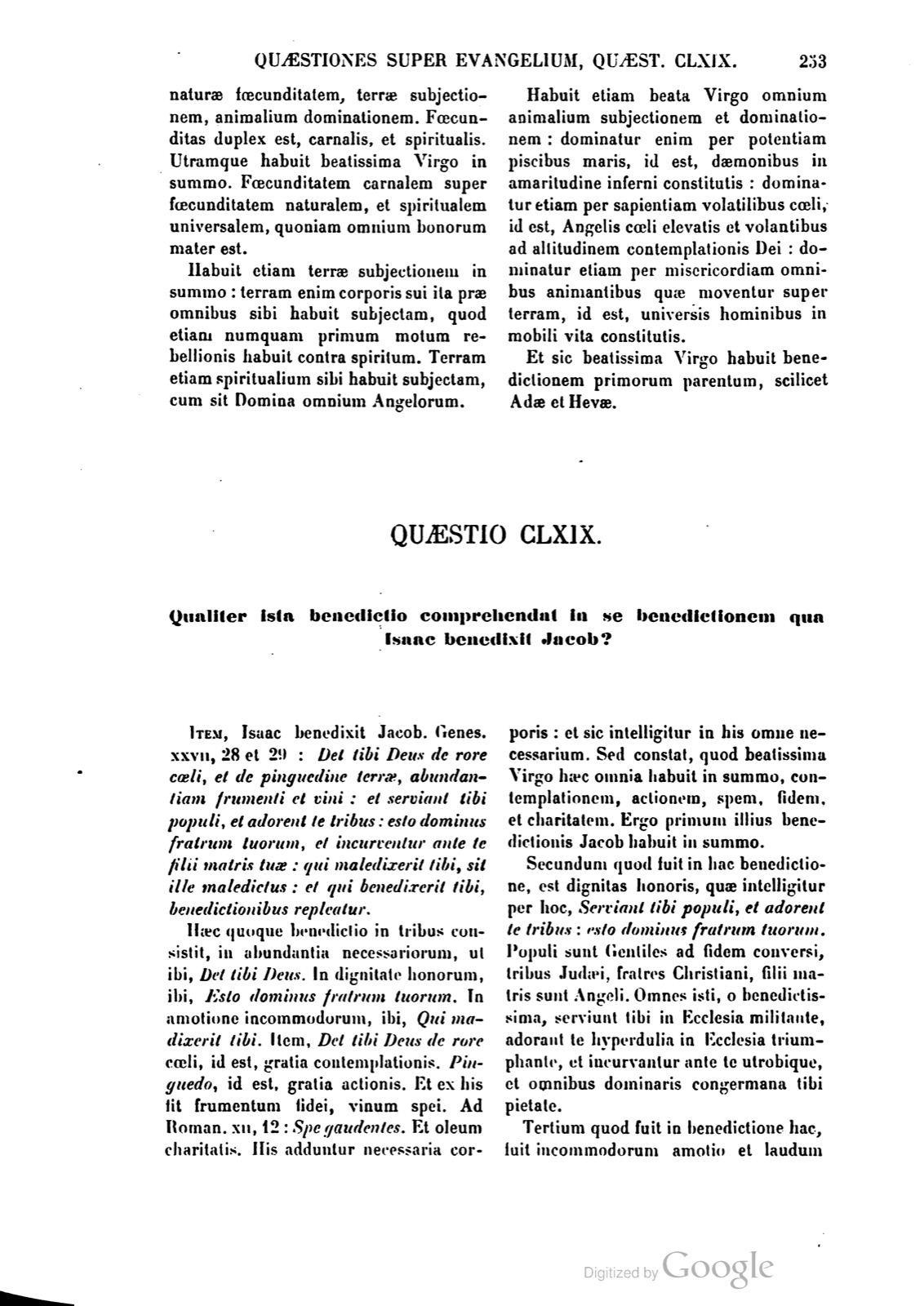
QUAESTIO CLXIX. Qualiter ista benedictio comprehendat in se benedictionem qua Isaac benedixit Jacob?
Item, Isaac benedixit Jacob. Genes. XXVII, 28 et 29: Det tibi Deus de rore caeli, et de pinguedine terrae, abundantiam frumenti et vini: et serviant tibi populi, et adorent te tribus: esto dominus fratrum tuorum, et incurventur ante te filii matris tuae: qui maledixerit tibi, sit ille maledictus: et qui benedixerit tibi, benedictionibus repleatur.
Haec quoque benedictio in tribus consistit, in abundantia necessariorum, ut ibi, Det tibi Deus. In dignitate honorum, ibi, Esto dominus fratrum tuorum. In amotione incommodorum, ibi, Qui maledixerit tibi. Item, Det tibi Deus de rore caeli, id est, gratia contemplationis. Pinguedo, id est, gratia actionis. Et ex his fit frumentum fidei, vinum spei. Ad Roman. XII, 12: Spe gaudentes. Et oleum charitatis. His adduntur necessaria corporis: et sic intelligitur in his omne necessarium. Sed constat, quod beatissima Virgo haec omnia habuit in summo, contemplationem, actionem, spem, fidem, et charitatem. Ergo primum illius benedictionis Jacob habuit in summo.
Secundum quod fuit in hac benedictione, est dignitas honoris, quae intelligitur per hoc, Serviant tibi populi, et adorent te tribus: esto dominus fratrum tuorum. Populi sunt Gentiles ad fidem conversi, tribus Judaei, fratres Christiani, filii matris sunt Angeli. Omnes isti, o benedictissima, serviunt tibi in Ecclesia militante, adorant te hyperdulia in Ecclesia triumphante, et incurvantur ante te utrobique, et omnibus dominaris congermana tibi pietate.
QUESTION 169. How does this blessing comprehend in itself the blessing by which Isaac blessed Jacob?
Likewise, Isaac blessed Jacob. Genesis 27:28 and 29: May God give you from the dew of heaven and from the fatness of the earth abundance of grain and wine; and may peoples serve you, and tribes adore you; be lord of your brothers, and may the sons of your mother bow before you; whoever curses you, let him be cursed; and whoever blesses you, let him be filled with blessings.
This blessing also consists in three things: in abundance of necessary things, as there, May God give you; in the dignity of honors, there, Be lord of your brothers; in the removal of inconveniences, there, Whoever curses you. Likewise, May God give you from the dew of heaven, that is, the grace of contemplation. Fatness, that is, the grace of action. And from these comes the grain of faith, the wine of hope. Romans 12:12: Rejoicing in hope. And the oil of charity. To these are added the necessary things of the body; and thus every necessary thing is understood in these. But it is agreed that the most blessed Virgin had all these things in the highest degree: contemplation, action, hope, faith, and charity. Therefore she had the first part of that blessing of Jacob in the highest degree.
The second thing that was in this blessing is the dignity of honor, which is understood through this: May peoples serve you, and may tribes adore you; be lord of your brothers. The peoples are the Gentiles converted to the faith; the tribes are the Jews; the brothers are Christians; the sons of the mother are Angels. All these, O most blessed one, serve you in the Church militant, adore you with hyperdulia in the Church triumphant, and bow before you in both, and you rule over all by a piety kindred to you.
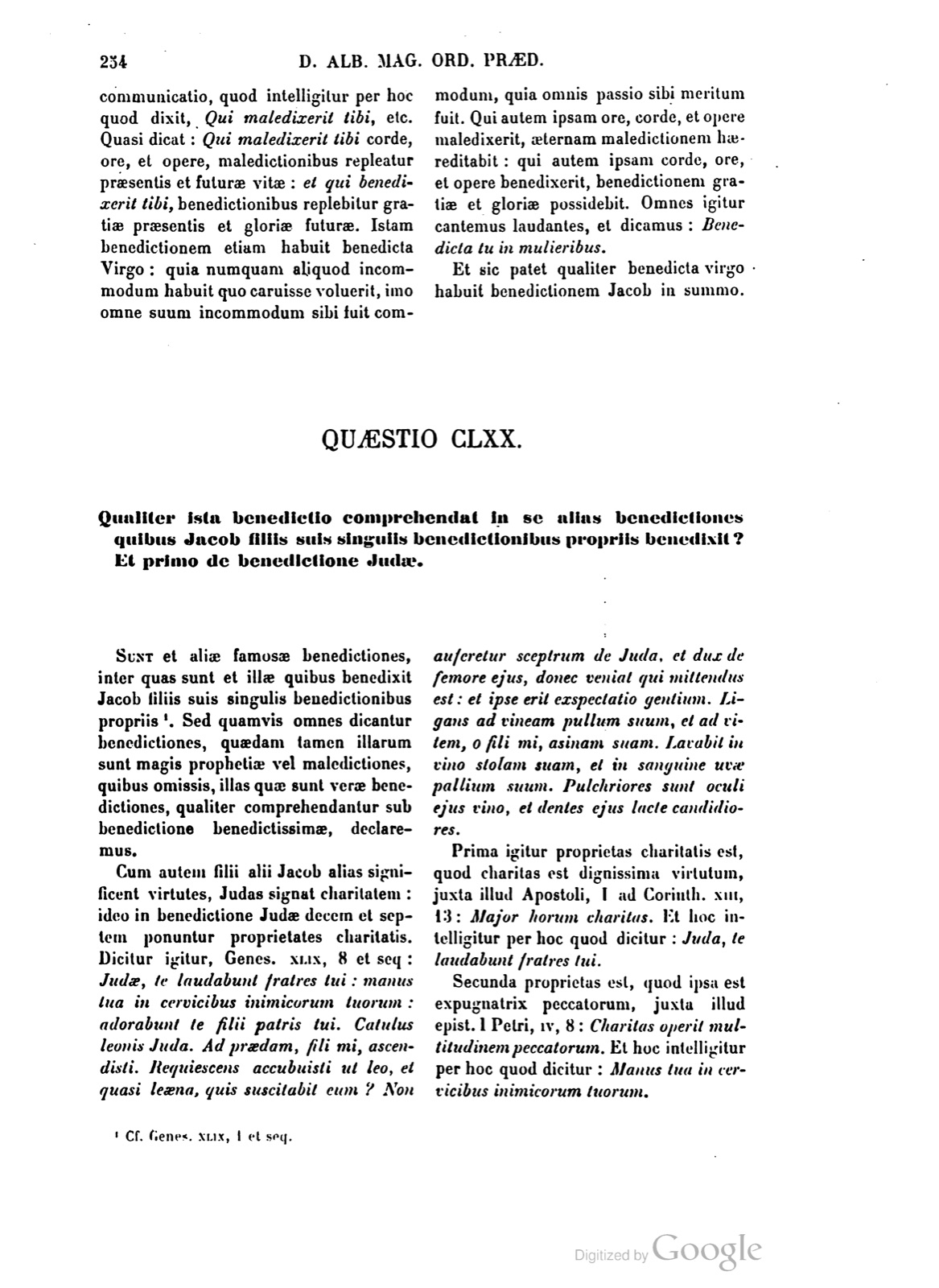
Tertium quod fuit in benedictione hac, fuit incommodorum amotio et laudum communicatio, quod intelligitur per hoc quod dixit, Qui maledixerit tibi, etc. Quasi dicat: Qui maledixerit tibi corde, ore, et opere, maledictionibus repleatur praesentis et futurae vitae: et qui benedixerit tibi, benedictionibus replebitur gratiae praesentis et gloriae futurae. Istam benedictionem etiam habuit benedicta Virgo: quia numquam aliquod incommodum habuit quo caruisse voluerit, imo omne suum incommodum sibi fuit commodum, quia omnis passio sibi meritum fuit. Qui autem ipsam ore, corde, et opere maledixerit, aeternam maledictionem haereditabit: qui autem ipsam corde, ore, et opere benedixerit, benedictionem gratiae et gloriae possidebit. Omnes igitur cantemus laudantes, et dicamus: Benedicta tu in mulieribus.
Et sic patet qualiter benedicta Virgo habuit benedictionem Jacob in summo.
The third thing that was in this blessing was the removal of inconveniences and the communication of praises, which is understood through what he said, Whoever curses you, etc. As if he were saying: whoever curses you in heart, mouth, and deed, let him be filled with the curses of the present and future life; and whoever blesses you, he will be filled with the blessings of present grace and future glory. The blessed Virgin also had this blessing, because she never had any inconvenience of which she wished to have been without; rather, every inconvenience of hers was an advantage to her, because every suffering was merit for her. But whoever curses her in mouth, heart, and deed will inherit eternal curse; and whoever blesses her in heart, mouth, and deed will possess the blessing of grace and glory. Therefore let us all sing in praise and say: Blessed are you among women.
And thus it is clear how the blessed Virgin had the blessing of Jacob in the highest degree.
If a page does not appear, its photograph has not been uploaded yet.