Works › The Mariale: Questions on “Missus est”
Volume 37 · pp. 249–251
Question 166. Whether it is well placed: Blessed are you among women?
A marker with ≈ is an approximate page boundary, placed by measure of the text; the page photographs remain the authority. In the paired views, clicking a page marker brings that page into view.
QUAESTIO CLXVI. Utrum bene ponatur: Benedicta tu in mulieribus?
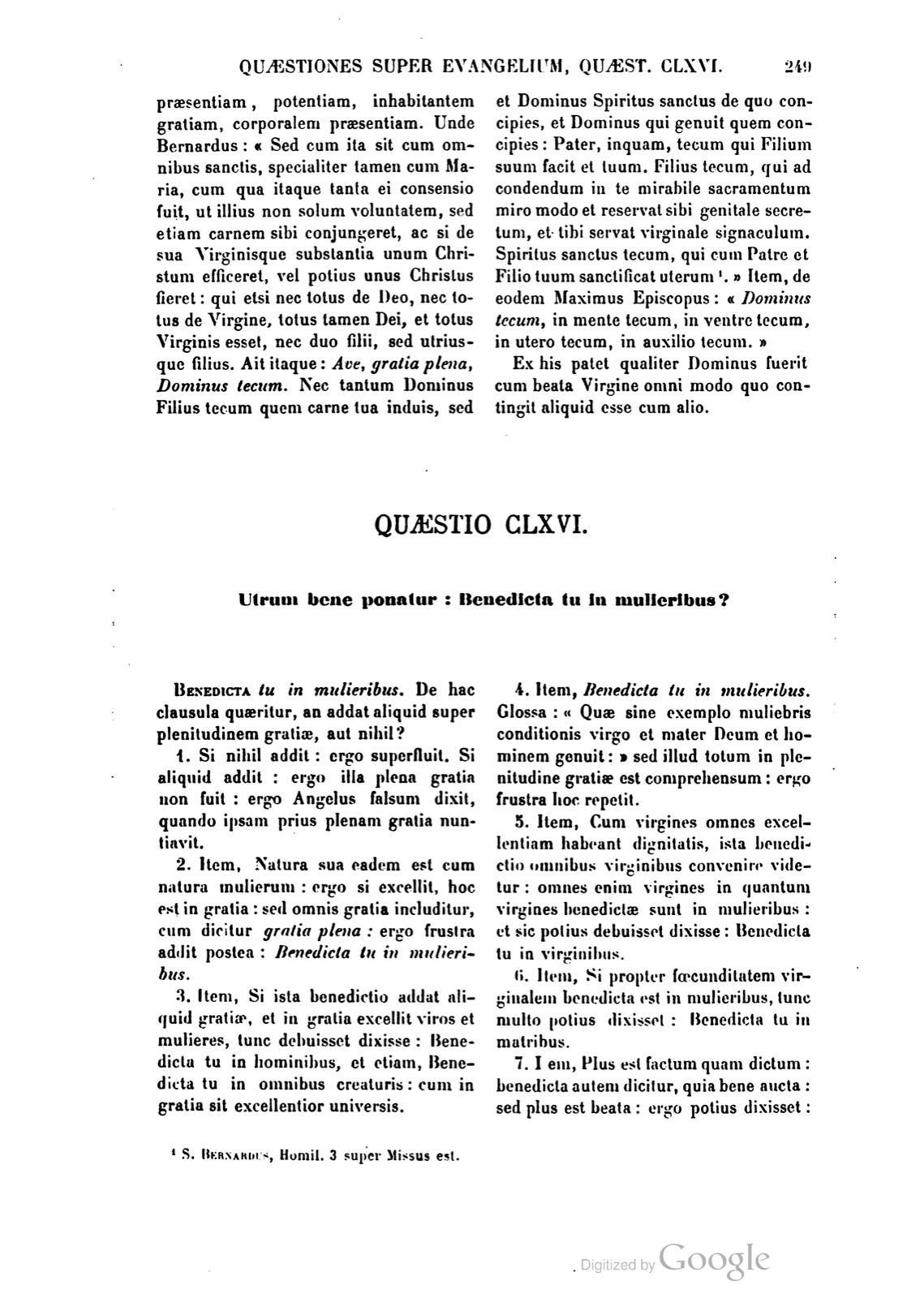
Benedicta tu in mulieribus. De hac clausula quaeritur, an addat aliquid super plenitudinem gratiae, aut nihil?
1. Si nihil addit: ergo superfluit. Si aliquid addit: ergo illa plena gratia non fuit: ergo Angelus falsum dixit, quando ipsam prius plenam gratia nuntiavit.
2. Item, Natura sua eadem est cum natura mulierum: ergo si excellit, hoc est in gratia: sed omnis gratia includitur, cum dicitur gratia plena: ergo frustra addit postea: Benedicta tu in mulieribus.
3. Item, Si ista benedictio addat aliquid gratiae, et in gratia excellit viros et mulieres, tunc debuisset dixisse: Benedicta tu in hominibus, et etiam, Benedicta tu in omnibus creaturis: cum in gratia sit excellentior universis.
4. Item, Benedicta tu in mulieribus. Glossa: « Quae sine exemplo muliebris conditionis virgo et mater Deum et hominem genuit: » sed illud totum in plenitudine gratiae est comprehensum: ergo frustra hoc repetit.
5. Item, Cum virgines omnes excellentiam habeant dignitatis, ista benedictio omnibus virginibus convenire videtur: omnes enim virgines in quantum virgines benedictae sunt in mulieribus: et sic potius debuisset dixisse: Benedicta tu in virginibus.
6. Item, Si propter foecunditatem virginalem benedicta est in mulieribus, tunc multo potius dixisset: Benedicta tu in matribus.
7. Item, Plus est factum quam dictum: benedicta autem dicitur, quia bene aucta: sed plus est beata: ergo potius dixisset: Beata tu in mulieribus, quam benedicta tu in mulieribus.
8. Item, Cum benedictio quaedam sit gloriae, quaedam gratiae: omnis autem benedictio gloriae includit in se benedictionem gratiae: ergo plus dixisset dicendo: Gloriosa tu in mulieribus.
9. Item, Benedicta tu in mulieribus. Glossa: id est, prae mulieribus. Et alibi in figura dicitur: Benedicta es tu prae omnibus mulieribus 1. Item, Esther, II, 17: Assuerus adamavit Esther plus quam omnes mulieres. Quaeritur ergo, utrum sit differentia inter benedicta tu in mulieribus, et prae mulieribus, et inter mulieres, et plus quam omnes mulieres?
10. Item, Quaeritur utrum pronomen demonstrativum secundae personae notet ibi excellentiam vel discretionem? Et videtur, quod non discretionem: quia sunt multae aliae mulieres benedictae in mulieribus. Si autem excellentiam, cum excellentiam non tantum habeat respectu mulierum, sed respectu omnium creaturarum, dixisse debuerat: Benedicta tu in omnibus creaturis.
11. Item, Quaeritur utrum ista benedictio beatissimae Virginis comprehendat omnium aliorum benedictionem in se? Et videtur, quod sic, imo nec dubitabile videtur: quid enim magni vel miri si habuerit benedictionem omnium gentium, quae benedictiones omnium Angelorum et gratias habuit, et a nullo illustrium vincitur?
Solutio. Ad haec solvendo dicimus, quod quadruplex est ratio benedictionis. Dicitur enim benedictio maledicti evacuatio. Item, dicitur benedictio foecunditatis ampliatio: unde benedixit eis, dicens: Crescite, et multiplicamini 2, etc. Dicitur etiam benedictio singularis gratiae collatio. Unde, Genes. XIV, 19: Benedixit ei, et dixit: Benedictus Abraham. Item, dicitur benedictio congratulantium collaudatio: unde, Matth. XXI, 9: Benedictus qui venit in nomine Domini. Secundum omnem istum modum et rationem fuit beatissima Virgo in mulieribus benedicta.
QUESTION 166. Whether it is well placed: Blessed are you among women?
Blessed are you among women. Concerning this clause it is asked whether it adds anything above the fullness of grace, or nothing.
1. If it adds nothing, then it is superfluous. If it adds something, then she was not full of grace; therefore the Angel spoke falsely when he first announced her as full of grace.
2. Likewise, her nature is the same as the nature of women. Therefore if she excels, this is in grace. But every grace is included when it is said full of grace. Therefore he adds afterward in vain: Blessed are you among women.
3. Likewise, if that blessing adds something of grace, and she excels men and women in grace, then he should have said: Blessed are you among human beings, and also, Blessed are you among all creatures, since in grace she is more excellent than all.
4. Likewise, Blessed are you among women. The Gloss says: “She who, without example of womanly condition, virgin and mother, gave birth to God and man.” But that whole thing is comprehended in fullness of grace. Therefore he repeats this in vain.
5. Likewise, since all virgins have excellence of dignity, this blessing seems to belong to all virgins. For all virgins, insofar as they are virgins, are blessed among women. And thus rather he should have said: Blessed are you among virgins.
6. Likewise, if she is blessed among women because of virginal fecundity, then much rather he would have said: Blessed are you among mothers.
7. Likewise, the thing made is more than the thing said. But she is called blessed, because well increased; but blessed in beatitude is more. Therefore he would rather have said: Blessed in beatitude are you among women, than blessed are you among women.
8. Likewise, since one blessing is of glory and another of grace, but every blessing of glory includes blessing of grace in itself, he would have said more by saying: Glorious are you among women.
9. Likewise, Blessed are you among women. The Gloss says: that is, before women. And elsewhere in figure it is said: Blessed are you before all women 1. Likewise, Esther 2:17: Ahasuerus loved Esther more than all women. Therefore it is asked whether there is a difference between blessed are you among women, before women, among women, and more than all women.
10. Likewise, it is asked whether the demonstrative pronoun of the second person notes excellence or distinction there. And it seems that it does not note distinction, because there are many other women blessed among women. But if it notes excellence, since she has excellence not only with respect to women but with respect to all creatures, he should have said: Blessed are you among all creatures.
11. Likewise, it is asked whether this blessing of the most blessed Virgin comprehends in itself the blessing of all others. And it seems that it does; indeed it does not seem doubtful. For what great or marvelous thing would it be if she had the blessing of all nations, when she had the blessings and graces of all Angels and is conquered by none of the illustrious?
Solution. To solve these things we say that the account of blessing is fourfold. For blessing is called the emptying out of a curse. Likewise, blessing is called the enlargement of fecundity; whence he blessed them, saying: Increase and multiply 2, etc. Blessing is also called the conferral of singular grace. Whence Genesis 14:19: He blessed him and said: Blessed is Abraham. Likewise, blessing is called the praising together of those congratulating; whence Matthew 21:9: Blessed is he who comes in the name of the Lord. According to every one of these modes and accounts, the most blessed Virgin was blessed among women.
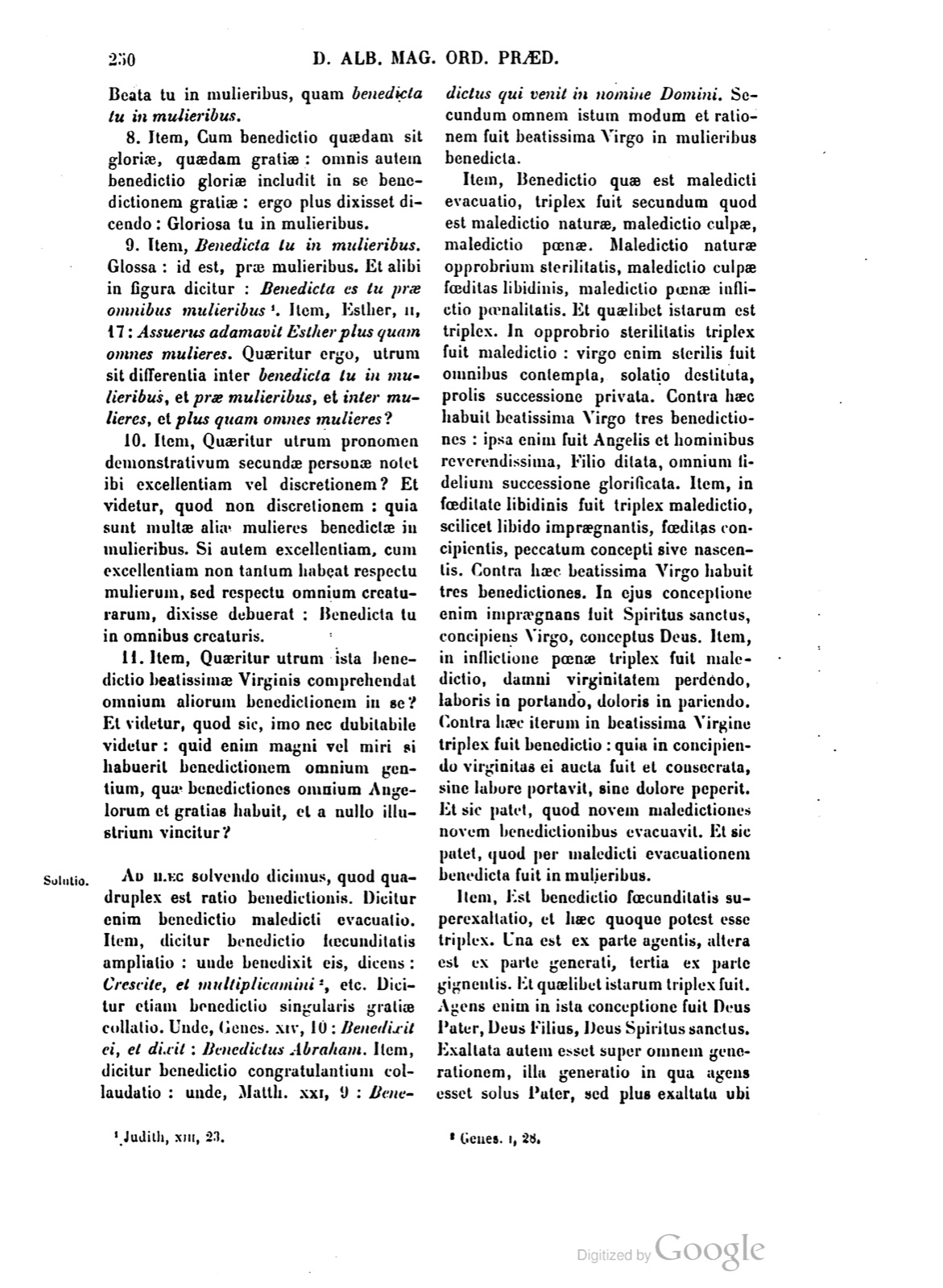
Item, Benedictio quae est maledicti evacuatio, triplex fuit secundum quod est maledictio naturae, maledictio culpae, maledictio poenae. Maledictio naturae opprobrium sterilitatis, maledictio culpae foeditas libidinis, maledictio poenae inflictio poenalitatis. Et quaelibet istarum est triplex. In opprobrio sterilitatis triplex fuit maledictio: virgo enim sterilis fuit omnibus contempta, solatio destituta, prolis successione privata. Contra haec habuit beatissima Virgo tres benedictiones: ipsa enim fuit Angelis et hominibus reverendissima, Filio ditata, omnium fidelium successione glorificata. Item, in foeditate libidinis fuit triplex maledictio, scilicet libido impraegnantis, foeditas concipientis, peccatum concepti sive nascentis. Contra haec beatissima Virgo habuit tres benedictiones. In ejus conceptione enim impraegnans fuit Spiritus sanctus, concipiens Virgo, conceptus Deus. Item, in inflictione poenae triplex fuit maledictio, damni virginitatem perdendo, laboris in portando, doloris in pariendo. Contra haec iterum in beatissima Virgine triplex fuit benedictio: quia in concipiendo virginitas ei aucta fuit et consecrata, sine labore portavit, sine dolore peperit. Et sic patet, quod novem maledictiones novem benedictionibus evacuavit. Et sic patet, quod per maledicti evacuationem benedicta fuit in mulieribus.
Item, Est benedictio foecunditatis superexaltatio, et haec quoque potest esse triplex. Una est ex parte agentis, altera est ex parte generati, tertia ex parte gignentis. Et quaelibet istarum triplex fuit. Agens enim in ista conceptione fuit Deus Pater, Deus Filius, Deus Spiritus sanctus. Exaltata autem esset super omnem generationem, illa generatio in qua agens esset solus Pater, sed plus exaltata ubi Pater et Filius, sed plurimum ubi Pater et Filius et Spiritus sanctus: quod totum in ista conceptione fuit. Item, ex parte generati est exaltata generatio super omnem generationem ubi concipitur vir perfectus in naturalibus, sed plus exaltata fuit ubi conceptus fuit vir sanctus gratia et virtutibus, sed superexaltata ubi vir perfectissimus, homo sanctissimus et summus Deus. Item, ex parte gignentis exaltata fuit, quia virgo concepit: plus exaltata, quia virgo peperit: exaltatissima, quia mater et virgo lactavit.
Est etiam benedictio singularis gratiae collatio, quae similiter in beatissima Virgine triplex fuit. Primo quia secundum dignitatem est caput omnium feminarum et principium. Secundo, quod est mater omnium. Tertio, quod est Domina omnium. Prima istarum adhuc triplex est: dicitur enim principium feminarum propter tria. Unum est quod habuit quidquid boni in feminis fuit. Aliud quod quodlibet illorum in summo habuit. Tertium, quod illud habuit quod numquam aliqua femina habuit vel habere potuit. Primum triplex. Triplex enim bonum fuit in feminis. Bonum virginum, bonum conjugatarum, bonum viduarum. In virginitate adhuc triplex benedictio est. Una est carnis incorruptio. Secunda, nullius viri subjectio. Tertia, angelica conversatio. In conjugatis est triplex bonum, fides, proles, et sacramentum. In viduis quoque triplex est benedictio, scilicet libertas contemplationis, exercitium in operibus pietatis, castigatio carnis. Omnia ista bona simul fuerunt in beata Virgine: habuit etiam ista omnia in summo. Praecellit enim virgines in tribus benedictionibus virginum: causalitate, quia virgo virginum: puritate, quia in summo pura: foecunditate, quia mater et virgo. Conjuges etiam excellit in tribus: habuit enim foecunditatem sine corruptione, prolem sine patre, foecunditatem respectu altissimae naturae, scilicet quod esset mater Dei. Bonum viduarum similiter habuit in summo, utputa in summa contemplatione, praecipua pietate, excellentissima castitate. Quidquid ergo fuit boni in mulieribus, haec omnia excellentissime habuit, quia virgo virginum fuit, et mater Dei fuit, atque mater virgo fuit.
Likewise, the blessing which is the emptying out of a curse was threefold according as there is curse of nature, curse of fault, and curse of punishment. The curse of nature is the reproach of sterility; the curse of fault, the foulness of lust; the curse of punishment, the infliction of penalty. And each of these is threefold. In the reproach of sterility there was a threefold curse: for the sterile virgin was despised by all, deprived of consolation, deprived of succession of offspring. Against these the most blessed Virgin had three blessings: for she was most reverend to Angels and human beings, enriched by the Son, glorified by the succession of all the faithful. Likewise, in the foulness of lust there was a threefold curse, namely the lust of the impregnating one, the foulness of the conceiving one, and the sin of the conceived or born one. Against these the most blessed Virgin had three blessings. For in her conception the impregnating one was the Holy Spirit, the conceiving one a Virgin, the conceived one God. Likewise, in the infliction of punishment there was a threefold curse: of loss by losing virginity, of labor in carrying, of pain in giving birth. Again against these in the most blessed Virgin there was a threefold blessing, because in conceiving her virginity was increased and consecrated, she carried without labor, and gave birth without pain. And thus it is clear that she emptied out nine curses by nine blessings. And thus it is clear that through the emptying out of the curse she was blessed among women.
Likewise, there is blessing as superexaltation of fecundity, and this too can be threefold. One is on the part of the agent, another on the part of the generated one, the third on the part of the generating one. And each of these was threefold. For the agent in that conception was God the Father, God the Son, God the Holy Spirit. Now that generation in which the agent was the Father alone would be exalted above every generation; but more exalted where Father and Son were agent; but most where Father and Son and Holy Spirit were agent, all of which was in that conception. Likewise, on the part of the generated one, generation is exalted above every generation where a man perfect in natural things is conceived, but it was more exalted where a man holy in grace and virtues was conceived, and superexalted where the most perfect man, the most holy human being, and highest God was conceived. Likewise, on the part of the one generating, it was exalted because a virgin conceived; more exalted because a virgin gave birth; most exalted because mother and virgin nursed.
There is also blessing as conferral of singular grace, which similarly was threefold in the most blessed Virgin. First, because according to dignity she is the head and principle of all females. Second, because she is mother of all. Third, because she is Lady of all. The first of these is still threefold, for she is called principle of females because of three things. One is that she had whatever good was in women. Another, that she had each of those goods in the highest degree. The third, that she had what no woman ever had or could have. The first is threefold, for there was a threefold good in women: the good of virgins, the good of married women, and the good of widows. In virginity there is still a threefold blessing: one is incorruption of flesh; the second, subjection to no man; the third, angelic manner of life. In married women there is a threefold good: faith, offspring, and sacrament. In widows too there is a threefold blessing, namely freedom of contemplation, exercise in works of piety, and chastisement of the flesh. All those goods were together in the blessed Virgin, and she also had all those in the highest degree. For she excels virgins in the three blessings of virgins: in causality, because she is Virgin of virgins; in purity, because pure in the highest degree; in fecundity, because mother and virgin. She also excels married women in three things: for she had fecundity without corruption, offspring without father, fecundity with respect to the highest nature, namely that she was mother of God. She likewise had the good of widows in the highest degree, namely in highest contemplation, special piety, and most excellent chastity. Therefore whatever good was in women, she had all these things most excellently, because she was Virgin of virgins, Mother of God, and mother virgin.
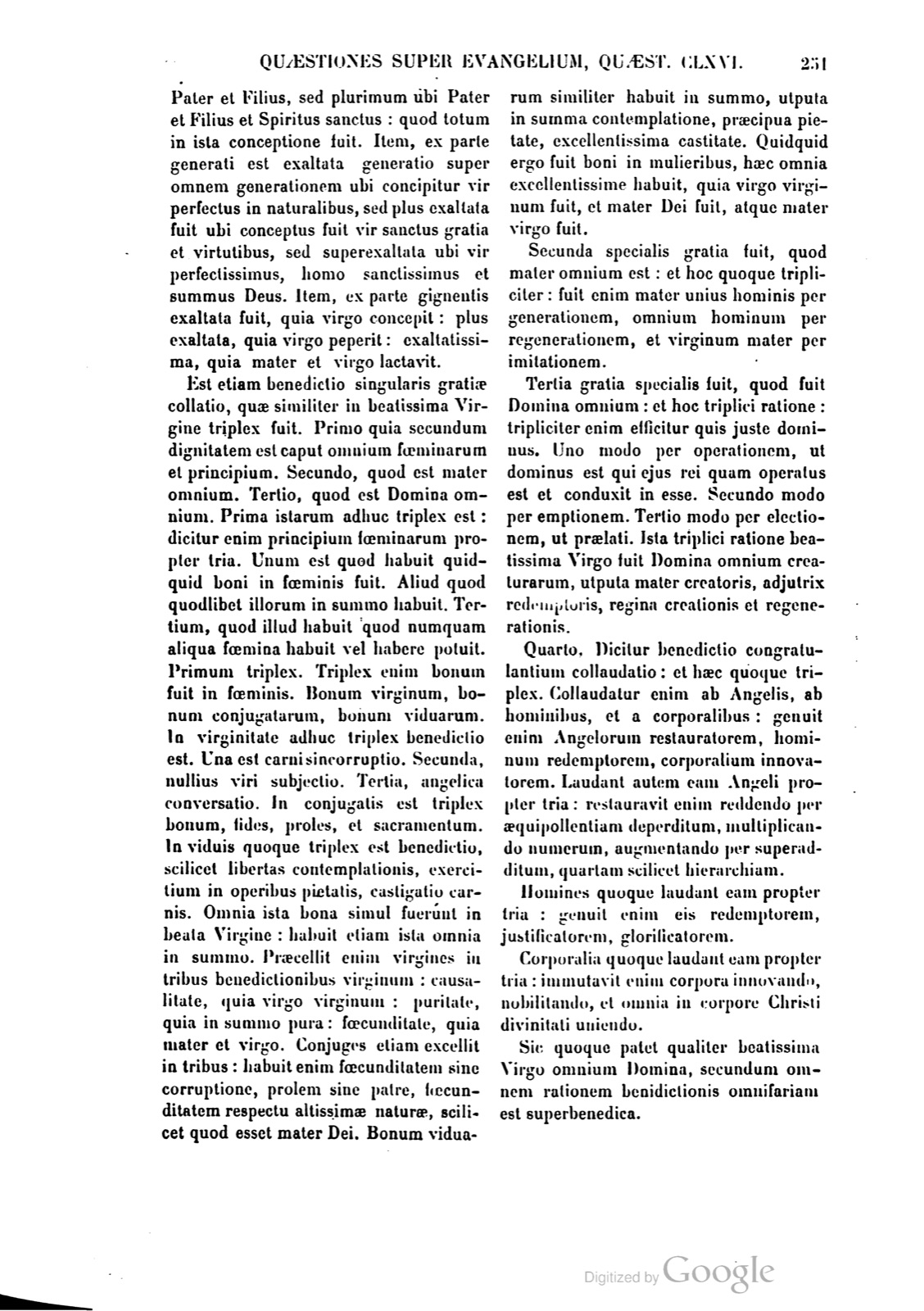
Secunda specialis gratia fuit, quod mater omnium est: et hoc quoque tripliciter: fuit enim mater unius hominis per generationem, omnium hominum per regenerationem, et virginum mater per imitationem.
Tertia gratia specialis fuit, quod fuit Domina omnium: et hoc triplici ratione: tripliciter enim efficitur quis juste dominus. Uno modo per operationem, ut dominus est qui ejus rei quam operatus est et conduxit in esse. Secundo modo per emptionem. Tertio modo per electionem, ut praelati. Ista triplici ratione beatissima Virgo fuit Domina omnium creaturarum, utputa mater creatoris, adjutrix redemptoris, regina creationis et regenerationis.
Quarto, Dicitur benedictio congratulantium collaudatio: et haec quoque triplex. Collaudatur enim ab Angelis, ab hominibus, et a corporalibus: genuit enim Angelorum restauratorem, hominum redemptorem, corporalium innovatorem. Laudant autem eam Angeli propter tria: restauravit enim reddendo per aequipollentiam deperditum, multiplicando numerum, augmentando per superadditum, quartam scilicet hierarchiam. Homines quoque laudant eam propter tria: genuit enim eis redemptorem, justificatorem, glorificatorem. Corporalia quoque laudant eam propter tria: immutavit enim corpora innovando, nobilitando, et omnia in corpore Christi divinitati uniendo.
Sic quoque patet qualiter beatissima Virgo omnium Domina, secundum omnem rationem benedictionis omnifariam est superbenedicta.
The second special grace was that she is mother of all; and this also in three ways, for she was mother of one man by generation, of all human beings by regeneration, and mother of virgins by imitation.
The third special grace was that she was Lady of all, and this for a threefold reason: for one is justly made lord in three ways. In one way by operation, as he is lord who has worked and brought that thing into being. In a second way by purchase. In a third way by election, as prelates are. By that threefold reason the most blessed Virgin was Lady of all creatures, namely mother of the creator, helper of the redeemer, queen of creation and regeneration.
Fourth, blessing is called the praising together of those congratulating; and this too is threefold. For she is praised together by Angels, by human beings, and by bodily things, because she gave birth to the restorer of Angels, the redeemer of human beings, and the renewer of bodily things. But Angels praise her because of three things: for she restored by rendering the lost thing by equivalence, by multiplying the number, and by increasing through what was added over and above, namely the fourth hierarchy. Human beings also praise her because of three things: for she gave birth for them to the redeemer, justifier, and glorifier. Bodily things also praise her because of three things: for she changed bodies by renewing, ennobling, and uniting all things in the body of Christ to divinity.
Thus too it is clear how the most blessed Virgin, Lady of all, according to every account of blessing, is in every way super-blessed.
If a page does not appear, its photograph has not been uploaded yet.