Works › The Mariale: Questions on “Missus est”
Volume 37 · pp. 246–249
Question 165. Whether it is well placed in the Angelic salutation: The Lord is with you?
A marker with ≈ is an approximate page boundary, placed by measure of the text; the page photographs remain the authority. In the paired views, clicking a page marker brings that page into view.
QUAESTIO CLXV. Utrum bene ponatur in salutatione Angelica: Dominus tecum?
Sequitur: Dominus tecum.
Videtur autem quod non bene ponatur in hoc loco: quia
1. Ut dicit Philosophus, sermones inquirendi sunt secundum materiam: ergo in materia salutationis non debet poni nomen timoris: sed Dominus est nomen timoris, juxta illud Malachiae, I, 6: Si Dominus ego sum, ubi est timor meus? Ergo cum hic agatur omnino de amore et materia amoris, nomen timoris hic non debet poni, sed amoris: et ita non debuit dicere, Dominus tecum: sed, Pater tecum.
2. Item, Cum tota Trinitas sit mittens hanc salutationem, videtur quod debuit dicere: Trinitas tecum.
3. Item, Ille qui annuntiatur, vocatur Emmanuel, quod est interpretatum nobiscum Deus 1: et illa allocutio facta fuit in ista annuntiatione: ergo potissime debuit dicere: Deus tecum, vel, Deus nobiscum.
4. Item, Per hanc annuntiationem factus est Dominus nobiscum: ergo dicere debuit: Dominus nobiscum.
5. Item, Dicitur Dominus esse nobiscum vel cum alio specialiter per inhabitantem gratiam: sed illa appropriatur Spiritui sancto: ergo debuit dicere: Spiritus sanctus tecum.
6. Item, Annuntiatio et ista conceptio appropriate facta fuit de Spiritu sancto: ergo debuit dicere: Spiritus sanctus tecum.
7. Item, Modus salutandi Dei fuit: Pax vobis 2: ergo cum iste salutaret ex parte Domini, debuit dicere: Pax vobis, vel, pax tecum.
8. Item, Augustinus in libro Confessionum: « Mecum eras, et ego tecum non eram: » ergo Dominus est cum malis, et mali non sunt cum Domino, sed tantum boni: ergo cum beatissima Virgo summe sit de numero bonorum, debuit dicere: Tu cum Domino.
9. Item, Cum Dominus hic nuntietur venturus in eam per corporalem praesentiam, fuit autem per corporalem praesentiam in ea, et iste est proprius modus essendi quo cum beatissima Virgine fuit et cum nullo alio: ergo cum illum proprium modum essendi deberet hic exprimere, debuisset dixisse: Dominus in te.
10. Item, Jeremias scribens de ista associatione de qua agitur hic, dicit, Jerem. XXXI, 22: Foemina circumdabit virum. Sed quod circumdatur ab alio, illud est in illo: ergo debuit dicere: Dominus in te.
11. Item, In divinis ubi est identitas naturae, dicitur una persona esse in alia, et e converso, ut ibi: Ego in Patre, et Pater in me est 3: ergo cum hic notetur associatio secundum eamdem naturam in specie, debuit dicere: Dominus in te.
12. Item, Dominus absolute dictum poni solet pro Patre, ut ibi, Verbo Domini caeli firmati sunt 4: ergo cum hic notetur praesentia corporalis quae non convenit Patri, non debuit dicere: Dominus tecum.
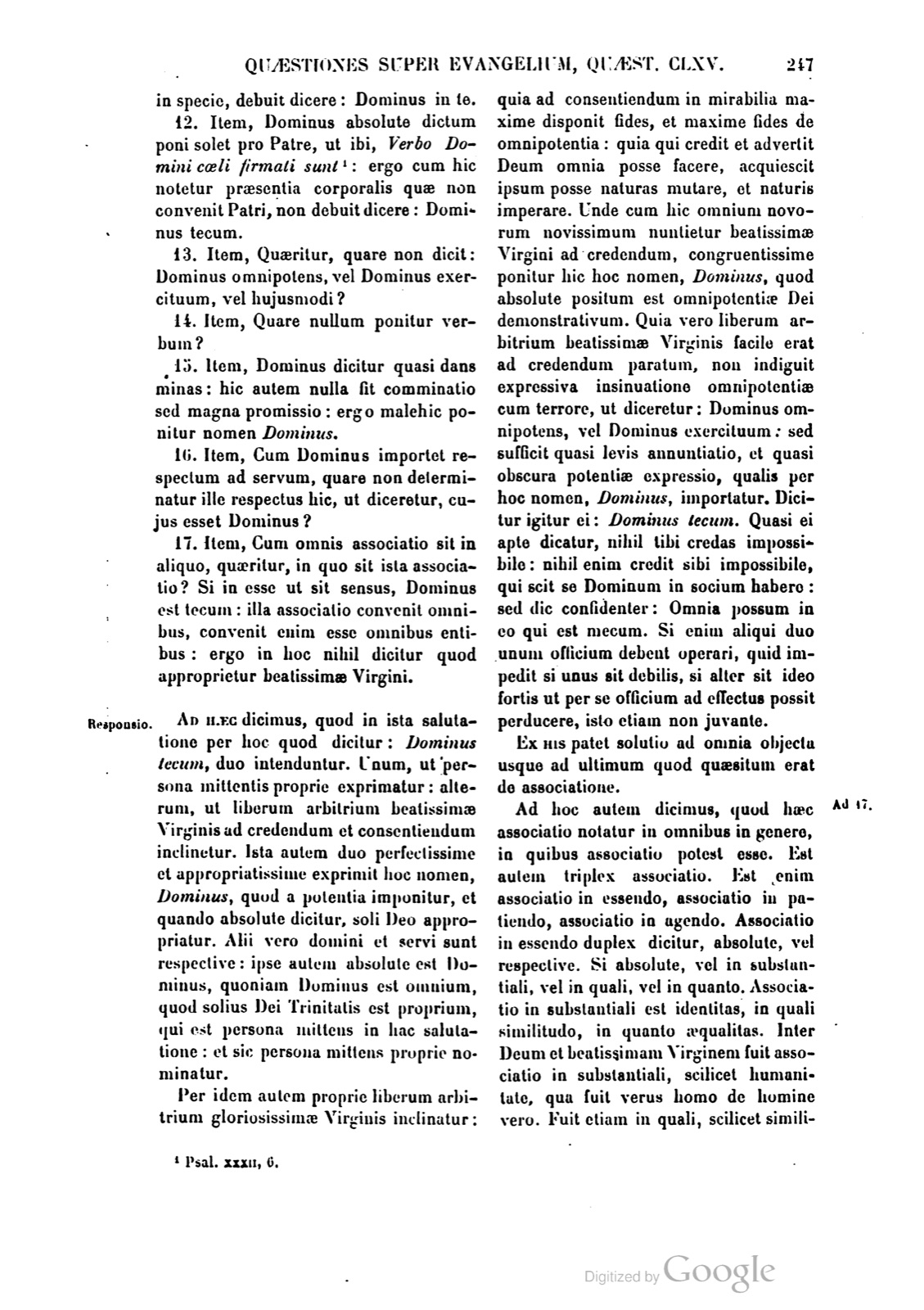
13. Item, Quaeritur, quare non dicit: Dominus omnipotens, vel Dominus exercituum, vel hujusmodi?
QUESTION 165. Whether it is well placed in the Angelic salutation: The Lord is with you?
There follows: The Lord is with you.
But it seems that this is not well placed here, because:
1. As the Philosopher says, speeches must be investigated according to the subject matter; therefore in the matter of greeting a name of fear ought not to be placed. But Lord is a name of fear, according to Malachi 1:6: If I am Lord, where is my fear? Therefore since here the whole matter concerns love and the matter of love, a name of fear ought not to be placed here, but one of love; and so he ought not to have said, The Lord is with you, but, The Father is with you.
2. Likewise, since the whole Trinity is sending this greeting, it seems that he ought to have said: The Trinity is with you.
3. Likewise, the one announced is called Emmanuel, which is interpreted God with us 1, and that address was made in this annunciation. Therefore most especially he ought to have said: God is with you, or God with us.
4. Likewise, through this annunciation the Lord was made with us. Therefore he ought to have said: The Lord is with us.
5. Likewise, the Lord is said to be with us or with another specially through indwelling grace; but that is appropriated to the Holy Spirit. Therefore he ought to have said: The Holy Spirit is with you.
6. Likewise, the annunciation and this conception were appropriatedly made by the Holy Spirit. Therefore he ought to have said: The Holy Spirit is with you.
7. Likewise, God’s manner of greeting was, Peace be to you 2. Therefore since he was greeting on the Lord’s behalf, he ought to have said: Peace be to you, or peace with you.
8. Likewise, Augustine in the book of Confessions says: “You were with me, and I was not with you.” Therefore the Lord is with the bad, and the bad are not with the Lord, but only the good are. Therefore since the most blessed Virgin is supremely of the number of the good, he ought to have said: You are with the Lord.
9. Likewise, since the Lord is here announced as about to come into her by bodily presence, and he was in her by bodily presence, and this is the proper mode of being by which he was with the most blessed Virgin and with no one else, therefore since he ought here to have expressed that proper mode of being, he should have said: The Lord is in you.
10. Likewise, Jeremiah, writing about that association which is treated here, says in Jeremiah 31:22: A woman will surround a man. But what is surrounded by another is in that other. Therefore he ought to have said: The Lord is in you.
11. Likewise, in divine things, where there is identity of nature, one person is said to be in another, and conversely, as there: I am in the Father, and the Father is in me 3. Therefore since here association according to the same nature in species is noted, he ought to have said: The Lord is in you.
12. Likewise, Lord said absolutely is usually posited for the Father, as there, By the word of the Lord the heavens were established 4. Therefore since bodily presence is noted here, which does not belong to the Father, he ought not to have said: The Lord is with you.
13. Likewise, it is asked why he does not say: the almighty Lord, or the Lord of hosts, or something of this sort.
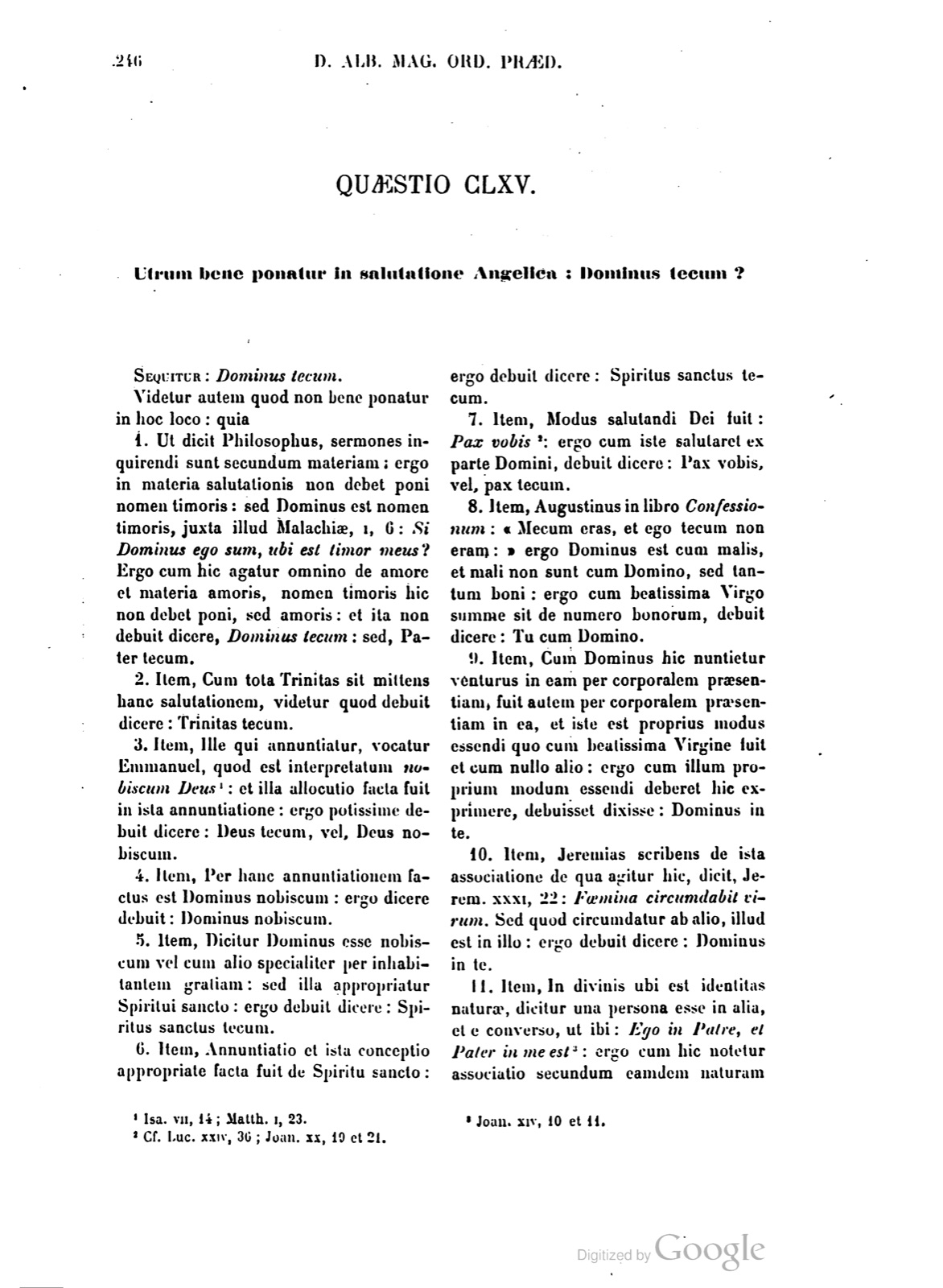
14. Item, Quare nullum ponitur verbum?
15. Item, Dominus dicitur quasi dans minas: hic autem nulla fit comminatio sed magna promissio: ergo male hic ponitur nomen Dominus.
16. Item, Cum Dominus importet respectum ad servum, quare non determinatur ille respectus hic, ut diceretur, cujus esset Dominus?
17. Item, Cum omnis associatio sit in aliquo, quaeritur, in quo sit ista associatio? Si in esse ut sit sensus, Dominus est tecum: illa associatio convenit omnibus, convenit enim esse omnibus entibus: ergo in hoc nihil dicitur quod approprietur beatissimae Virgini.
Responsio. Ad haec dicimus, quod in ista salutatione per hoc quod dicitur: Dominus tecum, duo intenduntur. Unum, ut persona mittentis proprie exprimatur: alterum, ut liberum arbitrium beatissimae Virginis ad credendum et consentiendum inclinetur. Ista autem duo perfectissime et appropriatissime exprimit hoc nomen, Dominus, quod a potentia imponitur, et quando absolute dicitur, soli Deo appropriatur. Alii vero domini et servi sunt respective: ipse autem absolute est Dominus, quoniam Dominus est omnium, quod solius Dei Trinitatis est proprium, qui est persona mittens in hac salutatione: et sic persona mittens proprie nominatur.
Per idem autem proprie liberum arbitrium gloriosissimae Virginis inclinatur: quia ad consentiendum in mirabilia maxime disponit fides, et maxime fides de omnipotentia: quia qui credit et advertit Deum omnia posse facere, acquiescit ipsum posse naturas mutare, et naturis imperare. Unde cum hic omnium novorum novissimum nuntietur beatissimae Virgini ad credendum, congruentissime ponitur hic hoc nomen, Dominus, quod absolute positum est omnipotentiae Dei demonstrativum. Quia vero liberum arbitrium beatissimae Virginis facile erat ad credendum paratum, non indiguit expressiva insinuatione omnipotentiae cum terrore, ut diceretur: Dominus omnipotens, vel Dominus exercituum: sed sufficit quasi levis annuntiatio, et quasi obscura potentiae expressio, qualis per hoc nomen, Dominus, importatur. Dicitur igitur ei: Dominus tecum. Quasi ei apte dicatur, nihil tibi credas impossibile: nihil enim credit sibi impossibile, qui scit se Dominum in socium habere: sed dic confidenter: Omnia possum in eo qui est mecum. Si enim aliqui duo unum officium debent operari, quid impedit si unus sit debilis, si alter sit ideo fortis ut per se officium ad effectus possit perducere, isto etiam non juvante.
Ex his patet solutio ad omnia objecta usque ad ultimum quod quaesitum erat de associatione.
Ad 17. Ad hoc autem dicimus, quod haec associatio notatur in omnibus in genere, in quibus associatio potest esse. Est autem triplex associatio. Est enim associatio in essendo, associatio in patiendo, associatio in agendo. Associatio in essendo duplex dicitur, absolute, vel respective. Si absolute, vel in substantiali, vel in quali, vel in quanto. Associatio in substantiali est identitas, in quali similitudo, in quanto aequalitas. Inter Deum et beatissimam Virginem fuit associatio in substantiali, scilicet humanitate, qua fuit verus homo de homine vero. Fuit etiam in quali, scilicet similitudo voluntatis unius in utroque. Fuit etiam in quanto, scilicet aequalis potentia in genere: ipsa enim ejusdem regni regina est, cujus ipse est rex. Item, Inter ipsos potest notari identitas in natura, similitudo in forma naturali, aequalitas in virtute naturali sive in potentia.
14. Likewise, why is no verb placed?
15. Likewise, Lord is said as though giving threats; but here no threat is made, but a great promise. Therefore the name Lord is badly placed here.
16. Likewise, since Lord imports a relation to a servant, why is that relation not determined here, so that it would be said whose Lord he was?
17. Likewise, since every association is in something, it is asked in what this association is. If in being, so that the sense is, The Lord is with you, that association belongs to all, for being belongs to all beings. Therefore in this nothing is said which is appropriated to the most blessed Virgin.
Response. To these things we say that in this greeting, by the words The Lord is with you, two things are intended. One is that the person of the sender be properly expressed; the other, that the free choice of the most blessed Virgin be inclined to believing and consenting. But this name Lord expresses those two things most perfectly and most appropriately, because it is imposed from power, and when said absolutely it is appropriated to God alone. Other lords and servants are such relatively; but he is Lord absolutely, since he is Lord of all, which is proper to the Trinity of God alone, who is the person sending in this greeting; and thus the sending person is properly named.
By the same name the free choice of the most glorious Virgin is properly inclined, because faith most disposes one to consent to marvels, and especially faith concerning omnipotence, because one who believes and notices that God can do all things agrees that he can change natures and command natures. Whence since here the newest of all new things is announced to the most blessed Virgin for belief, this name Lord is most fittingly placed here, because when placed absolutely it is demonstrative of God’s omnipotence. But because the free choice of the most blessed Virgin was easily prepared for believing, it did not need an expressive insinuation of omnipotence with terror, so that it would be said: almighty Lord, or Lord of hosts. Rather, a light announcement, as it were, and an obscure expression of power, such as is imported through this name Lord, suffices. Therefore it is said to her: The Lord is with you. As if it is aptly said to her: believe nothing impossible to you; for one who knows that he has the Lord as companion believes nothing impossible to himself, but says confidently: I can do all things in him who is with me. For if two persons ought to perform one office, what does it matter if one is weak, if the other is so strong that by himself he can bring the office to effects, even without this one helping?
From these things the solution to all the objections is clear up to the last, which asked about association.
To 17. To this we say that this association is noted in all things in general in which association can be. But association is threefold: association in being, association in suffering, and association in acting. Association in being is said in two ways, absolutely or relatively. If absolutely, it is either in substance, in quality, or in quantity. Association in substance is identity, in quality likeness, in quantity equality. Between God and the most blessed Virgin there was association in substance, namely humanity, by which he was true man from true human being. There was also association in quality, namely likeness of one will in both. There was also association in quantity, namely equal power in genus, for she is queen of the same kingdom of which he is king. Likewise, between them can be noted identity in nature, likeness in natural form, equality in natural virtue or in power.
Si autem est communio in essendo respective, hoc est duorum ad invicem, vel duorum ad unum. Si primo modo, illa communio fuit hic in summo: quia ipsa est mater sua, et ipse filius ejus. Si secundo modo, tunc est vel ad unum tempus, vel ad unum locum, vel ad unum situm, vel ad unum habitum. Secundum tempus fuit ibi communio: quia simul ipsa mater Dei, et ipse simul filius hominis, et e converso. Secundum locum fuit communio: ipsa enim eum secum portavit de loco ad locum quocumque infra novem menses ivit. Possumus autem et istas communiones temporis et loci subdividere. Est enim tempus adversitatis, et tempus prosperitatis. Adversitatis autem est duplex, vel a seipso, vel ab alio, et sic triplex erit tempus, scilicet tempus propriae humiliationis, tempus alienae persecutionis, et tempus consolationis. Et in his omnibus fuit Dominus cum ea. In tempore propriae humiliationis in purificatione, quando obtulit ipsum ad templum 5. In aliena persecutione, sicut in passione, quando stabat sub cruce 6. In suprema consolatione, sicut in resurrectione. Item, Locorum alius poenalis, alius naturalis, alius dignitatis. Naturalis est verus, poenalis ut exsilium, dignitatis ut solium. In his omnibus fuit Dominus secum, et ipsa cum Domino. Dominus enim secum fuit in utero, secum in exsilio, secum in solio. Item, diversi in diversis locis solent esse simul, fratres simul in domo, pater et filius simul in mensa, vir et mulier simul in lecto, dominus et servus simul in via vel in comitatu. Ipse autem in omnibus his fuit secum simul, in domo ut mater cum sorore, in mensa ut filius cum matre, in lecto ut sponsus cum sponsa, in comitatu ut Dominus cum ancilla. De primo dicit Psalmista, Psal. CXXXII, 1: Ecce quam bonum et quam jucundum habitare fratres in unum! De secundo, Matth. XV, 26: Non est bonum sumere panem filiorum, etc. De tertio dicitur in Genesi, II, 24: Quamobrem relinquet homo patrem suum et matrem. De quarto dicitur, Joan. XII, 26: Si quis mihi ministrat, me sequatur. Fuit etiam communio cum eo secundum situm omni modo: ipse enim novem mensibus cum jacente jacebat, cum sedente sedebat, cum surgente surgebat, et sic de reliquis fuit. Est ibi etiam communio substantialis secundum habitum: ipsa enim beata Virgo induit ipsum Deum eadem carne, qua ipsa fuit induta. Unde Apostolus: In similitudinem hominum factus, et habitu inventus ut homo 7.
But if there is communion in being relatively, this is either of two to each other or of two to one. If in the first way, that communion was here in the highest degree, because she is his mother and he is her son. If in the second way, then it is either to one time, one place, one position, or one habit. According to time there was communion there, because at once she was Mother of God, and he at once Son of man, and conversely. According to place there was communion, for she carried him with herself from place to place wherever she went within the nine months. We can also subdivide these communions of time and place. For there is a time of adversity and a time of prosperity. Adversity is twofold, either from oneself or from another, and thus there will be a threefold time: the time of one’s own humiliation, the time of another’s persecution, and the time of consolation. And in all these the Lord was with her: in the time of her own humiliation in the purification, when she offered him at the temple 5; in another’s persecution, as in the passion, when she stood beneath the cross 6; in highest consolation, as in the resurrection. Likewise, one place is penal, another natural, another of dignity. The natural is true; the penal, exile; that of dignity, the throne. In all these the Lord was with her, and she with the Lord. For the Lord was with her in the womb, with her in exile, with her on the throne. Likewise, different persons are accustomed to be together in different places: brothers together in a house, father and son together at table, man and woman together in bed, lord and servant together on the road or in company. But he was together with her in all these: in the house as mother with sister, at table as son with mother, in bed as bridegroom with bride, in company as Lord with handmaid. Of the first the Psalmist says, Psalm 132:1: Behold how good and pleasant it is for brothers to dwell as one! Of the second, Matthew 15:26: It is not good to take the bread of the children, etc. Of the third it is said in Genesis 2:24: Wherefore a man shall leave his father and mother. Of the fourth it is said, John 12:26: If anyone ministers to me, let him follow me. There was also communion with him according to position in every way: for for nine months, when she lay, he lay with her; when she sat, he sat; when she rose, he rose; and so with the rest. There is also substantial communion there according to habit, for the blessed Virgin clothed God himself with the same flesh with which she herself was clothed. Whence the Apostle says: Made in the likeness of human beings and found in habit as a man 7.
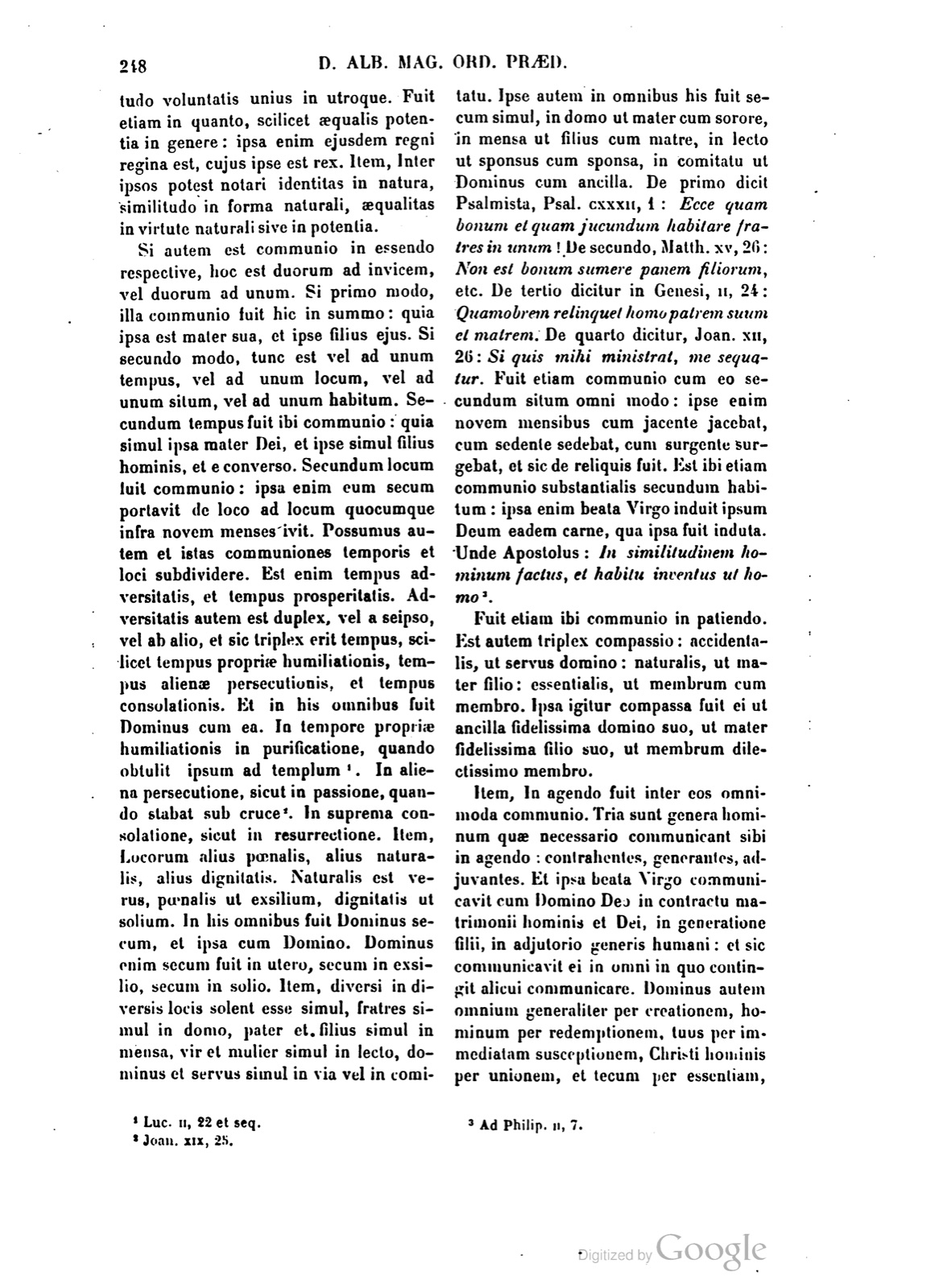
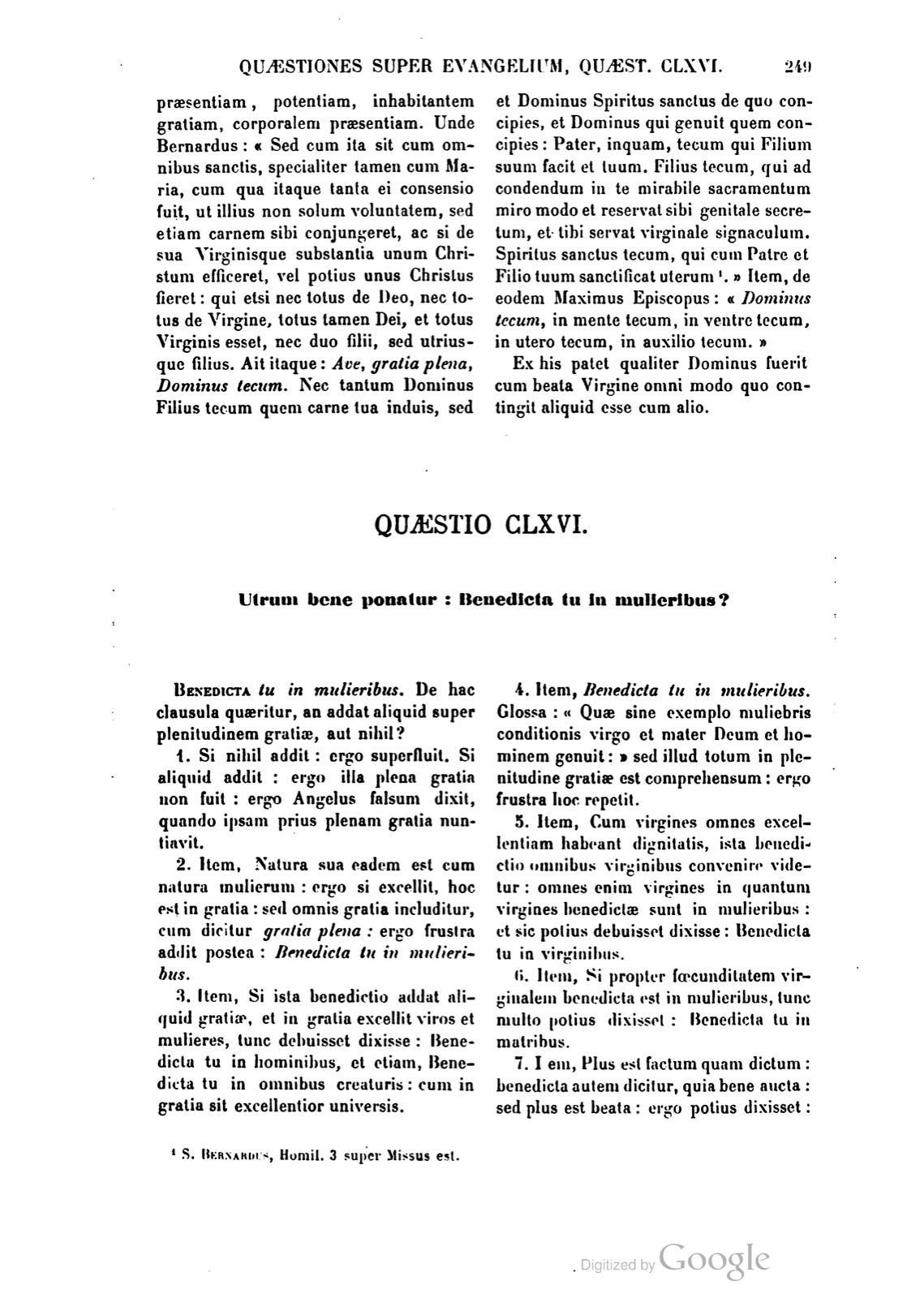
Fuit etiam ibi communio in patiendo. Est autem triplex compassio: accidentalis, ut servus domino: naturalis, ut mater filio: essentialis, ut membrum cum membro. Ipsa igitur compassa fuit ei ut ancilla fidelissima domino suo, ut mater fidelissima filio suo, ut membrum dilectissimo membro.
Item, In agendo fuit inter eos omnimoda communio. Tria sunt genera hominum quae necessario communicant sibi in agendo: contrahentes, generantes, adjuvantes. Et ipsa beata Virgo communicavit cum Domino Deo in contractu matrimonii hominis et Dei, in generatione filii, in adjutorio generis humani: et sic communicavit ei in omni in quo contingit alicui communicare. Dominus autem omnium generaliter per creationem, hominum per redemptionem, tuus per immediatam susceptionem, Christi hominis per unionem, et tecum per essentiam, praesentiam, potentiam, inhabitantem gratiam, corporalem praesentiam. Unde Bernardus: « Sed cum ita sit cum omnibus sanctis, specialiter tamen cum Maria, cum qua itaque tanta ei consensio fuit, ut illius non solum voluntatem, sed etiam carnem sibi conjungeret, ac si de sua Virginisque substantia unum Christum efficeret, vel potius unus Christus fieret: qui etsi nec totus de Deo, nec totus de Virgine, totus tamen Dei, et totus Virginis esset, nec duo filii, sed utriusque filius. Ait itaque: Ave, gratia plena, Dominus tecum. Nec tantum Dominus Filius tecum quem carne tua induis, sed et Dominus Spiritus sanctus de quo concipies, et Dominus qui genuit quem concipies: Pater, inquam, tecum qui Filium suum facit et tuum. Filius tecum, qui ad condendum in te mirabile sacramentum miro modo et reservat sibi genitale secretum, et tibi servat virginale signaculum. Spiritus sanctus tecum, qui cum Patre et Filio tuum sanctificat uterum 8. » Item, de eodem Maximus Episcopus: « Dominus tecum, in mente tecum, in ventre tecum, in utero tecum, in auxilio tecum. »
Ex his patet qualiter Dominus fuerit cum beata Virgine omni modo quo contingit aliquid esse cum alio.
There was also communion there in suffering. But compassion is threefold: accidental, as servant with lord; natural, as mother with son; essential, as member with member. Therefore she suffered with him as most faithful handmaid with her Lord, as most faithful mother with her son, as member with most beloved member.
Likewise, in acting there was every-mode communion between them. There are three genera of human beings who necessarily communicate with each other in acting: those contracting, those generating, and those helping. And the blessed Virgin communicated with the Lord God in the contract of marriage of man and God, in the generation of the Son, and in help of the human race. And thus she communicated with him in everything in which it happens that anyone communicates. But he is Lord of all generally through creation, of human beings through redemption, yours through immediate assumption, of Christ the man through union, and with you through essence, presence, power, indwelling grace, and bodily presence. Whence Bernard says: “But although he is thus with all saints, nevertheless specially with Mary, with whom indeed there was such great agreement for him that he joined to himself not only her will but also her flesh, as if he made one Christ from his own and the Virgin’s substance, or rather one Christ was made, who, even if not wholly from God nor wholly from the Virgin, nevertheless would be wholly God’s and wholly the Virgin’s, and not two sons, but the son of each. Therefore he says: Hail, full of grace, the Lord is with you. Not only the Lord Son is with you, whom you clothe with your flesh, but also the Lord Holy Spirit from whom you will conceive, and the Lord who begot the one whom you will conceive. The Father, I say, is with you, who makes his Son yours. The Son is with you, who in a wondrous way, to found in you the wondrous sacrament, both reserves the generative secret for himself and preserves the virginal seal for you. The Holy Spirit is with you, who with the Father and Son sanctifies your womb 8.” Likewise, about the same Maximus the Bishop says: “The Lord is with you, with you in mind, with you in belly, with you in womb, with you in help.”
From these things it is clear how the Lord was with the blessed Virgin in every way in which something can be with another.
Notes
- Isaiah 7:14; Matthew 1:23. (Isa. VII, 14; Matth. I, 23.) ↩
- Cf. Luke 24:36; John 20:19 and 21. (Cf. Luc. XXIV, 36; Joan. XX, 19 et 21.) ↩
- John 14:10-11. (Joan. XIV, 10 et 11.) ↩
- Psalm 32:6. (Psal. XXXII, 6.) ↩
- Luke 2:22 and following. (Luc. II, 22 et seq.) ↩
- John 19:25. (Joan. XIX, 25.) ↩
- Philippians 2:7. (Ad Philip. II, 7.) ↩
- St. Bernard, Homily 3 on Missus est. (S. Bernardus, Homil. 3 super Missus est.) ↩
If a page does not appear, its photograph has not been uploaded yet.