Works › The Mariale: Questions on “Missus est”
Volume 37 · pp. 240–245
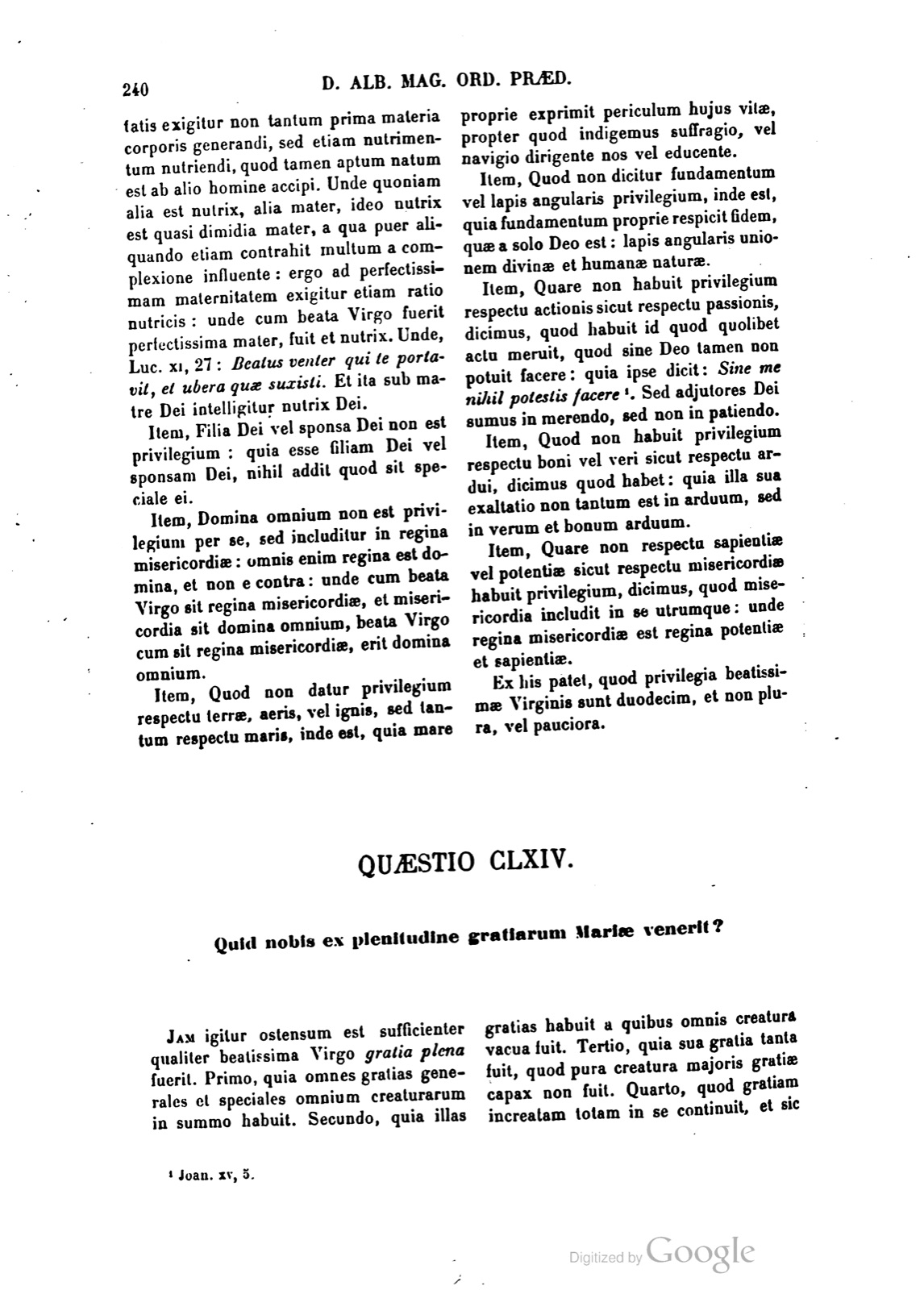
Question 164. What has come to us from the fullness of Mary’s graces?
A marker with ≈ is an approximate page boundary, placed by measure of the text; the page photographs remain the authority. In the paired views, clicking a page marker brings that page into view.
QUAESTIO CLXIV. Quid nobis ex plenitudine gratiarum Mariae venerit?
Jam igitur ostensum est sufficienter qualiter beatissima Virgo gratia plena fuerit. Primo, quia omnes gratias generales et speciales omnium creaturarum in summo habuit. Secundo, quia illas gratias habuit a quibus omnis creatura vacua fuit. Tertio, quia sua gratia tanta fuit, quod pura creatura majoris gratiae capax non fuit. Quarto, quod gratiam increatam totam in se continuit, et sic
QUESTION 164. What has come to us from the fullness of Mary’s graces?
Now therefore it has been shown sufficiently in what way the most blessed Virgin was full of grace. First, because she had in the highest degree all the general and special graces of all creatures. Second, because she had those graces of which every creature was empty. Third, because her grace was so great that a pure creature was not capable of greater grace. Fourth, because she contained in herself the whole uncreated grace, and thus
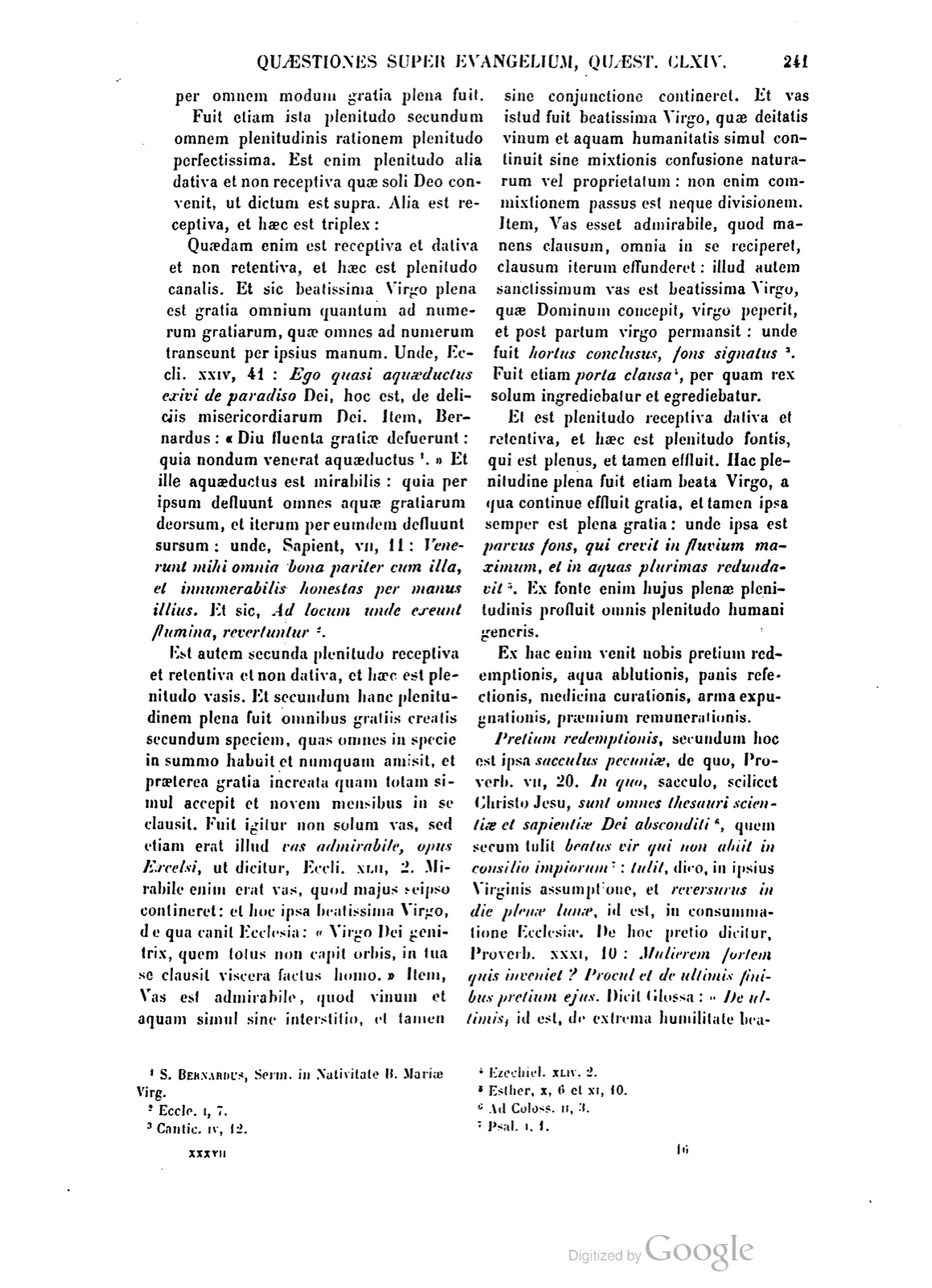
per omnem modum gratia plena fuit.
Fuit etiam ista plenitudo secundum omnem plenitudinis rationem plenitudo perfectissima. Est enim plenitudo alia dativa et non receptiva quae soli Deo convenit, ut dictum est supra. Alia est receptiva, et haec est triplex:
Quaedam enim est receptiva et dativa et non retentiva, et haec est plenitudo canalis. Et sic beatissima Virgo plena est gratia omnium quantum ad numerum gratiarum, quae omnes ad numerum transeunt per ipsius manum. Unde, Eccli. XXIV, 41: Ego quasi aquaeductus exivi de paradiso Dei, hoc est, de deliciis misericordiarum Dei. Item, Bernardus: « Diu fluenta gratiae defuerunt: quia nondum venerat aquaeductus 1. » Et ille aquaeductus est mirabilis: quia per ipsum defluunt omnes aquae gratiarum deorsum, et iterum per eundem defluunt sursum: unde, Sapient, VII, 11: Venerunt mihi omnia bona pariter cum illa, et innumerabilis honestas per manus illius. Et sic, Ad locum unde exeunt flumina, revertuntur 2.
Est autem secunda plenitudo receptiva et retentiva et non dativa, et haec est plenitudo vasis. Et secundum hanc plenitudinem plena fuit omnibus gratiis creatis secundum speciem, quas omnes in specie in summo habuit et numquam amisit, et praeterea gratia increata quam totam simul accepit et novem mensibus in se clausit. Fuit igitur non solum vas, sed etiam erat illud vas admirabile, opus Excelsi, ut dicitur, Eccli. XLII, 2. Mirabile enim erat vas, quod majus seipso contineret: et hoc ipsa beatissima Virgo, de qua canit Ecclesia: « Virgo Dei genitrix, quem totus non capit orbis, in tua se clausit viscera factus homo. » Item, Vas est admirabile, quod vinum et aquam simul sine interstitio, et tamen sine conjunctione contineret. Et vas istud fuit beatissima Virgo, quae deitatis vinum et aquam humanitatis simul continuit sine mixtionis confusione naturarum vel proprietatum: non enim commixtionem passus est neque divisionem. Item, Vas esset admirabile, quod manens clausum, omnia in se reciperet, clausum iterum effunderet: illud autem sanctissimum vas est beatissima Virgo, quae Dominum concepit, virgo peperit, et post partum virgo permansit: unde fuit hortus conclusus, fons signatus 3. Fuit etiam porta clausa 4, per quam rex solum ingrediebatur et egrediebatur.
Et est plenitudo receptiva dativa et retentiva, et haec est plenitudo fontis, qui est plenus, et tamen effluit. Hac plenitudine plena fuit etiam beata Virgo, a qua continue effluit gratia, et tamen ipsa semper est plena gratia: unde ipsa est parvus fons, qui crevit in fluvium maximum, et in aquas plurimas redundavit 5. Ex fonte enim hujus plenae plenitudinis profluit omnis plenitudo humani generis.
Ex hac enim venit nobis pretium redemptionis, aqua ablutionis, panis refectionis, medicina curationis, arma expugnationis, praemium remunerationis.
Pretium redemptionis, secundum hoc est ipsa sacculus pecuniae, de quo, Proverb. VII, 20. In quo, sacculo, scilicet Christo Jesu, sunt omnes thesauri scientiae et sapientiae Dei absconditi 6, quem secum tulit beatus vir qui non abiit in consilio impiorum 7: tulit, dico, in ipsius Virginis assumptione, et reversurus in die plenae lunae, id est, in consummatione Ecclesiae. De hoc pretio dicitur, Proverb. XXXI, 10: Mulierem fortem quis inveniet? Procul et de ultimis finibus pretium ejus. Dicit Glossa: « De ultimis, id est, de extrema humilitate beatissimae Virginis: vel, de ultimis, id est, de conjunctione Dei et hominis, qui sunt duo ultimi fines. » Attingit enim a fine usque ad finem fortiter, et disponit omnia suaviter 8. Illud pretium fuit in die annuntiationis collectum, in die passionis persolutum. Sed miseri Judaei pretium nostrum cogitaverunt repellere, quamvis enim esset aurum terrae illius, id est, beatissimae Virginis optimum, tamen ipsi non cognoverunt: quia ipsi non crediderunt ipsum Deum esse: et qui fuit aurum mundissimum, crediderunt esse cuprum, et mel suspicati sunt esse fel: unde et omni modo quo probatur aliqua pecunia, probaverunt ipsum. Examinaverunt eum per ignem. Psal. XVI, 3: Igne me examinasti. Sed nec sic invenerunt aliquid de scoria: unde, Et non est inventa in me iniquitas. Praeterea etiam numeraverunt. Psal. XXI, 18: Dinumeraverunt omnia ossa mea. Insuper in statera crucis libraverunt: unde cantatur: « Statera facta corporis. » Et sic effluxit pretium redemptionis.
she was full of grace in every way.
This fullness was also the most perfect fullness according to every account of fullness. For one fullness is giving and not receiving, which belongs to God alone, as was said above. Another is receptive, and this is threefold.
One is receptive and giving and not retaining, and this is the fullness of a channel. And thus the most blessed Virgin is full with the grace of all as to the number of graces, all of which pass in number through her hand. Whence Ecclesiasticus 24:41: I went out like an aqueduct from the paradise of God, that is, from the delights of the mercies of God. Likewise, Bernard says: “For a long time the streams of grace were lacking, because the aqueduct had not yet come 1.” And that aqueduct is marvelous, because through it all waters of graces flow downward, and again through the same one they flow upward. Whence Wisdom 7:11: All good things came to me together with her, and innumerable honor through her hands. And thus, To the place whence the rivers go forth, they return 2.
The second fullness is receptive and retentive and not giving, and this is the fullness of a vessel. And according to this fullness she was full of all created graces according to species, all of which in species she had in the highest degree and never lost; and besides, the uncreated grace which she received whole all at once and enclosed in herself for nine months. Therefore she was not only a vessel, but also that admirable vessel, the work of the Most High, as is said in Ecclesiasticus 42:2. For a vessel was admirable that contained something greater than itself; and this was the most blessed Virgin herself, of whom the Church sings: “Virgin Mother of God, he whom the whole world does not contain, made man, enclosed himself in your inward parts.” Likewise, a vessel is admirable which contains wine and water together without interval, and nevertheless without conjunction. And that vessel was the most blessed Virgin, who contained together the wine of deity and the water of humanity without confusion of mixture of natures or properties; for he suffered neither commixture nor division. Likewise, a vessel would be admirable which, remaining closed, received all things into itself and, closed again, poured them out. But that most holy vessel is the most blessed Virgin, who conceived the Lord, gave birth as a virgin, and after birth remained a virgin; whence she was an enclosed garden, a sealed fountain 3. She was also the closed gate 4, through which only the king entered and went out.
And there is a receptive, giving, and retaining fullness, and this is the fullness of a spring, which is full and nevertheless flows out. The blessed Virgin was also full with this fullness, from whom grace continually flows out, and nevertheless she herself is always full of grace. Whence she is the small spring which grew into a very great river and overflowed into very many waters 5. For from the spring of this full fullness flows forth every fullness of the human race.
For from this comes to us the price of redemption, the water of washing, the bread of refreshment, the medicine of healing, the weapons of assault, and the reward of remuneration.
The price of redemption, according to this, is she herself as the purse of money spoken of in Proverbs 7:20. In that purse, namely Christ Jesus, all the treasures of the knowledge and wisdom of God are hidden 6, which the blessed man who did not walk in the counsel of the impious carried with himself 7; he carried it, I say, in the Virgin’s own assumption, and he is to return on the day of the full moon, that is, in the consummation of the Church. Of this price it is said in Proverbs 31:10: Who shall find a strong woman? Her price is far off and from the farthest ends. The Gloss says: “From the farthest, that is, from the extreme humility of the most blessed Virgin; or from the farthest, that is, from the conjunction of God and man, who are the two farthest ends.” For she reaches strongly from end to end and disposes all things sweetly 8. That price was collected on the day of the annunciation and paid on the day of the passion. But the wretched Jews thought to reject our price; for although it was the best gold of that land, that is, of the most blessed Virgin, nevertheless they did not know it, because they did not believe him to be God. And him who was the purest gold they believed to be copper, and they suspected honey to be gall; whence they tested him in every way in which money is tested. They examined him by fire. Psalm 16:3: You examined me by fire. But even so they found no dross; whence, And iniquity was not found in me. Besides, they also counted him. Psalm 21:18: They counted all my bones. Moreover, they weighed him in the balance of the cross; whence it is sung: “The balance of the body having been made.” And thus the price of redemption flowed out.
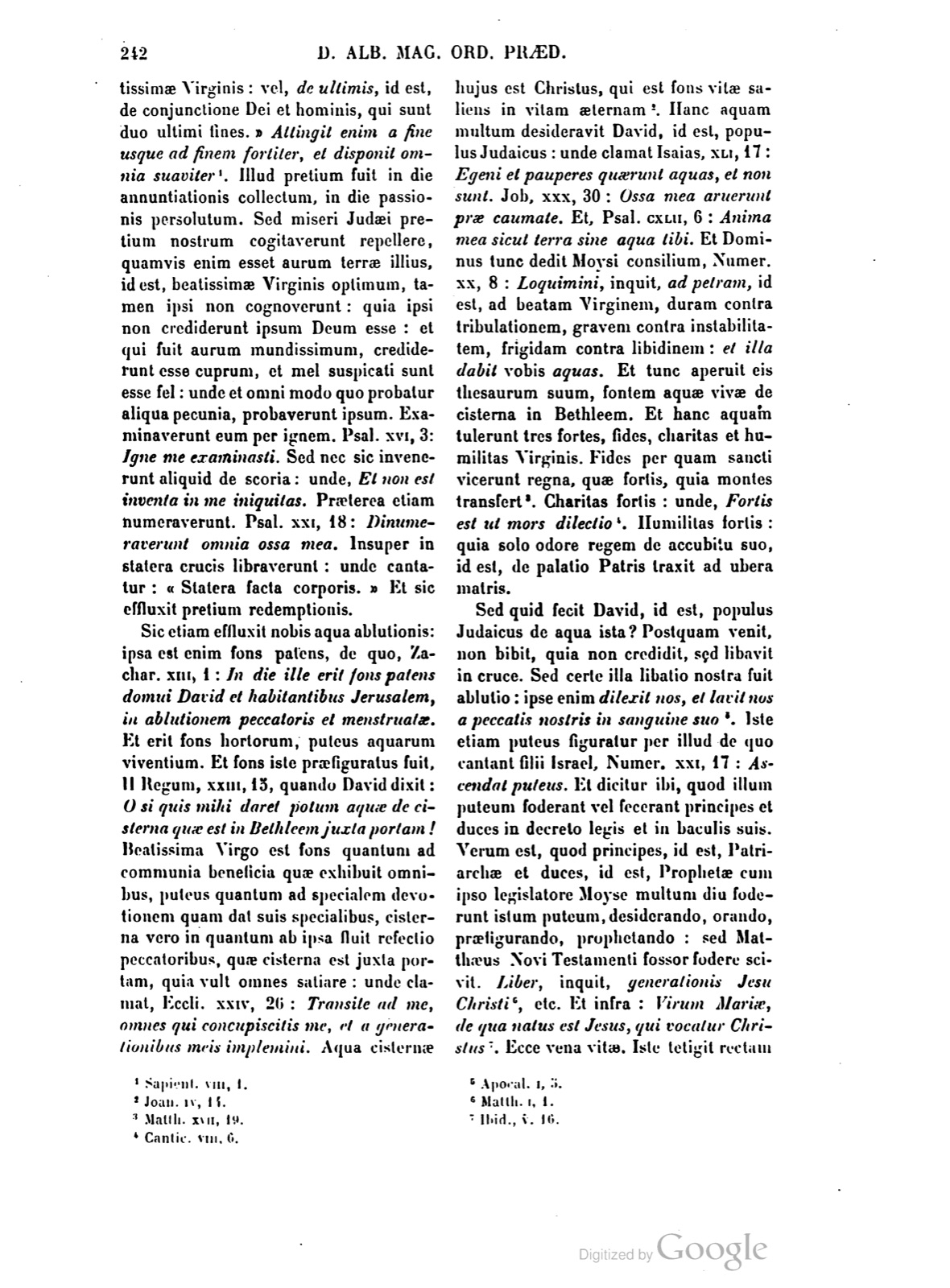
Sic etiam effluxit nobis aqua ablutionis: ipsa est enim fons patens, de quo, Zachar. XIII, 1: In die ille erit fons patens domui David et habitantibus Jerusalem, in ablutionem peccatoris et menstruatae. Et erit fons hortorum, puteus aquarum viventium. Et fons iste praefiguratus fuit, II Regum, XXIII, 15, quando David dixit: O si quis mihi daret potum aquae de cisterna quae est in Bethleem juxta portam! Beatissima Virgo est fons quantum ad communia beneficia quae exhibuit omnibus, puteus quantum ad specialem devotionem quam dat suis specialibus, cisterna vero in quantum ab ipsa fluit refectio peccatoribus, quae cisterna est juxta portam, quia vult omnes satiare: unde clamat, Eccli. XXIV, 26: Transite ad me, omnes qui concupiscitis me, et a generationibus meis implemini. Aqua cisternae hujus est Christus, qui est fons vitae saliens in vitam aeternam 9. Hanc aquam multum desideravit David, id est, populus Judaicus: unde clamat Isaias, XLI, 17: Egeni et pauperes quaerunt aquas, et non sunt. Job, XXX, 30: Ossa mea aruerunt prae caumate. Et, Psal. CXLII, 6: Anima mea sicut terra sine aqua tibi. Et Dominus tunc dedit Moysi consilium, Numer. XX, 8: Loquimini, inquit, ad petram, id est, ad beatam Virginem, duram contra tribulationem, gravem contra instabilitatem, frigidam contra libidinem: et illa dabit vobis aquas. Et tunc aperuit eis thesaurum suum, fontem aquae vivae de cisterna in Bethleem. Et hanc aquam tulerunt tres fortes, fides, charitas et humilitas Virginis. Fides per quam sancti vicerunt regna, quae fortis, quia montes transfert 10. Charitas fortis: unde, Fortis est ut mors dilectio 11. Humilitas fortis: quia solo odore regem de accubitu suo, id est, de palatio Patris traxit ad ubera matris.
Sed quid fecit David, id est, populus Judaicus de aqua ista? Postquam venit, non bibit, quia non credidit, sed libavit in cruce. Sed certe illa libatio nostra fuit ablutio: ipse enim dilexit nos, et lavit nos a peccatis nostris in sanguine suo 12. Iste etiam puteus figuratur per illud de quo cantant filii Israel, Numer. XXI, 17: Ascendat puteus. Et dicitur ibi, quod illum puteum foderant vel fecerant principes et duces in decreto legis et in baculis suis. Verum est, quod principes, id est, Patriarchae et duces, id est, Prophetae cum ipso legislatore Moyse multum diu foderunt istum puteum, desiderando, orando, praefigurando, prophetando: sed Matthaeus Novi Testamenti fossor fodere scivit. Liber, inquit, generationis Jesu Christi 13, etc. Et infra: Virum Mariae, de qua natus est Jesus, qui vocatur Christus 14. Ecce vena vitae. Iste tetigit rectam venam: quia, ut dicitur in Job, XXVIII, 1: Habet argentum venarum suarum principia. Et istud principium tetigit hic Matthaeus: ipsa enim protulit nobis fontem vitae, sicut optime figuratur in Genesi, II, 10, ubi legitur, quod fluvius egrediebatur de paradiso voluptatis, et dividebatur in quatuor flumina: quia de beata Virgine egressus est Dominus, qui effluit in nos illa quatuor maxima beneficia, a quibus derivantur omnia alia beneficia, scilicet generationis, recreationis, justificationis, et glorificationis. Et bene dicuntur flumina haec beneficia: quia contulerunt nobis quatuor quae solent flumina magna portare civitatibus per quas fluunt: flumen enim necessaria apportat, superflua deportat, sordes abluit, sitim exstinguit. Beneficium igitur creationis omnia necessaria apportavit, recreationis omnia detulit superflua, tunc enim hircus emissarius peccata populi detulit in desertum, sicut dicitur, Levit. XVI, 10. Nihil enim superfluum nisi peccatum. Beneficium justificationis omnia immunda abluit: quia Dominus abluit sordes filiarum Sion in spiritu judicii, et spiritu ardoris 15. Beneficium autem glorificationis omnem sitim exstinguit. Sitit enim omnis anima ad Deum fontem vivum. Et haec sitis numquam hic exstinguitur: quia hic non saturatur oculus visu, nec auris auditu, sicut dicitur, Eccle. I, 8: sed satiabimur cum apparuerit gloria ejus 16, quando de torrente voluptatis ejus potabimus 17. Haec sunt igitur quatuor flumina quae nobis profluunt ex plenitudine ista semper plena.
Thus also the water of washing flowed out to us. For she is the open fountain, of which Zechariah 13:1 says: On that day there will be an open fountain for the house of David and the inhabitants of Jerusalem, for the washing of the sinner and the menstruous woman. And she will be a fountain of gardens, a well of living waters. This fountain was prefigured in 2 Kings 23:15, when David said: O that someone would give me a drink of the water from the cistern which is in Bethlehem beside the gate! The most blessed Virgin is a fountain as to the common benefits which she displayed to all, a well as to the special devotion which she gives to her own special ones, and a cistern insofar as refreshment for sinners flows from her. This cistern is beside the gate, because she wishes to satisfy all; whence she cries, Ecclesiasticus 24:26: Come over to me, all you who desire me, and be filled from my generations. The water of this cistern is Christ, who is the fountain of life springing up into eternal life 9. David, that is, the Jewish people, greatly desired this water; whence Isaiah 41:17 cries: The needy and poor seek waters, and there are none. Job 30:30: My bones have dried up from heat. And Psalm 142:6: My soul is like earth without water to you. And then the Lord gave Moses counsel, Numbers 20:8: Speak, he says, to the rock, that is, to the blessed Virgin, hard against tribulation, weighty against instability, cold against lust, and she will give you waters. And then she opened to them her treasure, the fountain of living water from the cistern in Bethlehem. And three strong ones carried this water: the faith, charity, and humility of the Virgin. Faith, through which the saints conquered kingdoms, which is strong because it transfers mountains 10. Charity is strong; whence, Love is strong as death 11. Humility is strong, because by its scent alone it drew the king from his couch, that is, from the Father’s palace, to the mother’s breasts.
But what did David, that is, the Jewish people, do with that water? After it came, he did not drink, because he did not believe, but poured it out in libation on the cross. But surely that libation was our washing, for he loved us and washed us from our sins in his blood 12. This well is also figured by that about which the sons of Israel sing, Numbers 21:17: Let the well rise. And it is said there that princes and leaders dug or made that well by decree of the law and with their staves. It is true that the princes, that is, the Patriarchs, and the leaders, that is, the Prophets, with Moses the lawgiver himself, dug this well for a very long time by desiring, praying, prefiguring, and prophesying; but Matthew, the digger of the New Testament, knew how to dig. The book, he says, of the generation of Jesus Christ 13, etc. And below: The husband of Mary, of whom was born Jesus, who is called Christ 14. Behold the vein of life. He touched the straight vein, because, as is said in Job 28:1, silver has the beginnings of its veins. And Matthew here touched that beginning; for she brought forth for us the fountain of life, as is very well figured in Genesis 2:10, where it is read that a river went out from the paradise of pleasure and was divided into four rivers, because from the blessed Virgin went forth the Lord, who flows into us in those four greatest benefits from which all other benefits are derived, namely generation, recreation, justification, and glorification. And these benefits are well called rivers, because they bestowed on us the four things which great rivers are accustomed to bring to the cities through which they flow: for a river brings necessary things, carries away superfluous things, washes away filth, and extinguishes thirst. Therefore the benefit of creation brought all necessary things; that of recreation carried off all superfluous things, for then the emissary goat carried the sins of the people into the desert, as is said in Leviticus 16:10. For nothing is superfluous except sin. The benefit of justification washed away all unclean things, because the Lord washed away the filth of the daughters of Zion in the spirit of judgment and the spirit of burning 15. But the benefit of glorification extinguishes every thirst. For every soul thirsts for God, the living fountain. And this thirst is never extinguished here, because here the eye is not satisfied with sight nor the ear with hearing, as is said in Ecclesiastes 1:8; but we shall be satisfied when his glory appears 16, when we drink from the torrent of his pleasure 17. These therefore are the four rivers which flow forth for us from this fullness always full.
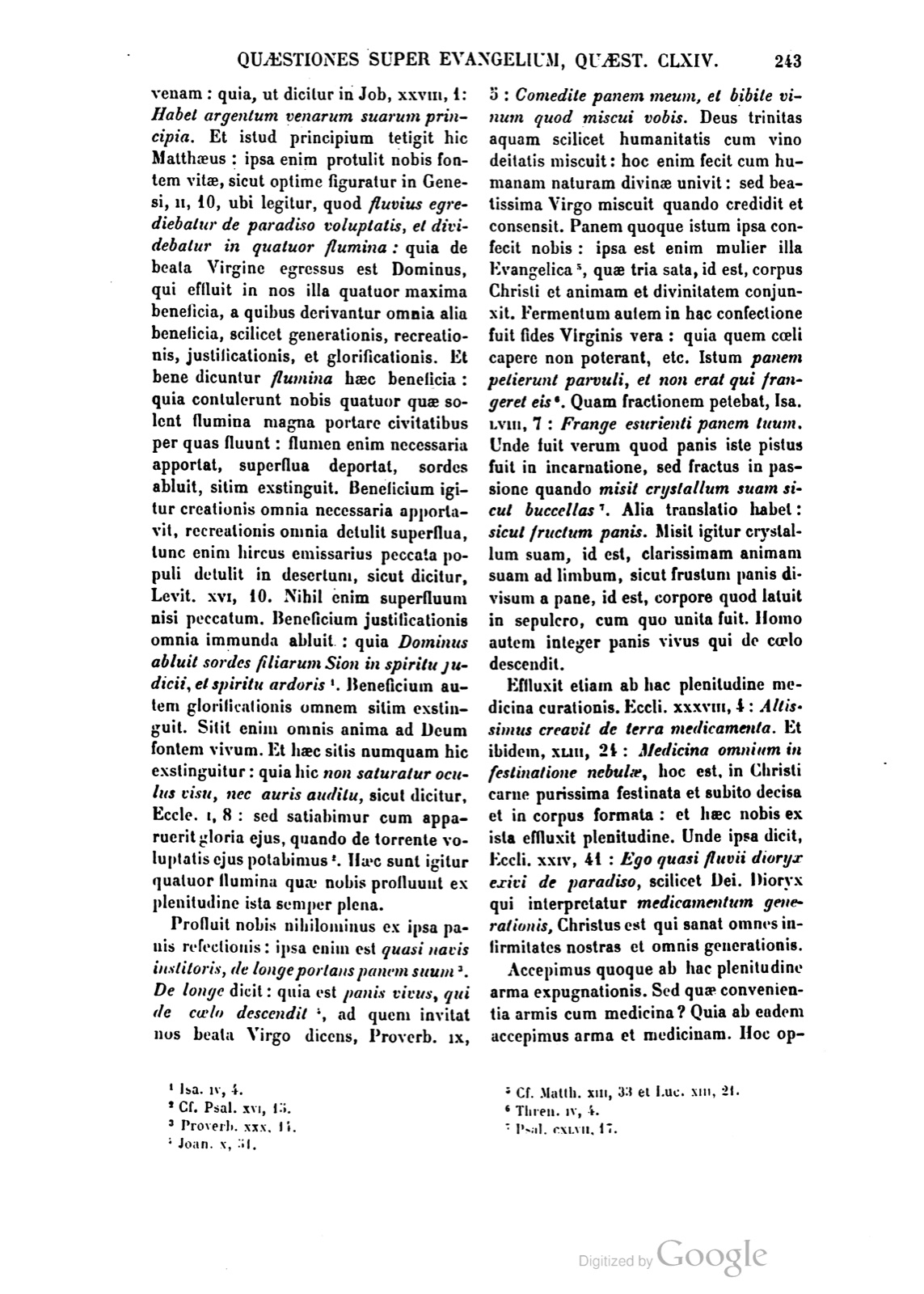
Profluit nobis nihilominus ex ipsa panis refectionis: ipsa enim est quasi navis institoris, de longe portans panem suum 18. De longe dicit: quia est panis vivus, qui de caelo descendit 19, ad quem invitat nos beata Virgo dicens, Proverb. IX, 5: Comedite panem meum, et bibite vinum quod miscui vobis. Deus trinitas aquam scilicet humanitatis cum vino deitatis miscuit: hoc enim fecit cum humanam naturam divinae univit: sed beatissima Virgo miscuit quando credidit et consensit. Panem quoque istum ipsa confecit nobis: ipsa est enim mulier illa Evangelica, quae tria sata, id est, corpus Christi et animam et divinitatem conjunxit 20. Fermentum autem in hac confectione fuit fides Virginis vera: quia quem caeli capere non poterant, etc. Istum panem petierunt parvuli, et non erat qui frangeret eis 21. Quam fractionem petebat, Isa. LVIII, 7: Frange esurienti panem tuum. Unde fuit verum quod panis iste pistus fuit in incarnatione, sed fractus in passione quando misit crystallum suam sicut buccellas 22. Alia translatio habet: sicut fructum panis. Misit igitur crystallum suam, id est, clarissimam animam suam ad limbum, sicut frustum panis divisum a pane, id est, corpore quod latuit in sepulcro, cum quo unita fuit. Homo autem integer panis vivus qui de caelo descendit.
Effluxit etiam ab hac plenitudine medicina curationis. Eccli. XXXVIII, 4: Altissimus creavit de terra medicamenta. Et ibidem, XLIII, 24: Medicina omnium in festinatione nebulae, hoc est, in Christi carne purissima festinata et subito decisa et in corpus formata: et haec nobis ex ista effluxit plenitudine. Unde ipsa dicit, Eccli. XXIV, 41: Ego quasi fluvii dioryx exivi de paradiso, scilicet Dei. Dioryx qui interpretatur medicamentum generationis, Christus est qui sanat omnes infirmitates nostras et omnis generationis.
Nevertheless from her flows for us the bread of refreshment. For she is like a merchant’s ship, bringing her bread from afar 18. It says from afar, because he is the living bread who came down from heaven 19, to whom the blessed Virgin invites us, saying, Proverbs 9:5: Eat my bread and drink the wine which I have mixed for you. God the Trinity mixed the water of humanity with the wine of deity, for he did this when he united human nature to the divine. But the most blessed Virgin mixed it when she believed and consented. She also prepared that bread for us: for she is that Gospel woman who joined three measures, that is, the body of Christ and the soul and divinity 20. But the leaven in this preparation was the true faith of the Virgin, because he whom the heavens could not contain, etc. The little ones asked for this bread, and there was no one to break it for them 21. Isaiah 58:7 was asking for this breaking: Break your bread for the hungry. Whence it was true that this bread was kneaded in the incarnation, but broken in the passion, when he sent his crystal like morsels 22. Another translation has: like the fruit of bread. Therefore he sent his crystal, that is, his brightest soul, to limbo, like a piece of bread divided from the bread, that is, from the body which lay hidden in the tomb, with which it was united. But the whole man is the living bread who came down from heaven.
From this fullness also flowed the medicine of healing. Ecclesiasticus 38:4: The Most High created medicines from the earth. And in the same book, 43:24: The medicine of all in the hastening of a cloud, that is, in Christ’s most pure flesh hastened and suddenly cut off and formed into a body; and this flowed to us from that fullness. Whence she says, Ecclesiasticus 24:41: I went out like a river-channel from paradise, namely of God. Dioryx, which is interpreted medicine of generation, is Christ, who heals all our infirmities and those of every generation.
Accepimus quoque ab hac plenitudine arma expugnationis. Sed quae convenientia armis cum medicina? Quia ab eadem accepimus arma et medicinam. Hoc optime figuratum est, III Regum, VII, 2, in domo saltus Libani quam aedificavit Salomon, ut explanat Magister in Historia. Domus illa in duas partes fuit distributa. Superior fuit pigmentaria, in qua fuerunt pigmenta et aromata ad usum templi. Altera fuit armaria ad tuitionem regis et decorem domus. Libanus candida est beata Virgo, quae tota candida, tota pulchra intus et extra, quam domum fecit sibi Salomon: quia sapientia aedificavit sibi domum 23, in qua fuit medicina contra vulnera peccatorum, arma contra mundum et diabolum.
In hac autem domo dicitur specialiter de scutis aureis quae fecit Salomon. Et quid signant illa scuta, nisi illud scutum quod petit Psalmista, Psal. XXXIV, 2: Apprehende arma et scutum, et exsurge in adjutorium mihi. Et Dominus ita fecit. Introibo, inquit, in admirabile tabernaculum: quia quem caeli capere non poterant, tuo gremio contulisti. Istud tabernaculum intravit, et se armavit, et ibi scutum induit bonae voluntatis, de quo Psalmista, Psal. V, 13: Scuto bonae voluntatis tuae, etc. Scutum bonae voluntatis suae ipse numquam in aliquo tantum ostendit quantum in nobis, in hoc quod assumpsit scutum istud, et factus est lucifer noster. Unde notabiliter dicit: Coronasti eos. Haec enim summa corona hominis ad alias coronas, quod vidit Deum ferentem scutum suum. Unde quod hic vocatur scutum, in libro Canticorum diadema appellatur, Cantic. III, 11: Egredimini et videte, filiae Sion, regem Salomonem in diademate quo coronavit illum mater sua. Glossa: « Virgo Maria. » Item, Alia Glossa super illud: In die desponsationis, dicit: « Tempore annuntiationis. » Scutum in pugna passionis in quinque locis fuit perforatum. Hujusmodi scuti insignia ferebat ille qui dicebat: Stigmata Domini Jesu in corpore meo porto 24. Est enim magna dignitas militis portare insignia regis. Unde, Esther, VI, 7 et seq.: Homo quem rex honorare cupit, debet indui vestibus regiis, et imponi super equum, qui de sella regis est, et accipere regium diadema super caput suum: et primus de regiis principibus ac tyrannis teneat equum ejus, et per plateam civitatis incedens clamet, et dicat: Sic honorabitur quemcumque voluerit rex honorare. Dominus igitur quando hominem honorare voluit, vestes regales ei induit, quando divinas proprietates ei communicavit: et e converso vestem servi induit, quando saccum nostrae mortalitatis sibi induit. Unde, I Regum, XVIII, 4: Exspoliavit se Jonathas tunica qua erat indutus, et dedit eam David, et reliqua vestimenta sua usque ad gladium et arcum suum, et usque ab balteum. Item, Super equum qui est de sella regis posuit hominem, quando corpus humilitatis nostrae corpori claritatis suae configuravit. Item, Diadema regis in capite hominis posuit, quando nos reges caelorum constituit. Unde, Apocal. XIX, 12, ille qui sedebat in equo, habuit in capite suo diademata multa. Multa procul dubio diademata habuit, qui cuilibet hominum unum dedit: et ipse tamen diademata nostra in capite suo habuit: quia nimirum in coronam gloriae suae convertitur, quod de patrimonio suo tot reges et reginas fecit. Unde in Apocalypsi, IV, 10, viginti quatuor seniores mittunt coronas suas ante sedentem in throno: quia omnes sancti per humilitatem Christi in humanitate recognoscunt se esse coronatos. Unde et mulier amicta sole, coronam stellarum duodecim in capite suo habuit 25: quia beatissima Virgo omnes sanctos coronavit. Principes autem cum equo per plateas civitatis nos ducunt, quando cum corporibus et animabus nos ad caelestia regna perducunt. Si igitur tantus est honor militis ferre insignia regis, quantae est dignitatis regem ferre insignia militis? quantae autem charitatis regem sibi reputare pro corona regni, quod fert scutum servi? In diademate, inquit, quo coronavit eum mater sua 26, Virgo Maria. Unde haec singularis mater singulariter filium coronavit, cum eum alia mater sic non coronavit, sed inhonoravit, et filium irae sibi generavit. Sed et ipse Filius e contrario solus matrem suam nascendo coronavit, cum ei foecunditatem matris contulit, et ejus virginitatem non abstulit, et esse matrem Dei et reginam misericordiae mox nascendo concessit.
We also received from this fullness weapons of assault. But what agreement do weapons have with medicine? Because from the same source we received weapons and medicine. This was very well figured in 3 Kings 7:2, in the house of the forest of Lebanon which Solomon built, as the Master explains in the History. That house was divided into two parts. The upper part was a storehouse of pigments, in which were pigments and aromatics for the use of the temple. The other was an armory for the protection of the king and the beauty of the house. White Lebanon is the blessed Virgin, wholly white, wholly beautiful within and without, which house Solomon made for himself, because wisdom built herself a house 23, in which there was medicine against the wounds of sinners, weapons against the world and the devil.
But in this house there is special mention of the golden shields which Solomon made. And what do those shields signify except that shield which the Psalmist asks for, Psalm 34:2: Take up arms and shield, and rise up to help me. And the Lord did so. I shall enter, he says, into the admirable tabernacle, because him whom the heavens could not contain, you bore in your womb. He entered that tabernacle, armed himself, and there put on the shield of good will, of which the Psalmist says, Psalm 5:13: With the shield of your good will, etc. He never showed the shield of his good will in anything as much as in us, in that he assumed that shield and became our morning star. Whence it notably says: You crowned them. For this is the highest crown of man beyond the other crowns, that he saw God bearing his shield. Whence what is here called a shield is called a diadem in the book of Canticles, Canticle 3:11: Go forth and see, daughters of Zion, king Solomon in the diadem with which his mother crowned him. The Gloss says: “The Virgin Mary.” Likewise, another Gloss on that phrase, On the day of his espousals, says: “At the time of the annunciation.” The shield was pierced in five places in the battle of the passion. He bore the insignia of this sort of shield who said: I bear the stigmata of the Lord Jesus in my body 24. For it is a great dignity for a soldier to bear the insignia of the king. Whence Esther 6:7 and following: The man whom the king wishes to honor ought to be clothed in royal garments, placed upon a horse from the king’s saddle, and receive a royal diadem upon his head; and the first of the royal princes and tyrants should hold his horse and, going through the street of the city, cry and say: Thus shall he be honored whom the king wishes to honor. Therefore when the Lord wished to honor man, he clothed him in royal garments when he communicated divine properties to him; and conversely he put on the garment of a servant when he put on for himself the sackcloth of our mortality. Whence 1 Kings 18:4: Jonathan stripped himself of the tunic with which he was clothed and gave it to David, and his remaining garments even to his sword and bow and even to his belt. Likewise, he placed man upon the horse from the king’s saddle when he conformed the body of our humility to the body of his brightness. Likewise, he placed the king’s diadem on man’s head when he established us as kings of the heavens. Whence in Apocalypse 19:12, the one who sat on the horse had many diadems on his head. Without doubt he had many diadems, who gave one to each human being; and nevertheless he had our diadems on his own head, because surely it is turned into the crown of his glory that from his patrimony he made so many kings and queens. Whence in Apocalypse 4:10 the twenty-four elders cast their crowns before the one sitting on the throne, because all the saints recognize that they have been crowned through the humility of Christ in humanity. Whence also the woman clothed with the sun had a crown of twelve stars on her head 25, because the most blessed Virgin crowned all the saints. But the princes with the horse lead us through the streets of the city when they lead us with bodies and souls to the heavenly kingdoms. If therefore it is so great an honor for a soldier to bear the insignia of the king, of how great dignity is it that the king bears the insignia of the soldier? And of how great charity is it that the king accounts it for himself as the crown of the kingdom that he bears the shield of a servant? In the diadem, it says, with which his mother crowned him 26, the Virgin Mary. Whence this singular mother singularly crowned her Son, since no other mother crowned him so, but dishonored him and generated for herself a son of wrath. But conversely the Son himself alone crowned his mother by being born, when he bestowed on her the fecundity of a mother and did not take away her virginity, and immediately by being born granted her to be Mother of God and queen of mercy.
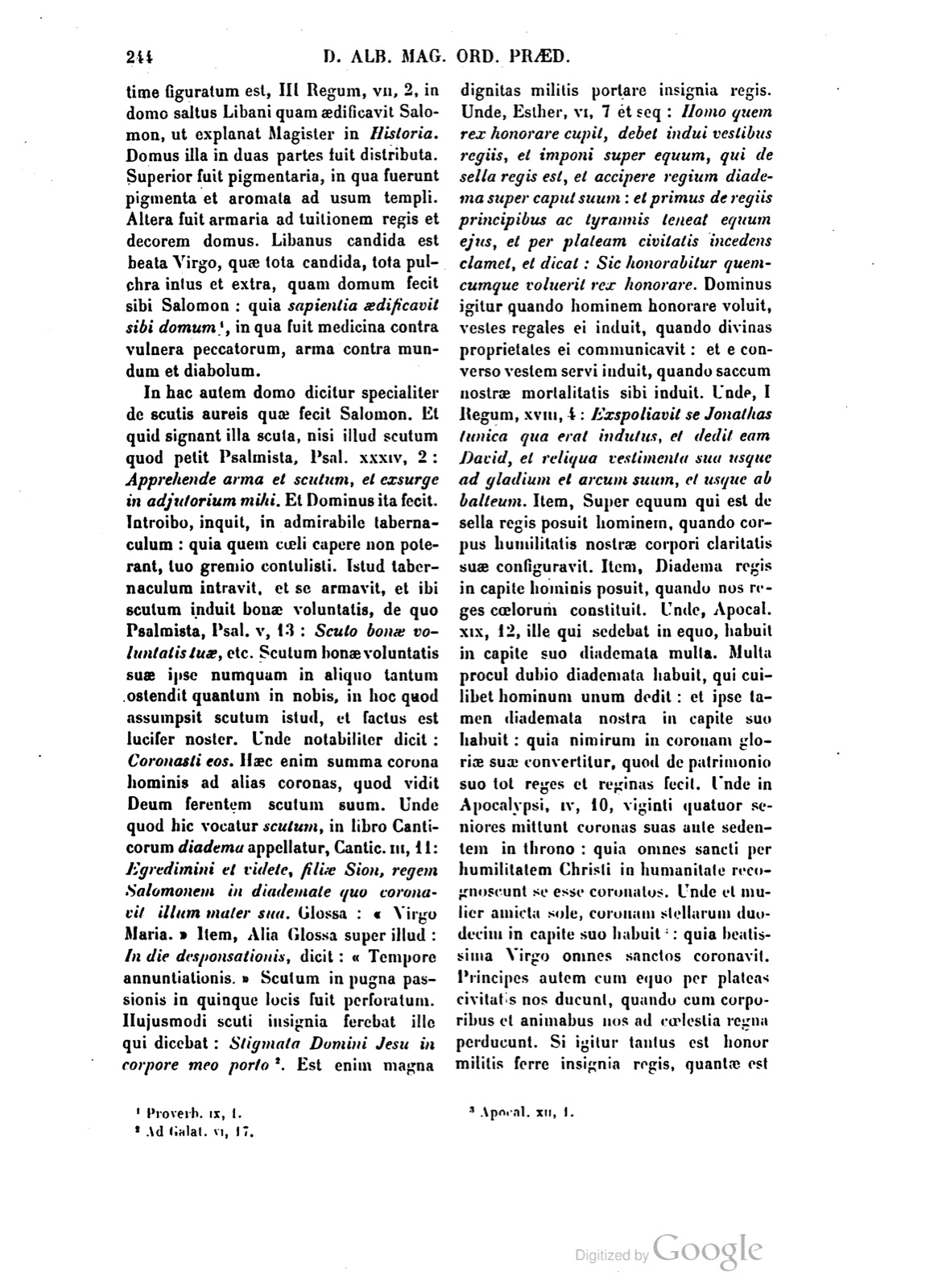
Patet igitur quae sunt arma et scutum quo nos Deus coronavit, et quae arma de ista plenitudine accepimus.
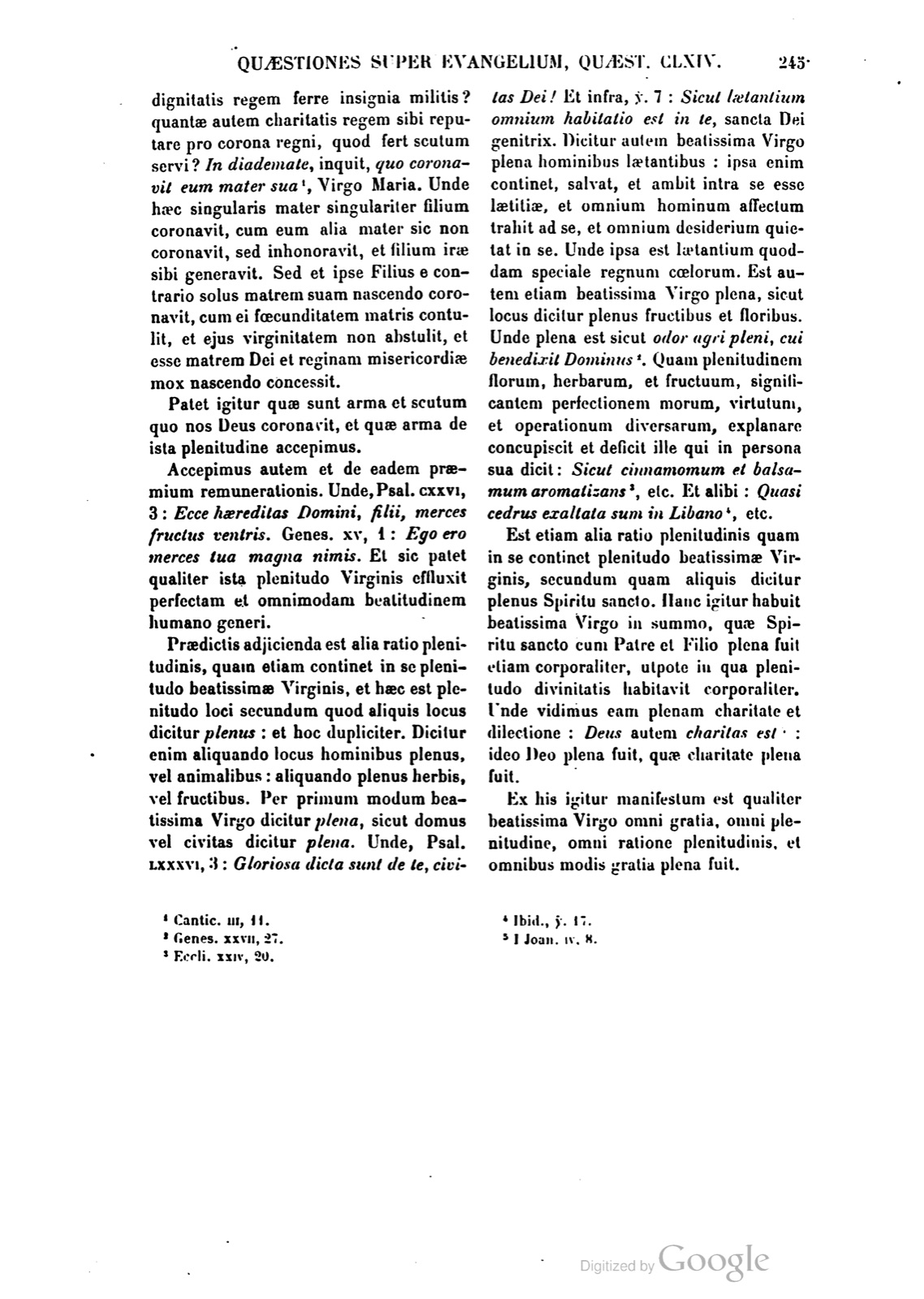
Accepimus autem et de eadem praemium remunerationis. Unde, Psal. CXXVI, 3: Ecce haereditas Domini, filii, merces fructus ventris. Genes. XV, 1: Ego ero merces tua magna nimis. Et sic patet qualiter ista plenitudo Virginis effluxit perfectam et omnimodam beatitudinem humano generi.
Praedictis adjicienda est alia ratio plenitudinis, quam etiam continet in se plenitudo beatissimae Virginis, et haec est plenitudo loci secundum quod aliquis locus dicitur plenus: et hoc dupliciter. Dicitur enim aliquando locus hominibus plenus, vel animalibus: aliquando plenus herbis, vel fructibus. Per primum modum beatissima Virgo dicitur plena, sicut domus vel civitas dicitur plena. Unde, Psal. LXXXVI, 3: Gloriosa dicta sunt de te, civitas Dei! Et infra, v. 7: Sicut laetantium omnium habitatio est in te, sancta Dei genitrix. Dicitur autem beatissima Virgo plena hominibus laetantibus: ipsa enim continet, salvat, et ambit intra se esse laetitiae, et omnium hominum affectum trahit ad se, et omnium desiderium quietat in se. Unde ipsa est laetantium quoddam speciale regnum caelorum. Est autem etiam beatissima Virgo plena, sicut locus dicitur plenus fructibus et floribus. Unde plena est sicut odor agri pleni, cui benedixit Dominus 27. Quam plenitudinem florum, herbarum, et fructuum, significantem perfectionem morum, virtutum, et operationum diversarum, explanare concupiscit et deficit ille qui in persona sua dicit: Sicut cinnamomum et balsamum aromatizans 28, etc. Et alibi: Quasi cedrus exaltata sum in Libano, etc.
Est etiam alia ratio plenitudinis quam in se continet plenitudo beatissimae Virginis, secundum quam aliquis dicitur plenus Spiritu sancto. Hanc igitur habuit beatissima Virgo in summo, quae Spiritu sancto cum Patre et Filio plena fuit etiam corporaliter, utpote in qua plenitudo divinitatis habitavit corporaliter. Unde vidimus eam plenam charitate et dilectione: Deus autem charitas est 29: ideo Deo plena fuit, quae charitate plena fuit.
Ex his igitur manifestum est qualiter beatissima Virgo omni gratia, omni plenitudine, omni ratione plenitudinis, et omnibus modis gratia plena fuit.
Therefore it is clear what the weapons and shield are by which God crowned us, and what weapons we received from this fullness.
But from the same fullness we also received the reward of remuneration. Whence Psalm 126:3: Behold, sons are the inheritance of the Lord, the reward of the fruit of the womb. Genesis 15:1: I will be your exceedingly great reward. And thus it is clear how this fullness of the Virgin flowed out as perfect and every-mode beatitude for the human race.
To the aforesaid must be added another account of fullness, which the fullness of the most blessed Virgin also contains in itself, and this is fullness of place, according as some place is called full; and this in two ways. For sometimes a place is called full of human beings or animals, sometimes full of plants or fruits. In the first way the most blessed Virgin is called full, as a house or city is called full. Whence Psalm 86:3: Glorious things are said of you, city of God! And below, verse 7: As the dwelling of all who rejoice is in you, holy Mother of God. But the most blessed Virgin is called full of rejoicing human beings, for she contains, saves, and embraces within herself the being of joy, and draws to herself the affection of all human beings, and quiets in herself the desire of all. Whence she is a certain special kingdom of heaven for those who rejoice. The most blessed Virgin is also full as a place is called full of fruits and flowers. Whence she is full like the scent of a full field which the Lord has blessed 27. He who says in her person, Like cinnamon and aromatic balm 28, etc., and elsewhere, Like a cedar I was exalted in Lebanon, etc., desires and fails to explain this fullness of flowers, herbs, and fruits, signifying perfection of morals, virtues, and diverse operations.
There is also another account of fullness which the fullness of the most blessed Virgin contains in itself, according to which someone is said to be full of the Holy Spirit. Therefore the most blessed Virgin had this in the highest degree, since she was full of the Holy Spirit with the Father and the Son even bodily, as one in whom the fullness of divinity dwelt bodily. Whence we saw her full of charity and love; but God is charity 29. Therefore she who was full of charity was full of God.
From these things therefore it is manifest how the most blessed Virgin was full of every grace, every fullness, every account of fullness, and full of grace in every way.
Notes
- St. Bernard, Sermon on the Nativity of the Blessed Virgin Mary. (S. Bernardus, Serm. in Nativitate B. Mariae Virg.) ↩
- Ecclesiastes 1:7. (Eccle. I, 7.) ↩
- Canticle 4:12. (Cantic. IV, 12.) ↩
- Ezekiel 44:2. (Ezechiel. XLIV, 2.) ↩
- Esther 10:6 and 11:10. (Esther, X, 6 et XI, 10.) ↩
- Colossians 2:3. (Ad Coloss. II, 3.) ↩
- Psalm 1:1. (Psal. I, 1.) ↩
- Wisdom 8:1. (Sapient. VIII, 1.) ↩
- John 4:14. (Joan. IV, 14.) ↩
- Matthew 17:19. (Matth. XVII, 19.) ↩
- Canticle 8:6. (Cantic. VIII, 6.) ↩
- Apocalypse 1:5. (Apocal. I, 5.) ↩
- Matthew 1:1. (Matth. I, 1.) ↩
- Ibid., verse 16. (Ibid., v. 16.) ↩
- Isaiah 4:4. (Isa. IV, 4.) ↩
- Cf. Psalm 16:15. (Cf. Psal. XVI, 15.) ↩
- Cf. Psalm 35:9. (Cf. Psal. XXXV, 9.) ↩
- Proverbs 31:14. (Proverb. XXXI, 14.) ↩
- John 6:51. (Joan. VI, 51.) ↩
- Cf. Matthew 13:33 and Luke 13:21. (Cf. Matth. XIII, 33 et Luc. XIII, 21.) ↩
- Lamentations 4:4. (Thren. IV, 4.) ↩
- Psalm 147:17. (Psal. CXLVII, 17.) ↩
- Proverbs 9:1. (Proverb. IX, 1.) ↩
- Galatians 6:17. (Ad Galat. VI, 17.) ↩
- Apocalypse 12:1. (Apocal. XII, 1.) ↩
- Canticle 3:11. (Cantic. III, 11.) ↩
- Genesis 27:27. (Genes. XXVII, 27.) ↩
- Ecclesiasticus 24:20. (Eccli. XXIV, 20.) ↩
- 1 John 4:8. (I Joan. IV, 8.) ↩
If a page does not appear, its photograph has not been uploaded yet.