Works › The Mariale: Questions on “Missus est”
Volume 37 · pp. 237–240
Question 163. Whether the Blessed Virgin had sufficiency of privileges?
A marker with ≈ is an approximate page boundary, placed by measure of the text; the page photographs remain the authority. In the paired views, clicking a page marker brings that page into view.
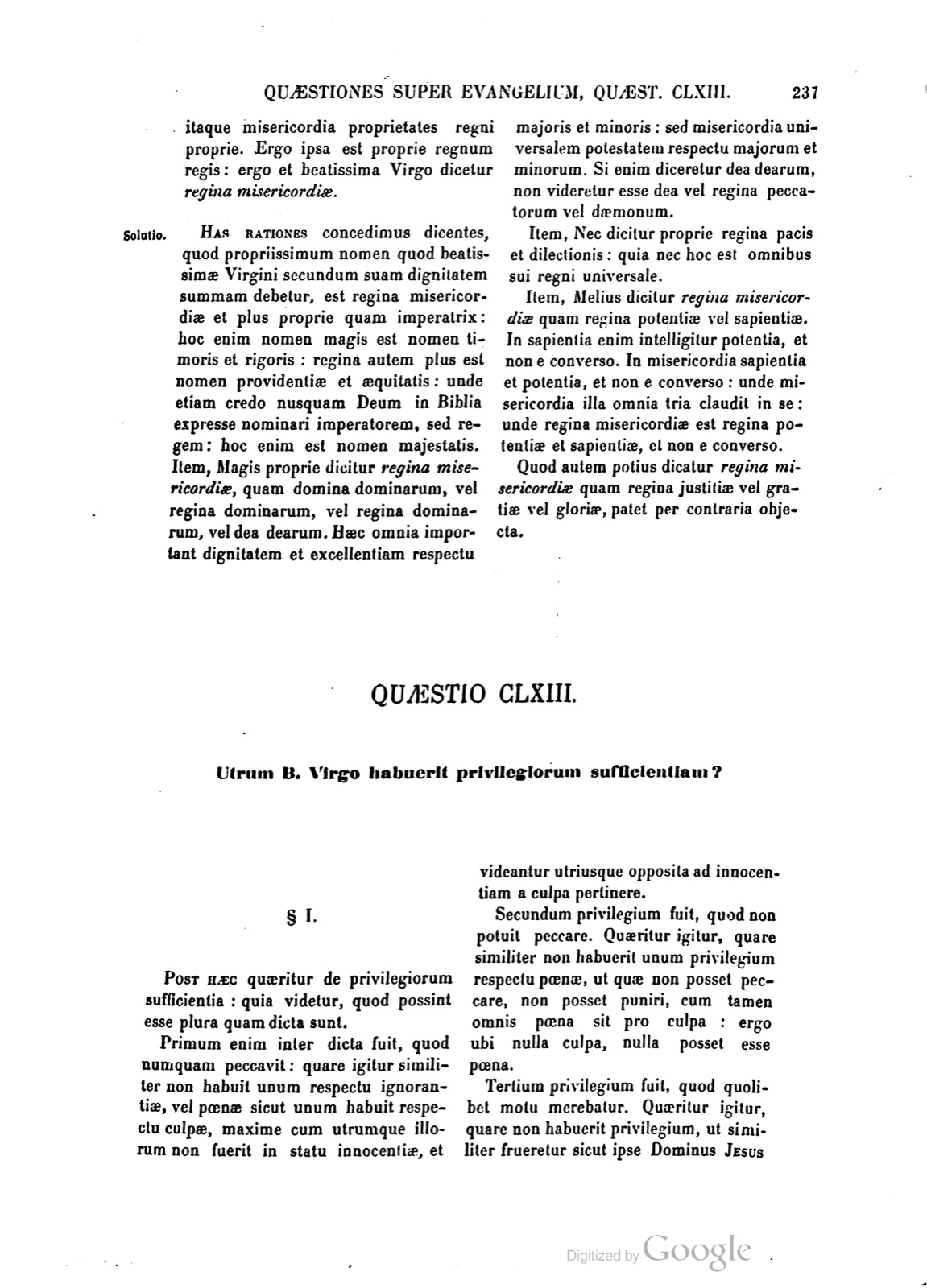
QUAESTIO CLXIII. Utrum B. Virgo habuerit privilegiorum sufficientiam?
§ I.
Post haec quaeritur de privilegiorum sufficientia: quia videtur, quod possint esse plura quam dicta sunt.
Primum enim inter dicta fuit, quod numquam peccavit: quare igitur similiter non habuit unum respectu ignorantiae, vel poenae sicut unum habuit respectu culpae, maxime cum utrumque illorum non fuerit in statu innocentiae, et videantur utriusque opposita ad innocentiam a culpa pertinere.
Secundum privilegium fuit, quod non potuit peccare. Quaeritur igitur, quare similiter non habuerit unum privilegium respectu poenae, ut quae non posset peccare, non posset puniri, cum tamen omnis poena sit pro culpa: ergo ubi nulla culpa, nulla posset esse poena.
Tertium privilegium fuit, quod quolibet motu merebatur. Quaeritur igitur, quare non habuerit privilegium, ut similiter frueretur sicut ipse Dominus Jesus Christus, qui similiter unitus fuit carni mortali?
Quartum privilegium fuit puritas in summo. Cum igitur triplex sit actus hierarchiae, purgare, illuminare, et perficere, et beatissima Virgo habuit privilegium respectu purgationis: ergo debuit habere alia duo, unum respectu illuminationis, aliud respectu perfectionis.
Quintum privilegium fuit Virgo virginum. Cum autem beatissima fuerit, et virgo, et mater, et conjugata, et viduata, et habuerit unum privilegium respectu virginum, videtur quod debuit alia tria habere respectu conjugatarum, matrum et viduarum.
Sextum privilegium fuit mater Dei. Et constat, quod similiter fuit filia Dei, et sponsa Dei, et multa consimilia: ergo respectu eorum debuit habere privilegia multa.
Septimum privilegium fuit mater omnium. Quare similiter non habuit privilegium unum, quod esset soror et filia omnium, vel saltem, quod esset domina omnium?
Octavum privilegium fuit stella maris. Illud habuit beatissima Virgo respectu maris pro privilegio: ergo et aliud debuit habere respectu ignis, et unum respectu aeris, et unum respectu terrae.
Nonum privilegium fuit porta caeli. Si respectu portae habuit unum privilegium, ergo eadem ratione respectu fundamenti vel parietum deberet habere unum privilegium, ut dicatur lapis angularis vel aliquid hujusmodi.
Decimum privilegium fuit passionis communicatio. Cum igitur privilegium habuerit respectu passionis, etiam habebit aliud respectu actionis, cum actio sit nobilior passione.
Undecimum privilegium fuit exaltatio. Et si unum habuit respectu ardui: ergo alia duo habebit respectu veri et respectu boni.
QUESTION 163. Whether the Blessed Virgin had sufficiency of privileges?
§ I.
After this inquiry is made concerning the sufficiency of the privileges, because it seems that there can be more than have been stated.
For the first among those stated was that she never sinned. Why therefore did she not similarly have one with respect to ignorance or punishment, just as she had one with respect to fault, especially since neither of those two was in the state of innocence, and the opposites of both seem to pertain to innocence from fault?
The second privilege was that she could not sin. Therefore it is asked why she similarly did not have one privilege with respect to punishment, so that she who could not sin could not be punished, since nevertheless every punishment is for fault. Therefore where there was no fault, there could be no punishment.
The third privilege was that she merited by every movement. Therefore it is asked why she did not have the privilege that she should similarly enjoy fruition as the Lord Jesus Christ himself did, who was similarly united to mortal flesh.
The fourth privilege was purity in the highest degree. Since therefore the act of hierarchy is threefold, to purge, to illuminate, and to perfect, and the most blessed Virgin had a privilege with respect to purgation, therefore she ought to have had the other two, one with respect to illumination, another with respect to perfection.
The fifth privilege was Virgin of virgins. But since the most blessed one was virgin, mother, married woman, and widow, and had one privilege with respect to virgins, it seems that she ought to have had three others with respect to married women, mothers, and widows.
The sixth privilege was mother of God. And it is clear that she was similarly daughter of God, spouse of God, and many similar things. Therefore with respect to these she ought to have had many privileges.
The seventh privilege was mother of all. Why similarly did she not have one privilege, that she was sister and daughter of all, or at least that she was lady of all?
The eighth privilege was star of the sea. The most blessed Virgin had that as a privilege with respect to the sea; therefore she ought also to have another with respect to fire, and one with respect to air, and one with respect to earth.
The ninth privilege was gate of heaven. If with respect to a gate she had one privilege, then by the same reasoning with respect to the foundation or walls she ought to have had one privilege, so that she might be called cornerstone or something of this sort.
The tenth privilege was sharing in the passion. Since therefore she had a privilege with respect to passion, she will also have another with respect to action, since action is nobler than passion.
The eleventh privilege was exaltation. And if she had one with respect to the arduous, then she will have the other two with respect to the true and with respect to the good.
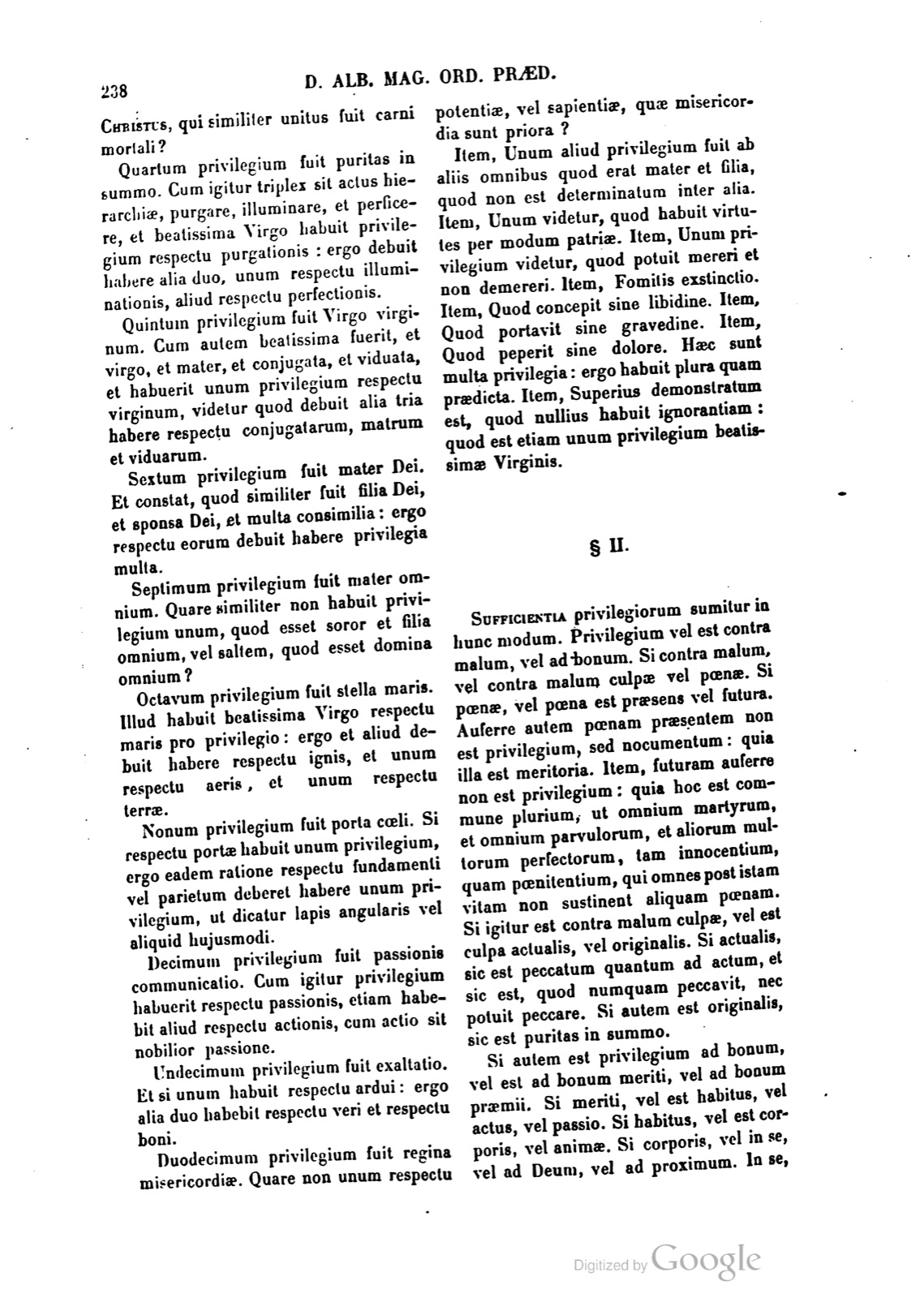
Duodecimum privilegium fuit regina misericordiae. Quare non unum respectu potentiae, vel sapientiae, quae misericordia sunt priora?
Item, Unum aliud privilegium fuit ab aliis omnibus quod erat mater et filia, quod non est determinatum inter alia. Item, Unum videtur, quod habuit virtutes per modum patriae. Item, Unum privilegium videtur, quod potuit mereri et non demereri. Item, Fomitis exstinctio. Item, Quod concepit sine libidine. Item, Quod portavit sine gravedine. Item, Quod peperit sine dolore. Haec sunt multa privilegia: ergo habuit plura quam praedicta. Item, Superius demonstratum est, quod nullius habuit ignorantiam: quod est etiam unum privilegium beatissimae Virginis.
§ II.
Sufficientia privilegiorum sumitur in hunc modum. Privilegium vel est contra malum, vel ad bonum. Si contra malum, vel contra malum culpae vel poenae. Si poenae, vel poena est praesens vel futura. Auferre autem poenam praesentem non est privilegium, sed nocumentum: quia illa est meritoria. Item, futuram auferre non est privilegium: quia hoc est commune plurium, ut omnium martyrum, et omnium parvulorum, et aliorum multorum perfectorum, tam innocentium, quam poenitentium, qui omnes post istam vitam non sustinent aliquam poenam. Si igitur est contra malum culpae, vel est culpa actualis, vel originalis. Si actualis, sic est peccatum quantum ad actum, et sic est, quod numquam peccavit, nec potuit peccare. Si autem est originalis, sic est puritas in summo.
Si autem est privilegium ad bonum, vel est ad bonum meriti, vel ad bonum praemii. Si meriti, vel est habitus, vel actus, vel passio. Si habitus, vel est corporis, vel animae. Si corporis, vel in se, vel ad Deum, vel ad proximum. In se, sic est virgo mater. Ad Deum, sic est mater Dei. Si ad proximum, sic est Virgo virginum. Si autem est habitus animae, vel est intellectus, vel affectus. Si intellectus, sic est nullius ignorantia. Si affectus, vel ad Deum, vel ad proximum. Si ad Deum, sic est puritas in summo. Si ad proximum, sic est mater omnium. Si autem privilegium est actus, vel est in se, vel ad proximum. Si in se, sic quolibet motu merebatur. Si ad proximum, vel est exemplum, et sic est stella maris: vel ad auxilium, sic est porta caeli. Si autem privilegium est passio, sic est passionis communicatio. Si autem pertinet ad praemium, vel hoc quantum ad rem, et sic est super omnes creaturas exaltatio: vel quantum ad nomen, et sic est regina misericordiae.
The twelfth privilege was queen of mercy. Why not one with respect to power or wisdom, which are prior to mercy?
Likewise, one other privilege apart from all the others was that she was mother and daughter, which is not determined among the others. Likewise, one seems to be that she had virtues according to the mode of the homeland. Likewise, one privilege seems to be that she could merit and not demerit. Likewise, extinction of the fomes. Likewise, that she conceived without lust. Likewise, that she carried without heaviness. Likewise, that she gave birth without pain. These are many privileges; therefore she had more than the aforesaid. Likewise, it was demonstrated above that she had ignorance of nothing, which is also one privilege of the most blessed Virgin.
§ II.
The sufficiency of the privileges is taken in this way. A privilege is either against evil or toward good. If against evil, it is either against the evil of fault or of punishment. If of punishment, either the punishment is present or future. But to remove present punishment is not a privilege but harm, because that punishment is meritorious. Likewise, to remove future punishment is not a privilege, because this is common to many, such as all martyrs, and all little children, and many other perfect persons, both innocent and penitent, all of whom after this life sustain no punishment. Therefore if it is against the evil of fault, the fault is either actual or original. If actual, so is sin as to act, and thus she never sinned and could not sin. But if it is original, thus there is purity in the highest degree.
But if it is a privilege toward good, it is either toward the good of merit or toward the good of reward. If of merit, it is either habit, act, or passion. If habit, it is either of body or of soul. If of body, either in itself, toward God, or toward neighbor. In itself, thus she is virgin mother. Toward God, thus she is mother of God. If toward neighbor, thus she is Virgin of virgins. But if it is habit of soul, it is either intellect or affection. If intellect, thus there is ignorance of nothing. If affection, either toward God or toward neighbor. If toward God, thus there is purity in the highest degree. If toward neighbor, thus she is mother of all. But if the privilege is act, it is either in itself or toward neighbor. If in itself, thus she merited by every movement. If toward neighbor, either it is example, and thus she is star of the sea; or it is toward help, and thus she is gate of heaven. But if the privilege is passion, thus there is sharing in the passion. But if it pertains to reward, either this is as to the thing, and thus there is exaltation above all creatures, or as to the name, and thus she is queen of mercy.
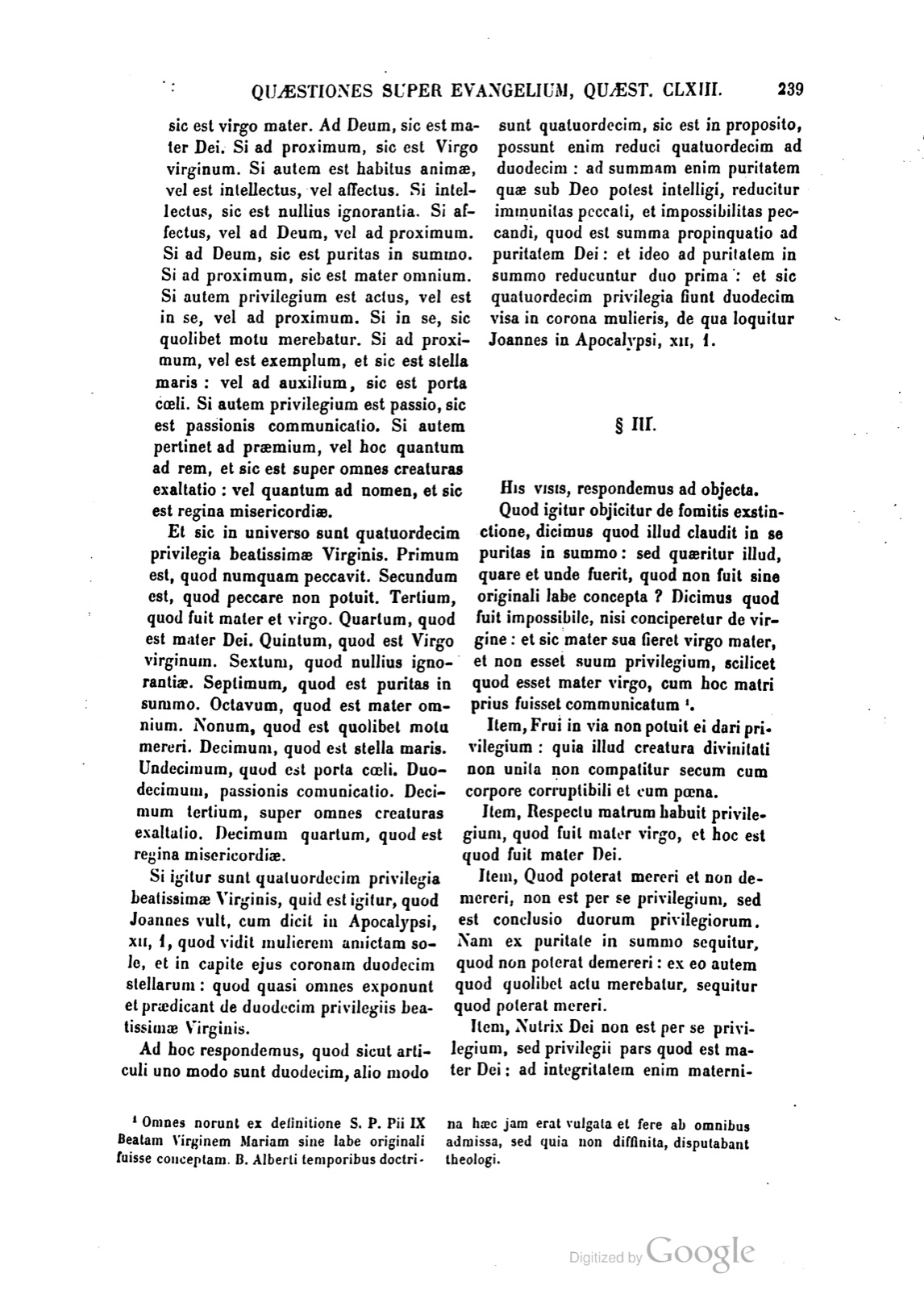
Et sic in universo sunt quatuordecim privilegia beatissimae Virginis. Primum est, quod numquam peccavit. Secundum est, quod peccare non potuit. Tertium, quod fuit mater et virgo. Quartum, quod est mater Dei. Quintum, quod est Virgo virginum. Sextum, quod nullius ignorantiae. Septimum, quod est puritas in summo. Octavum, quod est mater omnium. Nonum, quod est quolibet motu mereri. Decimum, quod est stella maris. Undecimum, quod est porta caeli. Duodecimum, passionis communicatio. Decimum tertium, super omnes creaturas exaltatio. Decimum quartum, quod est regina misericordiae.
Si igitur sunt quatuordecim privilegia beatissimae Virginis, quid est igitur, quod Joannes vult, cum dicit in Apocalypsi, XII, 1, quod vidit mulierem amictam sole, et in capite ejus coronam duodecim stellarum: quod quasi omnes exponunt et praedicant de duodecim privilegiis beatissimae Virginis.
Ad hoc respondemus, quod sicut articuli uno modo sunt duodecim, alio modo sunt quatuordecim, sic est in proposito, possunt enim reduci quatuordecim ad duodecim: ad summam enim puritatem quae sub Deo potest intelligi, reducitur immunitas peccati, et impossibilitas peccandi, quod est summa propinquatio ad puritatem Dei: et ideo ad puritatem in summo reducuntur duo prima: et sic quatuordecim privilegia fiunt duodecim visa in corona mulieris, de qua loquitur Joannes in Apocalypsi, XII, 1.
§ III.
His visis, respondemus ad objecta.
Quod igitur objicitur de fomitis exstinctione, dicimus quod illud claudit in se puritas in summo: sed quaeritur illud, quare et unde fuerit, quod non fuit sine originali labe concepta? Dicimus quod fuit impossibile, nisi conciperetur de virgine: et sic mater sua fieret virgo mater, et non esset suum privilegium, scilicet quod esset mater virgo, cum hoc matri prius fuisset communicatum 1.
Item, Frui in via non potuit ei dari privilegium: quia illud creatura divinitati non unita non compatitur secum cum corpore corruptibili et cum poena.
Item, Respectu matrum habuit privilegium, quod fuit mater virgo, et hoc est quod fuit mater Dei.
Item, Quod poterat mereri et non demereri, non est per se privilegium, sed est conclusio duorum privilegiorum. Nam ex puritate in summo sequitur, quod non poterat demereri: ex eo autem quod quolibet actu merebatur, sequitur quod poterat mereri.
And thus in the whole there are fourteen privileges of the most blessed Virgin. The first is that she never sinned. The second is that she could not sin. The third, that she was mother and virgin. The fourth, that she is mother of God. The fifth, that she is Virgin of virgins. The sixth, that she is of no ignorance. The seventh, that she is purity in the highest degree. The eighth, that she is mother of all. The ninth, that she merits by every movement. The tenth, that she is star of the sea. The eleventh, that she is gate of heaven. The twelfth, sharing in the passion. The thirteenth, exaltation above all creatures. The fourteenth, that she is queen of mercy.
If therefore there are fourteen privileges of the most blessed Virgin, what then does John mean when he says in Apocalypse 12:1 that he saw a woman clothed with the sun, and on her head a crown of twelve stars, which almost all expound and proclaim concerning the twelve privileges of the most blessed Virgin?
To this we respond that, just as the articles in one way are twelve and in another way are fourteen, so it is in the proposed matter; for fourteen can be reduced to twelve. For to the highest purity which can be understood under God are reduced immunity from sin and impossibility of sinning, which is the highest nearness to the purity of God. And therefore the first two are reduced to purity in the highest degree; and thus the fourteen privileges become the twelve seen in the crown of the woman of whom John speaks in Apocalypse 12:1.
§ III.
Having seen these things, we respond to the objections.
Therefore as to what is objected concerning extinction of the fomes, we say that purity in the highest degree encloses that in itself. But that is asked: why and whence was it that she was not conceived without original stain? We say that it was impossible unless she were conceived from a virgin, and thus her mother would become virgin mother, and it would not be her own privilege, namely that she would be mother virgin, since this had first been communicated to her mother 1.
Likewise, fruition on the way could not be given to her as a privilege, because a creature not united to divinity does not allow this together with itself with a corruptible body and with punishment.
Likewise, with respect to mothers she had the privilege that she was virgin mother, and this is that she was mother of God.
Likewise, that she could merit and not demerit is not a privilege through itself, but is the conclusion of two privileges. For from purity in the highest degree it follows that she could not demerit; but from the fact that she merited by every act, it follows that she could merit.
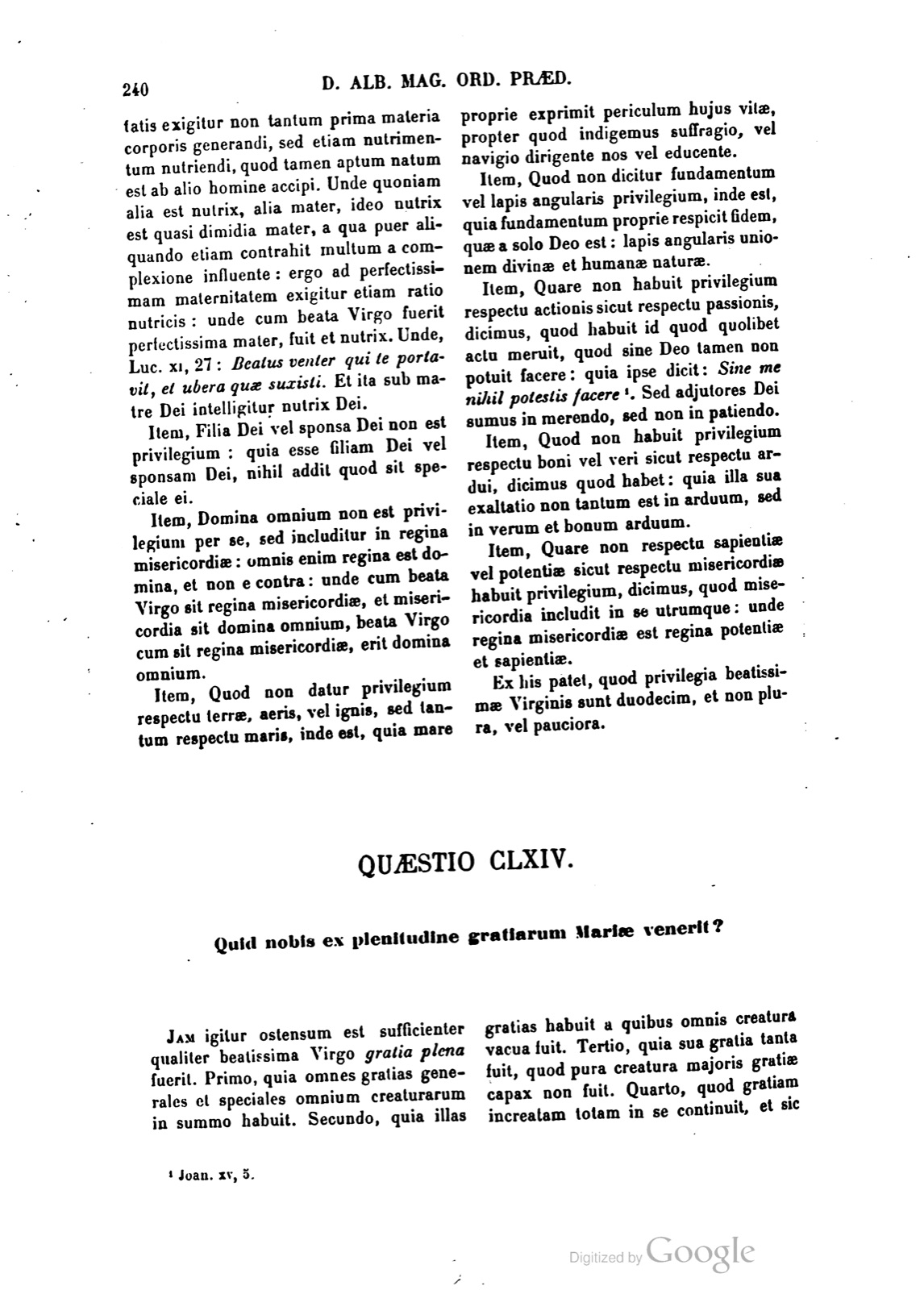
Item, Nutrix Dei non est per se privilegium, sed privilegii pars quod est mater Dei: ad integritatem enim maternitatis exigitur non tantum prima materia corporis generandi, sed etiam nutrimentum nutriendi, quod tamen aptum natum est ab alio homine accipi. Unde quoniam alia est nutrix, alia mater, ideo nutrix est quasi dimidia mater, a qua puer aliquando etiam contrahit multum a complexione influente: ergo ad perfectissimam maternitatem exigitur etiam ratio nutricis: unde cum beata Virgo fuerit perfectissima mater, fuit et nutrix. Unde, Luc. XI, 27: Beatus venter qui te portavit, et ubera quae suxisti. Et ita sub matre Dei intelligitur nutrix Dei.
Item, Filia Dei vel sponsa Dei non est privilegium: quia esse filiam Dei vel sponsam Dei, nihil addit quod sit speciale ei.
Item, Domina omnium non est privilegium per se, sed includitur in regina misericordiae: omnis enim regina est domina, et non e contra: unde cum beata Virgo sit regina misericordiae, et misericordia sit domina omnium, beata Virgo cum sit regina misericordiae, erit domina omnium.
Item, Quod non datur privilegium respectu terrae, aeris, vel ignis, sed tantum respectu maris, inde est, quia mare proprie exprimit periculum hujus vitae, propter quod indigemus suffragio, vel navigio dirigente nos vel educente.
Item, Quod non dicitur fundamentum vel lapis angularis privilegium, inde est, quia fundamentum proprie respicit fidem, quae a solo Deo est: lapis angularis unionem divinae et humanae naturae.
Item, Quare non habuit privilegium respectu actionis sicut respectu passionis, dicimus, quod habuit id quod quolibet actu meruit, quod sine Deo tamen non potuit facere: quia ipse dicit: Sine me nihil potestis facere 2. Sed adjutores Dei sumus in merendo, sed non in patiendo.
Item, Quod non habuit privilegium respectu boni vel veri sicut respectu ardui, dicimus quod habet: quia illa sua exaltatio non tantum est in arduum, sed in verum et bonum arduum.
Item, Quare non respectu sapientiae vel potentiae sicut respectu misericordiae habuit privilegium, dicimus, quod misericordia includit in se utrumque: unde regina misericordiae est regina potentiae et sapientiae.
Ex his patet, quod privilegia beatissimae Virginis sunt duodecim, et non plura, vel pauciora.
Likewise, nurse of God is not a privilege through itself, but part of the privilege which is mother of God. For to the integrity of motherhood is required not only the first matter of the body to be generated, but also nourishment for the one to be nourished, which nevertheless is apt by nature to be received from another human being. Whence since one woman is nurse, another mother, therefore a nurse is as it were a half-mother, from whom a child also sometimes contracts much from the complexion being influenced. Therefore the notion of nurse also is required for the most perfect motherhood. Whence since the blessed Virgin was the most perfect mother, she was also nurse. Whence Luke 11:27: Blessed is the womb that bore you, and the breasts which you sucked. And thus under mother of God, nurse of God is understood.
Likewise, daughter of God or spouse of God is not a privilege, because to be daughter of God or spouse of God adds nothing that is special to her.
Likewise, lady of all is not a privilege through itself, but is included in queen of mercy. For every queen is lady, and not conversely. Whence since the blessed Virgin is queen of mercy, and mercy is lady of all, the blessed Virgin, since she is queen of mercy, will be lady of all.
Likewise, that a privilege is not given with respect to earth, air, or fire, but only with respect to sea, is because sea properly expresses the danger of this life, on account of which we need suffrage, or a ship directing or leading us out.
Likewise, that foundation or cornerstone is not called a privilege is because foundation properly regards faith, which is from God alone; cornerstone regards the union of divine and human nature.
Likewise, as to why she did not have a privilege with respect to action as with respect to passion, we say that she had this, that by every act she merited, which nevertheless she could not do without God, because he says: Without me you can do nothing 2. But we are helpers of God in meriting, but not in suffering.
Likewise, as to the fact that she did not have a privilege with respect to the good or the true as with respect to the arduous, we say that she does have it, because that exaltation of hers is not only into the arduous, but into the true and good arduous.
Likewise, as to why she did not have a privilege with respect to wisdom or power as with respect to mercy, we say that mercy includes both in itself. Whence queen of mercy is queen of power and wisdom.
From these things it is clear that the privileges of the most blessed Virgin are twelve, and not more or fewer.
Notes
- All know from the definition of His Holiness Pius IX that the Blessed Virgin Mary was conceived without original stain. In the times of Blessed Albert this doctrine was already widely spread and admitted by almost all, but because it had not been defined, theologians disputed. (Omnes norunt ex definitione S. P. Pii IX Beatam Virginem Mariam sine labe originali fuisse conceptam. B. Alberti temporibus doctrina haec jam erat vulgata et fere ab omnibus admissa, sed quia non diffinita, disputabant theologi.) ↩
- John 15:5. (Joan. XV, 5.) ↩
If a page does not appear, its photograph has not been uploaded yet.