Works › The Mariale: Questions on “Missus est”
Volume 37 · pp. 234–237
Question 162. Whether the name queen of mercy properly belongs to the Blessed Virgin?
A marker with ≈ is an approximate page boundary, placed by measure of the text; the page photographs remain the authority. In the paired views, clicking a page marker brings that page into view.
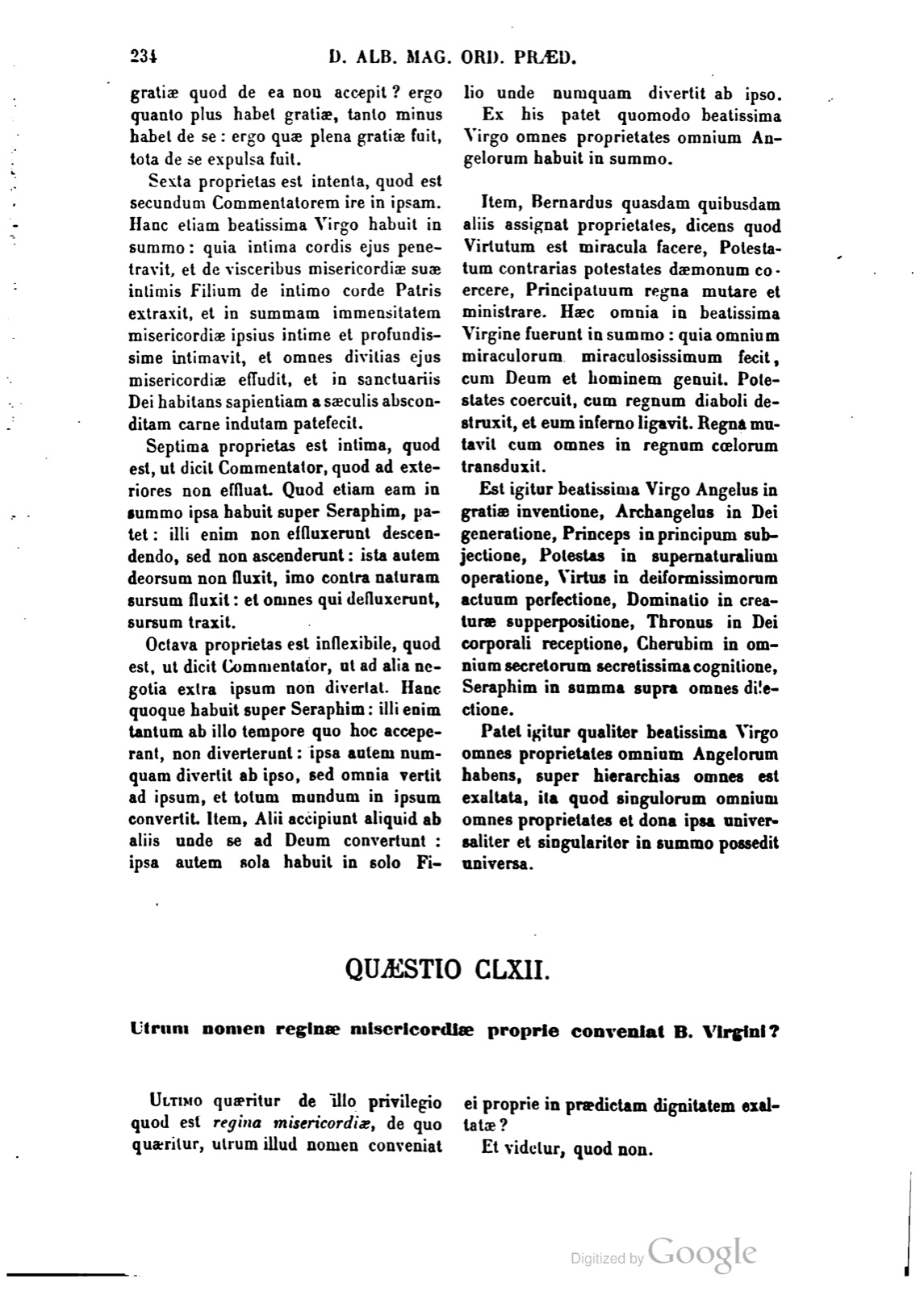
QUAESTIO CLXII. Utrum nomen reginae misericordiae proprie conveniat B. Virgini?
Ultimo quaeritur de illo privilegio quod est regina misericordiae, de quo quaeritur, utrum illud nomen conveniat ei proprie in praedictam dignitatem exaltatae?
Et videtur, quod non.
1. Majori enim dignitati convenit dignius nomen: ergo summae dignitati convenit dignissimum nomen: sed dignitas in quam exaltata est, est summa dignitas: ergo secundum illam convenit ei dignissimum nomen: dignissimum autem nomen creaturae est mater Dei: ergo secundum illum statum debet mater Dei appellari.
2. Item, Ipsa est exaltata ad summum statum gloriae: ergo potius diceretur regina gloriae.
3. Item, A digniori fiunt denominationes: sed dignissimum est gloria: ergo ipsa est regina gloriae.
4. Item, Quod nobiliori et digniori est similius, hoc est dignius et nobilius: sed nomen nobilissimum et dignissimum est rex gloriae: ergo ipsa similiter deberet dici regina gloriae.
5. Item, Ab eodem regno a quo Filius suus dicitur rex, ipsa dicitur regina, sicut a Francia dicitur rex Franciae et Regina Franciae: sed Filius dicitur Rex gloriae: ergo ipsa regina gloriae.
6. Item, Ubicumque non est miseria, non est misericordia: unde Glossae aliquando dicunt, quod in caelo non est misericordia: sed ipsa est regina caelorum: ergo ipsa non est regina misericordiae.
7. Item, Secundum statum illum ipsa est super omnes hierarchias: ergo videtur, quod debeat dici regina caelorum.
8. Item, Gloria tantum est in caelo, misericordia tantum proprie in mundo, gratia autem communiter est in caelo et in terra, juxta illud: Gratiam pro gratia 1: ergo debet dici regina gratiae.
9. Item, Imperator est super reges, et imperatrix super reginas: ergo deberet imperatrix misericordiae nominari.
10. Item, In ordinibus Angelorum superiores denominantur a superioribus et dignioribus donis: sed summum ac nobilissimum donum est charitas: ergo ipsa deberet regina charitatis nuncupari.
11. Item, Filius Deus pacis dicitur et dilectionis: ergo ipsa regina pacis et dilectionis.
12. Item, Seraphim denominantur a charitate: sed ipsa est superior Seraphim: ergo ipsa debet a superiori denominari: sed nihil est superius charitate, nisi Deus: ergo ipsa deberet a Deo denominari: ergo ipsa deberet a Deo dici dea misericordiae.
QUESTION 162. Whether the name queen of mercy properly belongs to the Blessed Virgin?
Lastly inquiry is made concerning that privilege which is queen of mercy, concerning which it is asked whether that name properly belongs to her as exalted into the aforesaid dignity.
And it seems not.
1. For a worthier name belongs to a greater dignity; therefore the worthiest name belongs to the highest dignity. But the dignity into which she is exalted is the highest dignity. Therefore according to that, the worthiest name belongs to her. But the worthiest name of a creature is mother of God. Therefore according to that state she ought to be called mother of God.
2. Likewise, she is exalted to the highest state of glory; therefore she would rather be called queen of glory.
3. Likewise, denominations are made from the worthier thing; but glory is the worthiest. Therefore she is queen of glory.
4. Likewise, what is more like the nobler and worthier thing is worthier and nobler. But the noblest and worthiest name is king of glory. Therefore she similarly ought to be called queen of glory.
5. Likewise, from the same kingdom from which her Son is called king, she is called queen, as from France one is called king of France and Queen of France. But the Son is called King of glory. Therefore she is queen of glory.
6. Likewise, wherever there is no misery, there is no mercy; whence the Glosses sometimes say that there is no mercy in heaven. But she is queen of the heavens. Therefore she is not queen of mercy.
7. Likewise, according to that state she is above all hierarchies. Therefore it seems that she ought to be called queen of the heavens.
8. Likewise, glory is only in heaven, mercy only properly in the world, but grace is commonly in heaven and on earth, according to that saying, Grace for grace 1. Therefore she ought to be called queen of grace.
9. Likewise, an emperor is above kings, and an empress above queens. Therefore she ought to be named empress of mercy.
10. Likewise, in the orders of Angels the higher ones are named from higher and worthier gifts. But the highest and noblest gift is charity. Therefore she ought to be called queen of charity.
11. Likewise, the Son is called God of peace and of love. Therefore she is queen of peace and love.
12. Likewise, Seraphim are named from charity. But she is higher than Seraphim. Therefore she ought to be named from something higher. But nothing is higher than charity except God. Therefore she ought to be named from God; therefore she ought by God to be called goddess of mercy.
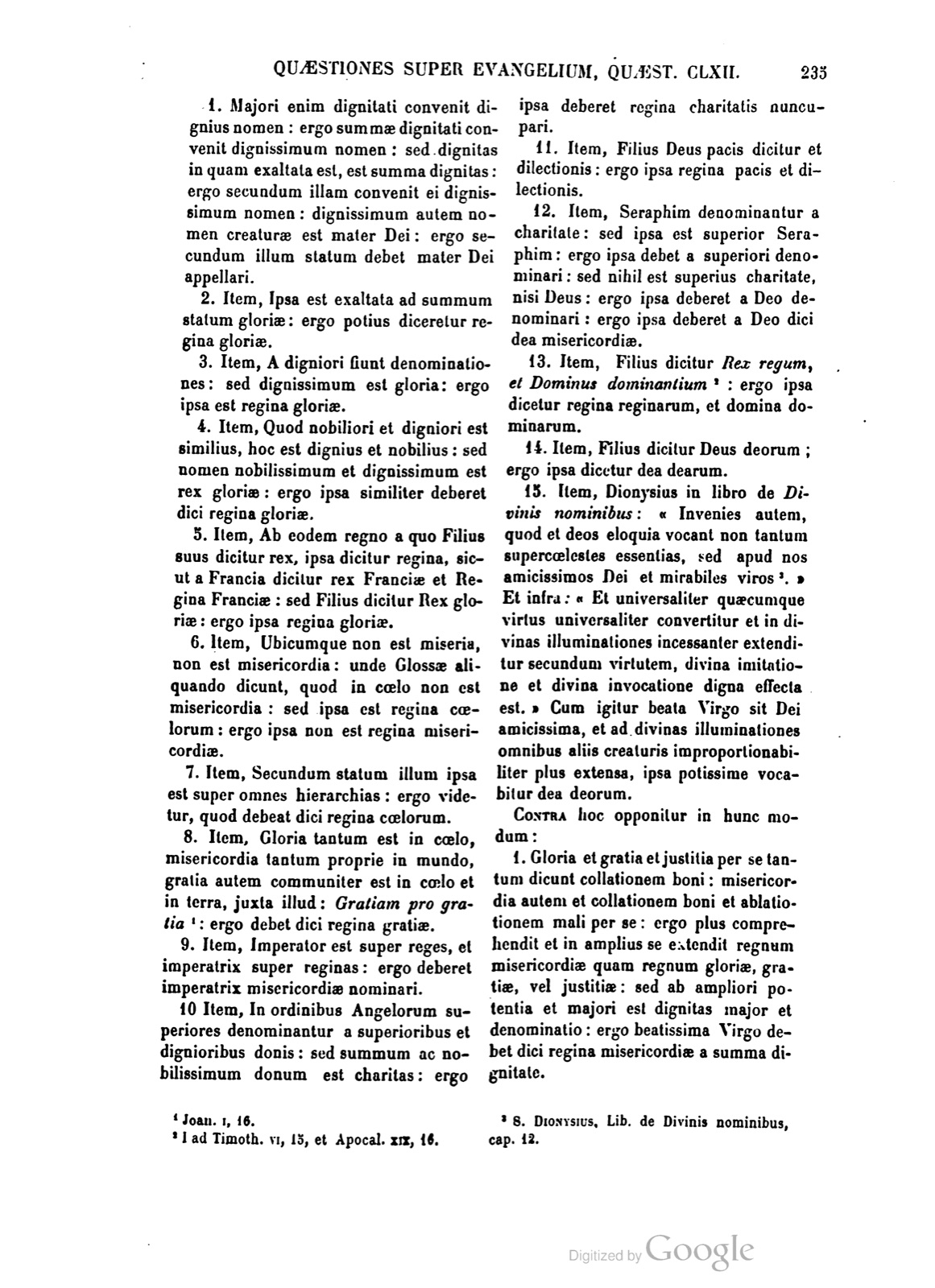
13. Item, Filius dicitur Rex regum, et Dominus dominantium 2: ergo ipsa dicetur regina reginarum, et domina dominarum.
14. Item, Filius dicitur Deus deorum: ergo ipsa dicetur dea dearum.
15. Item, Dionysius in libro de Divinis nominibus: « Invenies autem, quod et deos eloquia vocant non tantum supercaelestes essentias, sed apud nos amicissimos Dei et mirabiles viros 3. » Et infra: « Et universaliter quaecumque virtus universaliter convertitur et in divinas illuminationes incessanter extenditur secundum virtutem, divina imitatione et divina invocatione digna effecta est. » Cum igitur beata Virgo sit Dei amicissima, et ad divinas illuminationes omnibus aliis creaturis improportionabiliter plus extensa, ipsa potissime vocabitur dea deorum.
Contra hoc opponitur in hunc modum:
1. Gloria et gratia et justitia per se tantum dicunt collationem boni: misericordia autem et collationem boni et ablationem mali per se: ergo plus comprehendit et in amplius se extendit regnum misericordiae quam regnum gloriae, gratiae, vel justitiae: sed ab ampliori potentia et majori est dignitas major et denominatio: ergo beatissima Virgo debet dici regina misericordiae a summa dignitate.
2. Item, Gloria tantum proprie est in caelo, et non in terra, nec in purgatorio, nec in inferno: misericordia autem est in caelo et in terra et in purgatorio et in inferno: ergo maximum est regnum misericordiae: ergo maxima regina debet dici regina misericordiae.
3. Item, Quidquid est superius superiore, est superius inferiore: sed misericordia est super omnia opera Dei, et regina misericordiae super misericordiam: ergo regina misericordiae determinat positionem super omnia: sed illa proprie convenit beatissimae Virgini: ergo proprie et vere est regina misericordiae.
4. Item, Ipsa est super patrimonium et proprietatem sui Filii: sed haec est misericordia, proprium est enim Dei misereri: ergo proprie est regina misericordiae.
13. Likewise, the Son is called King of kings and Lord of lords 2. Therefore she will be called queen of queens and lady of ladies.
14. Likewise, the Son is called God of gods; therefore she will be called goddess of goddesses.
15. Likewise, Dionysius in the book On the Divine Names says: “You will find that the utterances call gods not only supercelestial essences, but among us the men most beloved of God and marvelous 3.” And below: “And universally whatever power is universally converted and unceasingly extended into divine illuminations according to power, has been made worthy of divine imitation and divine invocation.” Since therefore the blessed Virgin is most beloved of God, and extended toward divine illuminations disproportionately more than all other creatures, she will most especially be called goddess of gods.
Against this it is opposed in this way:
1. Glory and grace and justice through themselves say only the conferral of good; but mercy says through itself both conferral of good and removal of evil. Therefore the kingdom of mercy comprehends more and extends itself more widely than the kingdom of glory, grace, or justice. But from wider and greater power comes greater dignity and denomination. Therefore the most blessed Virgin ought to be called queen of mercy from the highest dignity.
2. Likewise, glory is properly only in heaven, and not on earth, nor in purgatory, nor in hell. But mercy is in heaven and on earth and in purgatory and in hell. Therefore the kingdom of mercy is greatest; therefore the greatest queen ought to be called queen of mercy.
3. Likewise, whatever is higher than the higher is higher than the lower. But mercy is above all the works of God, and queen of mercy is above mercy. Therefore queen of mercy determines a position above all. But that properly belongs to the most blessed Virgin. Therefore she is properly and truly queen of mercy.
4. Likewise, she is above the patrimony and property of her Son. But this is mercy, for it is proper to God to have mercy. Therefore she is properly queen of mercy.
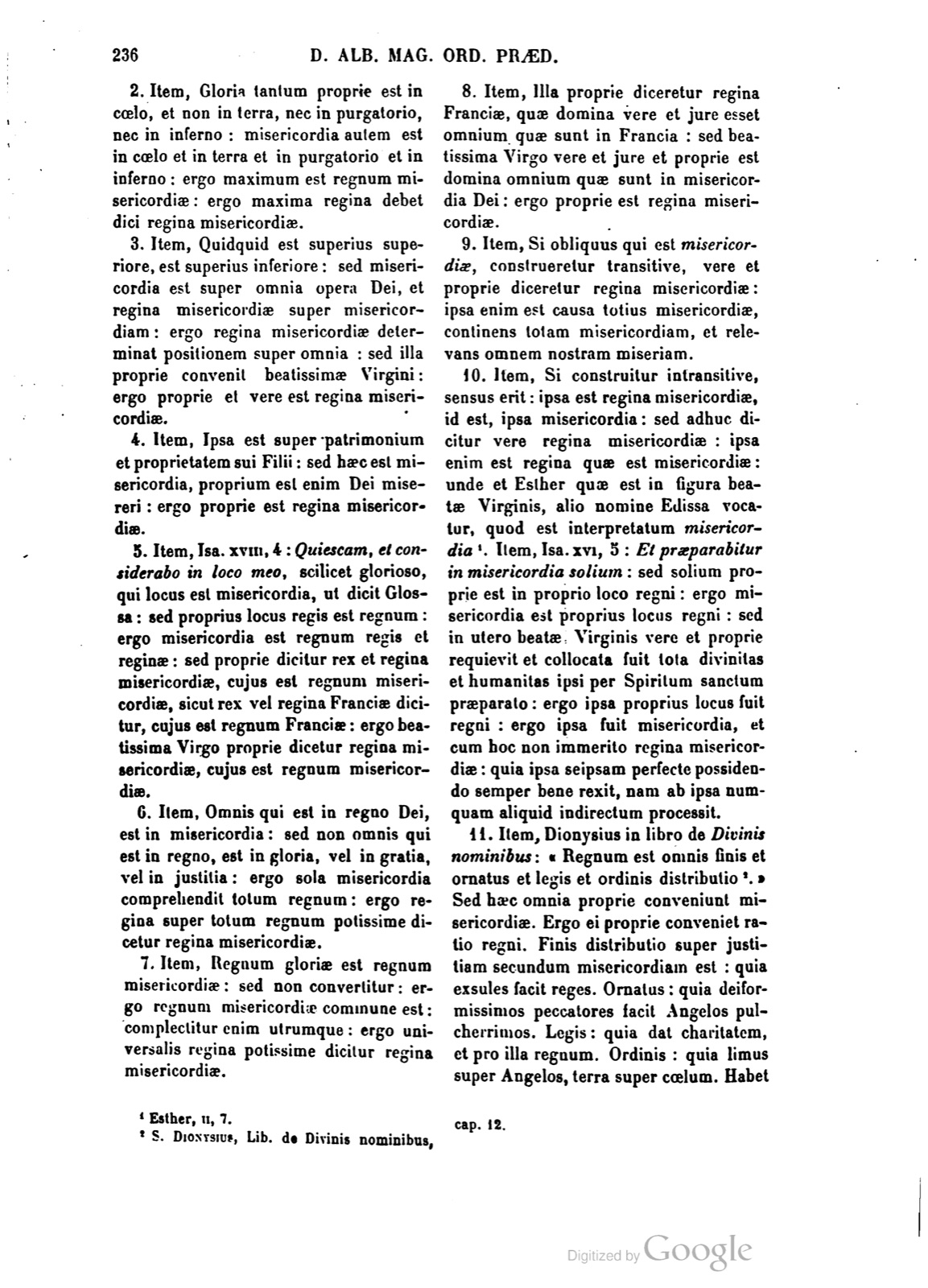
5. Item, Isa. XVIII, 4: Quiescam, et considerabo in loco meo, scilicet glorioso, qui locus est misericordia, ut dicit Glossa: sed proprius locus regis est regnum: ergo misericordia est regnum regis et reginae: sed proprie dicitur rex et regina misericordiae, cujus est regnum misericordiae, sicut rex vel regina Franciae dicitur, cujus est regnum Franciae: ergo beatissima Virgo proprie dicetur regina misericordiae, cujus est regnum misericordiae.
6. Item, Omnis qui est in regno Dei, est in misericordia: sed non omnis qui est in regno, est in gloria, vel in gratia, vel in justitia: ergo sola misericordia comprehendit totum regnum: ergo regina super totum regnum potissime dicetur regina misericordiae.
7. Item, Regnum gloriae est regnum misericordiae: sed non convertitur: ergo regnum misericordiae commune est: complectitur enim utrumque: ergo universalis regina potissime dicitur regina misericordiae.
8. Item, Illa proprie diceretur regina Franciae, quae domina vere et jure esset omnium quae sunt in Francia: sed beatissima Virgo vere et jure et proprie est domina omnium quae sunt in misericordia Dei: ergo proprie est regina misericordiae.
9. Item, Si obliquus qui est misericordiae, construeretur transitive, vere et proprie diceretur regina misericordiae: ipsa enim est causa totius misericordiae, continens totam misericordiam, et relevans omnem nostram miseriam.
10. Item, Si construitur intransitive, sensus erit: ipsa est regina misericordiae, id est, ipsa misericordia: sed adhuc dicitur vere regina misericordiae: ipsa enim est regina quae est misericordiae: unde et Esther quae est in figura beatae Virginis, alio nomine Edissa vocatur, quod est interpretatum misericordia 4. Item, Isa. XVI, 5: Et praeparabitur in misericordia solium: sed solium proprie est in proprio loco regni: ergo misericordia est proprius locus regni: sed in utero beatae Virginis vere et proprie requievit et collocata fuit tota divinitas et humanitas ipsi per Spiritum sanctum praeparato: ergo ipsa proprius locus fuit regni: ergo ipsa fuit misericordia, et cum hoc non immerito regina misericordiae: quia ipsa seipsam perfecte possidendo semper bene rexit, nam ab ipsa numquam aliquid indirectum processit.
5. Likewise, Isaiah 18:4: I will rest and consider in my place, namely glorious, which place is mercy, as the Gloss says. But the proper place of a king is a kingdom. Therefore mercy is the kingdom of the king and queen. But the one whose kingdom is the kingdom of mercy is properly called king and queen of mercy, just as king or queen of France is said of one whose kingdom is France. Therefore the most blessed Virgin, whose kingdom is the kingdom of mercy, will properly be called queen of mercy.
6. Likewise, everyone who is in the kingdom of God is in mercy; but not everyone who is in the kingdom is in glory, or in grace, or in justice. Therefore mercy alone comprehends the whole kingdom; therefore the queen over the whole kingdom will most especially be called queen of mercy.
7. Likewise, the kingdom of glory is the kingdom of mercy, but not conversely. Therefore the kingdom of mercy is common, for it embraces both. Therefore the universal queen is most especially called queen of mercy.
8. Likewise, that woman would properly be called queen of France who truly and by right was lady of all things which are in France. But the most blessed Virgin truly and by right and properly is lady of all things which are in the mercy of God. Therefore she is properly queen of mercy.
9. Likewise, if the oblique term “of mercy” were construed transitively, she would truly and properly be called queen of mercy, for she is the cause of all mercy, containing all mercy and relieving all our misery.
10. Likewise, if it is construed intransitively, the sense will be: she is queen of mercy, that is, mercy itself. But she is still truly called queen of mercy, for she is the queen who is of mercy. Whence Esther, who is in figure of the blessed Virgin, is called by another name Edissa, which is interpreted mercy 4. Likewise, Isaiah 16:5: And a throne will be prepared in mercy. But a throne is properly in the proper place of a kingdom; therefore mercy is the proper place of the kingdom. But in the womb of the blessed Virgin the whole divinity and humanity truly and properly rested and was placed, that womb being prepared for him by the Holy Spirit. Therefore she was the proper place of the kingdom; therefore she was mercy, and with this not undeservedly queen of mercy, because by perfectly possessing herself she always ruled herself well, for nothing indirect ever proceeded from her.
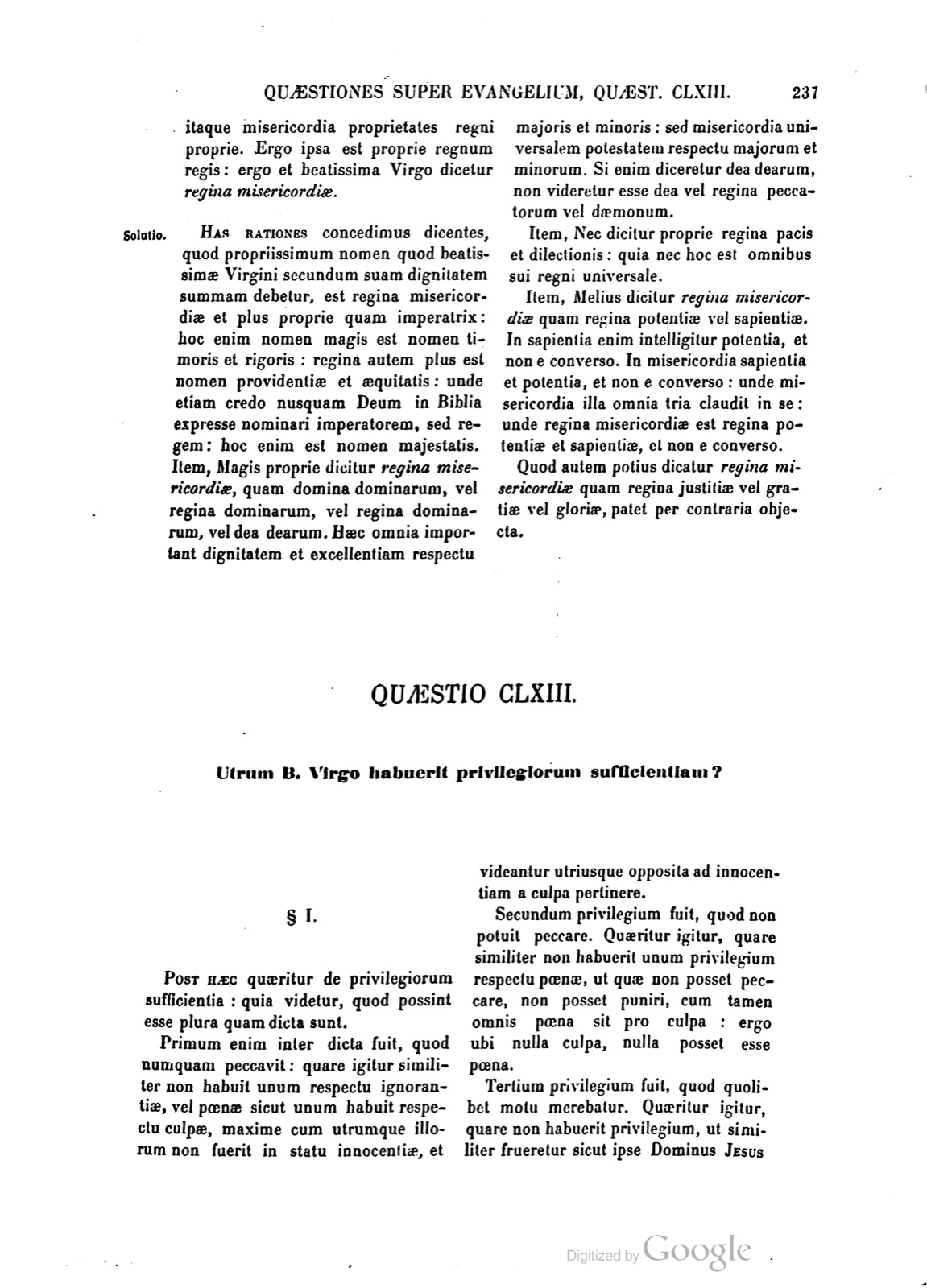
11. Item, Dionysius in libro de Divinis nominibus: « Regnum est omnis finis et ornatus et legis et ordinis distributio 5. » Sed haec omnia proprie conveniunt misericordiae. Ergo ei proprie conveniet ratio regni. Finis distributio super justitiam secundum misericordiam est: quia exsules facit reges. Ornatus: quia deiformissimos peccatores facit Angelos pulcherrimos. Legis: quia dat charitatem, et pro illa regnum. Ordinis: quia limus super Angelos, terra super caelum. Habet itaque misericordia proprietates regni proprie. Ergo ipsa est proprie regnum regis: ergo et beatissima Virgo dicetur regina misericordiae.
Solutio. Has rationes concedimus dicentes, quod propriissimum nomen quod beatissimae Virgini secundum suam dignitatem summam debetur, est regina misericordiae et plus proprie quam imperatrix: hoc enim nomen magis est nomen timoris et rigoris: regina autem plus est nomen providentiae et aequitatis: unde etiam credo nusquam Deum in Biblia expresse nominari imperatorem, sed regem: hoc enim est nomen majestatis. Item, Magis proprie dicitur regina misericordiae, quam domina dominarum, vel regina dominarum, vel regina dominarum, vel dea dearum. Haec omnia important dignitatem et excellentiam respectu majoris et minoris: sed misericordia universalem potestatem respectu majorum et minorum. Si enim diceretur dea dearum, non videretur esse dea vel regina peccatorum vel daemonum.
Item, Nec dicitur proprie regina pacis et dilectionis: quia nec hoc est omnibus sui regni universale.
Item, Melius dicitur regina misericordiae quam regina potentiae vel sapientiae. In sapientia enim intelligitur potentia, et non e converso. In misericordia sapientia et potentia, et non e converso: unde misericordia illa omnia tria claudit in se: unde regina misericordiae est regina potentiae et sapientiae, et non e converso.
Quod autem potius dicatur regina misericordiae quam regina justitiae vel gratiae vel gloriae, patet per contraria objecta.
11. Likewise, Dionysius in the book On the Divine Names says: “A kingdom is the distribution of every end and adornment and law and order 5.” But all these things properly belong to mercy. Therefore the account of kingdom will properly belong to it. The distribution of the end above justice is according to mercy, because it makes exiles kings. Adornment: because it makes most God-formed sinners most beautiful Angels. Law: because it gives charity, and for that a kingdom. Order: because mud is above Angels, earth above heaven. Therefore mercy properly has the properties of a kingdom. Therefore it is properly the kingdom of the king; therefore also the most blessed Virgin will be called queen of mercy.
Solution. We concede these arguments, saying that the most proper name owed to the most blessed Virgin according to her highest dignity is queen of mercy, and more properly than empress; for this name is more a name of fear and rigor, but queen is more a name of providence and equity. Whence I also believe God is nowhere expressly named emperor in the Bible, but king; for this is a name of majesty. Likewise, she is more properly called queen of mercy than lady of ladies, or queen of ladies, or goddess of goddesses. All these import dignity and excellence with respect to greater and lesser; but mercy imports universal power with respect to greater and lesser. For if she were called goddess of goddesses, she would not seem to be goddess or queen of sinners or demons.
Likewise, she is not properly called queen of peace and love, because neither is this universal for all of her kingdom.
Likewise, she is better called queen of mercy than queen of power or wisdom. For in wisdom power is understood, and not conversely. In mercy are wisdom and power, and not conversely. Whence mercy closes all those three within itself. Therefore queen of mercy is queen of power and wisdom, and not conversely.
But that she is rather called queen of mercy than queen of justice or grace or glory is clear through the objections to the contrary.
Notes
- John 1:16. (Joan. I, 16.) ↩
- 1 Timothy 6:15 and Apocalypse 19:16. (I ad Timoth. VI, 15, et Apocal. XIX, 16.) ↩
- St. Dionysius, book On the Divine Names, chapter 12. (S. Dionysius, Lib. de Divinis nominibus, cap. 12.) ↩
- Esther 2:7. (Esther, II, 7.) ↩
- St. Dionysius, book On the Divine Names, chapter 12. (S. Dionysius, Lib. de Divinis nominibus, cap. 12.) ↩
If a page does not appear, its photograph has not been uploaded yet.