Works › The Mariale: Questions on “Missus est”
Volume 37 · pp. 232–234
Question 161. Whether she had the properties of Seraphim?
A marker with ≈ is an approximate page boundary, placed by measure of the text; the page photographs remain the authority. In the paired views, clicking a page marker brings that page into view.
QUAESTIO CLXI. Utrum habuerit proprietates Seraphim?
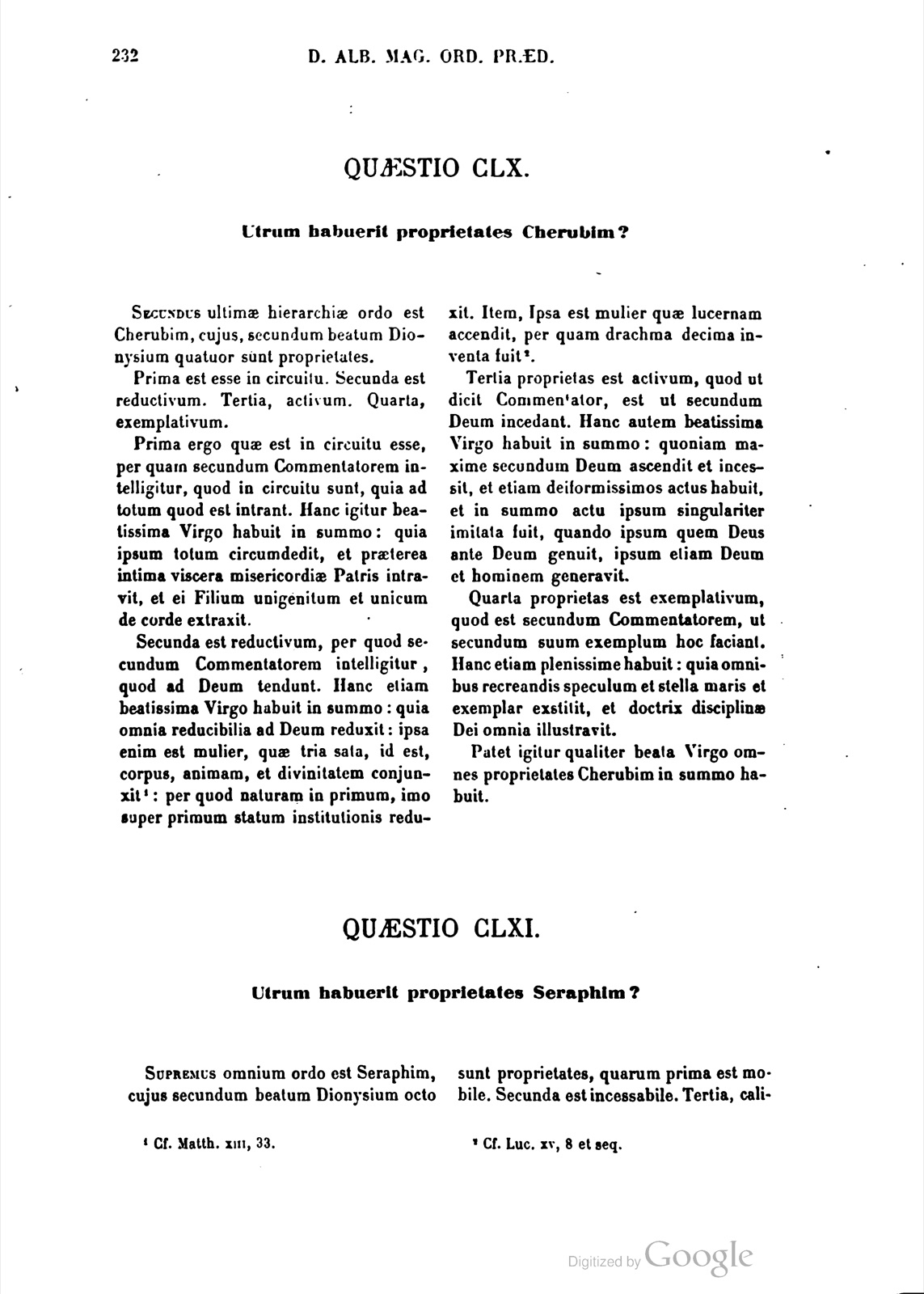
Supremus omnium ordo est Seraphim, cujus secundum beatum Dionysium octo sunt proprietates, quarum prima est mobile. Secunda est incessabile. Tertia, calidum. Quarta, acutum. Quinta, superfervidum. Sexta, intenta. Septima, intima. Octava, inflexibilis.
Quas proprietates exponit Commentator sic: Prima igitur proprietas est dilectionis quod est vita. Hanc habuit beata Virgo in summo: ipsa enim sua charitate meruit de congruo sibi vivere vita summe gloriosa, et quod ipsa fuerit principium vitae increatae et omnibus nobis causa vitae aeternae. Item, Si vita est effectus dilectionis: ergo cum in ipsa improportionabiliter sit dilectio, in ea improportionabilis erit vita.
Secunda proprietas est incessabile, et est incessabile charitas, quia est perpetuum. Incessabilitatem charitatis habuit in summo super Seraphim beatissima Virgo: magis est enim incessabile quod non cessat nec potest cessare nec umquam potuit cessare, quam quod non cessat et non potest cessare modo, sed tamen aliquando potuit cessare: sed charitas Angelorum Seraphim potuit aliquando cessare, summus enim de illo ordine cessavit quando cecidit, et similiter alii potuerunt tunc sicut ille: sed charitas beatissimae Virginis numquam potuit cessare: ergo magis fuit incessabile: ergo excellit Seraphim in incessabili charitate. Minor patet per hoc quod non potest cessare nisi per peccatum mortale: sed ipsa numquam mortaliter peccare potuit: in utero enim nullus potest peccare mortaliter, ipsa autem adhuc in utero matris sanctificata fuit et contra peccata confirmata, et sic numquam potuit charitatem amittere: Seraphim autem amittere potuerunt: ergo excellit illos in hoc quod est incessabile.
Tertia proprietas calidum est, et calidum est dilectio quasi sopita: sed hanc habuit beatissima Virgo super Seraphim: aliis enim paribus fortior est virtus quae tantumdem operatur cum resistentia contrarii, quam illa quae sine resistentia: unde major est virtus quae sopitum facit in tumultu et strepitu, quam quae facit sopitum in silentio et quiete: ergo cum beatissima Virgo sopita fuerit et omnino tranquilla in tumultu et strepitu tribulationum, tentationum et persecutionum hujus mundi, magis fuit sopita quam Seraphim extra hujusmodi strepitum et tumultum constituti: sicut major est violentia somni quae cogit hominem in strepitu dormire, quam quae in quiete.
QUESTION 161. Whether she had the properties of Seraphim?
The highest order of all is the Seraphim, of which, according to blessed Dionysius, there are eight properties. The first is movable. The second is unceasing. The third, hot. The fourth, sharp. The fifth, superfervid. The sixth, intent. The seventh, inward. The eighth, inflexible.
The Commentator expounds these properties thus. Therefore the first property is that of love, which is life. The blessed Virgin had this in the highest degree, for by her charity she merited congruously to live for herself with a supremely glorious life, and that she herself would be the principle of uncreated life and the cause of eternal life for all of us. Likewise, if life is the effect of love, then since love is disproportionately in her, life will be disproportionate in her.
The second property is unceasing, and charity is unceasing because it is perpetual. The most blessed Virgin had unceasingness of charity in the highest degree above the Seraphim. For that which does not cease, cannot cease, and could never have ceased, is more unceasing than that which does not cease and now cannot cease, but nevertheless at some time could have ceased. But the charity of the Angels, the Seraphim, could at some time have ceased; for the highest one of that order ceased when he fell, and similarly others could then have done as he did. But the charity of the most blessed Virgin could never have ceased. Therefore it was more unceasing; therefore she excels the Seraphim in unceasing charity. The minor premise is clear through this, that it cannot cease except through mortal sin; but she could never sin mortally. For no one can sin mortally in the womb; but she was sanctified while still in her mother’s womb and confirmed against sins, and thus could never lose charity. But the Seraphim could have lost it; therefore she excels them in that which is unceasing.
The third property is hot, and heat is love as though lulled to sleep. But the most blessed Virgin had this above the Seraphim. For, other things being equal, a virtue that works as much with resistance from a contrary is stronger than one that works without resistance. Whence the virtue that makes one lulled to sleep in tumult and noise is greater than that which makes one lulled to sleep in silence and quiet. Therefore since the most blessed Virgin was lulled to sleep and wholly tranquil in the tumult and noise of tribulations, temptations, and persecutions of this world, she was more lulled to sleep than Seraphim set outside such noise and tumult, just as the force of sleep which compels a person to sleep in noise is greater than that which does so in quiet.
Quarta proprietas est acutum. Et dicit Commentator: Acutum quod est sapientiae. In hac excellit beatissima Virgo Seraphim, ut patet supra in pluribus locis de ipsius sapientia. Praeterea dicit Augustinus: « Christus est in Maria: ergo omnes thesauri sapientiae et scientiae Dei in Maria sunt. » Item, Unctio Seraphim docet de omnibus necessariis ad salutem: unctio Dominae nostrae dat omnia necessaria ad salutem. Item, Participant sapientiam creatam accidentaliter: ipsa est mater sapientiae increatae essentialiter.
Quinta proprietas est superfervidum, quod est, ut dicit Commentator, dum per vim amoris extollitur super se et per vim amoris expellitur a se. Hanc etiam beatissima Virgo habuit in summo: vidi enim speciosam sicut columbam ascendentem per contemplationem desuper rivos aquarum, id est, super omnes choros Angelorum. Et nardus ejus charitatis ac humilitatis introivit in cubiculum regis et deduxit regis filium de domo patris. Item, Spiritus elevat sursum: sed improportionabiliter aliis habuit Spiritum sanctum: ergo improportionabiliter aliis habuit cor sursum. Item, Ubi est thesaurus tuus, ibi est et cor tuum 1: sed ipsa prae omnibus maximum thesaurum habuit sursum: ergo maxime fuit ipsius cor sursum. Item, Ipsa fuit maxime expulsa a se: quia totaliter se Deo dederat, corpore et anima Deo plena erat, ita quod nec corpus nec anima plus gratiae secundum statum pro tempore recipere poterant: quid enim homo habet gratiae quod de ea non accepit? ergo quanto plus habet gratiae, tanto minus habet de se: ergo quae plena gratiae fuit, tota de se expulsa fuit.
Sexta proprietas est intenta, quod est secundum Commentatorem ire in ipsam. Hanc etiam beatissima Virgo habuit in summo: quia intima cordis ejus penetravit, et de visceribus misericordiae suae intimis Filium de intimo corde Patris extraxit, et in summam immensitatem misericordiae ipsius intime et profundissime intimavit, et omnes divitias ejus misericordiae effudit, et in sanctuariis Dei habitans sapientiam a saeculis absconditam carne indutam patefecit.
The fourth property is sharp. And the Commentator says: sharp, which belongs to wisdom. In this the most blessed Virgin excels the Seraphim, as is clear above in several places concerning her wisdom. Besides, Augustine says: “Christ is in Mary; therefore all the treasures of the wisdom and knowledge of God are in Mary.” Likewise, the anointing of the Seraphim teaches concerning all things necessary for salvation; the anointing of our Lady gives all things necessary for salvation. Likewise, they participate created wisdom accidentally; she is essentially mother of uncreated wisdom.
The fifth property is superfervid, which is, as the Commentator says, when by the force of love one is lifted above oneself and by the force of love driven out from oneself. The most blessed Virgin also had this in the highest degree: for I saw her beautiful like a dove ascending through contemplation above the streams of waters, that is, above all choirs of Angels. And the nard of her charity and humility entered the chamber of the king and led the king’s son down from the father’s house. Likewise, the Spirit lifts upward; but she had the Holy Spirit disproportionately beyond others; therefore she had her heart upward disproportionately beyond others. Likewise, Where your treasure is, there is your heart also 1. But she, before all, had the greatest treasure above; therefore her heart was most of all above. Likewise, she was most driven out from herself, because she had totally given herself to God, was full of God in body and soul, so that neither body nor soul could receive more grace according to the state of the time. For what grace does a human being have which he has not received from her? Therefore the more one has of grace, the less one has of oneself; therefore she who was full of grace was wholly driven out from herself.
The sixth property is intent, which according to the Commentator is to go into it. The most blessed Virgin also had this in the highest degree, because she penetrated the innermost things of his heart, and from the innermost bowels of her mercy drew the Son from the innermost heart of the Father, and most inwardly and most profoundly made known the highest immensity of his mercy, poured out all the riches of his mercy, and, dwelling in the sanctuaries of God, revealed wisdom hidden from the ages clothed in flesh.
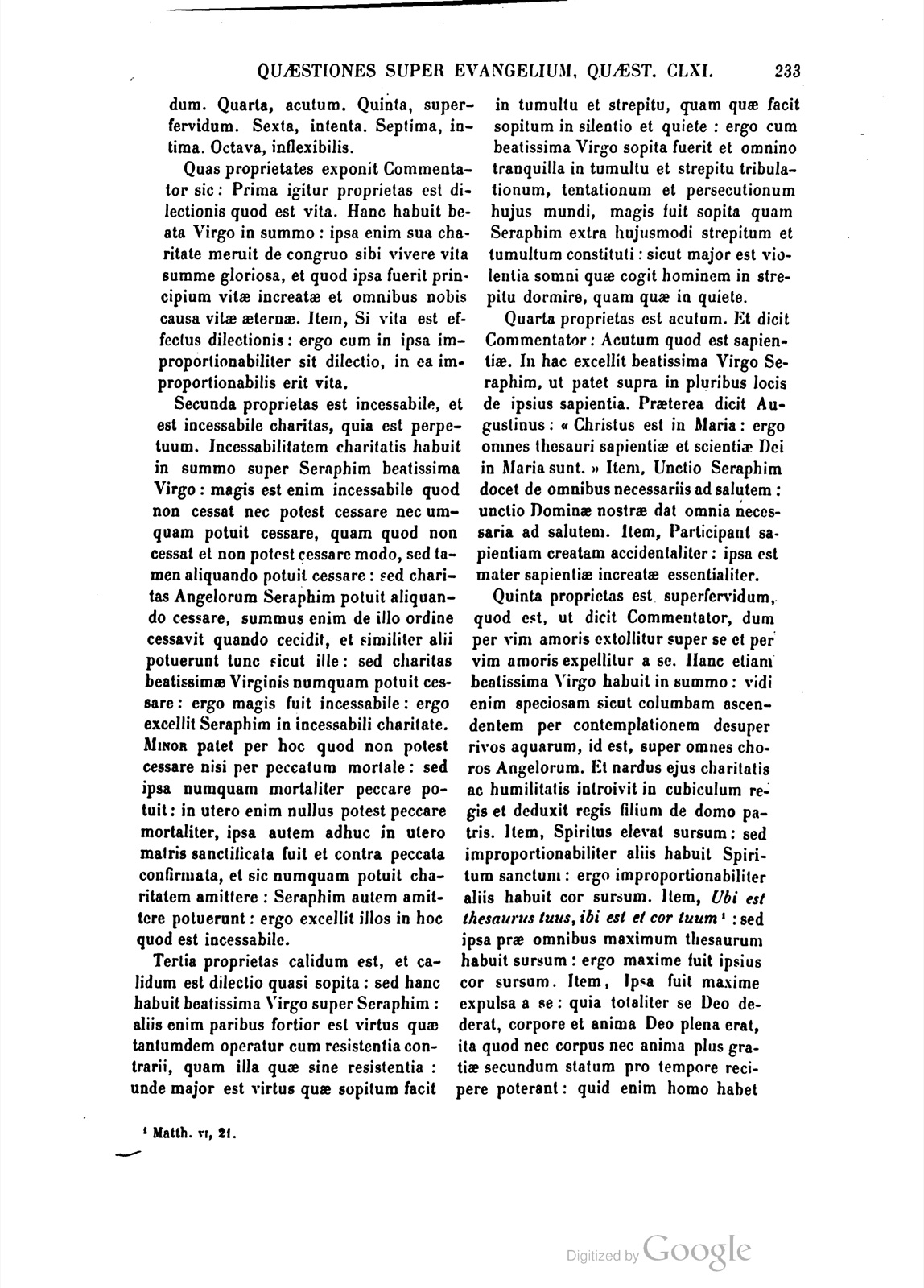
Septima proprietas est intima, quod est, ut dicit Commentator, quod ad exteriores non effluat. Quod etiam eam in summo ipsa habuit super Seraphim, patet: illi enim non effluxerunt descendendo, sed non ascenderunt: ista autem deorsum non fluxit, imo contra naturam sursum fluxit: et omnes qui defluxerunt, sursum traxit.
Octava proprietas est inflexibile, quod est, ut dicit Commentator, ut ad alia negotia extra ipsum non divertat. Hanc quoque habuit super Seraphim: illi enim tantum ab illo tempore quo hoc acceperant, non diverterunt: ipsa autem numquam divertit ab ipso, sed omnia vertit ad ipsum, et totum mundum in ipsum convertit. Item, Alii accipiunt aliquid ab aliis unde se ad Deum convertunt: ipsa autem sola habuit in solo Filio unde numquam divertit ab ipso.
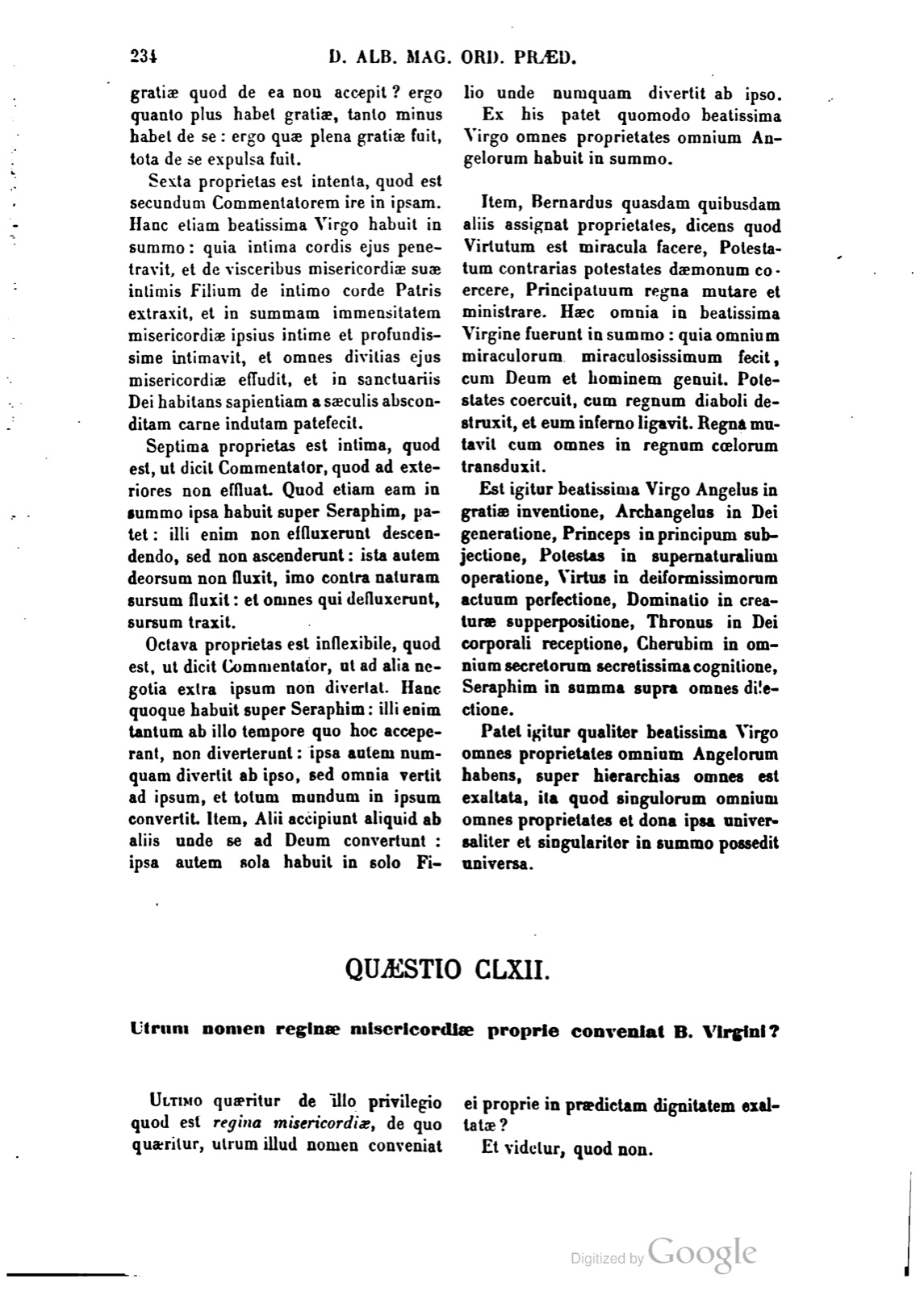
Ex his patet quomodo beatissima Virgo omnes proprietates omnium Angelorum habuit in summo.
Item, Bernardus quasdam quibusdam aliis assignat proprietates, dicens quod Virtutum est miracula facere, Potestatum contrarias potestates daemonum coercere, Principatuum regna mutare et ministrare. Haec omnia in beatissima Virgine fuerunt in summo: quia omnium miraculorum miraculosissimum fecit, cum Deum et hominem genuit. Potestates coercuit, cum regnum diaboli destruxit, et eum inferno ligavit. Regna mutavit cum omnes in regnum caelorum transduxit.
Est igitur beatissima Virgo Angelus in gratiae inventione, Archangelus in Dei generatione, Princeps in principum subjectione, Potestas in supernaturalium operatione, Virtus in deiformissimorum actuum perfectione, Dominatio in creaturae supperpositione, Thronus in Dei corporali receptione, Cherubim in omnium secretorum secretissima cognitione, Seraphim in summa supra omnes dilectione.
Patet igitur qualiter beatissima Virgo omnes proprietates omnium Angelorum habens, super hierarchias omnes est exaltata, ita quod singulorum omnium omnes proprietates et dona ipsa universaliter et singulariter in summo possedit universa.
The seventh property is inward, which is, as the Commentator says, that it does not flow out to exterior things. That she also had this in the highest degree above the Seraphim is clear: for they did not flow out by descending, but they did not ascend; but she did not flow downward, indeed contrary to nature she flowed upward, and drew upward all who had flowed down.
The eighth property is inflexible, which is, as the Commentator says, that it does not turn aside to other business outside him. She also had this above the Seraphim: for they did not turn aside only from that time at which they had received this; but she never turned aside from him, but turned all things toward him and converted the whole world into him. Likewise, others receive something from others by which they convert themselves to God; but she alone had in the Son alone that from which she never turned away from him.
From these things it is clear how the most blessed Virgin had all the properties of all Angels in the highest degree.
Likewise, Bernard assigns certain properties to certain other orders, saying that it belongs to Virtues to do miracles, to Powers to restrain the contrary powers of demons, and to Principalities to change and minister kingdoms. All these were in the most blessed Virgin in the highest degree, because she did the most miraculous of all miracles when she gave birth to God and man. She restrained Powers when she destroyed the kingdom of the devil and bound him in hell. She changed kingdoms when she led all into the kingdom of heaven.
Therefore the most blessed Virgin is Angel in the finding of grace, Archangel in the generation of God, Prince in the subjection of princes, Power in the operation of supernatural things, Virtue in the perfection of most God-formed acts, Domination in being placed above creature, Throne in the bodily reception of God, Cherubim in most secret knowledge of all secrets, Seraphim in the highest love above all.
Therefore it is clear how the most blessed Virgin, having all the properties of all Angels, is exalted above all hierarchies, so that she universally and singularly possessed in the highest degree all the properties and gifts of each and all.
Notes
- Matthew 6:21. (Matth. VI, 21.) ↩
If a page does not appear, its photograph has not been uploaded yet.