Works › The Mariale: Questions on “Missus est”
Volume 37 · pp. 220–223
Question 151. Whether the Blessed Virgin was exalted above every creature in a fourth hierarchy?
A marker with ≈ is an approximate page boundary, placed by measure of the text; the page photographs remain the authority. In the paired views, clicking a page marker brings that page into view.
QUAESTIO CLI. Utrum B. Virgo fuerit exaltata super omnem creaturam in quarta hierarchia?
Ultimo quaeritur de illo privilegio, quod est super omnem creaturam in quarta hierarchia exaltata.
Et videtur, quod beatissima Virgo ultra tertiam hierarchiam in quartam non sit exaltata.
1. Primo: quia in parabola ubi legitur de reparatione generis humani 1, dicitur, quod drachma decima est inventa, quae fuerat perdita: ergo videtur, quod tantum in illud fuerit restitutio, ex quo facta fuit perditio: sed tantum ex hierarchiis tribus fuit casus et perditio: ergo tantum in illis fuit reddita restauratio.
2. Item, Dicitur Judith in figura Dominae nostrae: Subvenisti ruinae ante conspectum Dei nostri 2: sed ruina fuit solum in illis tribus hierarchiis: ergo restitutio erit tantum in illis tribus.
3. Item, Alia parabola: Qui habet centum oves 3, etc. Glossa: Deus est pastor, cujus nos centesima ovis: sed centesima est de numero aliarum nonaginta novem et consortio: ergo homo pertinet ad aliquem ordinem Angelorum.
4. Item, Hierarchia humana est sub angelica: ergo supremus chorus de humana est sub infimo de angelica: ergo nullus homo est super choros Angelorum.
5. Ad idem facit quod ipse Deus in passione permisit, ut Lucas, XXII, 43, dicit, quod apparuit illi Angelus de caelo, confortans eum, per quod, ut dicit Dionysius, constat naturam humanam naturae angelicae naturaliter esse subjectam: sed sicut simpliciter ad simpliciter, ita summum ad summum: ergo si Angelus super hominem, et supremus super supremum hominem: ergo nullus homo super omnes Angelos.
6. Item, Genes. II, 2: Requievit Dominus die septimo ab universo opere quod patrarat: sed tunc non fuit quarta hierarchia: ergo nec modo.
7. Item, Cantat Ecclesia: « Gaudent chori Angelorum consortes et concives nostri. » Si concives et consortes: ergo in eadem hierarchia.
8. Item, In prima hierarchia supremus ordo est sacer principatus: sed princeps in eadem civitate et regno cum subditis est: ergo regina Angelorum in eadem mansione cum Angelis est.
9. Item, Augustinus: « Minime dubitandum est et raptam hominis a carnis sensibus mentem, et post mortem ipsa carne deposita, non sic Deum videre posse sicut vident Angeli 4. » Et vult, quod inferioris gradus est cognitio hominis quam Angeli. Sed penes illam cognitionem est ordo: ergo homo est inferioris ordinis quam Angelus: ergo supremus est sub supremo Angelo.
QUESTION 151. Whether the Blessed Virgin was exalted above every creature in a fourth hierarchy?
Lastly inquiry is made concerning that privilege, that she was exalted above every creature in a fourth hierarchy.
And it seems that the most blessed Virgin was not exalted beyond the third hierarchy into a fourth.
1. First, because in the parable where the restoration of the human race is read 1, it is said that the tenth drachma which had been lost was found. Therefore it seems that restoration was only into that from which loss had been made. But fall and loss were only from the three hierarchies. Therefore restoration was rendered only in those.
2. Likewise, it is said of Judith in figure of our Lady: You have helped the ruin before the sight of our God 2. But the ruin was only in those three hierarchies. Therefore restoration will be only in those three.
3. Likewise, another parable: He who has a hundred sheep 3, etc. The Gloss says: God is the shepherd, of whom we are the hundredth sheep. But the hundredth is of the number and fellowship of the other ninety-nine. Therefore man pertains to some order of Angels.
4. Likewise, the human hierarchy is beneath the angelic. Therefore the highest choir of the human hierarchy is beneath the lowest of the angelic; therefore no human being is above the choirs of Angels.
5. To the same point belongs what God himself permitted in the passion, as Luke 22:43 says, that an Angel appeared to him from heaven strengthening him. Through this, as Dionysius says, it is clear that human nature is naturally subject to angelic nature. But as simple to simple, so highest to highest. Therefore if Angel is above man, the highest Angel is above the highest human being; therefore no human being is above all Angels.
6. Likewise, Genesis 2:2: The Lord rested on the seventh day from all the work which he had made. But then there was no fourth hierarchy. Therefore neither is there now.
7. Likewise, the Church sings: “The choirs of Angels rejoice, our partners and fellow-citizens.” If fellow-citizens and partners, then in the same hierarchy.
8. Likewise, in the first hierarchy the highest order is sacred principality. But a prince is in the same city and kingdom with his subjects. Therefore the queen of Angels is in the same dwelling with the Angels.
9. Likewise, Augustine says: “It is by no means to be doubted that both the mind of a man rapt away from the senses of the flesh, and after death when that flesh has been laid aside, cannot see God as the Angels see him 4.” And he means that human cognition is of a lower grade than that of an Angel. But order is according to that cognition. Therefore man is of a lower order than Angel; therefore the highest man is under the highest Angel.
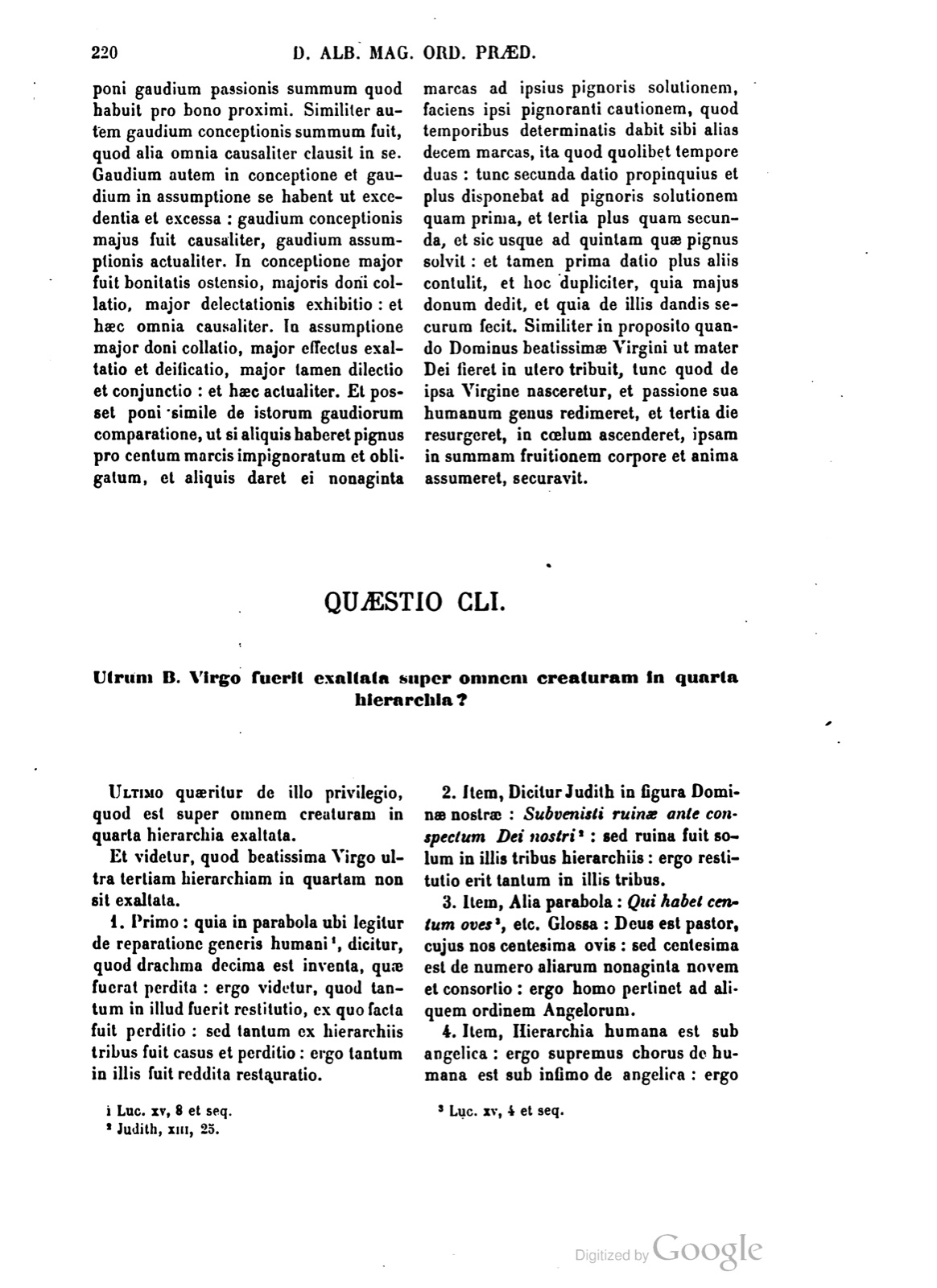
10. Item, Hierarchia angelica descendit per exemplaritatem a divina: sed in divina tantum tres hierarchiae: ergo non erit quarta.
11. Item, Filius est in divina hierarchia: ergo si beatissima Virgo non est in angelica hierarchia, sola erit in una: sed ubi tantum unum vel una, ibi non est ordo: et ubi non est ordo, ibi non est hierarchia: ergo non potest sola habere hierarchiam unam.
12. Item, Dionysius dicit, quod in qualibet hierarchia sunt prima, media, et infima: ergo ipsa non erit in una hierarchia.
13. Item, Ipsa est medium inter alias creaturas et Deum: sed medium non habet medium et ultimum: ergo non facit hierarchiam per se.
Contra:
1. Hieronymus et omnes sancti et ipsa universalis Ecclesia cantat solemniter, quod ipsa est exaltata super choros Angelorum. Inde sic: Omnes chori Angelorum sunt de aliqua hierarchia: sed ipsa exaltata est super choros Angelorum: ergo ipsa est super omnes hierarchias Angelorum. Vel directe: Quidquid est in aliqua hierarchia, est in aliquo choro: ergo quod non est in aliquo choro, non est in aliqua hierarchia: ergo quidquid est super omnes choros, non est in aliqua hierarchia.
2. Item, Plus distat beatissima Virgo a Seraphim in dignitate et gloria, quam Seraphim super Cherubim: sed propter excellentiam dignitatis ordinantur Seraphim super Cherubim uno ordine: ergo beatissima Virgo erit super Seraphim ad minus uno ordine: ergo super hierarchiam Angelorum.
3. Item, Improportionabiliter differt magis Domina a servo, quam servus a servo: sed Seraphim sic se habet ad Cherubim ut servus ad servum, Domina autem ad Seraphim ut regina sua et omnium Angelorum: ergo improportionabiliter plus est ipsa super Seraphim quam Seraphim super Cherubim: ergo in alio ordine super ipsum: sed Seraphim est supremus ordo Angelorum: ergo ipsa est super omnes hierarchias Angelorum.
4. Item, Rex et regina ab eadem denominantur dignitate et regno et principatu: ab eodem enim regno dicitur rex Franciae et regina Franciae: ergo ab eodem regno dicitur Rex caelorum et Regina caelorum: sed sua dignitas regalis est super omnes dignitates Angelorum et principatus: ergo dignitas reginae caelorum est super omnes choros et hierarchias Angelorum.
10. Likewise, the angelic hierarchy descends by exemplarity from the divine; but in the divine there are only three hierarchies. Therefore there will not be a fourth.
11. Likewise, the Son is in the divine hierarchy. Therefore if the most blessed Virgin is not in the angelic hierarchy, she alone will be in one. But where there is only one masculine or one feminine, there is not order; and where there is not order, there is not hierarchy. Therefore she alone cannot have one hierarchy.
12. Likewise, Dionysius says that in any hierarchy there are first, middle, and lowest things. Therefore she will not be in one hierarchy.
13. Likewise, she is a middle between other creatures and God. But a middle does not have a middle and last. Therefore she does not make a hierarchy through herself.
To the contrary:
1. Jerome and all the saints and the universal Church itself solemnly sing that she is exalted above the choirs of Angels. Hence thus: all choirs of Angels are of some hierarchy. But she is exalted above the choirs of Angels. Therefore she is above all hierarchies of Angels. Or directly: whatever is in some hierarchy is in some choir; therefore what is not in some choir is not in some hierarchy. Therefore whatever is above all choirs is not in some hierarchy.
2. Likewise, the most blessed Virgin is farther distant from the Seraphim in dignity and glory than the Seraphim are above the Cherubim. But because of excellence of dignity the Seraphim are ordered above the Cherubim by one order. Therefore the most blessed Virgin will be above the Seraphim by at least one order; therefore above the hierarchy of Angels.
3. Likewise, Lady differs disproportionately more from servant than servant from servant. But Seraphim is related to Cherubim as servant to servant, but the Lady to the Seraphim as their queen and the queen of all Angels. Therefore she is disproportionately more above the Seraphim than the Seraphim above the Cherubim; therefore in another order above it. But Seraphim is the highest order of Angels. Therefore she is above all hierarchies of Angels.
4. Likewise, king and queen are named from the same dignity and kingdom and principality, for from the same kingdom one is called king of France and queen of France. Therefore from the same kingdom he is called King of the heavens and she Queen of the heavens. But his royal dignity is above all dignities and principalities of Angels. Therefore the dignity of the queen of the heavens is above all choirs and hierarchies of Angels.
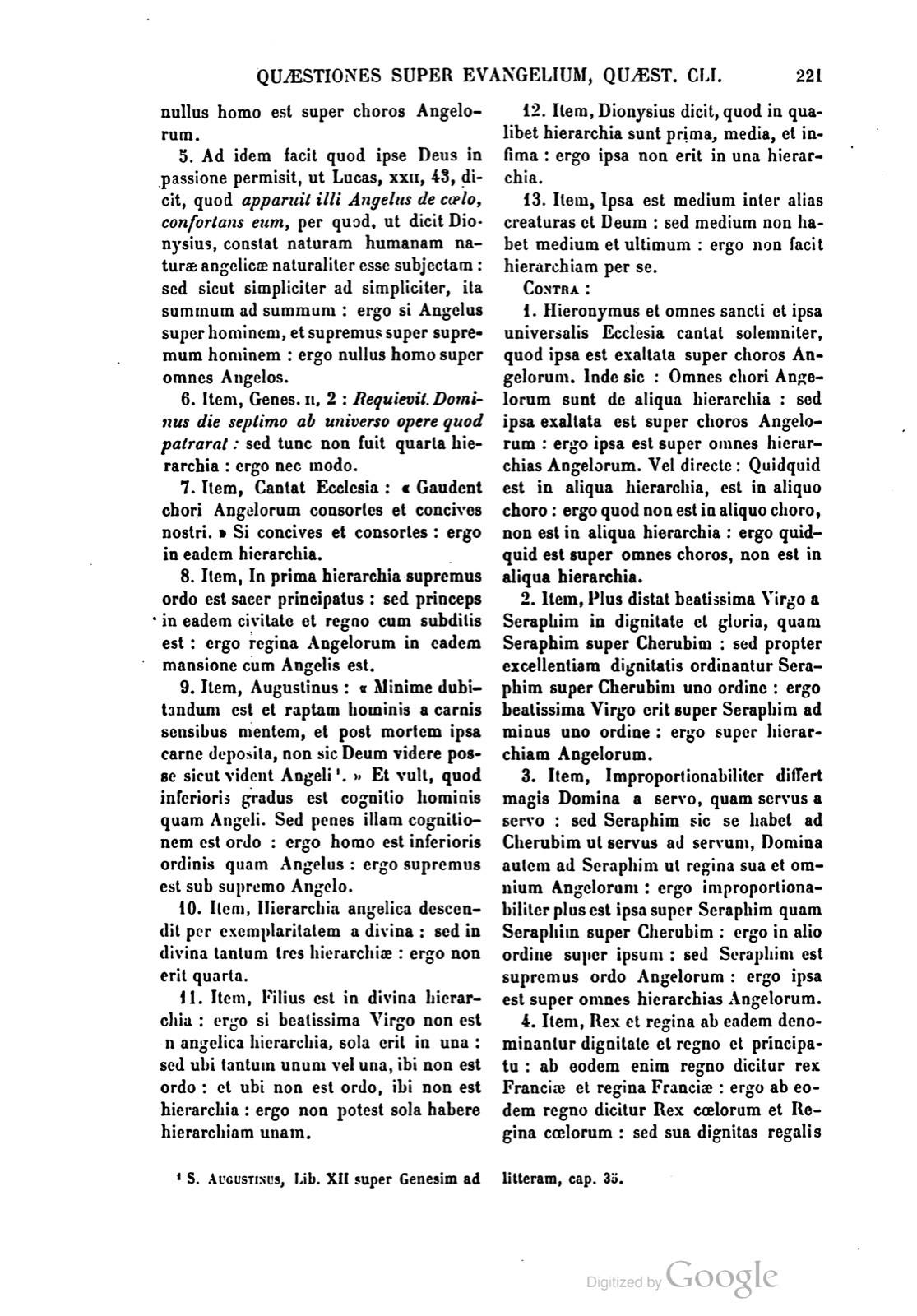
5. Item, III Regum, II, 19: Positus est thronus matri regis, quae sedit ad dexteram ejus, scilicet regis: sed constat, quod thronus regis improportionabiliter est super omnes thronos Angelorum: ergo thronus matris regis.
6. Item, Ipsa habet regnum per Filium, et dicitur regina a regno Filii: sed illud est increatum et aeternum: ergo ipsa est regina a regno aeterno.
7. Item, Alii homines possunt venire ad Seraphim: nullus autem ad dignitatem et statum beatissimae Virginis: est igitur super Seraphim.
8. Item, Status gloriae est elevatus super statum innocentiae in corporibus: ergo et in animabus: sed si homo stetisset, aliquis assumptus fuisset ad Seraphim: ergo aliquis modo debet elevari super ipsos.
9. Ad idem sunt auctoritates sanctorum. Augustinus: « Sed de te, o Virgo Maria, quid dicam pauper ingenio, cum quidquid dixero, minor laus est, quam dignitas tua meretur? Si caelum appelle, tu altior es. Si matrem gentium dicam, praecedis. Si formam Dei appellem, digna existis. Si Dominam Angelorum vocitem, super omnia te esse probaris 5. » Si igitur Domina Angelorum, ergo est super omnes Angelos.
10. Item, Hieronymus: « Haec est dies praeclara, in qua meruit exaltari super choros Angelorum et pervenire ultra quam nostrae humanitatis est natura, ubi non substantia tollitur, sed gloriae magnitudo monstratur, ubi Christus pro nobis introivit Pontifex factus in aeternum ad caeli palatium 6: » ergo exaltata ultra quam humanae naturae sit licitum, scilicet ubi Christus introivit: ergo super omnes hierarchias Angelorum.
11. Item, Hieronymus: « Haec est, inquam, dies in qua usque ad throni celsitudinem intemerata virgo et mater processit, atque in regni solium sublimata, post Christum gloriosa resedit. Sic itaque illi sancta Ecclesia canit, quod de nullo alio sanctorum fas est credere, ut ultra Angelorum et Archangelorum dignitatem merito transcenderit: quia etsi similitudo sanctis promittitur, veritas tamen negatur. » Et infra: « Non temere super choros Angelorum exaltata devotissime hodie praedicatur: quia praecessit eam Dominus et salvator noster ad caelestia, ut praepararet ei in aethereis mansionibus locum. » Ex his patet qualiter beatissima Virgo super ordines et hierarchias Angelorum, in quartam et novam hierarchiam cum Filio specialiter est exaltata.
5. Likewise, 3 Kings 2:19: A throne was placed for the mother of the king, who sat at his right hand, namely the king’s. But it is clear that the throne of the king is disproportionately above all thrones of Angels; therefore so is the throne of the mother of the king.
6. Likewise, she has the kingdom through the Son, and is called queen from the Son’s kingdom. But that kingdom is uncreated and eternal. Therefore she is queen from the eternal kingdom.
7. Likewise, other human beings can come to the Seraphim, but no one to the dignity and state of the most blessed Virgin. Therefore she is above the Seraphim.
8. Likewise, the state of glory is elevated above the state of innocence in bodies; therefore also in souls. But if man had stood, someone would have been assumed to the Seraphim. Therefore now someone ought to be elevated above them.
9. To the same point are authorities of the saints. Augustine says: “But concerning you, O Virgin Mary, what shall I, poor in talent, say, since whatever I say is less praise than your dignity deserves? If I call you heaven, you are higher. If I call you mother of nations, you precede. If I call you the form of God, you are worthy. If I call you Lady of Angels, you are proved to be above all things 5.” Therefore if she is Lady of Angels, she is above all Angels.
10. Likewise, Jerome says: “This is the bright day on which she merited to be exalted above the choirs of Angels and to arrive beyond what belongs to the nature of our humanity, where substance is not taken away, but the greatness of glory is shown, where Christ for us entered the palace of heaven, made high priest forever 6.” Therefore she was exalted beyond what is lawful to human nature, namely where Christ entered; therefore above all hierarchies of Angels.
11. Likewise, Jerome says: “This is, I say, the day on which the unblemished virgin and mother proceeded even to the height of the throne, and, raised to the seat of the kingdom, gloriously sat after Christ. Thus therefore holy Church sings to her what it is lawful to believe of no other saint, that by merit she transcended beyond the dignity of Angels and Archangels, because although likeness is promised to the saints, nevertheless truth is denied.” And below: “Not rashly is she today most devoutly proclaimed exalted above the choirs of Angels, because our Lord and savior preceded her to heavenly things to prepare a place for her in the ethereal mansions.” From these things it is clear how the most blessed Virgin, above the orders and hierarchies of Angels, was specially exalted with the Son into a fourth and new hierarchy.
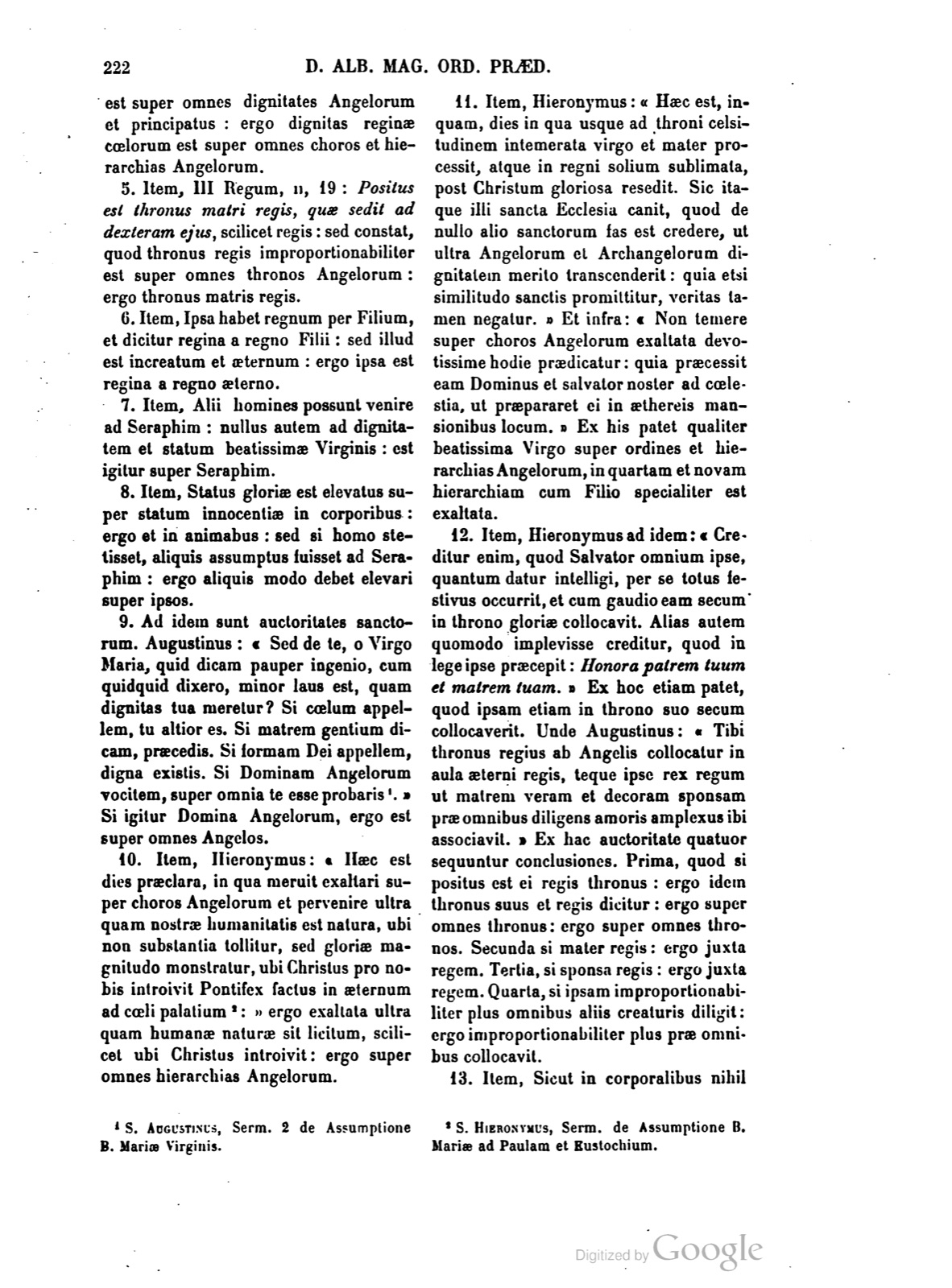
12. Item, Hieronymus ad idem: « Creditur enim, quod Salvator omnium ipse, quantum datur intelligi, per se totus festivus occurrit, et cum gaudio eam secum in throno gloriae collocavit. Alias autem quomodo implevisse creditur, quod in lege ipse praecepit: Honora patrem tuum et matrem tuam. » Ex hoc etiam patet, quod ipsam etiam in throno suo secum collocaverit. Unde Augustinus: « Tibi thronus regius ab Angelis collocatur in aula aeterni regis, teque ipse rex regum ut matrem veram et decoram sponsam prae omnibus diligens amoris amplexus ibi associavit. » Ex hac auctoritate quatuor sequuntur conclusiones. Prima, quod si positus est ei regis thronus: ergo idem thronus suus et regis dicitur: ergo super omnes thronus: ergo super omnes thronos. Secunda si mater regis: ergo juxta regem. Tertia, si sponsa regis: ergo juxta regem. Quarta, si ipsam improportionabiliter plus omnibus aliis creaturis diligit: ergo improportionabiliter plus prae omnibus collocavit.
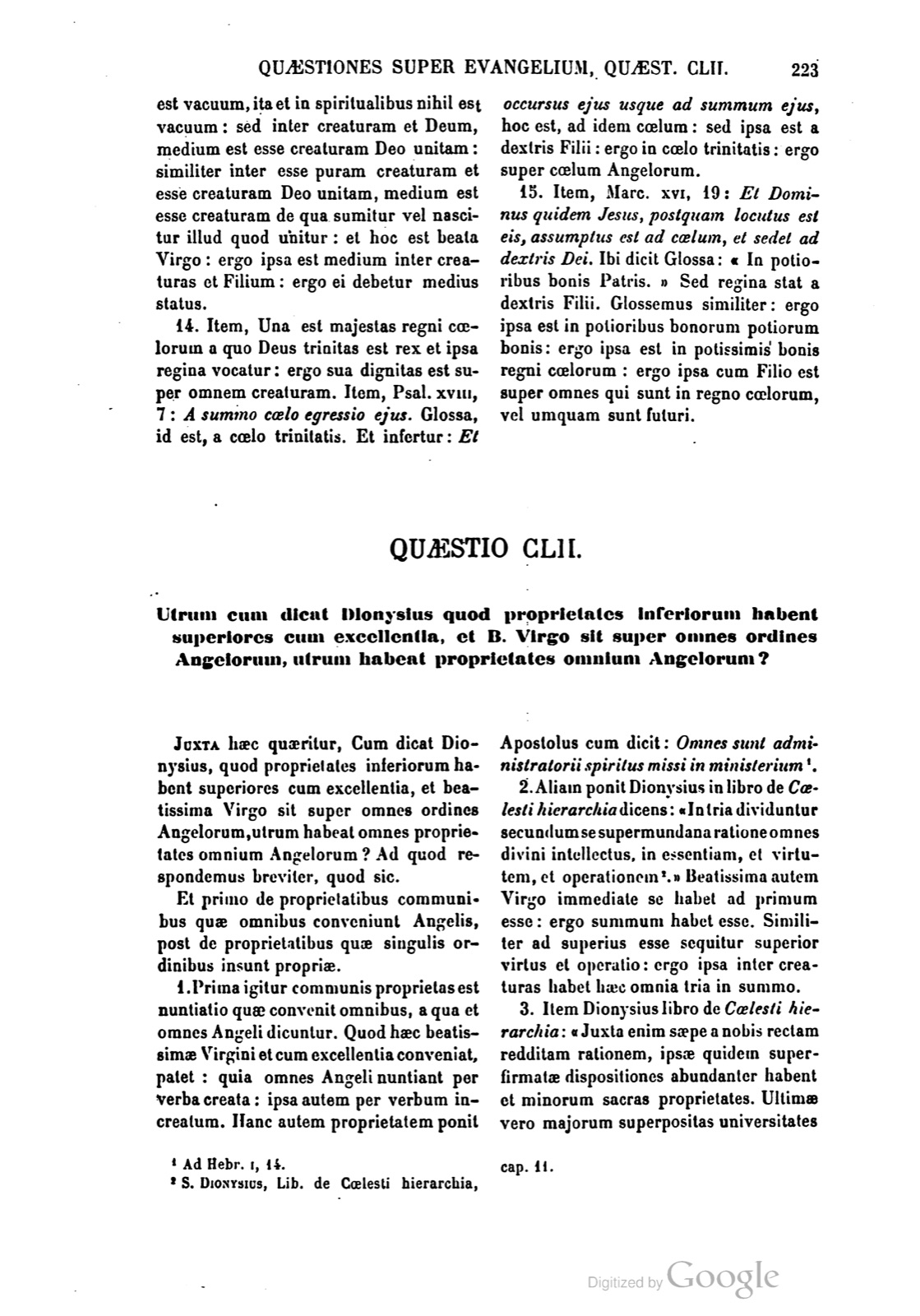
13. Item, Sicut in corporalibus nihil est vacuum, ita et in spiritualibus nihil est vacuum: sed inter creaturam et Deum, medium est esse creaturam Deo unitam: similiter inter esse puram creaturam et esse creaturam Deo unitam, medium est esse creaturam de qua sumitur vel nascitur illud quod unitur: et hoc est beata Virgo: ergo ipsa est medium inter creaturas et Filium: ergo ei debetur medius status.
14. Item, Una est majestas regni caelorum a quo Deus trinitas est rex et ipsa regina vocatur: ergo sua dignitas est super omnem creaturam. Item, Psal. XVIII, 7: A summo caelo egressio ejus. Glossa, id est, a caelo trinitatis. Et infertur: Et occursus ejus usque ad summum ejus, hoc est, ad idem caelum: sed ipsa est a dextris Filii: ergo in caelo trinitatis: ergo super caelum Angelorum.
15. Item, Marc. XVI, 19: Et Dominus quidem Jesus, postquam locutus est eis, assumptus est ad caelum, et sedet ad dextris Dei. Ibi dicit Glossa: « In potioribus bonis Patris. » Sed regina stat a dextris Filii. Glossemus similiter: ergo ipsa est in potioribus bonorum potiorum bonis: ergo ipsa est in potissimis bonis regni caelorum: ergo ipsa cum Filio est super omnes qui sunt in regno caelorum, vel umquam sunt futuri.
12. Likewise, Jerome to the same point says: “For it is believed that the Savior of all himself, insofar as it is given to understand, wholly festive by himself met her and with joy placed her with himself on the throne of glory. Otherwise how is he believed to have fulfilled what he himself commanded in the Law: Honor your father and your mother?” From this too it is clear that he placed her with himself even on his throne. Whence Augustine says: “For you a royal throne is set by the Angels in the court of the eternal king, and the king of kings himself, loving you before all as true mother and beautiful spouse, associated you there with the embrace of love.” From this authority four conclusions follow. The first, that if the throne of the king was placed for her, then the same throne is called hers and the king’s; therefore above every throne; therefore above all thrones. The second: if mother of the king, then beside the king. The third: if spouse of the king, then beside the king. The fourth: if he loves her disproportionately more than all other creatures, then he has placed her disproportionately more before all.
13. Likewise, as in bodily things nothing is empty, so also in spiritual things nothing is empty. But between creature and God the middle is to be a creature united to God. Similarly, between being a pure creature and being a creature united to God, the middle is to be the creature from whom that which is united is taken or born; and this is the blessed Virgin. Therefore she is the middle between creatures and the Son; therefore a middle state is owed to her.
14. Likewise, there is one majesty of the kingdom of the heavens, from which God the Trinity is king and she is called queen. Therefore her dignity is above every creature. Likewise, Psalm 18:7: His going forth is from the highest heaven. The Gloss says: that is, from the heaven of the Trinity. And it is inferred: And his meeting even to its highest point, that is, to the same heaven. But she is at the right hand of the Son. Therefore she is in the heaven of the Trinity; therefore above the heaven of Angels.
15. Likewise, Mark 16:19: And the Lord Jesus, after he had spoken to them, was taken up into heaven and sits at the right hand of God. There the Gloss says: “In the better goods of the Father.” But the queen stands at the right hand of the Son. Let us gloss similarly: therefore she is in the better goods of the better goods; therefore she is in the best goods of the kingdom of the heavens. Therefore she with the Son is above all who are in the kingdom of the heavens, or ever will be.
Notes
- Luke 15:8 and following. (Luc. XV, 8 et seq.) ↩
- Judith 11:25. (Judith, XI, 25.) ↩
- Luke 15:4 and following. (Luc. XV, 4 et seq.) ↩
- St. Augustine, book 12 on Genesis to the Letter, chapter 35. (S. Augustinus, Lib. XII super Genesim ad litteram, cap. 35.) ↩
- St. Augustine, Sermon 2 on the Assumption of the Blessed Virgin Mary. (S. Augustinus, Serm. 2 de Assumptione B. Mariae Virginis.) ↩
- St. Jerome, Sermon on the Assumption of Blessed Mary to Paula and Eustochium. (S. Hieronymus, Serm. de Assumptione B. Mariae ad Paulam et Eustochium.) ↩
If a page does not appear, its photograph has not been uploaded yet.