Works › The Mariale: Questions on “Missus est”
Volume 37 · pp. 223–225
Question 152. Whether she has the properties of all Angels?
A marker with ≈ is an approximate page boundary, placed by measure of the text; the page photographs remain the authority. In the paired views, clicking a page marker brings that page into view.
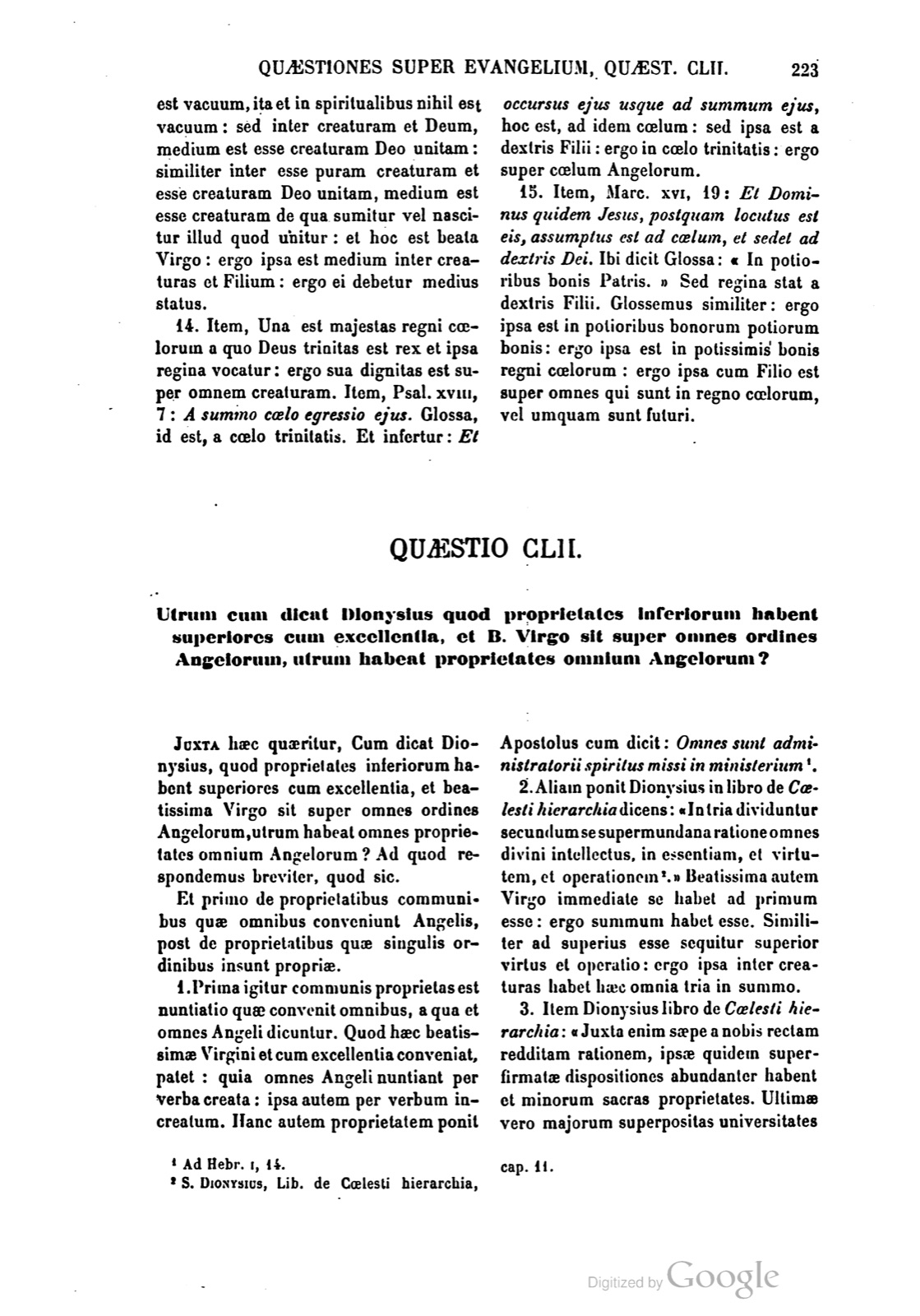
QUAESTIO CLII. Utrum cum dicat Dionysius quod proprietates inferiorum habent superiores cum excellentia, et B. Virgo sit super omnes ordines Angelorum, utrum habeat proprietates omnium Angelorum?
Juxta haec quaeritur, Cum dicat Dionysius, quod proprietates inferiorum habent superiores cum excellentia, et beatissima Virgo sit super omnes ordines Angelorum, utrum habeat omnes proprietates omnium Angelorum? Ad quod respondemus breviter, quod sic.
Et primo de proprietatibus communibus quae omnibus conveniunt Angelis, post de proprietatibus quae singulis ordinibus insunt propriae.
1. Prima igitur communis proprietas est nuntiatio quae convenit omnibus, a qua et omnes Angeli dicuntur. Quod haec beatissimae Virgini et cum excellentia conveniat, patet: quia omnes Angeli nuntiant per verba creata: ipsa autem per verbum increatum. Hanc autem proprietatem ponit Apostolus cum dicit: Omnes sunt administratorii spiritus missi in ministerium 1.
2. Aliam ponit Dionysius in libro de Caelesti hierarchia dicens: « In tria dividuntur secundum se supermundana ratione omnes divini intellectus, in essentiam, et virtutem, et operationem 2. » Beatissima autem Virgo immediate se habet ad primum esse: ergo summum habet esse. Similiter ad superius esse sequitur superior virtus et operatio: ergo ipsa inter creaturas habet haec omnia tria in summo.
3. Item Dionysius libro de Caelesti hierarchia: « Juxta enim saepe a nobis rectam redditam rationem, ipsae quidem superfirmatae dispositiones abundanter habent et minorum sacras proprietates. Ultimae vero majorum superpositas universitates non habent, particulariter in eas primo apparentibus illuminationibus, per primas proportionabiliter eis distributas 3. » Ergo cum beatissima Virgo superior sit omnibus caelestibus dispositionibus, ipsa habet proprietates omnium abundanter.
QUESTION 152. Whether, since Dionysius says that superiors have the properties of inferiors with excellence, and the Blessed Virgin is above all orders of Angels, she has the properties of all Angels?
In connection with these things it is asked: since Dionysius says that superiors have the properties of inferiors with excellence, and the most blessed Virgin is above all orders of Angels, whether she has all the properties of all Angels. To this we respond briefly that she does.
And first concerning the common properties which belong to all Angels; afterward concerning the properties proper to the individual orders.
1. Therefore the first common property is announcing, which belongs to all, from which all are also called Angels. That this belongs to the most blessed Virgin, and with excellence, is clear, because all Angels announce through created words, but she through the uncreated Word. The Apostle posits this property when he says: All are ministering spirits sent for ministry 1.
2. Dionysius posits another in the book On the Celestial Hierarchy, saying: “All divine intellects, by a supermundane account according to themselves, are divided into three: into essence, power, and operation 2.” But the most blessed Virgin is immediately related to the first being; therefore she has being in the highest degree. Similarly, a superior power and operation follows upon superior being. Therefore among creatures she has all these three things in the highest degree.
3. Likewise Dionysius in the book On the Celestial Hierarchy says: “According to the account often correctly given by us, the higher-established dispositions abundantly have also the sacred properties of the lesser ones. But the last do not have the superposed universals of the greater, the illuminations first appearing particularly in them being proportionally distributed to them through the first 3.” Therefore since the most blessed Virgin is higher than all heavenly dispositions, she has the properties of all abundantly.
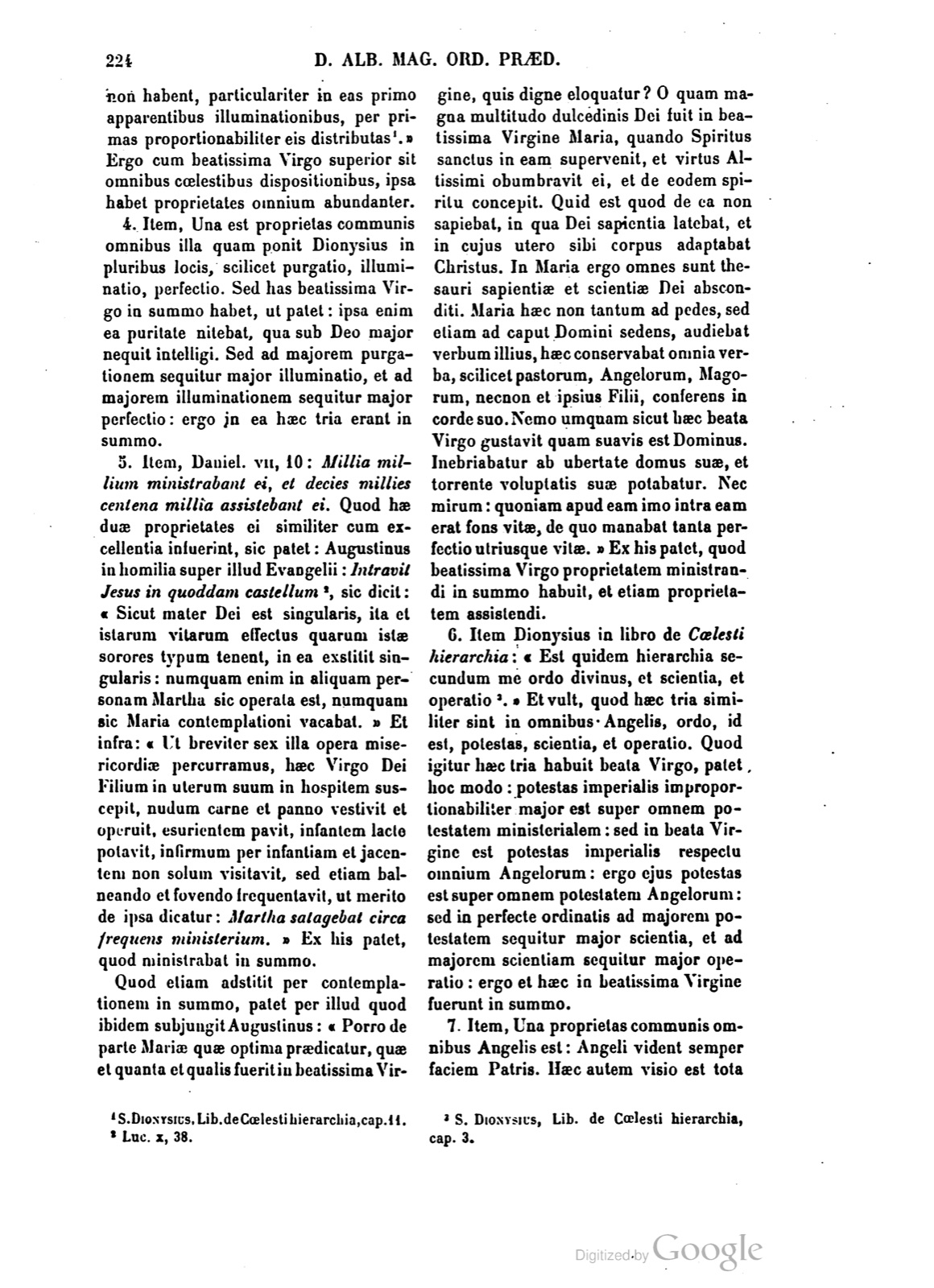
4. Item, Una est proprietas communis omnibus illa quam ponit Dionysius in pluribus locis, scilicet purgatio, illuminatio, perfectio. Sed has beatissima Virgo in summo habet, ut patet: ipsa enim ea puritate nitebat, qua sub Deo major nequit intelligi. Sed ad majorem purgationem sequitur major illuminatio, et ad majorem illuminationem sequitur major perfectio: ergo in ea haec tria erant in summo.
5. Item, Daniel. VII, 10: Millia millium ministrabant ei, et decies millies centena millia assistebant ei. Quod hae duae proprietates ei similiter cum excellentia infuerint, sic patet: Augustinus in homilia super illud Evangelii: Intravit Jesus in quoddam castellum 4, sic dicit: « Sicut mater Dei est singularis, ita et istarum vitarum effectus quarum istae sorores typum tenent, in ea exstitit singularis: numquam enim in aliquam personam Martha sic operata est, numquam sic Maria contemplationi vacabat. » Et infra: « Ut breviter sex illa opera misericordiae percurramus, haec Virgo Dei Filium in uterum suum in hospitem suscepit, nudum carne et panno vestivit et operuit, esurientem pavit, infantem lacte potavit, infirmum per infantiam et jacentem non solum visitavit, sed etiam balneando et fovendo frequentavit, ut merito de ipsa dicatur: Martha satagebat circa frequens ministerium. » Ex his patet, quod ministrabat in summo.
Quod etiam adstitit per contemplationem in summo, patet per illud quod ibidem subjungit Augustinus: « Porro de parte Mariae quae optima praedicatur, quae et quanta et qualis fuerit in beatissima Virgine, quis digne eloquatur? O quam magna multitudo dulcedinis Dei fuit in beatissima Virgine Maria, quando Spiritus sanctus in eam supervenit, et virtus Altissimi obumbravit ei, et de eodem spiritu concepit. Quid est quod de ea non sapiebat, in qua Dei sapientia latebat, et in cujus utero sibi corpus adaptabat Christus. In Maria ergo omnes sunt thesauri sapientiae et scientiae Dei absconditi. Maria haec non tantum ad pedes, sed etiam ad caput Domini sedens, audiebat verbum illius, haec conservabat omnia verba, scilicet pastorum, Angelorum, Magorum, necnon et ipsius Filii, conferens in corde suo. Nemo umquam sicut haec beata Virgo gustavit quam suavis est Dominus. Inebriabatur ab ubertate domus suae, et torrente voluptatis suae potabatur. Nec mirum: quoniam apud eam imo intra eam erat fons vitae, de quo manabat tanta perfectio utriusque vitae. » Ex his patet, quod beatissima Virgo proprietatem ministrandi in summo habuit, et etiam proprietatem assistendi.
4. Likewise, one property common to all is that which Dionysius posits in several places, namely purgation, illumination, and perfection. But the most blessed Virgin has these in the highest degree, as is clear: for she shone with that purity than which, under God, a greater cannot be understood. But upon greater purgation follows greater illumination, and upon greater illumination follows greater perfection. Therefore these three were in her in the highest degree.
5. Likewise, Daniel 7:10: Thousands of thousands ministered to him, and ten thousand times a hundred thousand stood before him. That these two properties likewise belonged to her with excellence is clear thus. Augustine in the homily on that Gospel saying, Jesus entered a certain village 4, says thus: “As the Mother of God is singular, so also the effect of those lives whose type those sisters bear existed singularly in her. For never did Martha so work upon any person, never was Mary so free for contemplation.” And below: “That we may briefly run through those six works of mercy, this Virgin received the Son of God into her womb as a guest, clothed and covered him naked with flesh and cloth, fed him hungry, gave him milk to drink as an infant, and when he was weak through infancy and lying down, she not only visited him, but also repeatedly attended him by bathing and warming him, so that deservedly it may be said of her: Martha was busy about much service.” From these things it is clear that she ministered in the highest degree.
That she also stood by through contemplation in the highest degree is clear through what Augustine adds in the same place: “But concerning the part of Mary which is proclaimed best, who could worthily speak what and how great and of what kind it was in the most blessed Virgin? O how great was the multitude of God’s sweetness in the most blessed Virgin Mary, when the Holy Spirit came upon her, and the power of the Most High overshadowed her, and she conceived from the same Spirit. What is there that did not have its savor from her, in whom the wisdom of God lay hidden, and in whose womb Christ was adapting a body for himself? Therefore in Mary all the treasures of the wisdom and knowledge of God are hidden. This Mary, sitting not only at the feet but also at the head of the Lord, heard his word; she kept all words, namely those of shepherds, Angels, Magi, and also of the Son himself, pondering them in her heart. No one ever tasted as this blessed Virgin did how sweet the Lord is. She was made drunk from the abundance of her house, and was given drink from the torrent of her pleasure. Nor is it marvelous, since with her, indeed within her, was the fountain of life, from which so great a perfection of each life flowed.” From these things it is clear that the most blessed Virgin had the property of ministering in the highest degree, and also the property of standing by.
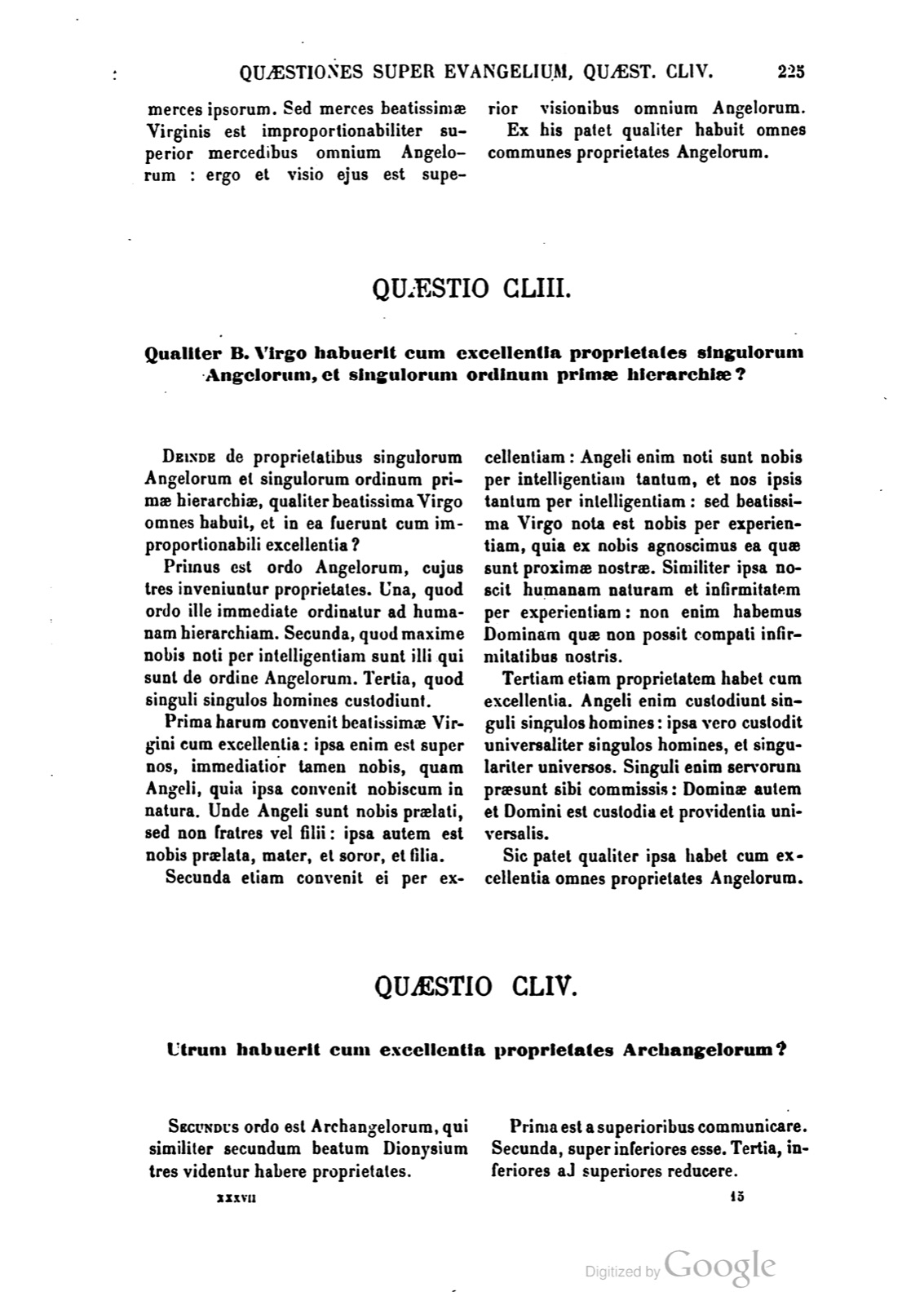
6. Item Dionysius in libro de Caelesti hierarchia: « Est quidem hierarchia secundum me ordo divinus, et scientia, et operatio 5. » Et vult, quod haec tria similiter sint in omnibus Angelis, ordo, id est, potestas, scientia, et operatio. Quod igitur haec tria habuit beata Virgo, patet, hoc modo: potestas imperialis improportionabiliter major est super omnem potestatem ministerialem: sed in beata Virgine est potestas imperialis respectu omnium Angelorum: ergo ejus potestas est super omnem potestatem Angelorum: sed in perfecte ordinatis ad majorem potestatem sequitur major scientia, et ad majorem scientiam sequitur major operatio: ergo et haec in beatissima Virgine fuerunt in summo.
7. Item, Una proprietas communis omnibus Angelis est: Angeli vident semper faciem Patris. Haec autem visio est tota merces ipsorum. Sed merces beatissimae Virginis est improportionabiliter superior mercedibus omnium Angelorum: ergo et visio ejus est superior visionibus omnium Angelorum.
Ex his patet qualiter habuit omnes communes proprietates Angelorum.
6. Likewise Dionysius in the book On the Celestial Hierarchy says: “Hierarchy, according to me, is a divine order, and knowledge, and operation 5.” And he means that these three are similarly in all Angels: order, that is, power, knowledge, and operation. Therefore that the blessed Virgin had these three is clear in this way: imperial power is disproportionately greater than every ministerial power. But in the blessed Virgin there is imperial power with respect to all Angels. Therefore her power is above every power of Angels. But in things perfectly ordered, greater knowledge follows upon greater power, and greater operation follows upon greater knowledge. Therefore these too were in the most blessed Virgin in the highest degree.
7. Likewise, one property common to all Angels is this: Angels always see the face of the Father. But this vision is their whole reward. Yet the reward of the most blessed Virgin is disproportionately higher than the rewards of all Angels. Therefore her vision also is higher than the visions of all Angels.
From these things it is clear how she had all the common properties of Angels.
Notes
- Hebrews 1:14. (Ad Hebr. I, 14.) ↩
- St. Dionysius, book On the Celestial Hierarchy, chapter 11. (S. Dionysius, Lib. de Caelesti hierarchia, cap. 11.) ↩
- St. Dionysius, book On the Celestial Hierarchy, chapter 11. (S. Dionysius, Lib. de Caelesti hierarchia, cap. 11.) ↩
- Luke 10:38. (Luc. X, 38.) ↩
- St. Dionysius, book On the Celestial Hierarchy, chapter 3. (S. Dionysius, Lib. de Caelesti hierarchia, cap. 3.) ↩
If a page does not appear, its photograph has not been uploaded yet.