Works › The Mariale: Questions on “Missus est”
Volume 37 · pp. 207–209
Question 146. Whether Mary is called star of the sea properly or by transference?
A marker with ≈ is an approximate page boundary, placed by measure of the text; the page photographs remain the authority. In the paired views, clicking a page marker brings that page into view.
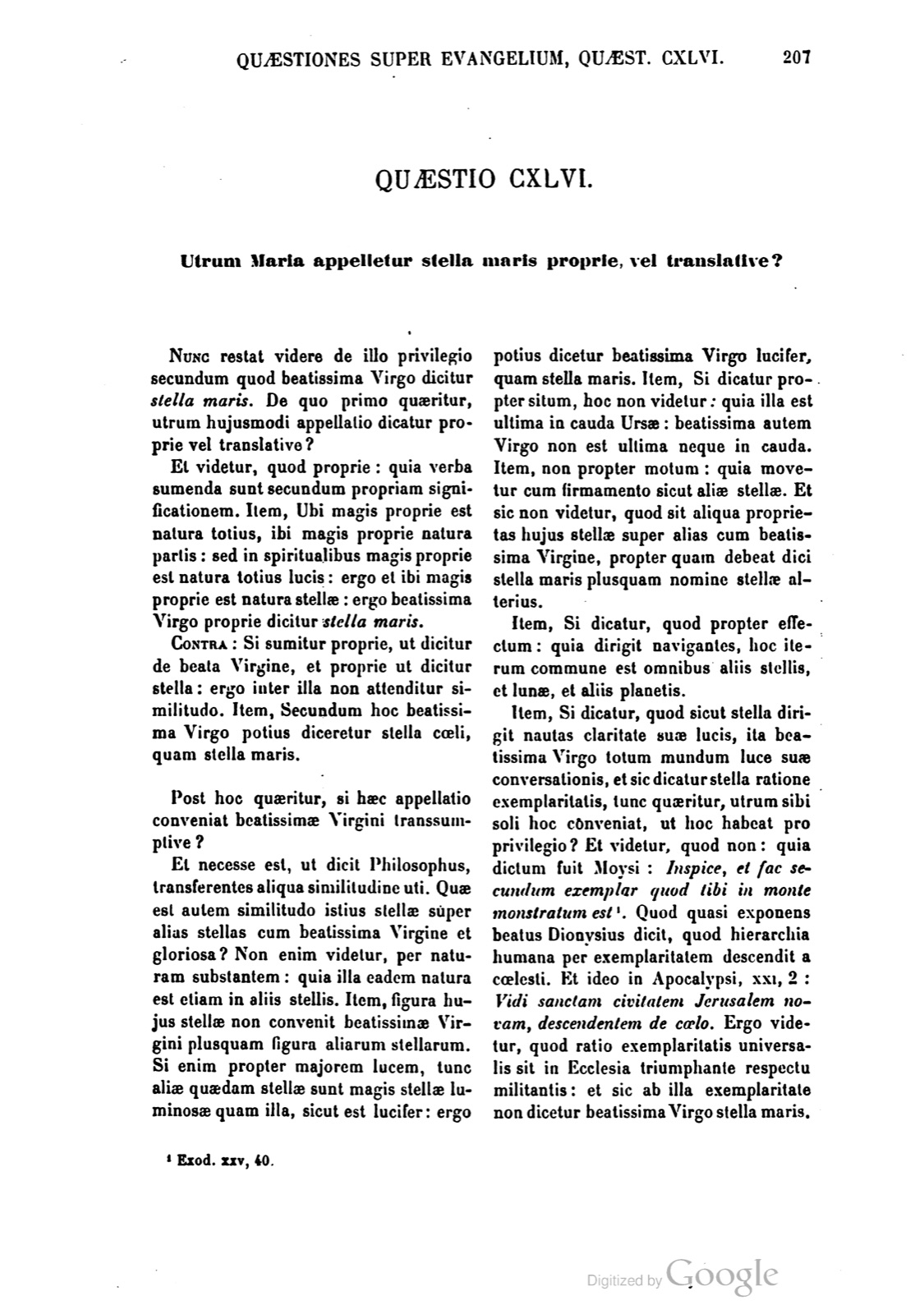
QUAESTIO CXLVI. Utrum Maria appelletur stella maris proprie, vel translative?
Nunc restat videre de illo privilegio secundum quod beatissima Virgo dicitur stella maris. De quo primo quaeritur, utrum hujusmodi appellatio dicatur proprie vel translative?
Et videtur, quod proprie: quia verba sumenda sunt secundum propriam significationem. Item, Ubi magis proprie est natura totius, ibi magis proprie natura partis: sed in spiritualibus magis proprie est natura totius lucis: ergo et ibi magis proprie est natura stellae: ergo beatissima Virgo proprie dicitur stella maris.
Contra: Si sumitur proprie, ut dicitur de beata Virgine, et proprie ut dicitur stella: ergo inter illa non attenditur similitudo. Item, Secundum hoc beatissima Virgo potius diceretur stella caeli, quam stella maris.
Post hoc quaeritur, si haec appellatio conveniat beatissimae Virgini transsumptive?
Et necesse est, ut dicit Philosophus, transferentes aliqua similitudine uti. Quae est autem similitudo istius stellae super alias stellas cum beatissima Virgine et gloriosa? Non enim videtur, per naturam substantem: quia illa eadem natura est etiam in aliis stellis. Item, figura hujus stellae non convenit beatissimae Virgini plusquam figura aliarum stellarum. Si enim propter majorem lucem, tunc aliae quaedam stellae sunt magis stellae luminosae quam illa, sicut est lucifer: ergo potius dicetur beatissima Virgo lucifer, quam stella maris. Item, Si dicatur propter situm, hoc non videtur: quia illa est ultima in cauda Ursae: beatissima autem Virgo non est ultima neque in cauda. Item, non propter motum: quia movetur cum firmamento sicut aliae stellae. Et sic non videtur, quod sit aliqua proprietas hujus stellae super alias cum beatissima Virgine, propter quam debeat dici stella maris plusquam nomine stellae alterius.
Item, Si dicatur, quod propter effectum: quia dirigit navigantes, hoc iterum commune est omnibus aliis stellis, et lunae, et aliis planetis.
Item, Si dicatur, quod sicut stella dirigit nautas claritate suae lucis, ita beatissima Virgo totum mundum luce suae conversationis, et sic dicatur stella ratione exemplaritatis, tunc quaeritur, utrum sibi soli hoc conveniat, ut hoc habeat pro privilegio? Et videtur, quod non: quia dictum fuit Moysi: Inspice, et fac secundum exemplar quod tibi in monte monstratum est 1. Quod quasi exponens beatus Dionysius dicit, quod hierarchia humana per exemplaritatem descendit a caelesti. Et ideo in Apocalypsi, XXI, 2: Vidi sanctam civitatem Jerusalem novam, descendentem de caelo. Ergo videtur, quod ratio exemplaritatis universalis sit in Ecclesia triumphante respectu militantis: et sic ab illa exemplaritate non dicetur beatissima Virgo stella maris.
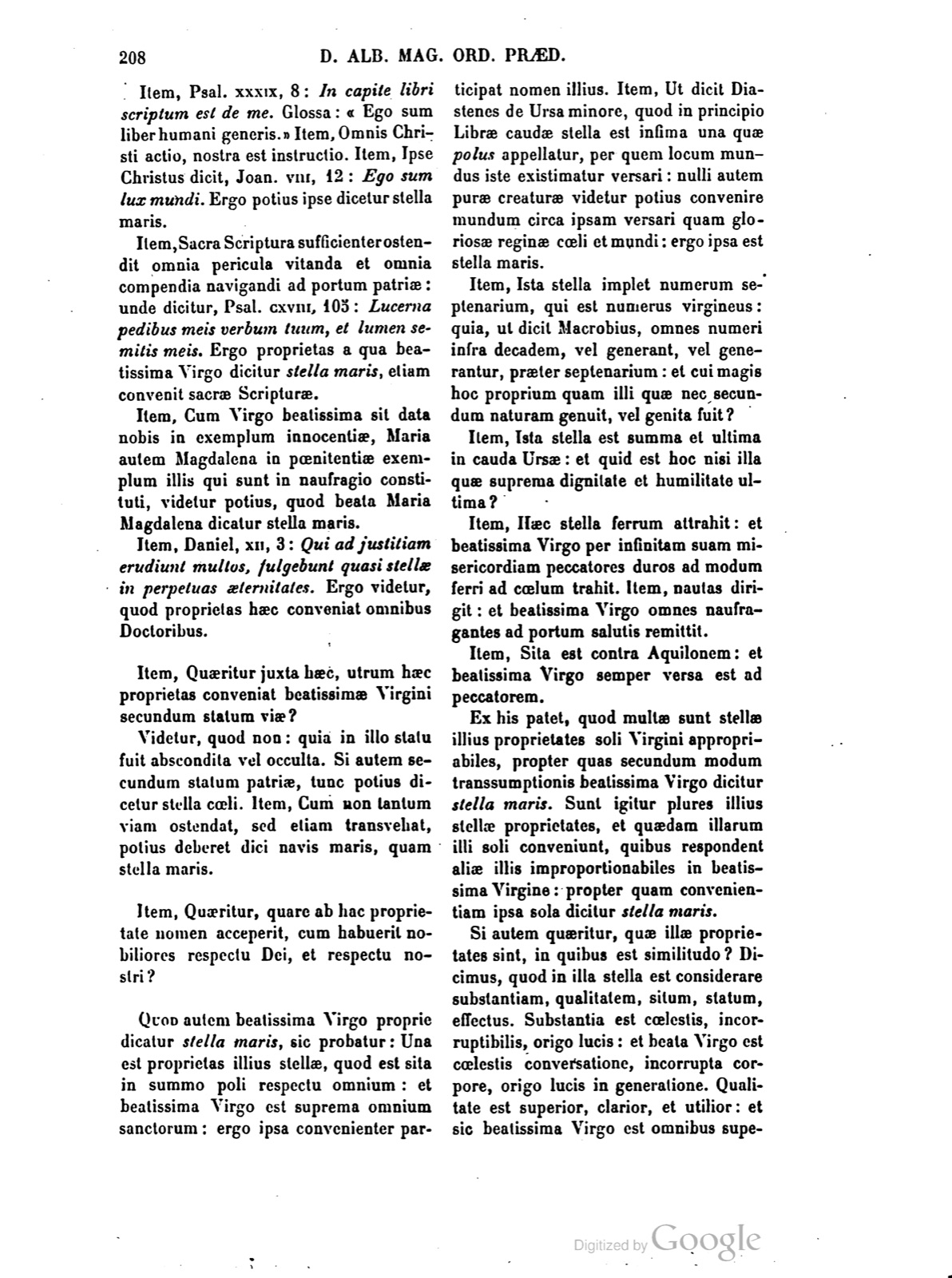
Item, Psal. XXXIX, 8: In capite libri scriptum est de me. Glossa: « Ego sum liber humani generis. » Item, Omnis Christi actio, nostra est instructio. Item, Ipse Christus dicit, Joan. VIII, 12: Ego sum lux mundi. Ergo potius ipse dicetur stella maris.
Item, Sacra Scriptura sufficienter ostendit omnia pericula vitanda et omnia compendia navigandi ad portum patriae: unde dicitur, Psal. CXVIII, 105: Lucerna pedibus meis verbum tuum, et lumen semitis meis. Ergo proprietas a qua beatissima Virgo dicitur stella maris, etiam convenit sacrae Scripturae.
QUESTION 146. Whether Mary is called star of the sea properly or by transference?
Now it remains to see concerning that privilege according to which the most blessed Virgin is called star of the sea. Concerning this it is first asked whether an appellation of this kind is said properly or by translation.
And it seems that it is said properly, because words are to be taken according to their proper signification. Likewise, where the nature of the whole is more properly, there also the nature of the part is more properly. But in spiritual things the nature of the whole light is more properly. Therefore there also the nature of a star is more properly; therefore the most blessed Virgin is properly called star of the sea.
To the contrary: if it is taken properly as it is said of the blessed Virgin, and properly as it is called a star, then likeness is not considered between those things. Likewise, according to this the most blessed Virgin would rather be called star of heaven than star of the sea.
After this it is asked whether this appellation belongs to the most blessed Virgin by transference.
And it is necessary, as the Philosopher says, that those transferring things use some likeness. But what is the likeness of that star above the other stars with the most blessed and glorious Virgin? For it does not seem to be by the underlying nature, because that same nature is also in the other stars. Likewise, the figure of this star does not belong to the most blessed Virgin more than the figure of the other stars. For if it is because of greater light, then certain other stars are more luminous stars than that one, such as the morning star. Therefore the most blessed Virgin will rather be called morning star than star of the sea. Likewise, if it is said to be because of position, this does not seem so, because that star is last in the tail of the Bear; but the most blessed Virgin is not last nor in a tail. Likewise, not because of motion, because it is moved with the firmament as the other stars are. And thus it does not seem that there is any property of this star above others with the most blessed Virgin, because of which she ought to be called star of the sea more than by the name of another star.
Likewise, if it is said that it is because of an effect, because it directs sailors, this again is common to all the other stars, and to the moon, and to the other planets.
Likewise, if it is said that as a star directs sailors by the brightness of its light, so the most blessed Virgin directs the whole world by the light of her manner of life, and thus she is called star by reason of exemplarity, then it is asked whether this belongs to her alone so that she has it as a privilege. And it seems not, because it was said to Moses: Look, and make it according to the pattern which was shown to you on the mountain 1. Explaining this, as it were, blessed Dionysius says that the human hierarchy descends by exemplarity from the heavenly one. And therefore in Apocalypse 21:2: I saw the holy city, the new Jerusalem, coming down from heaven. Therefore it seems that the reason of universal exemplarity is in the Church triumphant with respect to the militant Church; and thus from that exemplarity the most blessed Virgin will not be called star of the sea.
Likewise, Psalm 39:8: In the head of the book it is written of me. The Gloss says: “I am the book of the human race.” Likewise, every action of Christ is our instruction. Likewise, Christ himself says, John 8:12: I am the light of the world. Therefore he will rather be called star of the sea.
Likewise, Sacred Scripture sufficiently shows all dangers to be avoided and all shortcuts for sailing to the harbor of the homeland. Whence it is said, Psalm 118:105: Your word is a lamp to my feet and a light to my paths. Therefore the property from which the most blessed Virgin is called star of the sea also belongs to Sacred Scripture.
Item, Cum Virgo beatissima sit data nobis in exemplum innocentiae, Maria autem Magdalena in poenitentiae exemplum illis qui sunt in naufragio constituti, videtur potius, quod beata Maria Magdalena dicatur stella maris.
Item, Daniel, XII, 3: Qui ad justitiam erudiunt multos, fulgebunt quasi stellae in perpetuas aeternitates. Ergo videtur, quod proprietas haec conveniat omnibus Doctoribus.
Item, Quaeritur juxta haec, utrum haec proprietas conveniat beatissimae Virgini secundum statum viae?
Videtur, quod non: quia in illo statu fuit abscondita vel occulta. Si autem secundum statum patriae, tunc potius dicetur stella caeli. Item, Cum non tantum viam ostendat, sed etiam transvehat, potius deberet dici navis maris, quam stella maris.
Item, Quaeritur, quare ab hac proprietate nomen acceperit, cum habuerit nobiliores respectu Dei, et respectu nostri?
Quod autem beatissima Virgo proprie dicatur stella maris, sic probatur: Una est proprietas illius stellae, quod est sita in summo poli respectu omnium: et beatissima Virgo est suprema omnium sanctorum: ergo ipsa convenienter participat nomen illius. Item, Ut dicit Diastenes de Ursa minore, quod in principio Librae caudae stella est infima una quae polus appellatur, per quem locum mundus iste existimatur versari: nulli autem purae creaturae videtur potius convenire mundum circa ipsam versari quam gloriosae reginae caeli et mundi: ergo ipsa est stella maris.
Item, Ista stella implet numerum septenarium, qui est numerus virgineus: quia, ut dicit Macrobius, omnes numeri infra decadem, vel generant, vel generantur, praeter septenarium: et cui magis hoc proprium quam illi quae nec secundum naturam genuit, vel genita fuit?
Item, Ista stella est summa et ultima in cauda Ursae: et quid est hoc nisi illa quae suprema dignitate et humilitate ultima?
Item, Haec stella ferrum attrahit: et beatissima Virgo per infinitam suam misericordiam peccatores duros ad modum ferri ad caelum trahit. Item, nautas dirigit: et beatissima Virgo omnes naufragantes ad portum salutis remittit.
Item, Sita est contra Aquilonem: et beatissima Virgo semper versa est ad peccatorem.
Ex his patet, quod multae sunt stellae illius proprietates soli Virgini appropriabiles, propter quas secundum modum transsumptionis beatissima Virgo dicitur stella maris. Sunt igitur plures illius stellae proprietates, et quaedam illarum illi soli conveniunt, quibus respondent aliae illis improportionabiles in beatissima Virgine: propter quam convenientiam ipsa sola dicitur stella maris.
Si autem quaeritur, quae illae proprietates sint, in quibus est similitudo? Dicimus, quod in illa stella est considerare substantiam, qualitatem, situm, statum, effectus. Substantia est caelestis, incorruptibilis, origo lucis: et beata Virgo est caelestis conversatione, incorrupta corpore, origo lucis in generatione. Qualitate est superior, clarior, et utilior: et sic beatissima Virgo est omnibus superior dignitate, clarior virginitate, utilior foecunditate. Situ est suprema, et in cauda ultima: et beatissima est suprema situ poli in dilectione Dei, et in cauda nostrae turpitudinis protectione, et ultima humilitate. Statu haec stella est quasi sine motu, sine occasu, et quasi sine errore: et beatissima Virgo fuit sine motu inconstantiae, sine casu culpae, sine errore ignorantiae. Effectus stellae est triplex, ferrum attrahit, lucem tribuit, nautas dirigit. Sic beatissima Virgo attrahit peccatores, illuminat poenitentes, dirigit innocentes. Item, attrahit a culpa, illuminat in justitia, dirigit ad gloriam. Vel sic, attrahit insipientes, illuminat proficientes, diligit perfectos et perseverantes.
Likewise, since the most blessed Virgin has been given to us as an example of innocence, but Mary Magdalene as an example of penitence to those who have been placed in shipwreck, it seems rather that blessed Mary Magdalene should be called star of the sea.
Likewise, Daniel 12:3: Those who instruct many to justice shall shine like stars unto perpetual eternities. Therefore it seems that this property belongs to all Doctors.
Likewise, in connection with these things it is asked whether this property belongs to the most blessed Virgin according to the state of the way.
It seems not, because in that state she was hidden or concealed. But if according to the state of the homeland, then she will rather be called star of heaven. Likewise, since she not only shows the way but also carries across, she ought rather to be called ship of the sea than star of the sea.
Likewise, it is asked why she received her name from this property, since she had nobler ones with respect to God and with respect to us.
But that the most blessed Virgin is properly called star of the sea is proved thus: one property of that star is that it is placed at the highest point of the pole with respect to all; and the most blessed Virgin is the highest of all saints; therefore she fittingly shares its name. Likewise, as Diastenes says about the Lesser Bear, that at the beginning of the tail of Libra there is one lowest star which is called the pole, through which place this world is judged to turn; but it seems to belong to no pure creature rather than to the glorious queen of heaven and the world that the world turns around her. Therefore she is star of the sea.
Likewise, that star fills out the number seven, which is a virginal number, because, as Macrobius says, all numbers below the decade either generate or are generated, except seven; and to whom is this more proper than to her who neither generated nor was generated according to nature?
Likewise, that star is the highest and last in the tail of the Bear. And what is this except she who is highest in dignity and last in humility?
Likewise, this star attracts iron, and the most blessed Virgin through her infinite mercy draws sinners, hard like iron, to heaven. Likewise, it directs sailors, and the most blessed Virgin sends back all shipwrecked persons to the harbor of salvation.
Likewise, it is set against the North, and the most blessed Virgin is always turned toward the sinner.
From these things it is clear that there are many properties of that star capable of being appropriated to the Virgin alone, because of which, according to the mode of transference, the most blessed Virgin is called star of the sea. Therefore there are several properties of that star, and some of them belong to her alone, to which other properties, disproportionate to those, correspond in the most blessed Virgin; because of this agreement she alone is called star of the sea.
But if it is asked what those properties are in which there is likeness, we say that in that star one must consider substance, quality, position, state, and effects. Its substance is heavenly, incorruptible, and origin of light; and the blessed Virgin is heavenly in manner of life, incorrupt in body, and origin of light in generation. In quality it is higher, brighter, and more useful; and thus the most blessed Virgin is higher than all in dignity, brighter in virginity, more useful in fecundity. In position it is highest, and last in the tail; and the most blessed one is highest by the position of the pole in love of God, and in the tail of our foulness by protection, and last by humility. In state this star is as though without motion, without setting, and as though without error; and the most blessed Virgin was without motion of inconstancy, without fall of fault, without error of ignorance. The effect of the star is threefold: it attracts iron, gives light, and directs sailors. Thus the most blessed Virgin attracts sinners, illuminates penitents, directs the innocent. Likewise, she attracts from fault, illuminates in justice, directs to glory. Or thus: she attracts the unwise, illuminates those making progress, loves the perfect and persevering.
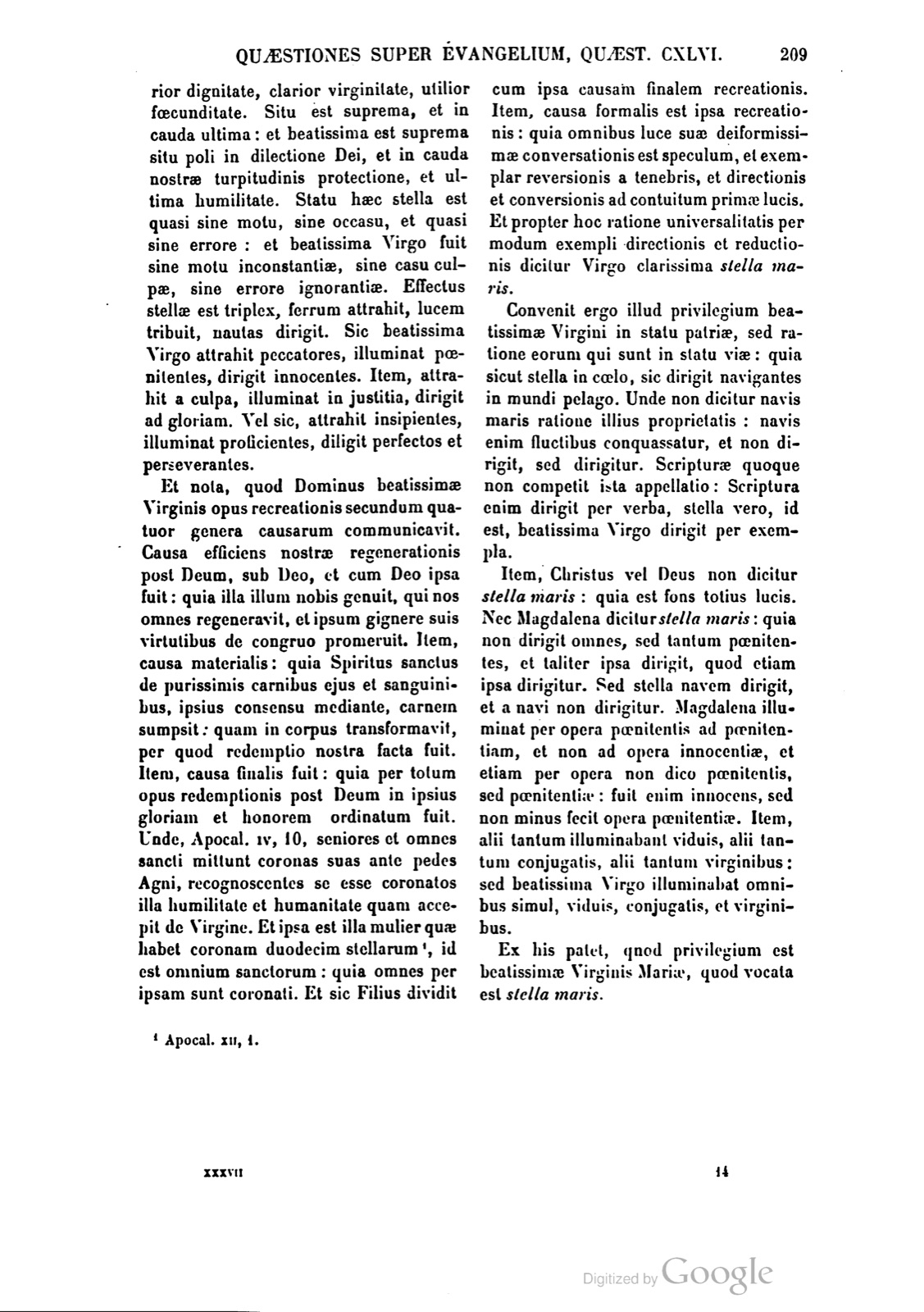
Et nota, quod Dominus beatissimae Virginis opus recreationis secundum quatuor genera causarum communicavit. Causa efficiens nostrae regenerationis post Deum, sub Deo, et cum Deo ipsa fuit: quia illa illum nobis genuit, qui nos omnes regeneravit, et ipsum gignere suis virtutibus de congruo promeruit. Item, causa materialis: quia Spiritus sanctus de purissimis carnibus ejus et sanguinibus, ipsius consensu mediante, carnem sumpsit: quam in corpus transformavit, per quod redemptio nostra facta fuit. Item, causa finalis fuit: quia per totum opus redemptionis post Deum in ipsius gloriam et honorem ordinatum fuit. Unde, Apocal. XII, 1, seniores et omnes sancti mittunt coronas suas ante pedes Agni, recognoscentes se esse coronatos illa humilitate et humanitate quam accepit de Virgine. Et ipsa est illa mulier quae habet coronam duodecim stellarum 2, id est omnium sanctorum: quia omnes per ipsam sunt coronati. Et sic Filius dividit cum ipsa causam finalem recreationis. Item, causa formalis est ipsa recreationis: quia omnibus luce suae deiformissimae conversationis est speculum, et exemplar reversionis a tenebris, et directionis et conversionis ad contuitum primae lucis. Et propter hoc ratione universalitatis per modum exempli directionis et reductionis dicitur Virgo clarissima stella maris.
Convenit ergo illud privilegium beatissimae Virgini in statu patriae, sed ratione eorum qui sunt in statu viae: quia sicut stella in caelo, sic dirigit navigantes in mundi pelago. Unde non dicitur navis maris ratione illius proprietatis: navis enim fluctibus conquassatur, et non dirigit, sed dirigitur. Scripturae quoque non competit ista appellatio: Scriptura enim dirigit per verba, stella vero, id est, beatissima Virgo dirigit per exempla.
Item, Christus vel Deus non dicitur stella maris: quia est fons totius lucis. Nec Magdalena dicitur stella maris: quia non dirigit omnes, sed tantum poenitentes, et taliter ipsa dirigit, quod etiam ipsa dirigitur. Sed stella navem dirigit, et a navi non dirigitur. Magdalena illuminat per opera poenitentis ad poenitentiam, et non ad opera innocentiae, et etiam per opera non dico poenitentis, sed poenitentiae: fuit enim innocens, sed non minus fecit opera poenitentiae. Item, alii tantum illuminabant viduis, alii tantum conjugatis, alii tantum virginibus: sed beatissima Virgo illuminabat omnibus simul, viduis, conjugatis, et virginibus.
Ex his patet, quod privilegium est beatissimae Virginis Mariae, quod vocata est stella maris.
And note that the Lord communicated the work of recreation to the most blessed Virgin according to the four genera of causes. She herself was the efficient cause of our regeneration after God, under God, and with God, because she gave birth for us to him who regenerated us all, and she merited congruously by her virtues to beget him. Likewise, the material cause, because the Holy Spirit, by mediation of her consent, took flesh from her most pure flesh and blood, which he transformed into a body, through which our redemption was made. Likewise, she was the final cause, because after God the whole work of redemption was ordered to her glory and honor. Whence, Apocalypse 12:1, the elders and all saints cast their crowns before the feet of the Lamb, recognizing that they have been crowned by that humility and humanity which he received from the Virgin. And she is that woman who has the crown of twelve stars 2, that is, of all saints, because all have been crowned through her. And thus the Son shares with her the final cause of recreation. Likewise, she is the formal cause of that recreation, because by the light of her most God-formed manner of life she is for all a mirror and exemplar of return from darkness, and of direction and conversion to the beholding of the first light. And because of this, by reason of universality, through the mode of an example of direction and leading back, the most bright Virgin is called star of the sea.
Therefore that privilege belongs to the most blessed Virgin in the state of the homeland, but by reason of those who are in the state of the way, because as a star in heaven directs sailors, so she directs those sailing on the sea of the world. Whence she is not called ship of the sea by reason of that property, for a ship is shaken by waves and does not direct but is directed. Nor does this appellation belong to Scripture: for Scripture directs by words, but the star, that is, the most blessed Virgin, directs by examples.
Likewise, Christ or God is not called star of the sea, because he is the fountain of the whole light. Nor is Magdalene called star of the sea, because she does not direct all, but only penitents, and she directs in such a way that she too is directed. But a star directs a ship and is not directed by a ship. Magdalene illuminates through the works of a penitent toward penitence, and not toward works of innocence, and also through works, I do not say of one penitent, but of penitence; for she was innocent, but nevertheless did works of penitence. Likewise, some illuminated only widows, others only married persons, others only virgins; but the most blessed Virgin illuminated all at once, widows, married persons, and virgins.
From these things it is clear that it is a privilege of the most blessed Virgin Mary that she was called star of the sea.
If a page does not appear, its photograph has not been uploaded yet.