Works › The Mariale: Questions on “Missus est”
Volume 37 · pp. 194–196
Question 138. Whether according to that state she shone with that purity than which no greater can be understood under God?
A marker with ≈ is an approximate page boundary, placed by measure of the text; the page photographs remain the authority. In the paired views, clicking a page marker brings that page into view.
QUAESTIO CXXXVIII. Utrum niteret secundum statum illum ea puritate, scilicet qua sub Deo nequit major intelligi?
Secundum hoc quaeritur, utrum beatissima Virgo niteret secundum statum illum ea puritate, scilicet qua sub Deo major nequit intelligi?
Et videtur, quod non: quia
1. Etiam ipsa post in statu gloriae nitebat majori puritate, et tamen sub Deo.
2. Item, Omnes sancti patriae in sua puritate plus videntur appropinquare puritati patriae quam quaecumque puritas viae: illa enim sufficit ad hoc ut possint primam lucem per speciem videre: haec autem non ita: ergo Virgo beatissima non nitebat summa sub Deo puritate.
3. Item, Si dicatur, quod intelligitur secundum statum viae, adhuc non videtur, quod possit stare: quia anima Christi quae creatura fuit, in statu viae majori nitebat puritate quam beatissima Virgo.
Contra praedicta objicitur in hunc modum:
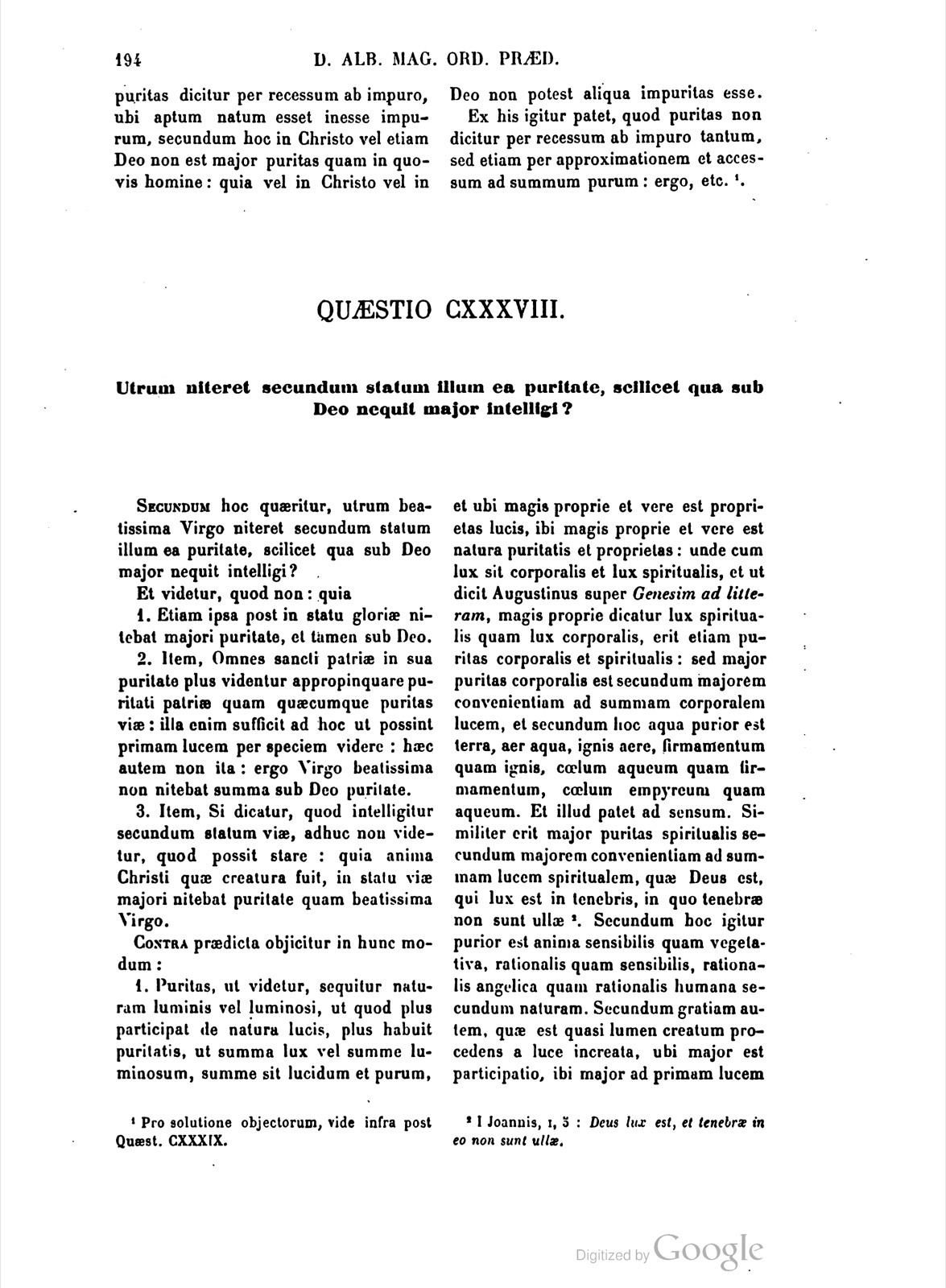
1. Puritas, ut videtur, sequitur naturam luminis vel luminosi, ut quod plus participat de natura lucis, plus habuit puritatis, ut summa lux vel summe luminosum, summe sit lucidum et purum, et ubi magis proprie et vere est proprietas lucis, ibi magis proprie et vere est natura puritatis et proprietas: unde cum lux sit corporalis et lux spiritualis, et ut dicit Augustinus super Genesim ad litteram, magis proprie dicatur lux spiritualis quam lux corporalis, erit etiam puritas corporalis et spiritualis: sed major puritas corporalis est secundum majorem convenientiam ad summam corporalem lucem, et secundum hoc aqua purior est terra, aer aqua, ignis aere, firmamentum quam ignis, caelum aqueum quam firmamentum, caelum empyreum quam aqueum. Et illud patet ad sensum. Similiter erit major puritas spiritualis secundum majorem convenientiam ad summam lucem spiritualem, quae Deus est, qui lux est in tenebris, in quo tenebrae non sunt ullae 1. Secundum hoc igitur purior est anima sensibilis quam vegetativa, rationalis quam sensibilis, rationalis angelica quam rationalis humana secundum naturam. Secundum gratiam autem, quae est quasi lumen creatum procedens a luce increata, ubi major est participatio, ibi major ad primam lucem appropinquatio: ergo ubi gratia in summo, ibi appropinquatio in summo et puritas in summo. Sed in beatissima Virgine respectu omnium aliarum creaturarum non unitarum fuit gratia in summo: ergo appropinquatio in summo ad primam lucem: ergo puritas in summo.
QUESTION 138. Whether according to that state she shone with that purity than which no greater can be understood under God?
According to this it is asked whether the most blessed Virgin shone according to that state with that purity, namely that than which no greater can be understood under God.
And it seems that she did not, because:
1. Even she herself afterward in the state of glory shone with greater purity, and yet under God.
2. Likewise, all the saints of the homeland in their purity seem to approach more closely the purity of the homeland than any purity of the way: for that purity suffices for this, that they can see the first light through its species; but this one does not so suffice. Therefore the most blessed Virgin did not shine with the highest purity under God.
3. Likewise, if it is said that this is understood according to the state of the way, it still does not seem able to stand, because the soul of Christ, which was a creature, in the state of the way shone with greater purity than the most blessed Virgin.
Against the foregoing one objects in this way:
1. Purity, as it seems, follows the nature of light or of the luminous, so that what participates more in the nature of light had more purity, so that the highest light or the supremely luminous is supremely bright and pure; and where the property of light is more properly and truly, there the nature and property of purity is more properly and truly. Hence since there is bodily light and spiritual light, and, as Augustine says on Genesis to the letter, spiritual light is more properly called light than bodily light, there will also be bodily and spiritual purity. But greater bodily purity exists according to greater agreement with the highest bodily light, and according to this water is purer than earth, air than water, fire than air, the firmament than fire, the aqueous heaven than the firmament, the empyrean heaven than the aqueous. And that is clear to sense. Similarly there will be greater spiritual purity according to greater agreement with the highest spiritual light, which is God, who is light in darkness, in whom there are no darknesses 1. According to this, therefore, the sensitive soul is purer than the vegetative, the rational than the sensitive, the angelic rational soul than the human rational soul according to nature. But according to grace, which is as it were a created light proceeding from uncreated light, where there is greater participation, there is greater approach to the first light. Therefore where grace is in the highest degree, there is approach in the highest degree and purity in the highest degree. But in the most blessed Virgin, with respect to all other non-united creatures, grace was in the highest degree. Therefore there was approach in the highest degree to the first light; therefore purity in the highest degree.
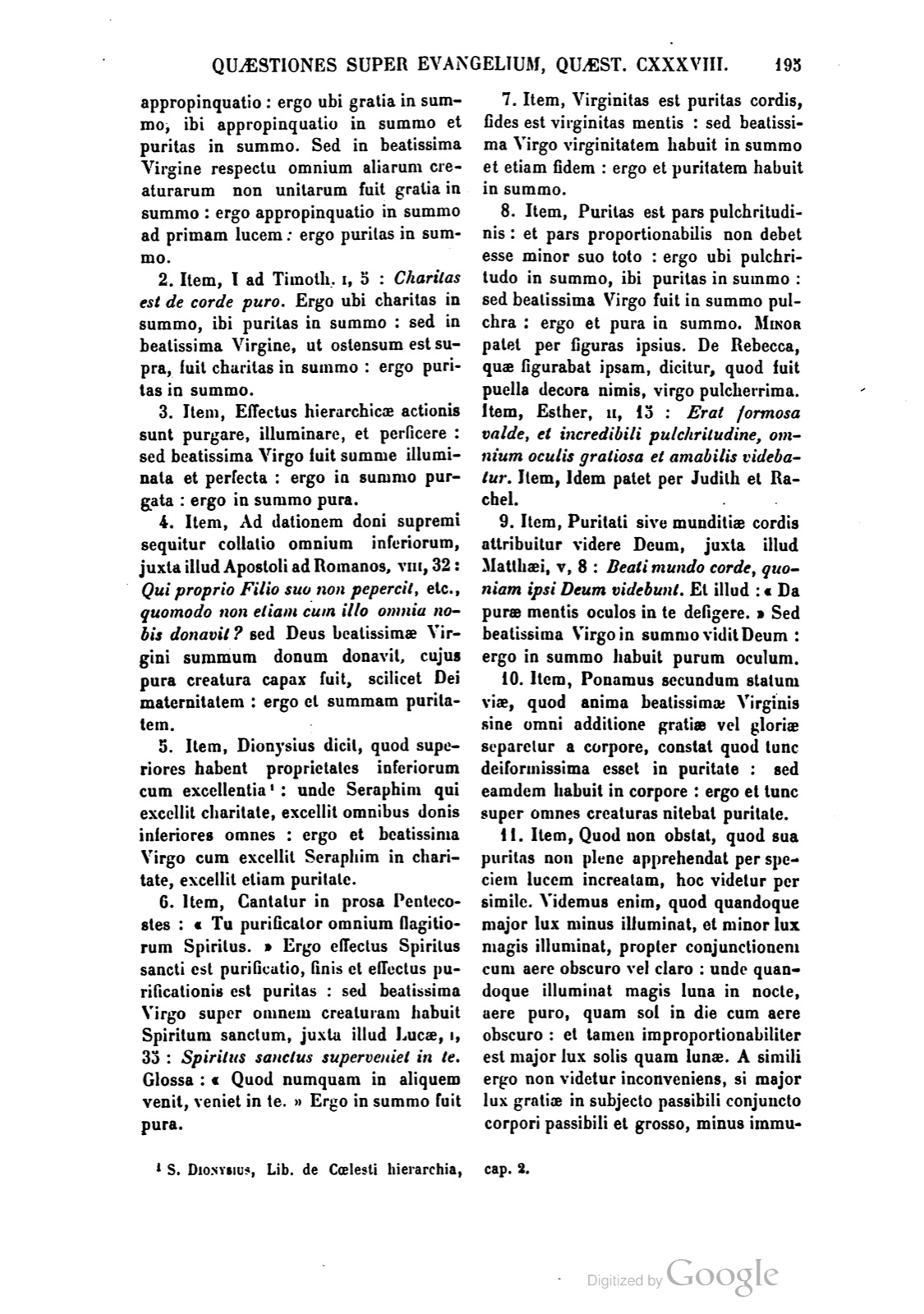
2. Item, I ad Timoth. I, 5: Charitas est de corde puro. Ergo ubi charitas in summo, ibi puritas in summo: sed in beatissima Virgine, ut ostensum est supra, fuit charitas in summo: ergo puritas in summo.
3. Item, Effectus hierarchicae actionis sunt purgare, illuminare, et perficere: sed beatissima Virgo fuit summe illuminata et perfecta: ergo in summo purgata: ergo in summo pura.
4. Item, Ad dationem doni supremi sequitur collatio omnium inferiorum, juxta illud Apostoli ad Romanos, VIII, 32: Qui proprio Filio suo non pepercit, etc., quomodo non etiam cum illo omnia nobis donavit? sed Deus beatissimae Virgini summum donum donavit, cujus pura creatura capax fuit, scilicet Dei maternitatem: ergo et summam puritatem.
5. Item, Dionysius dicit, quod superiores habent proprietates inferiorum cum excellentia 2: unde Seraphim qui excellit charitate, excellit omnibus donis inferiores omnes: ergo et beatissima Virgo cum excellit Seraphim in charitate, excellit etiam puritate.
6. Item, Cantatur in prosa Pentecostes: « Tu purificator omnium flagitiorum Spiritus. » Ergo effectus Spiritus sancti est purificatio, finis et effectus purificationis est puritas: sed beatissima Virgo super omnem creaturam habuit Spiritum sanctum, juxta illud Lucae, I, 35: Spiritus sanctus superveniet in te. Glossa: « Quod numquam in aliquem venit, veniet in te. » Ergo in summo fuit pura.
7. Item, Virginitas est puritas cordis, fides est virginitas mentis: sed beatissima Virgo virginitatem habuit in summo et etiam fidem: ergo et puritatem habuit in summo.
2. Likewise, 1 Timothy 1:5: Charity is from a pure heart. Therefore where charity is in the highest degree, there purity is in the highest degree. But in the most blessed Virgin, as was shown above, charity was in the highest degree. Therefore purity was in the highest degree.
3. Likewise, the effects of hierarchical action are to purge, to illuminate, and to perfect. But the most blessed Virgin was supremely illuminated and perfected. Therefore she was purged in the highest degree; therefore pure in the highest degree.
4. Likewise, upon the giving of the supreme gift there follows the conferral of all lower gifts, according to that saying of the Apostle in Romans 8:32: He who did not spare his own Son, etc., how has he not also given us all things with him? But God gave to the most blessed Virgin the supreme gift of which a pure creature was capable, namely the maternity of God. Therefore he also gave the highest purity.
5. Likewise, Dionysius says that higher things have the properties of lower things with excellence 2. Hence the Seraph, who excels in charity, excels all lower beings in all gifts. Therefore also the most blessed Virgin, since she excels the Seraph in charity, also excels in purity.
6. Likewise, it is sung in the prose of Pentecost: “You, Spirit, purifier of all crimes.” Therefore the effect of the Holy Spirit is purification; the end and effect of purification is purity. But the most blessed Virgin had the Holy Spirit beyond every creature, according to Luke 1:35: The Holy Spirit will come upon you. The Gloss says: “What never came into anyone will come into you.” Therefore she was pure in the highest degree.
7. Likewise, virginity is purity of heart; faith is virginity of mind. But the most blessed Virgin had virginity in the highest degree and also faith. Therefore she also had purity in the highest degree.
8. Item, Puritas est pars pulchritudinis: et pars proportionabilis non debet esse minor suo toto: ergo ubi pulchritudo in summo, ibi puritas in summo: sed beatissima Virgo fuit in summo pulchra: ergo et pura in summo. Minor patet per figuras ipsius. De Rebecca, quae figurabat ipsam, dicitur, quod fuit puella decora nimis, virgo pulcherrima. Item, Esther, II, 15: Erat formosa valde, et incredibili pulchritudine, omnium oculis gratiosa et amabilis videbatur. Item, Idem patet per Judith et Rachel.
9. Item, Puritati sive munditiae cordis attribuitur videre Deum, juxta illud Matthaei, V, 8: Beati mundo corde, quoniam ipsi Deum videbunt. Et illud: « Da purae mentis oculos in te defigere. » Sed beatissima Virgo in summo vidit Deum: ergo in summo habuit purum oculum.
10. Item, Ponamus secundum statum viae, quod anima beatissimae Virginis sine omni additione gratiae vel gloriae separetur a corpore, constat quod tunc deiformissima esset in puritate: sed eamdem habuit in corpore: ergo et tunc super omnes creaturas nitebat puritate.
11. Item, Quod non obstat, quod sua puritas non plene apprehendat per speciem lucem increatam, hoc videtur per simile. Videmus enim, quod quandoque major lux minus illuminat, et minor lux magis illuminat, propter conjunctionem cum aere obscuro vel claro: unde quandoque illuminat magis luna in nocte, aere puro, quam sol in die cum aere obscuro: et tamen improportionabiliter est major lux solis quam lunae. A simili ergo non videtur inconveniens, si major lux gratiae in subjecto passibili conjuncto corpori passibili et grosso, minus immutat et movet actualiter, quam minor lux gloriae in subjecto impassibili et glorioso.
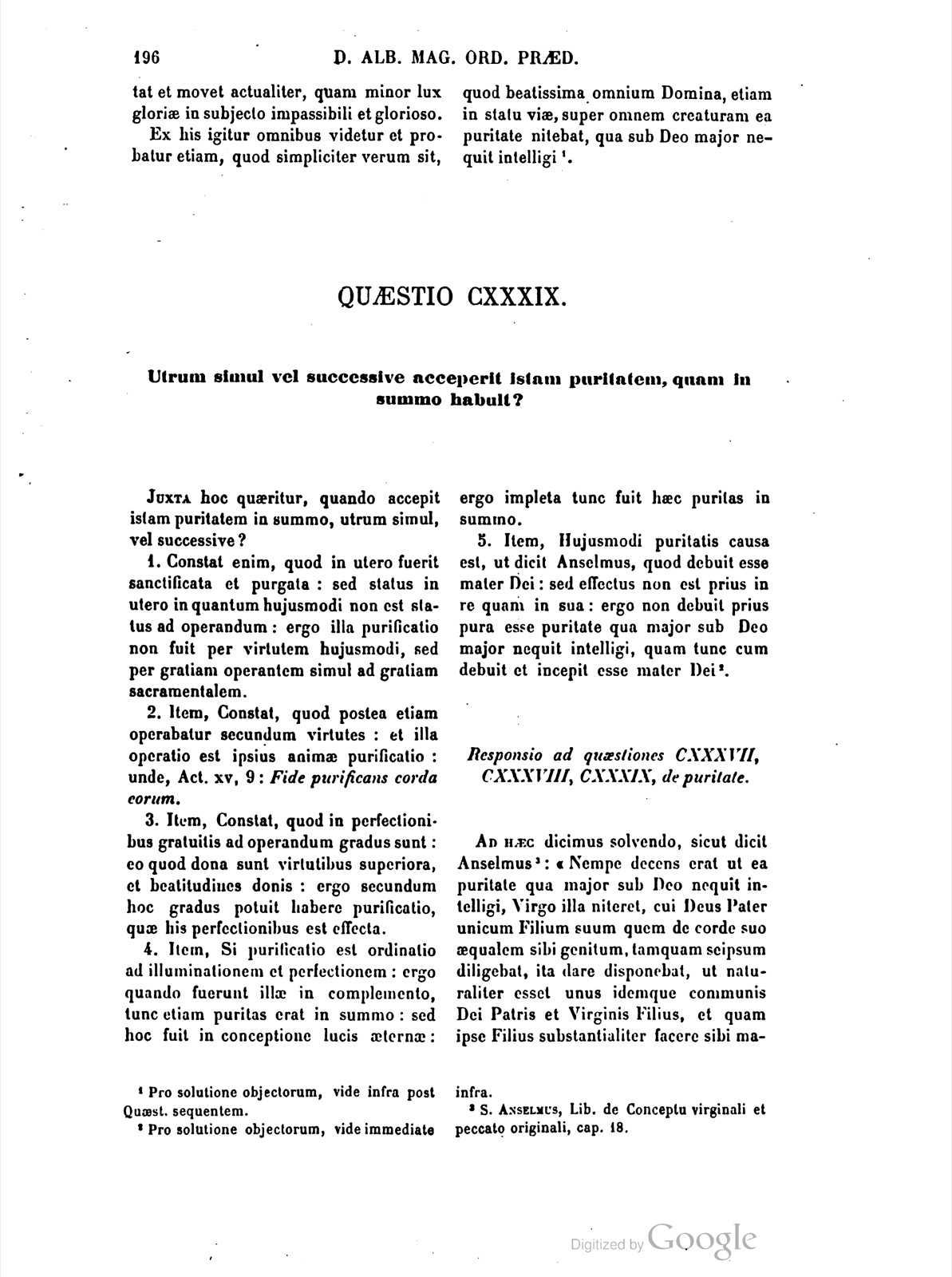
Ex his igitur omnibus videtur et probatur etiam, quod simpliciter verum sit, quod beatissima omnium Domina, etiam in statu viae, super omnem creaturam ea puritate nitebat, qua sub Deo major nequit intelligi 3.
8. Likewise, purity is part of beauty, and a proportionable part ought not to be less than its whole. Therefore where beauty is in the highest degree, there purity is in the highest degree. But the most blessed Virgin was beautiful in the highest degree. Therefore also pure in the highest degree. The minor is clear through her figures. Concerning Rebecca, who figured her, it is said that she was a girl exceedingly comely, a most beautiful virgin. Likewise, Esther 2:15: She was very fair, and of unbelievable beauty, gracious and lovable in the eyes of all. Likewise, the same is clear through Judith and Rachel.
9. Likewise, to purity or cleanness of heart is attributed seeing God, according to Matthew 5:8: Blessed are the clean of heart, for they shall see God. And that saying: “Grant the eyes of a pure mind to fix themselves on you.” But the most blessed Virgin saw God in the highest degree. Therefore in the highest degree she had a pure eye.
10. Likewise, let us posit, according to the state of the way, that the soul of the most blessed Virgin is separated from the body without any addition of grace or glory. It is certain that then it would be most deiform in purity. But she had the same purity in the body. Therefore also then above all creatures she shone with purity.
11. Likewise, that her purity does not fully apprehend the uncreated light through its species is not an obstacle; this is seen by a likeness. For we see that sometimes a greater light illumines less, and a lesser light illumines more, because of conjunction with obscure or clear air. Hence sometimes the moon illumines more at night, when the air is clear, than the sun by day with obscure air, and yet the light of the sun is disproportionately greater than that of the moon. Therefore by a likeness it does not seem unfitting if a greater light of grace in a passible subject joined to a passible and coarse body changes and moves actually less than a lesser light of glory in an impassible and glorious subject.
From all these things therefore it seems and is also proved that it is simply true that the most blessed Lady of all, even in the state of the way, shone above every creature with that purity than which no greater can be understood under God 3.
Notes
- 1 John 1:5: God is light, and there are no darknesses in him. (I Joannis, I, 5: Deus lux est, et tenebrae in eo non sunt ullae.) ↩
- St. Dionysius, Book On the Celestial Hierarchy, chapter 2. (S. Dionysius, Lib. de Coelesti hierarchia, cap. 2.) ↩
- For the solution of the objections, see below after the following Question. (Pro solutione objectorum, vide infra post Quaest. sequentem.) ↩
If a page does not appear, its photograph has not been uploaded yet.