Works › The Mariale: Questions on “Missus est”
Volume 37 · pp. 196–197
Question 139. Whether she received this purity at once or successively?
A marker with ≈ is an approximate page boundary, placed by measure of the text; the page photographs remain the authority. In the paired views, clicking a page marker brings that page into view.
QUAESTIO CXXXIX. Utrum simul vel successive acceperit istam puritatem, quam in summo habuit?
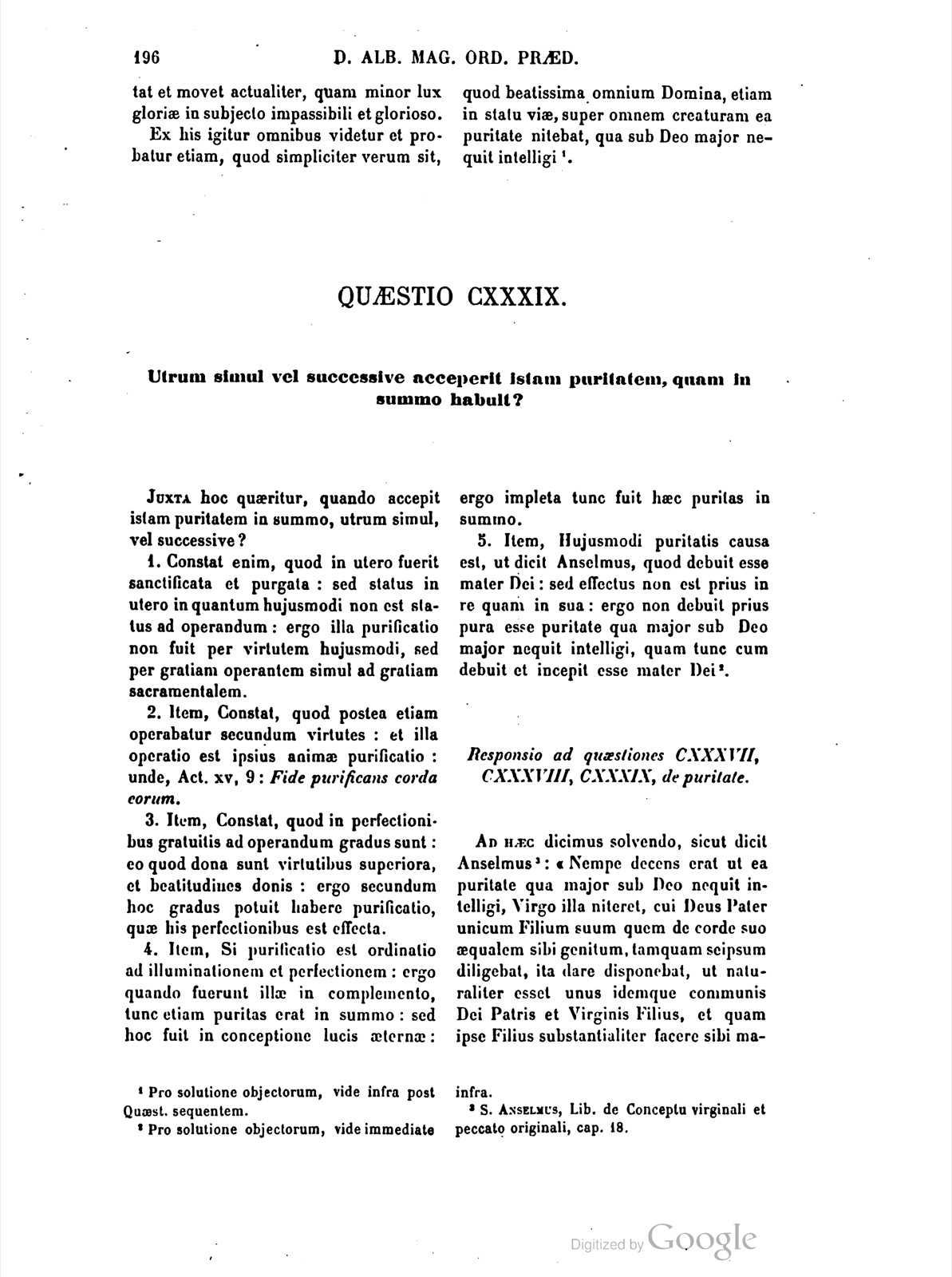
Juxta hoc quaeritur, quando accepit istam puritatem in summo, utrum simul, vel successive?
1. Constat enim, quod in utero fuerit sanctificata et purgata: sed status in utero in quantum hujusmodi non est status ad operandum: ergo illa purificatio non fuit per virtutem hujusmodi, sed per gratiam operantem simul ad gratiam sacramentalem.
2. Item, Constat, quod postea etiam operabatur secundum virtutes: et illa operatio est ipsius animae purificatio: unde, Act. XV, 9: Fide purificans corda eorum.
3. Item, Constat, quod in perfectionibus gratuitis ad operandum gradus sunt: eo quod dona sunt virtutibus superiora, et beatitudines donis: ergo secundum hoc gradus potuit habere purificatio, quae his perfectionibus est effecta.
4. Item, Si purificatio est ordinatio ad illuminationem et perfectionem: ergo quando fuerunt illae in complemento, tunc etiam puritas erat in summo: sed hoc fuit in conceptione lucis aeternae: ergo impleta tunc fuit haec puritas in summo.
5. Item, Hujusmodi puritatis causa est, ut dicit Anselmus, quod debuit esse mater Dei: sed effectus non est prius in re quam in sua causa: ergo non debuit prius pura esse puritate qua major sub Deo major nequit intelligi, quam tunc cum debuit et incepit esse mater Dei 1.
Responsio ad quaestiones CXXXVII, CXXXVIII, CXXXIX, de puritate.
Ad haec dicimus solvendo, sicut dicit Anselmus 2: « Nempe decens erat ut ea puritate qua major sub Deo nequit intelligi, Virgo illa niteret, cui Deus Pater unicum Filium suum quem de corde suo aequalem sibi genitum, tamquam seipsum diligebat, ita dare disponebat, ut naturaliter esset unus idemque communis Dei Patris et Virginis Filius, et quam ipse Filius substantialiter facere sibi matrem eligebat, et de qua Spiritus sanctus volebat, et operaturus erat, ut conciperetur et nasceretur ille de quo procedebat. » Dicimus igitur, quod puritas haec est ab originali non dico distantia, sed segregatio, et ad primam lucem, quantum possibile est purae creaturae, deiformis approximatio. Unde secundum rem nihil est haec puritas aliud, nisi peccati originalis deletio, fomitis exstinctio, gratuitarum perfectionum ultimatio.
Ex his patet, quod nihil est ad propositum quod objicitur de aliis sanctis, vel de inanimatis, vel Christo, vel Angelis, vel Deo.
Et concedimus etiam, quod in beatissima Virgine secundum statum viae fuit gratia deiformior quam in Angelis: et hoc dico quantum ad substantiam, sed non quantum ad actum qui est operatio, ut supra plene dictum est in materia de charitate.
QUESTION 139. Whether she received at once or successively this purity which she had in the highest degree?
Next to this it is asked when she received this purity in the highest degree, whether at once or successively.
1. For it is certain that she was sanctified and purged in the womb. But the state in the womb, as such, is not a state for operating. Therefore that purification was not through a virtue of this kind, but through operating grace together with sacramental grace.
2. Likewise, it is certain that afterward she also operated according to the virtues; and that operation is the purification of her soul. Hence Acts 15:9: Purifying their hearts by faith.
3. Likewise, it is certain that in gratuitous perfections for operating there are degrees, because gifts are higher than virtues, and beatitudes higher than gifts. Therefore according to this purification, which is effected by these perfections, could have degrees.
4. Likewise, if purification is an ordering to illumination and perfection, then when those were in completion, then also purity was in the highest degree. But this was in the conception of the eternal light. Therefore this purity was then fulfilled in the highest degree.
5. Likewise, the cause of purity of this kind is, as Anselm says, that she ought to be the mother of God. But an effect is not earlier in the thing than in its own cause. Therefore she ought not earlier to be pure with a purity than which no greater under God can be understood, than when she ought and began to be Mother of God 1.
Response to Questions 137, 138, 139, concerning purity.
To these things we answer by solving, as Anselm says 2: “Indeed it was fitting that that Virgin should shine with that purity than which no greater can be understood under God: she to whom God the Father was disposing to give his only Son, whom, begotten from his heart as equal to himself, he loved as himself, in such a way that naturally one and the same would be the common Son of God the Father and of the Virgin; and whom the Son himself was choosing to make substantially his mother; and from whom the Holy Spirit willed, and was going to work, that he from whom he proceeded should be conceived and born.” Therefore we say that this purity is not, I say, distance from original sin, but segregation from it, and deiform approach to the first light as far as is possible for a pure creature. Hence according to the thing this purity is nothing other than the deletion of original sin, the extinction of the fomes, and the completion of gratuitous perfections.
From these things it is clear that what is objected concerning other saints, or concerning inanimate things, or Christ, or Angels, or God, is nothing to the point.
And we also concede that in the most blessed Virgin according to the state of the way there was grace more deiform than in the Angels; and I say this as to substance, but not as to the act which is operation, as was fully said above in the matter concerning charity.
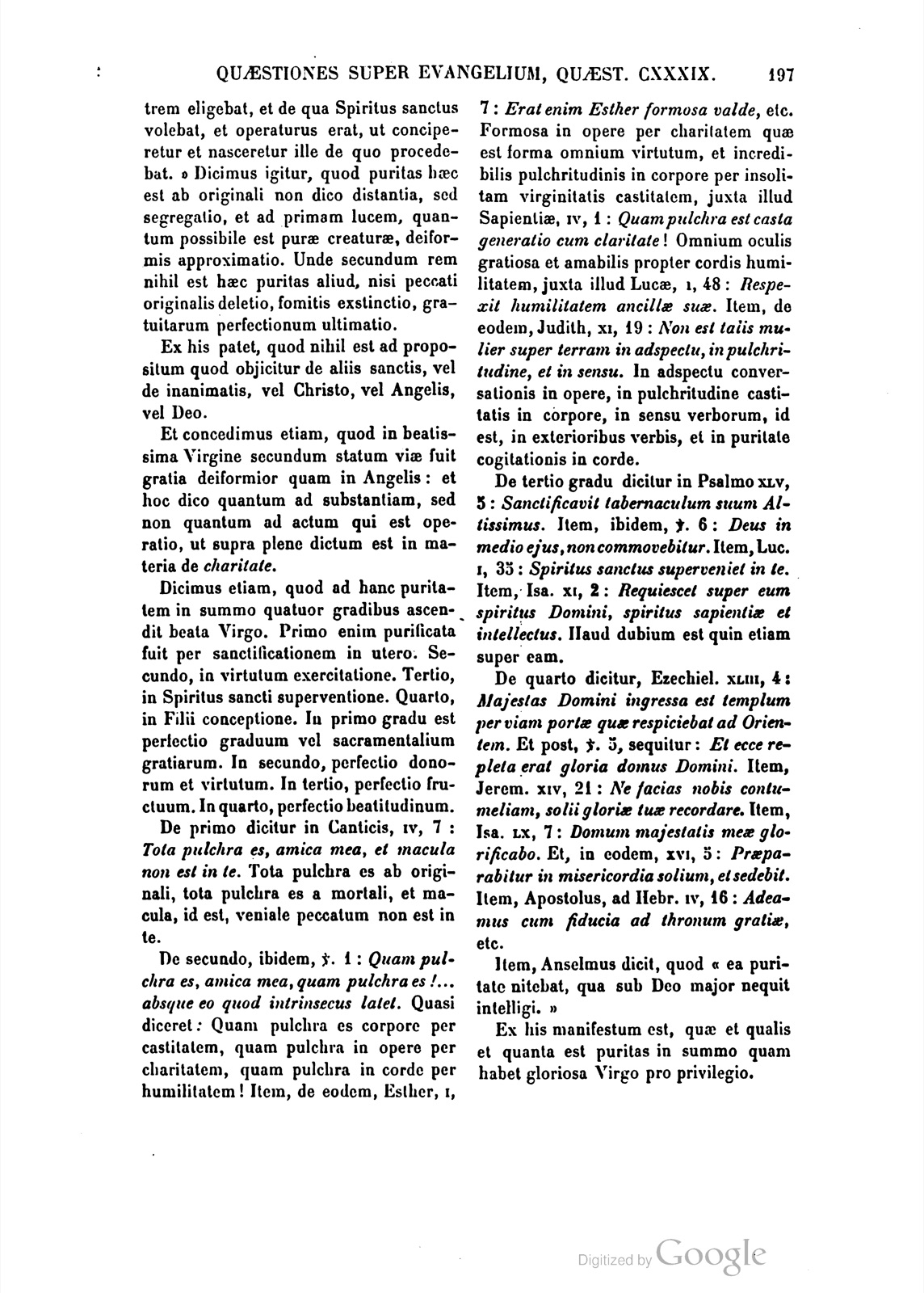
Dicimus etiam, quod ad hanc puritatem in summo quatuor gradibus ascendit beata Virgo. Primo enim purificata fuit per sanctificationem in utero. Secundo, in virtutum exercitatione. Tertio, in Spiritus sancti superventione. Quarto, in Filii conceptione. In primo gradu est perfectio graduum vel sacramentalium gratiarum. In secundo, perfectio donorum et virtutum. In tertio, perfectio fructuum. In quarto, perfectio beatitudinum.
De primo dicitur in Canticis, IV, 7: Tota pulchra es, amica mea, et macula non est in te. Tota pulchra es ab originali, tota pulchra es a mortali, et macula, id est, veniale peccatum non est in te.
De secundo, ibidem, v. 1: Quam pulchra es, amica mea, quam pulchra es! ... absque eo quod intrinsecus latet. Quasi diceret: Quam pulchra es corpore per castitatem, quam pulchra in opere per charitatem, quam pulchra in corde per humilitatem! Item, de eodem, Esther, I, 7: Erat enim Esther formosa valde, etc. Formosa in opere per charitatem quae est forma omnium virtutum, et incredibilis pulchritudinis in corpore per insolitam virginitatis castitatem, juxta illud Sapientiae, IV, 1: Quam pulchra est casta generatio cum claritate! Omnium oculis gratiosa et amabilis propter cordis humilitatem, juxta illud Lucae, I, 48: Respexit humilitatem ancillae suae. Item, de eodem, Judith, XI, 19: Non est talis mulier super terram in adspectu, in pulchritudine, et in sensu. In adspectu conversationis in opere, in pulchritudine castitatis in corpore, in sensu verborum, id est, in exterioribus verbis, et in puritate cogitationis in corde.
De tertio gradu dicitur in Psalmo XLV, 5: Sanctificavit tabernaculum suum Altissimus. Item, ibidem, v. 6: Deus in medio ejus, non commovebitur. Item, Luc. I, 35: Spiritus sanctus superveniet in te. Item, Isa. XI, 2: Requiescet super eum spiritus Domini, spiritus sapientiae et intellectus. Haud dubium est quin etiam super eam.
De quarto dicitur, Ezechiel. XLII, 4: Majestas Domini ingressa est templum per viam portae quae respiciebat ad Orientem. Et post, v. 5, sequitur: Et ecce repleta erat gloria domus Domini. Item, Jerem. XIV, 21: Ne facias nobis contumeliam, solii gloriae tuae recordare. Item, Isa. LX, 7: Domum majestatis meae glorificabo. Et, in eodem, XVI, 5: Praeparabitur in misericordia solium, et sedebit. Item, Apostolus, ad Hebr. IV, 16: Adeamus cum fiducia ad thronum gratiae, etc.
Item, Anselmus dicit, quod « ea puritate nitebat, qua sub Deo major nequit intelligi. »
Ex his manifestum est, quae et qualis et quanta est puritas in summo quam habet gloriosa Virgo pro privilegio.
We also say that the blessed Virgin ascended to this purity in the highest degree by four degrees. For first she was purified through sanctification in the womb. Second, in the exercise of virtues. Third, in the coming-upon of the Holy Spirit. Fourth, in the conception of the Son. In the first degree there is the perfection of degrees or of sacramental graces. In the second, the perfection of gifts and virtues. In the third, the perfection of fruits. In the fourth, the perfection of beatitudes.
Concerning the first it is said in Song of Songs 4:7: You are wholly beautiful, my friend, and there is no stain in you. You are wholly beautiful from original sin, wholly beautiful from mortal sin, and stain, that is, venial sin, is not in you.
Concerning the second, in the same place, verse 1: How beautiful you are, my friend, how beautiful you are! ... apart from that which lies hidden within. As though he were saying: How beautiful you are in body through chastity, how beautiful in work through charity, how beautiful in heart through humility! Likewise, concerning the same, Esther 1:7: For Esther was very beautiful, etc. Beautiful in work through charity, which is the form of all virtues, and of unbelievable beauty in body through the unusual chastity of virginity, according to Wisdom 4:1: How beautiful is a chaste generation with brightness! Gracious and lovable in the eyes of all because of humility of heart, according to Luke 1:48: He has regarded the humility of his handmaid. Likewise, concerning the same, Judith 11:19: There is no such woman upon earth in appearance, in beauty, and in sense. In appearance of manner of life in work, in beauty of chastity in body, in sense of words, that is, in exterior words, and in purity of thought in heart.
Concerning the third degree it is said in Psalm 45:5: The Most High has sanctified his tabernacle. Likewise, in the same place, verse 6: God is in its midst; it shall not be moved. Likewise, Luke 1:35: The Holy Spirit will come upon you. Likewise, Isaiah 11:2: The spirit of the Lord shall rest upon him, the spirit of wisdom and understanding. There is no doubt that it also rested upon her.
Concerning the fourth it is said, Ezekiel 42:4: The majesty of the Lord entered the temple by the way of the gate which looked toward the East. And afterward, verse 5, there follows: And behold, the glory of the house of the Lord was filled. Likewise, Jeremiah 14:21: Do not bring reproach upon us; remember the throne of your glory. Likewise, Isaiah 60:7: I will glorify the house of my majesty. And in the same book, 16:5: A throne shall be prepared in mercy, and he shall sit. Likewise, the Apostle, Hebrews 4:16: Let us approach with confidence to the throne of grace, etc.
Likewise, Anselm says that “she shone with that purity than which no greater can be understood under God.”
From these things it is manifest what, of what sort, and how great is the purity in the highest degree which the glorious Virgin has as a privilege.
If a page does not appear, its photograph has not been uploaded yet.