Works › The Mariale: Questions on “Missus est”
Volume 37 · pp. 193–194
Question 137. Whether purity in the highest degree ought to be assigned to the Blessed Virgin as a privilege?
A marker with ≈ is an approximate page boundary, placed by measure of the text; the page photographs remain the authority. In the paired views, clicking a page marker brings that page into view.
QUAESTIO CXXXVII. Utrum puritas in summo debeat assignari B. Virgini pro privilegio?
Post haec quaeritur de hoc quod est puritas in summo, utrum debeat assignari beatissimae Virgini pro privilegio?
Et videtur, quod non: quia
1. Si intensio puritatis est recessus a contrario, sicut albius quod nigro est impermixtius, et purius quod est impuro impermixtius, tunc quaeritur, quid sit illud impurum per cujus impermixtionem sit puritas haec in summo? Et videtur, quod non posset dici proprie aliud impurum nisi in corporalibus opacum vel opaco mixtum, in spiritualibus poena vel culpa. Si primo modo, tunc sol fuit purior beata Virgine. Si secundo modo, tunc in statu innocentiae, et omnes animae beatae a corporibus separatae, et etiam Angeli qui fuerunt sine poena, eamdem puritatem habuerunt. Si igitur tertio modo, tunc omnes sancti patriae etiam eamdem puritatem habuerunt, et etiam illi qui sunt in purgatorio, qui omnes sunt sine culpa.
2. Item, Si dicatur, quod haec puritas sit major post Deum a recessu originalis: quia Christus habuit recessum et puritatem ab origine talem quod numquam et nullo modo habuit originale, alii omnes baptizati habent puritatem ab originali, ita quod peccatum originale habuerunt, et adhuc aliquo modo habent quantum ad poenam fomitis. Sed inter nullo modo habere nec habuisse, et inter habere et habuisse, quodammodo medium est, scilicet quodammodo habuisse, et non habere: et haec fuit puritas beatissimae Virginis immediata post puritatem Christi. Si sic dicatur, contra est quod dicit Anselmus: « Non post Christum, sed post Deum. » Item, secundum hoc Angeli majori puritate lucerent: quia peccatum originale numquam habuerunt: vel secundum hoc etiam bruta et inanimata majori puritate lucerent: quia peccatum originale nec habent nec habere possunt. Item si dicatur, quod intelligitur de hominibus, hoc adhuc non potest stare: quia Adam in statu innocentiae secundum hoc majori nitebat puritate: quia tunc nullo modo habuit nec habuerat originale.
QUESTION 137. Whether purity in the highest degree ought to be assigned to the Blessed Virgin as a privilege?
After this inquiry is made about that which is purity in the highest degree, whether it ought to be assigned to the most blessed Virgin as a privilege.
And it seems that it should not, because:
1. If the intensification of purity is withdrawal from a contrary, just as that is whiter which is less mixed with black, and that purer which is less mixed with the impure, then it is asked what that impure thing is through non-mixture with which this purity is in the highest degree. And it seems that nothing else could properly be called impure except, in bodily things, the opaque or what is mixed with the opaque, and in spiritual things, punishment or fault. If in the first way, then the sun was purer than the blessed Virgin. If in the second way, then in the state of innocence, and all blessed souls separated from bodies, and also the Angels who were without punishment, had the same purity. If therefore in the third way, then all the saints of the homeland also had the same purity, and also those who are in purgatory, who all are without fault.
2. Likewise, if it is said that this purity is greater after God because of withdrawal from original sin, because Christ had such withdrawal and purity from his origin that he never and in no way had original sin, while all other baptized persons have purity from original sin in such a way that they had original sin, and still in some way have it as to the punishment of the fomes: but between in no way having nor having had, and having and having had, there is in a certain way a middle, namely to have had in a certain way and not to have; and this was the purity of the most blessed Virgin, immediately after the purity of Christ. If it is said so, to the contrary is what Anselm says: “Not after Christ, but after God.” Likewise, according to this the Angels would shine with greater purity, because they never had original sin; or according to this also brute animals and inanimate things would shine with greater purity, because they neither have nor can have original sin. Likewise, if it is said that this is understood of human beings, even this cannot stand, because Adam in the state of innocence according to this shone with greater purity, because then he in no way had nor had had original sin.
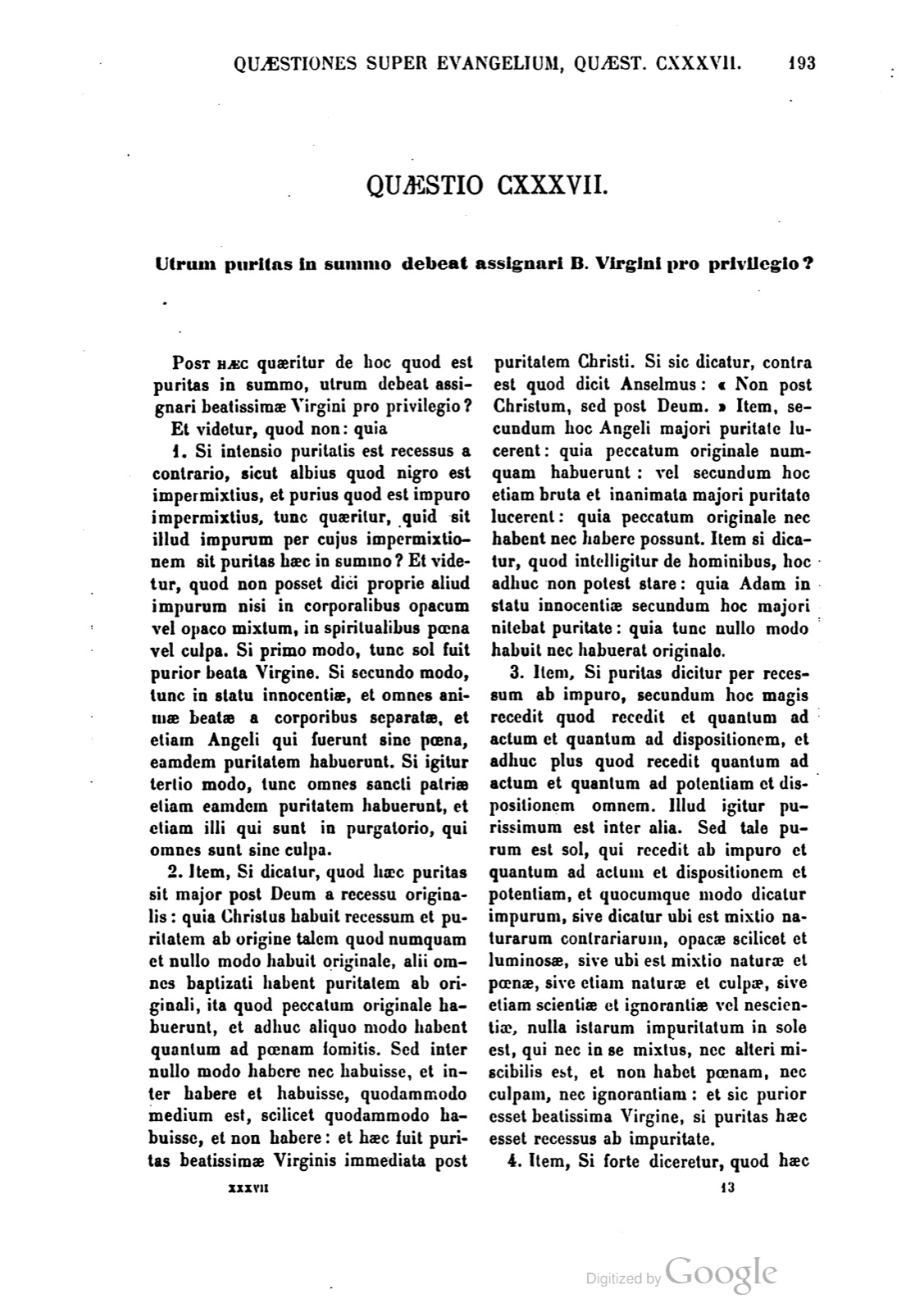
3. Item, Si puritas dicitur per recessum ab impuro, secundum hoc magis recedit quod recedit et quantum ad actum et quantum ad dispositionem, et adhuc plus quod recedit quantum ad actum et quantum ad potentiam et dispositionem omnem. Illud igitur purissimum est inter alia. Sed tale purum est sol, qui recedit ab impuro et quantum ad actum et dispositionem et potentiam, et quocumque modo dicatur impurum, sive dicatur ubi est mixtio naturarum contrariarum, opacae scilicet et luminosae, sive ubi est mixtio naturae et poenae, sive etiam naturae et culpae, sive etiam scientiae et ignorantiae vel nescientiae, nulla istarum impuritatum in sole est, qui nec in se mixtus, nec alteri miscibilis est, et non habet poenam, nec culpam, nec ignorantiam: et sic purior esset beatissima Virgine, si puritas haec esset recessus ab impuritate.
4. Item, Si forte diceretur, quod haec puritas dicitur per recessum ab impuro, ubi aptum natum esset inesse impurum, secundum hoc in Christo vel etiam Deo non est major puritas quam in quovis homine: quia vel in Christo vel in Deo non potest aliqua impuritas esse.
Ex his igitur patet, quod puritas non dicitur per recessum ab impuro tantum, sed etiam per approximationem et accessum ad summum purum: ergo, etc. 1.
3. Likewise, if purity is spoken of through withdrawal from the impure, according to this that withdraws more which withdraws both as to act and as to disposition, and still more that which withdraws as to act and as to potency and every disposition. Therefore that is the purest among others. But such a pure thing is the sun, which withdraws from the impure as to act and disposition and potency; and in whatever way the impure is spoken of, whether it is said to be where there is a mixture of contrary natures, namely opaque and luminous, or where there is a mixture of nature and punishment, or even of nature and fault, or even of knowledge and ignorance or nescience, none of these impurities is in the sun, which is neither mixed in itself nor mixable with another, and does not have punishment, nor fault, nor ignorance. And thus it would be purer than the most blessed Virgin, if this purity were withdrawal from impurity.
4. Likewise, if perhaps it were said that this purity is spoken of through withdrawal from the impure where the impure would be apt by nature to be present, according to this in Christ or even in God there is no greater purity than in any human being whatever, because in Christ or in God there can be no impurity.
From these things therefore it is clear that purity is not spoken of only through withdrawal from the impure, but also through approach and access to the highest pure one. Therefore, etc. 1.
Notes
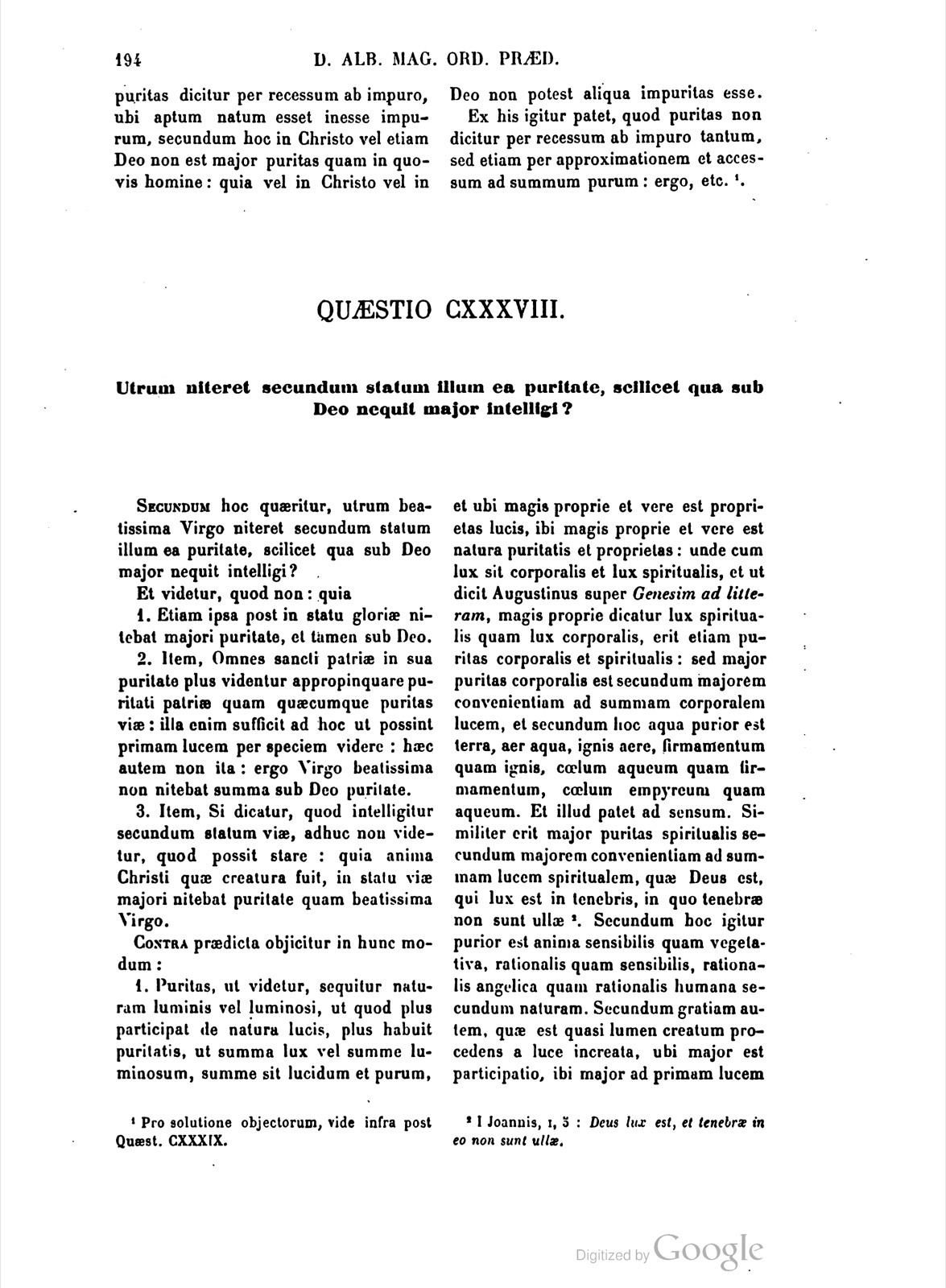
- For the solution of the objections, see below after Question CXXXIX. (Pro solutione objectorum, vide infra post Quaest. CXXXIX.) ↩
If a page does not appear, its photograph has not been uploaded yet.