Works › The Mariale: Questions on “Missus est”
Volume 37 · p. 192
Question 136. Whether she merited by every passion?
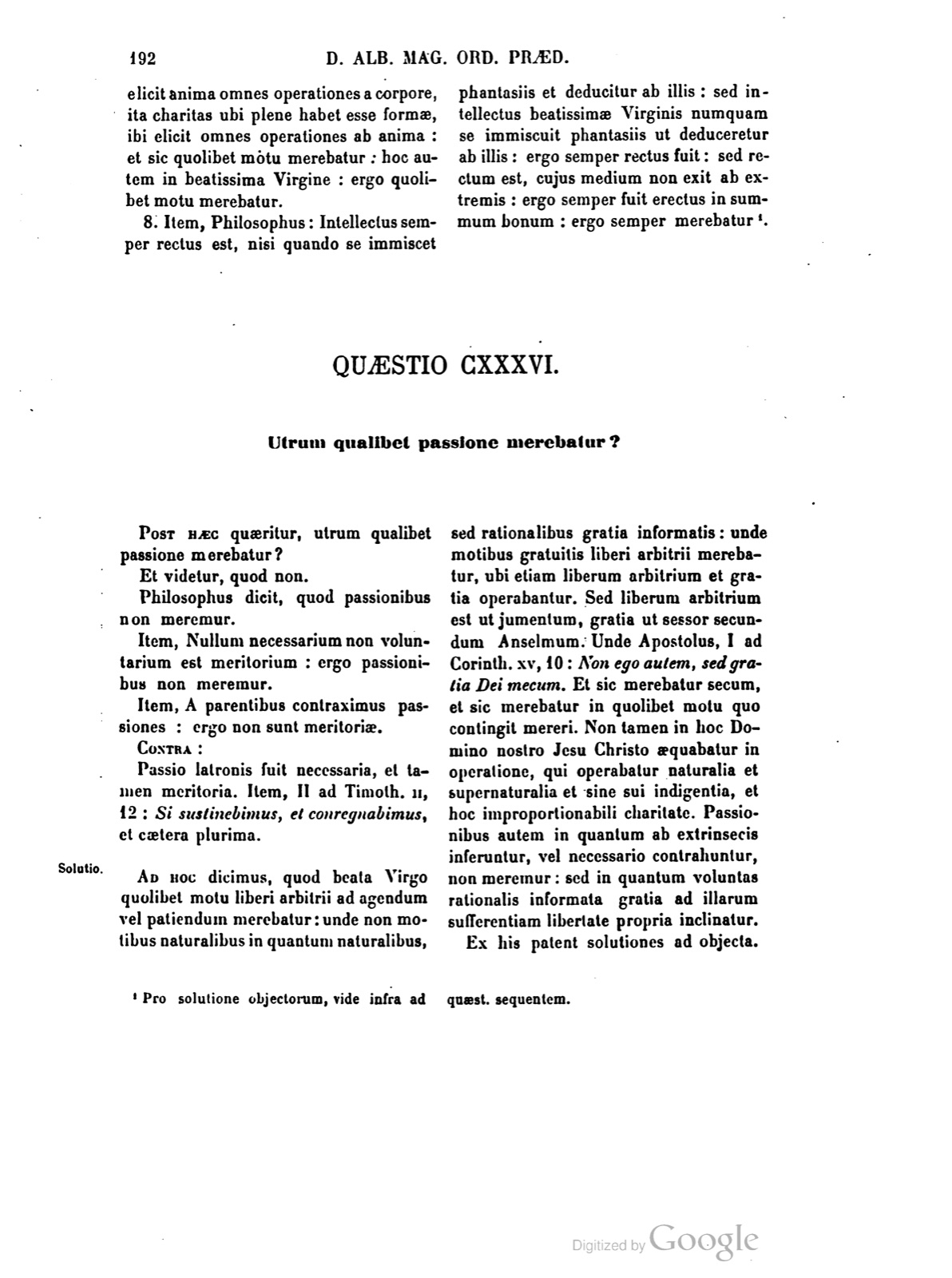
QUAESTIO CXXXVI. Utrum qualibet passione merebatur?
Post haec quaeritur, utrum qualibet passione merebatur?
Et videtur, quod non.
Philosophus dicit, quod passionibus non meremur.
Item, Nullum necessarium non voluntarium est meritorium: ergo passionibus non meremur.
Item, A parentibus contraximus passiones: ergo non sunt meritoriae.
Contra:
Passio latronis fuit necessaria, et tamen meritoria. Item, II ad Timoth. II, 12: Si sustinebimus, et conregnabimus, et caetera plurima.
Solutio.
Ad hoc dicimus, quod beata Virgo quolibet motu liberi arbitrii ad agendum vel patiendum merebatur: unde non motibus naturalibus in quantum naturalibus, sed rationalibus gratia informatis: unde motibus gratuitis liberi arbitrii merebatur, ubi etiam liberum arbitrium et gratia operabantur. Sed liberum arbitrium est ut jumentum, gratia ut sessor secundum Anselmum. Unde Apostolus, I ad Corinth. XV, 10: Non ego autem, sed gratia Dei mecum. Et sic merebatur secum, et sic merebatur in quolibet motu quo contingit mereri. Non tamen in hoc Domino nostro Jesu Christo aequabatur in operatione, qui operabatur naturalia et supernaturalia et sine sui indigentia, et hoc improportionabili charitate. Passionibus autem in quantum ab extrinsecis inferuntur, vel necessario contrahuntur, non meremur: sed in quantum voluntas rationalis informata gratia ad illarum sufferentiam libertate propria inclinatur.
Ex his patent solutiones ad objecta.
QUESTION 136. Whether she merited by every passion?
After this it is asked whether she merited by every passion.
And it seems that she did not.
The Philosopher says that we do not merit by passions.
Likewise, no necessary thing that is not voluntary is meritorious. Therefore we do not merit by passions.
Likewise, we contracted passions from our parents. Therefore they are not meritorious.
To the contrary:
The passion of the thief was necessary and nevertheless meritorious. Likewise, 2 Timothy 2:12: If we endure, we shall also reign together, and many other things.
Solution.
To this we say that the blessed Virgin merited by every motion of free choice for acting or suffering. Hence she did not merit by natural motions insofar as they were natural, but by rational motions informed by grace. Hence she merited by gratuitous motions of free choice, where free choice and grace also operated. But free choice is as a beast of burden, grace as the rider, according to Anselm. Hence the Apostle, 1 Corinthians 15:10: Not I, but the grace of God with me. And thus she merited with herself, and thus she merited in every motion by which it happens to merit. Yet in this she was not equaled in operation to our Lord Jesus Christ, who worked natural and supernatural things and without need of himself, and this with disproportionate charity. But by passions insofar as they are inflicted from external things or are necessarily contracted, we do not merit; but we do merit insofar as the rational will informed by grace is inclined by its own freedom to the endurance of them.
From these things the solutions to the objections are clear.
If a page does not appear, its photograph has not been uploaded yet.