Works › The Mariale: Questions on “Missus est”
Volume 37 · pp. 191–192
Question 135. Whether the Blessed Virgin had as a privilege that she merited by every motion?
A marker with ≈ is an approximate page boundary, placed by measure of the text; the page photographs remain the authority. In the paired views, clicking a page marker brings that page into view.
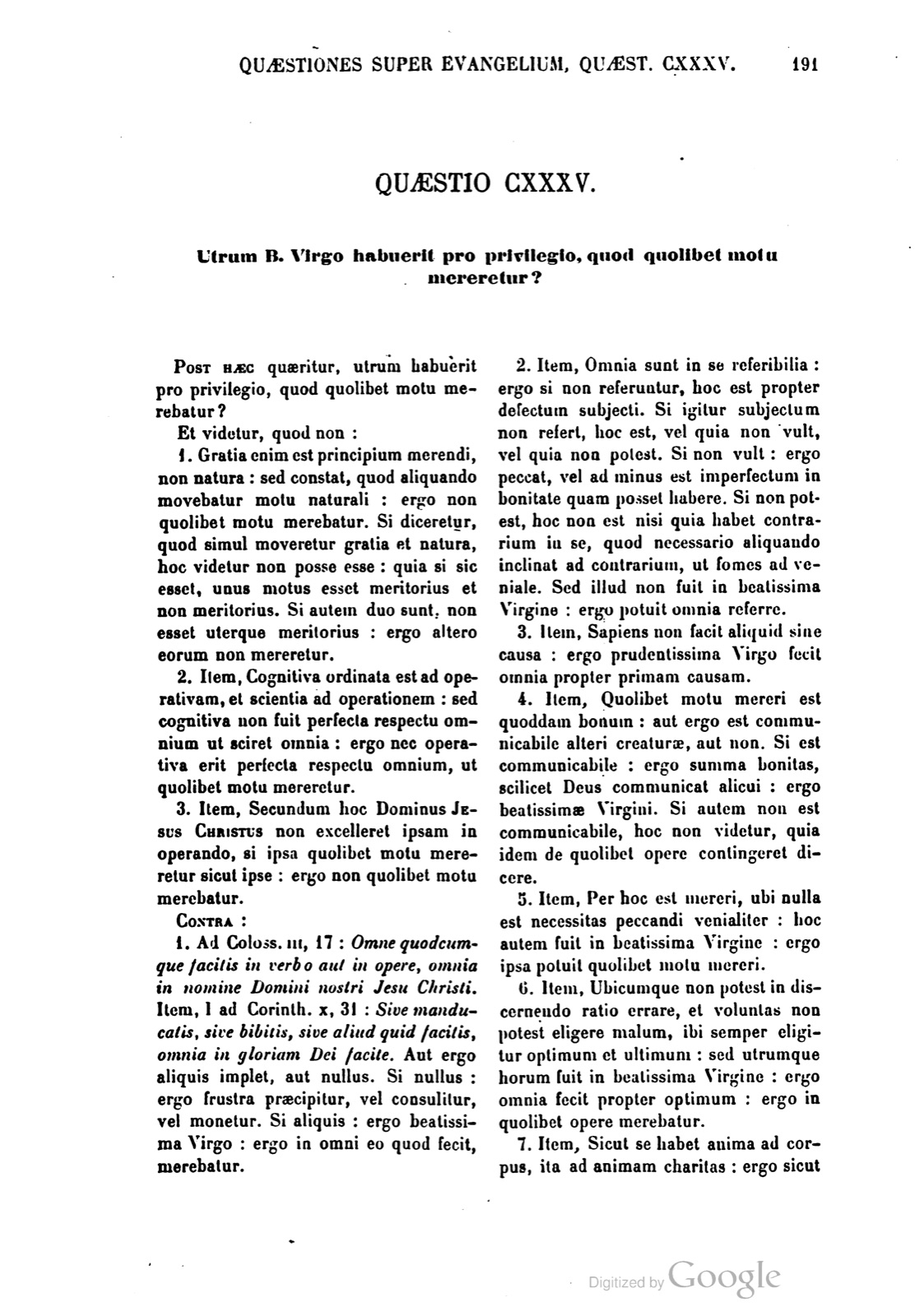
QUAESTIO CXXXV. Utrum B. Virgo habuerit pro privilegio, quod quolibet motu mereretur?
Post haec quaeritur, utrum habuerit pro privilegio, quod quolibet motu merebatur?
Et videtur, quod non:
1. Gratia enim est principium merendi, non natura: sed constat, quod aliquando movebatur motu naturali: ergo non quolibet motu merebatur. Si diceretur, quod simul moveretur gratia et natura, hoc videtur non posse esse: quia si sic esset, unus motus esset meritorius et non meritorius. Si autem duo sunt, non esset uterque meritorius: ergo altero eorum non mereretur.
2. Item, Cognitiva ordinata est ad operativam, et scientia ad operationem: sed cognitiva non fuit perfecta respectu omnium ut sciret omnia: ergo nec operativa erit perfecta respectu omnium, ut quolibet motu mereretur.
3. Item, Secundum hoc Dominus Jesus Christus non excelleret ipsam in operando, si ipsa quolibet motu mereretur sicut ipse: ergo non quolibet motu merebatur.
Contra:
1. Ad Coloss. III, 17: Omne quodcumque facitis in verbo aut in opere, omnia in nomine Domini nostri Jesu Christi. Item, I ad Corinth. X, 31: Sive manducatis, sive bibitis, sive aliud quid facitis, omnia in gloriam Dei facite. Aut ergo aliquis implet, aut nullus. Si nullus: ergo frustra praecipitur, vel consulitur, vel monetur. Si aliquis: ergo beatissima Virgo: ergo in omni eo quod fecit, merebatur.
2. Item, Omnia sunt in se referibilia: ergo si non referuntur, hoc est propter defectum subjecti. Si igitur subjectum non refert, hoc est, vel quia non vult, vel quia non potest. Si non vult: ergo peccat, vel ad minus est imperfectum in bonitate quam posset habere. Si non potest, hoc non est nisi quia habet contrarium in se, quod necessario aliquando inclinat ad contrarium, ut fomes ad veniale. Sed illud non fuit in beatissima Virgine: ergo potuit omnia referre.
QUESTION 135. Whether the Blessed Virgin had as a privilege that she merited by every motion?
After this it is asked whether she had as a privilege that she merited by every motion.
And it seems that she did not:
1. For grace is the principle of meriting, not nature. But it is certain that at some time she was moved by natural motion. Therefore she did not merit by every motion. If it were said that she was moved simultaneously by grace and nature, this seems unable to be, because if it were so, one motion would be meritorious and not meritorious. But if there are two motions, each would not be meritorious. Therefore by one of them she would not merit.
2. Likewise, the cognitive power is ordered to the operative power, and knowledge to operation. But the cognitive power was not perfect with respect to all things so that she would know all things. Therefore neither will the operative power be perfect with respect to all things so that she would merit by every motion.
3. Likewise, according to this the Lord Jesus Christ would not excel her in acting, if she merited by every motion as he did. Therefore she did not merit by every motion.
To the contrary:
1. Colossians 3:17: Whatever you do in word or in deed, do all things in the name of our Lord Jesus Christ. Likewise, 1 Corinthians 10:31: Whether you eat or drink, or do anything else, do all things for the glory of God. Therefore either someone fulfills this, or no one. If no one, then it is commanded, counseled, or admonished in vain. If someone does, then the most blessed Virgin does. Therefore in everything which she did, she merited.
2. Likewise, all things are referable in themselves. Therefore if they are not referred, this is because of a defect of the subject. Therefore if the subject does not refer them, this is either because it does not will to or because it cannot. If it does not will to, then it sins, or at least is imperfect in the goodness which it could have. If it cannot, this is only because it has a contrary in itself, which at some time necessarily inclines to the contrary, as the fomes inclines to venial sin. But that was not in the most blessed Virgin. Therefore she could refer all things.
3. Item, Sapiens non facit aliquid sine causa: ergo prudentissima Virgo fecit omnia propter primam causam.
4. Item, Quolibet motu mereri est quoddam bonum: aut ergo est communicabile alteri creaturae, aut non. Si est communicabile: ergo summa bonitas, scilicet Deus communicat alicui: ergo beatissimae Virgini. Si autem non est communicabile, hoc non videtur, quia idem de quolibet opere contingeret dicere.
5. Item, Per hoc est mereri, ubi nulla est necessitas peccandi venialiter: hoc autem fuit in beatissima Virgine: ergo ipsa potuit quolibet motu mereri.
6. Item, Ubicumque non potest in discernendo ratio errare, et voluntas non potest eligere malum, ibi semper eligitur optimum et ultimum: sed utrumque horum fuit in beatissima Virgine: ergo omnia fecit propter optimum: ergo in quolibet opere merebatur.
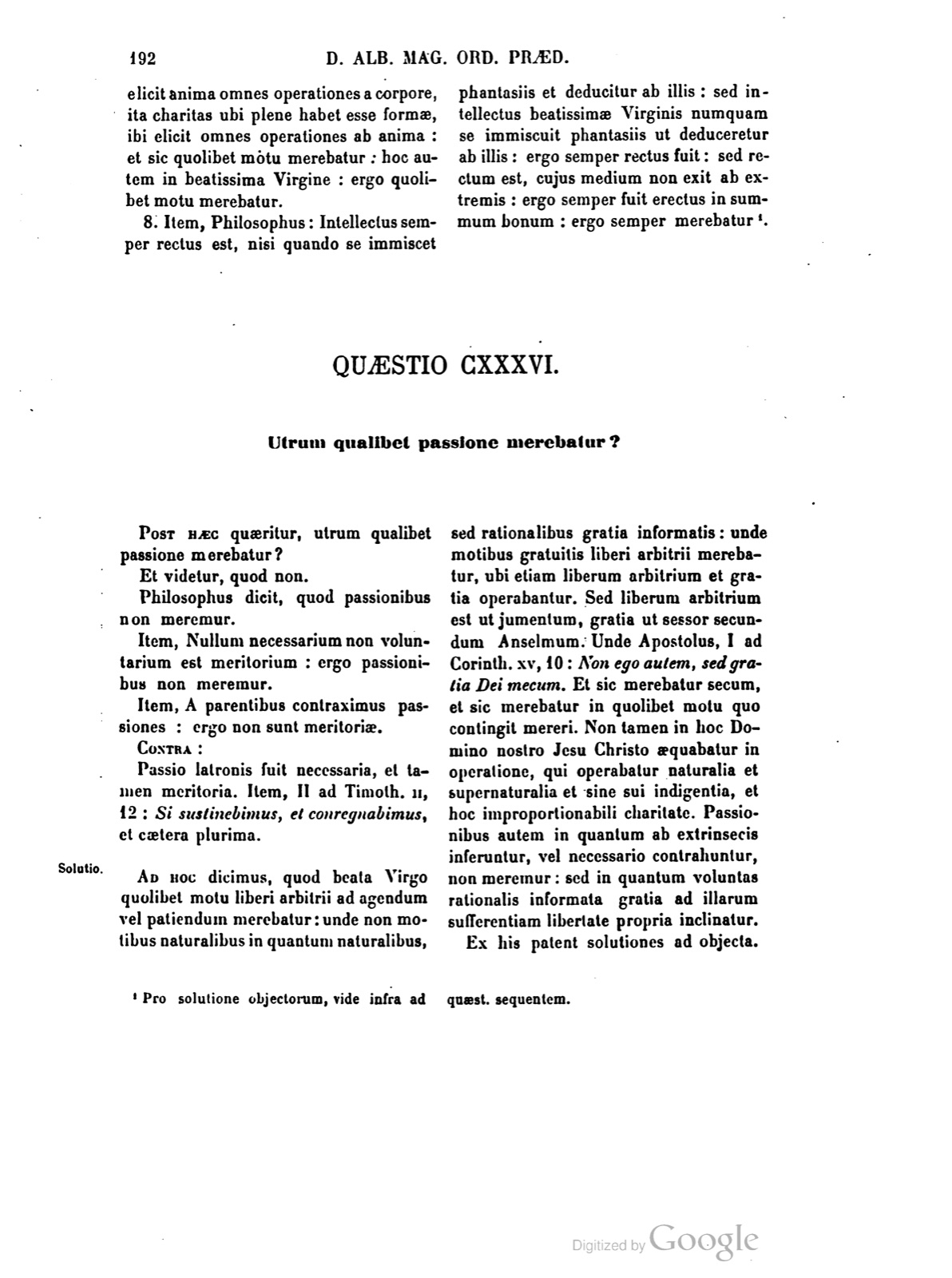
7. Item, Sicut se habet anima ad corpus, ita ad animam charitas: ergo sicut elicit anima omnes operationes a corpore, ita charitas ubi plene habet esse formae, ibi elicit omnes operationes ab anima: et sic quolibet motu merebatur: hoc autem in beatissima Virgine: ergo quolibet motu merebatur.
8. Item, Philosophus: Intellectus semper rectus est, nisi quando se immiscet phantasiis et deducitur ab illis: sed intellectus beatissimae Virginis numquam se immiscuit phantasiis ut deduceretur ab illis: ergo semper rectus fuit: sed rectum est, cujus medium non exit ab extremis: ergo semper fuit erectus in summum bonum: ergo semper merebatur 1.
3. Likewise, a wise person does nothing without a cause. Therefore the most prudent Virgin did all things for the first cause.
4. Likewise, to merit by every motion is a certain good. Therefore either it is communicable to another creature, or not. If it is communicable, then the highest goodness, namely God, communicates it to someone; therefore to the most blessed Virgin. But if it is not communicable, this does not seem so, because the same would happen to be said about any work whatever.
5. Likewise, through this there is meriting where there is no necessity of sinning venially. But this was in the most blessed Virgin. Therefore she herself could merit by every motion.
6. Likewise, wherever reason cannot err in discerning, and the will cannot choose evil, there the best and ultimate is always chosen. But both of these were in the most blessed Virgin. Therefore she did all things for the best. Therefore in every work she merited.
7. Likewise, as the soul is related to the body, so charity is related to the soul. Therefore as the soul elicits all operations from the body, so charity, where it fully has the being of a form, elicits all operations from the soul; and thus she merited by every motion. But this was in the most blessed Virgin. Therefore she merited by every motion.
8. Likewise, the Philosopher says: The intellect is always right, except when it mixes itself with phantasms and is led away by them. But the intellect of the most blessed Virgin never mixed itself with phantasms so as to be led away by them. Therefore it was always right. But the right is that whose middle does not depart from the extremes. Therefore she was always raised up to the highest good. Therefore she always merited 1.
Notes
- For the solution of the objections, see below at the following question. (Pro solutione objectorum, vide infra ad quaest. sequentem.) ↩
If a page does not appear, its photograph has not been uploaded yet.