Works › The Mariale: Questions on “Missus est”
Volume 37 · pp. 189–190
Question 134. Whether the Blessed Virgin could sin?
A marker with ≈ is an approximate page boundary, placed by measure of the text; the page photographs remain the authority. In the paired views, clicking a page marker brings that page into view.
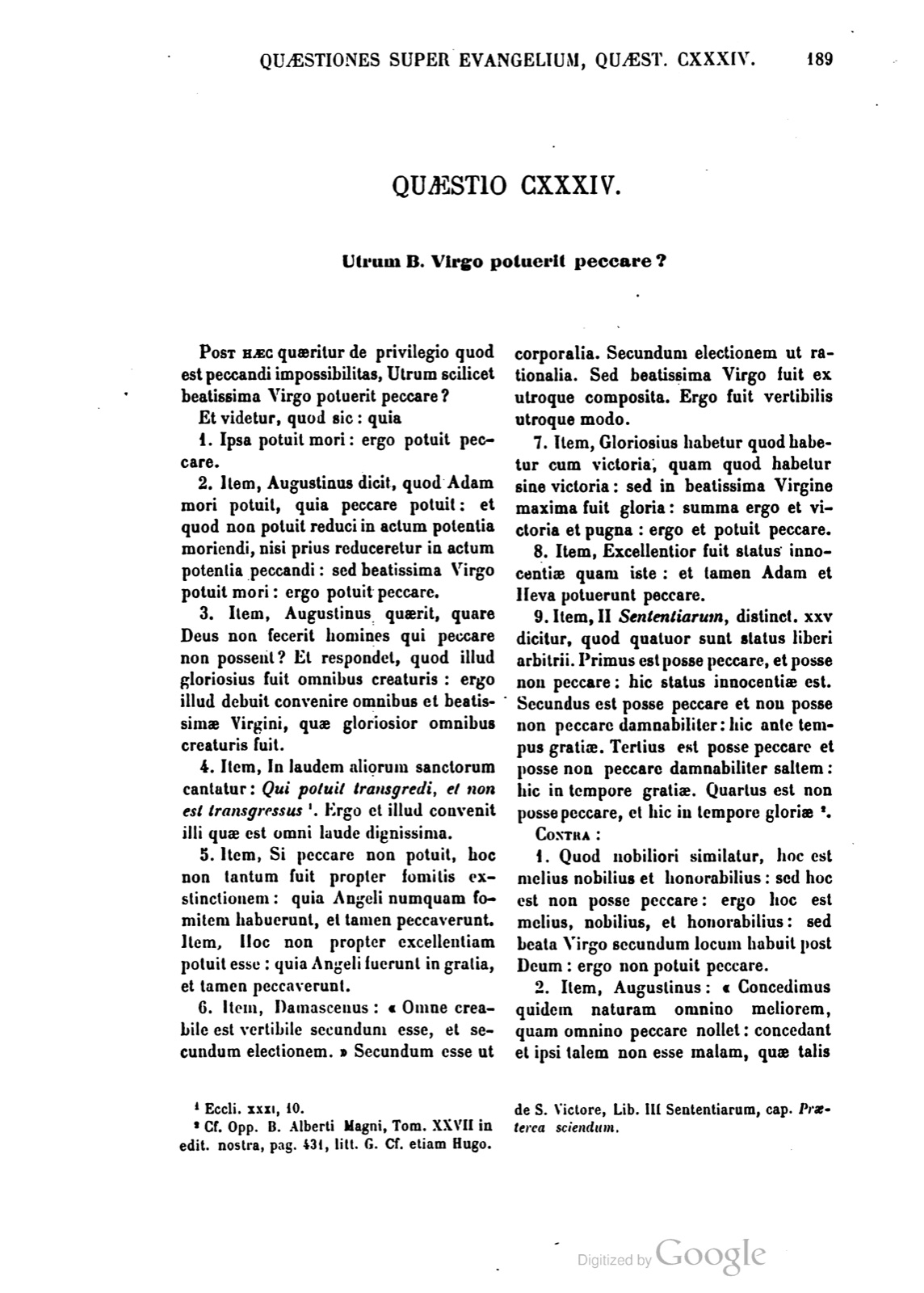
QUAESTIO CXXXIV. Utrum B. Virgo potuerit peccare?
Post haec quaeritur de privilegio quod est peccandi impossibilitas, utrum scilicet beatissima Virgo potuerit peccare?
Et videtur, quod sic: quia
1. Ipsa potuit mori: ergo potuit peccare.
2. Item, Augustinus dicit, quod Adam mori potuit, quia peccare potuit: et quod non potuit reduci in actum potentia moriendi, nisi prius reduceretur in actum potentia peccandi: sed beatissima Virgo potuit mori: ergo potuit peccare.
3. Item, Augustinus quaerit, quare Deus non fecerit homines qui peccare non possent? Et respondet, quod illud gloriosius fuit omnibus creaturis: ergo illud debuit convenire omnibus et beatissimae Virgini, quae gloriosior omnibus creaturis fuit.
4. Item, In laudem aliorum sanctorum cantatur: Qui potuit transgredi, et non est transgressus 1. Ergo et illud convenit illi quae est omni laude dignissima.
5. Item, Si peccare non potuit, hoc non tantum fuit propter fomitis exstinctionem: quia Angeli numquam fomitem habuerunt, et tamen peccaverunt. Item, hoc non propter excellentiam potuit esse: quia Angeli fuerunt in gratia, et tamen peccaverunt.
6. Item, Damascenus: « Omne creabile est vertibile secundum esse, et secundum electionem. » Secundum esse ut corporalia. Secundum electionem ut rationalia. Sed beatissima Virgo fuit ex utroque composita. Ergo fuit vertibilis utroque modo.
7. Item, Gloriosius habetur quod habetur cum victoria, quam quod habetur sine victoria: sed in beatissima Virgine maxima fuit gloria: summa ergo et victoria et pugna: ergo et potuit peccare.
8. Item, Excellentior fuit status innocentiae quam iste: et tamen Adam et Heva potuerunt peccare.
9. Item, II Sententiarum, distinct. XXV dicitur, quod quatuor sunt status liberi arbitrii. Primus est posse peccare, et posse non peccare: hic status innocentiae est. Secundus est posse peccare et non posse non peccare damnabiliter: hic ante tempus gratiae. Tertius est posse peccare et posse non peccare damnabiliter saltem: hic in tempore gratiae. Quartus est non posse peccare, et hic in tempore gloriae 2.
Contra:
1. Quod nobiliori similatur, hoc est melius nobilius et honorabilius: sed hoc est non posse peccare: ergo hoc est melius, nobilius, et honorabilius: sed beata Virgo secundum locum habuit post Deum: ergo non potuit peccare.
2. Item, Augustinus: « Concedimus quidem naturam omnino meliorem, quam omnino peccare nollet: concedant et ipsi talem non esse malam, quae talis facta est ut posset non peccare si vellet. »
3. Item, Frustra esset potentia quae numquam reduceretur ad actum: sed ipsa numquam fuit peccatrix: ergo frustra fuisset in ea potentia peccandi.
4. Item, Philosophus in IX Metaphysic. dicit, quod potentia est principium transmutandi alterum: sed beatissima Virgo nullum habuit principium transmutandi in peccatum: ergo nullam potentiam peccandi.
QUESTION 134. Whether the Blessed Virgin could sin?
After this inquiry is made concerning the privilege which is impossibility of sinning, namely whether the most blessed Virgin could sin.
And it seems that she could, because:
1. She herself could die; therefore she could sin.
2. Likewise, Augustine says that Adam could die because he could sin, and that the potency of dying could not be reduced into act unless first the potency of sinning were reduced into act. But the most blessed Virgin could die. Therefore she could sin.
3. Likewise, Augustine asks why God did not make human beings who could not sin. And he answers that that was more glorious for all creatures. Therefore that ought to belong to all and to the most blessed Virgin, who was more glorious than all creatures.
4. Likewise, in praise of other saints it is sung: He who could transgress and did not transgress 1. Therefore that also belongs to her who is most worthy of every praise.
5. Likewise, if she could not sin, this was not only because of the extinction of the fomes, because the Angels never had the fomes, and yet they sinned. Likewise, this could not be because of excellence, because the Angels were in grace, and yet they sinned.
6. Likewise, Damascene says: “Every creatable thing is changeable according to being and according to choice.” According to being, as bodily things; according to choice, as rational things. But the most blessed Virgin was composed of both. Therefore she was changeable in both ways.
7. Likewise, what is had with victory is possessed more gloriously than what is had without victory. But in the most blessed Virgin there was the greatest glory. Therefore there was the highest victory and battle. Therefore she also could sin.
8. Likewise, the state of innocence was more excellent than this one, and yet Adam and Eve could sin.
9. Likewise, in II Sentences, distinction 25, it is said that there are four states of free choice. The first is to be able to sin and to be able not to sin: this is the state of innocence. The second is to be able to sin and not to be able not to sin damnably: this is before the time of grace. The third is to be able to sin and at least to be able not to sin damnably: this is in the time of grace. The fourth is not to be able to sin, and this is in the time of glory 2.
To the contrary:
1. What is made like the nobler is better, nobler, and more honorable. But this is not to be able to sin. Therefore this is better, nobler, and more honorable. But the blessed Virgin had second place after God. Therefore she could not sin.
2. Likewise, Augustine says: “We indeed concede a nature altogether better, which would altogether not wish to sin; let them also concede that such a nature is not evil, which was made such that it could not sin if it wished.”
3. Likewise, a potency which would never be reduced to act would be vain. But she herself was never a sinner. Therefore a potency of sinning would have been vain in her.
4. Likewise, the Philosopher in Metaphysics IX says that potency is a principle of changing another thing. But the most blessed Virgin had no principle of being changed into sin. Therefore she had no potency of sinning.
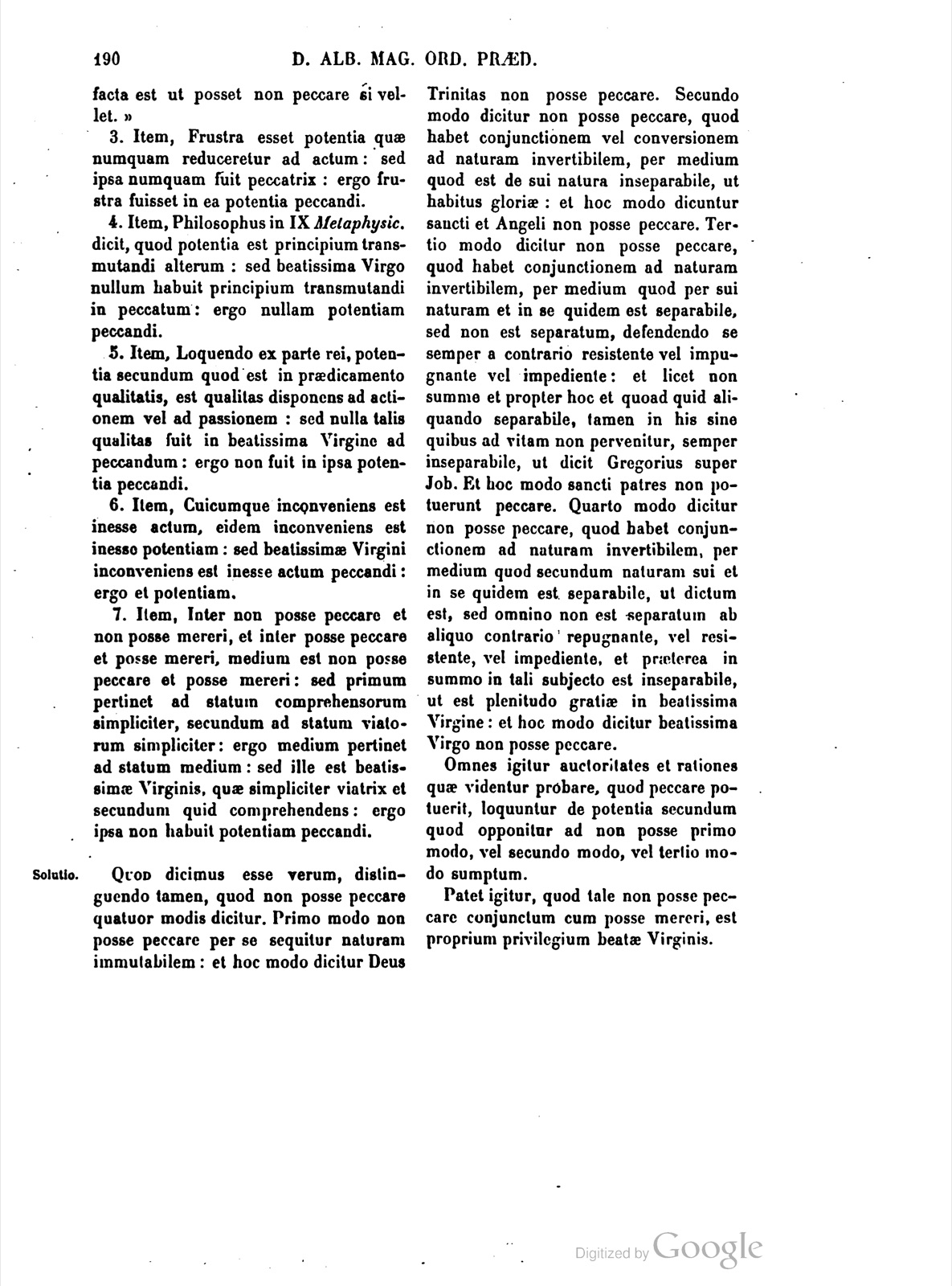
5. Item, Loquendo ex parte rei, potentia secundum quod est in praedicamento qualitatis, est qualitas disponens ad actionem vel ad passionem: sed nulla talis qualitas fuit in beatissima Virgine ad peccandum: ergo non fuit in ipsa potentia peccandi.
6. Item, Cuicumque inconveniens est inesse actum, eidem inconveniens est inesse potentiam: sed beatissimae Virgini inconveniens est inesse actum peccandi: ergo et potentiam.
7. Item, Inter non posse peccare et non posse mereri, et inter posse peccare et posse mereri, medium est non posse peccare et posse mereri: sed primum pertinet ad statum comprehensorum simpliciter, secundum ad statum viatorum simpliciter: ergo medium pertinet ad statum medium: sed ille est beatissimae Virginis, quae simpliciter viatrix et secundum quid comprehendens: ergo ipsa non habuit potentiam peccandi.
Solutio. Quod dicimus esse verum, distinguendo tamen, quod non posse peccare quatuor modis dicitur. Primo modo non posse peccare per se sequitur naturam immutabilem: et hoc modo dicitur Deus Trinitas non posse peccare. Secundo modo dicitur non posse peccare, quod habet conjunctionem vel conversionem ad naturam invertibilem, per medium quod est de sui natura inseparabile, ut habitus gloriae: et hoc modo dicuntur sancti et Angeli non posse peccare. Tertio modo dicitur non posse peccare, quod habet conjunctionem ad naturam invertibilem, per medium quod per sui naturam et in se quidem est separabile, sed non est separatum, defendendo se semper a contrario resistente vel impugnante vel impediente: et licet non summe et propter hoc et quoad quid aliquando separabile, tamen in his sine quibus ad vitam non pervenitur, semper inseparabile, ut dicit Gregorius super Job. Et hoc modo sancti patres non potuerunt peccare. Quarto modo dicitur non posse peccare, quod habet conjunctionem ad naturam invertibilem, per medium quod secundum naturam sui et in se quidem est separabile, ut dictum est, sed omnino non est separatum ab aliquo contrario repugnante, vel resistente, vel impediente, et praeterea in summo in tali subjecto est inseparabile, ut est plenitudo gratiae in beatissima Virgine: et hoc modo dicitur beatissima Virgo non posse peccare.
Omnes igitur auctoritates et rationes quae videntur probare, quod peccare potuerit, loquuntur de potentia secundum quod opponitur ad non posse primo modo, vel secundo modo, vel tertio modo sumptum.
Patet igitur, quod tale non posse peccare conjunctum cum posse mereri, est proprium privilegium beatae Virginis.
5. Likewise, speaking on the part of the thing, potency, insofar as it is in the category of quality, is a quality disposing to action or to passion. But no such quality for sinning was in the most blessed Virgin. Therefore the potency of sinning was not in her.
6. Likewise, for whomever it is unfitting that the act be present, for the same it is unfitting that the potency be present. But it is unfitting for the act of sinning to be in the most blessed Virgin. Therefore also the potency.
7. Likewise, between not being able to sin and not being able to merit, and being able to sin and being able to merit, the middle is not being able to sin and being able to merit. But the first pertains to the state of comprehensors simply, the second to the state of wayfarers simply. Therefore the middle pertains to the middle state. But that is the state of the most blessed Virgin, who is simply a wayfarer and in a qualified sense a comprehensor. Therefore she herself did not have the potency of sinning.
Solution. We say that this is true, nevertheless by distinguishing that not being able to sin is said in four ways. In the first way, not being able to sin follows per se upon immutable nature; and in this way God the Trinity is said not to be able to sin. In the second way, that is said not to be able to sin which has conjunction or conversion to unchangeable nature through a medium which by its nature is inseparable, as the habit of glory; and in this way the saints and Angels are said not to be able to sin. In the third way, that is said not to be able to sin which has conjunction to unchangeable nature through a medium which by its own nature and in itself is indeed separable, but is not separated, always defending itself from a contrary that resists or attacks or impedes; and although it is not supreme and therefore sometimes separable in a qualified respect, nevertheless in those things without which one does not arrive at life it is always inseparable, as Gregory says on Job. And in this way the holy fathers could not sin. In the fourth way, that is said not to be able to sin which has conjunction to unchangeable nature through a medium which according to its own nature and in itself is indeed separable, as has been said, but is altogether not separated by any contrary opposing, resisting, or impeding, and besides is in the highest degree inseparable in such a subject, as is the fullness of grace in the most blessed Virgin; and in this way the most blessed Virgin is said not to be able to sin.
Therefore all the authorities and reasons which seem to prove that she could sin speak of potency insofar as it is opposed to not being able in the first way, or in the second way, or in the third way taken.
Therefore it is clear that such not being able to sin, joined with being able to merit, is the proper privilege of the blessed Virgin.
Notes
- Ecclesiasticus 31:10. (Eccli. XXXI, 10.) ↩
- Compare Works of Blessed Albert the Great, volume 27 in our edition, page 431, letter G. Compare also Hugh of Saint Victor, Book III of the Sentences, chapter “Furthermore it must be known.” (Cf. Opp. B. Alberti Magni, Tom. XXVII in edit. nostra, pag. 431, litt. G. Cf. etiam Hugo de S. Victore, Lib. III Sententiarum, cap. Praeterea sciendum.) ↩
If a page does not appear, its photograph has not been uploaded yet.