Works › The Mariale: Questions on “Missus est”
Volume 37 · pp. 187–188
Question 133. Whether the Blessed Virgin was immune from sin?
A marker with ≈ is an approximate page boundary, placed by measure of the text; the page photographs remain the authority. In the paired views, clicking a page marker brings that page into view.
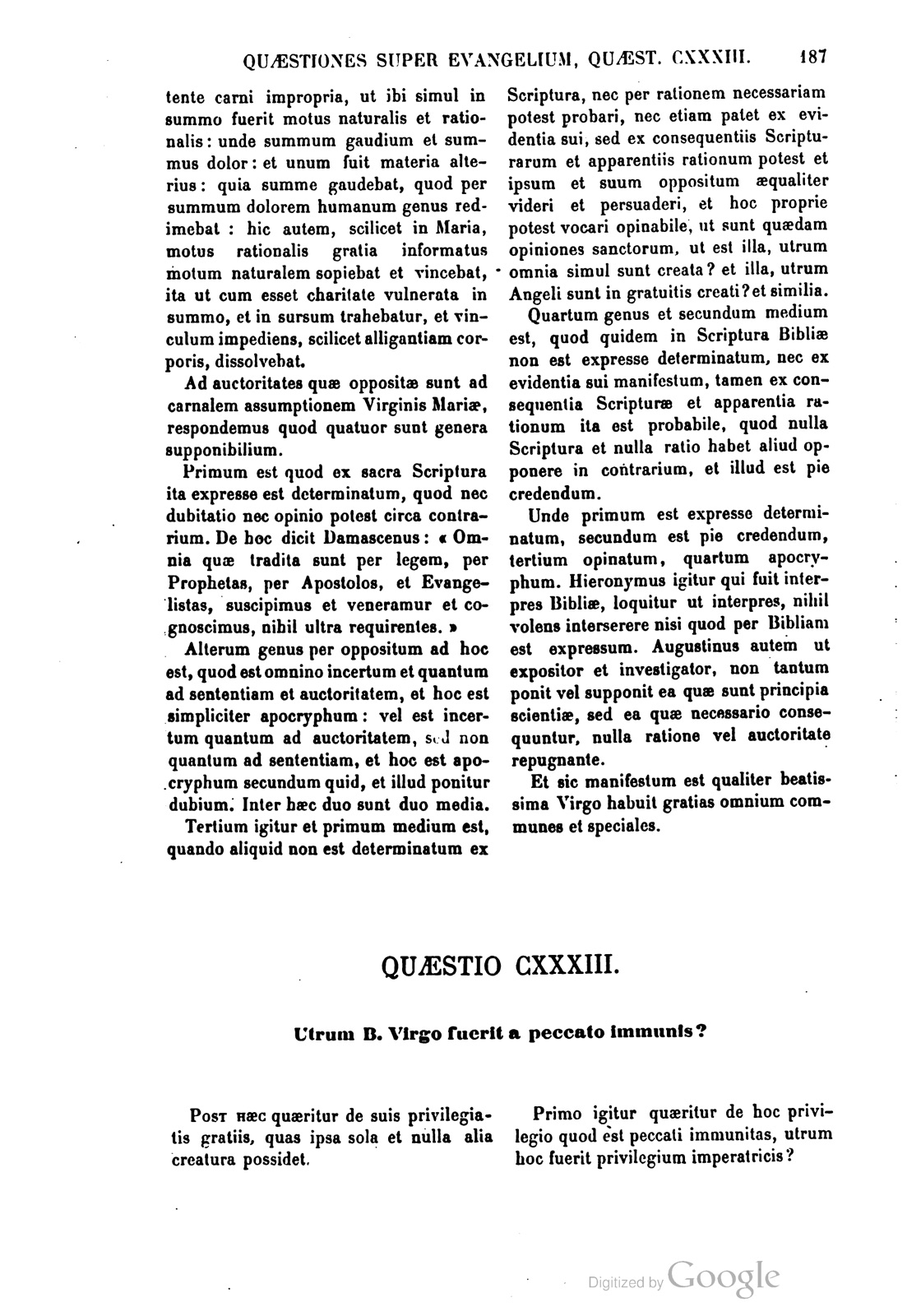
QUAESTIO CXXXIII. Utrum B. Virgo fuerit a peccato immunis?
Post haec quaeritur de suis privilegiatis gratiis, quas ipsa sola et nulla alia creatura possidet.
Primo igitur quaeritur de hoc privilegio quod est peccati immunitas, utrum hoc fuerit privilegium imperatricis?
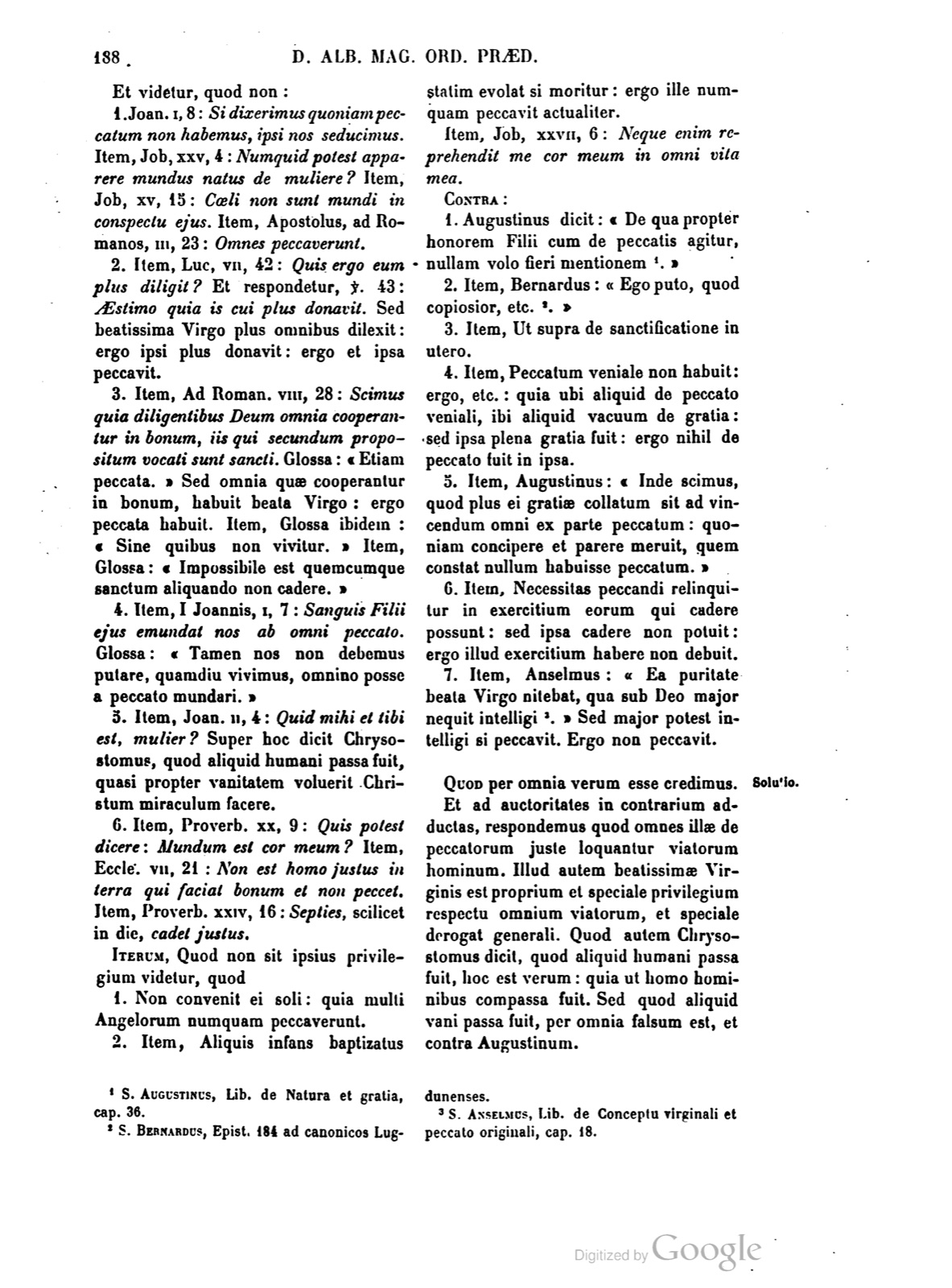
Et videtur, quod non:
1. Joan. I, 8: Si dixerimus quoniam peccatum non habemus, ipsi nos seducimus. Item, Job, XXV, 4: Numquid potest apparere mundus natus de muliere? Item, Job, XV, 15: Caeli non sunt mundi in conspectu ejus. Item, Apostolus, ad Romanos, III, 23: Omnes peccaverunt.
2. Item, Luc. VII, 42: Quis ergo eum plus diligit? Et respondetur, v. 43: Aestimo quia is cui plus donavit. Sed beatissima Virgo plus omnibus dilexit: ergo ipsi plus donavit: ergo et ipsa peccavit.
3. Item, Ad Roman. VIII, 28: Scimus quia diligentibus Deum omnia cooperantur in bonum, iis qui secundum propositum vocati sunt sancti. Glossa: « Etiam peccata. » Sed omnia quae cooperantur in bonum, habuit beata Virgo: ergo peccata habuit. Item, Glossa ibidem: « Sine quibus non vivitur. » Item, Glossa: « Impossibile est quemcumque sanctum aliquando non cadere. »
4. Item, I Joannis, I, 7: Sanguis Filii ejus emundat nos ab omni peccato. Glossa: « Tamen nos non debemus putare, quamdiu vivimus, omnino posse a peccato mundari. »
5. Item, Joan. II, 4: Quid mihi et tibi est, mulier? Super hoc dicit Chrysostomus, quod aliquid humani passa fuit, quasi propter vanitatem voluerit Christum miraculum facere.
6. Item, Proverb. XX, 9: Quis potest dicere: Mundum est cor meum? Item, Eccle. VII, 21: Non est homo justus in terra qui faciat bonum et non peccet. Item, Proverb. XXIV, 16: Septies, scilicet in die, cadet justus.
Iterum, Quod non sit ipsius privilegium videtur, quod:
QUESTION 133. Whether the Blessed Virgin was immune from sin?
After this inquiry is made concerning her privileged graces, which she alone and no other creature possesses.
First therefore inquiry is made about this privilege which is immunity from sin, whether this was the privilege of the empress.
And it seems that it was not:
1. John 1:8: If we say that we have no sin, we deceive ourselves. Likewise, Job 25:4: Can one born of woman appear clean? Likewise, Job 15:15: The heavens are not clean in his sight. Likewise, the Apostle, Romans 3:23: All have sinned.
2. Likewise, Luke 7:42: Who therefore loves him more? And the answer is, verse 43: I judge that it is he to whom he gave more. But the most blessed Virgin loved more than all. Therefore he gave more to her. Therefore she too sinned.
3. Likewise, Romans 8:28: We know that for those who love God all things work together unto good, for those who according to purpose are called saints. The Gloss says: “Even sins.” But the blessed Virgin had all things which work together unto good. Therefore she had sins. Likewise, the Gloss in the same place says: “Without which one does not live.” Likewise, the Gloss says: “It is impossible for any saint not at some time to fall.”
4. Likewise, 1 John 1:7: The blood of his Son cleanses us from all sin. The Gloss says: “Yet we ought not think that, as long as we live, we can altogether be cleansed from sin.”
5. Likewise, John 2:4: What is it to me and to you, woman? On this Chrysostom says that she suffered something human, as though because of vanity she wished Christ to do a miracle.
6. Likewise, Proverbs 20:9: Who can say: My heart is clean? Likewise, Ecclesiastes 7:21: There is no just man on earth who does good and does not sin. Likewise, Proverbs 24:16: Seven times, namely in a day, the just man will fall.
Again, that it is not her privilege seems because:
1. Non convenit ei soli: quia multi Angelorum numquam peccaverunt.
2. Item, Aliquis infans baptizatus statim evolat si moritur: ergo ille numquam peccavit actualiter.
Item, Job, XXVII, 6: Neque enim reprehendit me cor meum in omni vita mea.
Contra:
1. Augustinus dicit: « De qua propter honorem Filii cum de peccatis agitur, nullam volo fieri mentionem 1. »
2. Item, Bernardus: « Ego puto, quod copiosior, etc. 2. »
3. Item, Ut supra de sanctificatione in utero.
4. Item, Peccatum veniale non habuit: ergo, etc.: quia ubi aliquid de peccato veniali, ibi aliquid vacuum de gratia: sed ipsa plena gratia fuit: ergo nihil de peccato fuit in ipsa.
5. Item, Augustinus: « Inde scimus, quod plus ei gratiae collatum sit ad vincendum omni ex parte peccatum: quoniam concipere et parere meruit, quem constat nullum habuisse peccatum. »
6. Item, Necessitas peccandi relinquitur in exercitium eorum qui cadere possunt: sed ipsa cadere non potuit: ergo illud exercitium habere non debuit.
7. Item, Anselmus: « Ea puritate beata Virgo nitebat, qua sub Deo major nequit intelligi 3. » Sed major potest intelligi si peccavit. Ergo non peccavit.
Quod per omnia verum esse credimus. Solutio.
Et ad auctoritates in contrarium adductas, respondemus quod omnes illae de peccatorum juste loquantur viatorum hominum. Illud autem beatissimae Virginis est proprium et speciale privilegium respectu omnium viatorum, et speciale derogat generali. Quod autem Chrysostomus dicit, quod aliquid humani passa fuit, hoc est verum: quia ut homo hominibus compassa fuit. Sed quod aliquid vani passa fuit, per omnia falsum est, et contra Augustinum.
1. It does not belong to her alone, because many of the Angels never sinned.
2. Likewise, some baptized infant immediately flies forth if he dies. Therefore he never sinned actually.
Likewise, Job 27:6: For my heart has not reproached me in all my life.
To the contrary:
1. Augustine says: “Concerning her, on account of the honor of the Son, when sins are under discussion, I wish no mention to be made 1.”
2. Likewise, Bernard says: “I think that more abundant, etc. 2.”
3. Likewise, as above concerning sanctification in the womb.
4. Likewise, she did not have venial sin; therefore, etc., because where there is something of venial sin, there is something empty of grace. But she herself was full of grace. Therefore nothing of sin was in her.
5. Likewise, Augustine says: “From this we know that more grace was conferred on her for conquering sin on every side, because she merited to conceive and bear him who is known to have had no sin.”
6. Likewise, the necessity of sinning is left for the exercise of those who can fall. But she herself could not fall. Therefore she ought not to have had that exercise.
7. Likewise, Anselm says: “The blessed Virgin shone with that purity than which a greater cannot be understood under God 3.” But a greater can be understood if she sinned. Therefore she did not sin.
We believe this to be true in every respect. Solution.
And to the authorities brought forward to the contrary, we respond that all those speak justly concerning sinners who are wayfaring human beings. But that of the most blessed Virgin is a proper and special privilege with respect to all wayfarers, and the special derogates from the general. But what Chrysostom says, that she suffered something human, is true, because as a human being she suffered together with human beings. But that she suffered anything vain is false in every respect and contrary to Augustine.
Notes
- St. Augustine, Book On Nature and Grace, chapter 36. (S. Augustinus, Lib. de Natura et gratia, cap. 36.) ↩
- St. Bernard, Letter 184 to the Canons of Lyons. (S. Bernardus, Epist. 184 ad canonicos Lugdunenses.) ↩
- St. Anselm, Book On the Virginal Conception and Original Sin, chapter 18. (S. Anselmus, Lib. de Conceptu virginali et peccato originali, cap. 18.) ↩
If a page does not appear, its photograph has not been uploaded yet.