Works › The Mariale: Questions on “Missus est”
Volume 37 · p. 169
Question 112 continued. Concerning faith
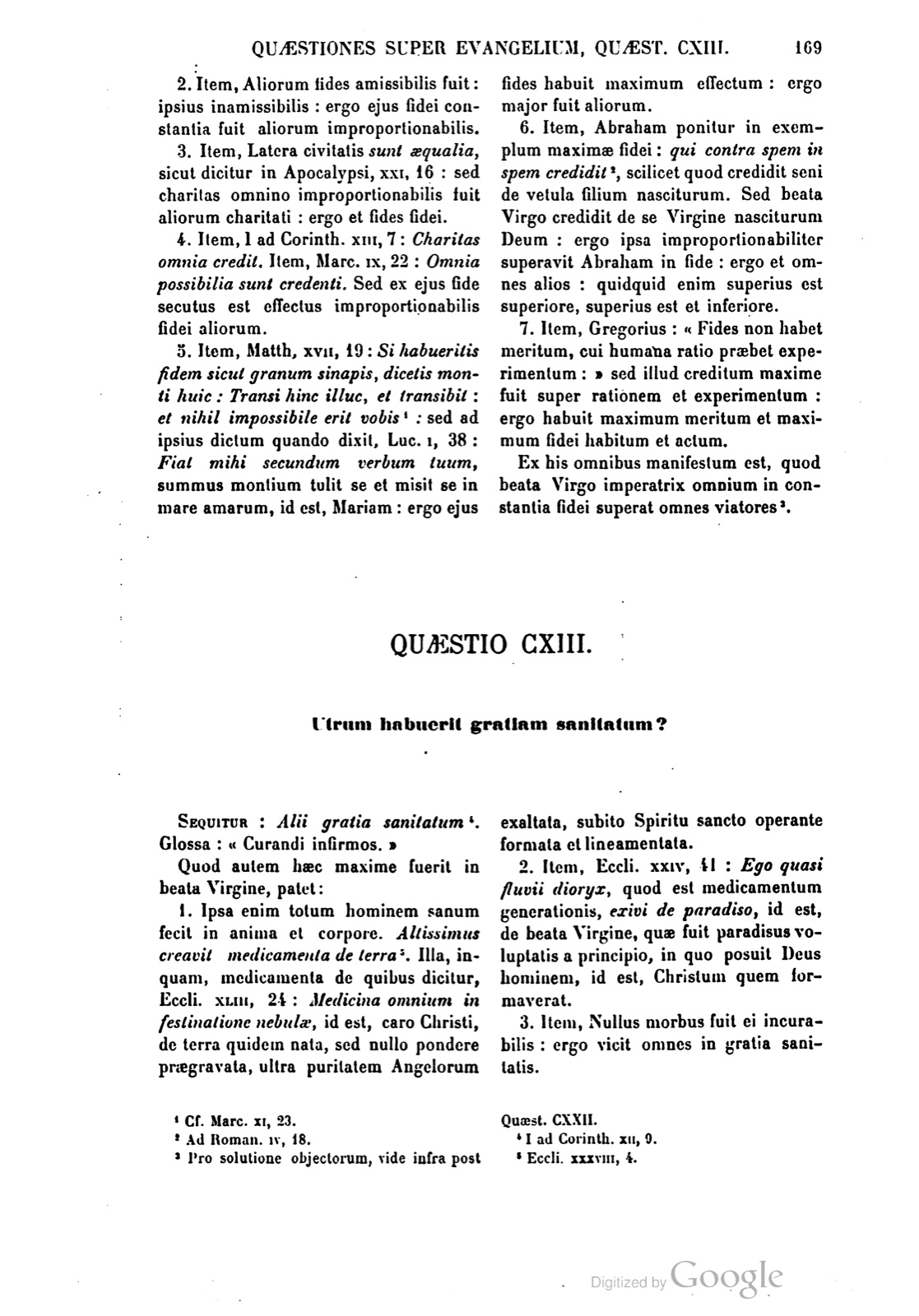
2. Item, Aliorum fides amissibilis fuit: ipsius inamissibilis: ergo ejus fidei constantia fuit aliorum improportionabilis.
3. Item, Latera civitatis sunt aequalia, sicut dicitur in Apocalypsi, XXI, 16: sed charitas omnino improportionabilis fuit aliorum charitati: ergo et fides fidei.
4. Item, I ad Corinth. XIII, 7: Charitas omnia credit. Item, Marc. IX, 22: Omnia possibilia sunt credenti. Sed ex ejus fide secutus est effectus improportionabilis fidei aliorum.
5. Item, Matth. XVII, 19: Si habueritis fidem sicut granum sinapis, dicetis monti huic: Transi hinc illuc, et transibit: et nihil impossibile erit vobis 1: sed ad ipsius dictum quando dixit, Luc. I, 38: Fiat mihi secundum verbum tuum, summus montium tulit se et misit se in mare amarum, id est, Mariam: ergo ejus fides habuit maximum effectum: ergo major fuit aliorum.
6. Item, Abraham ponitur in exemplum maximae fidei: qui contra spem in spem credidit 2, scilicet quod credidit seni de vetula filium nasciturum. Sed beata Virgo credidit de se Virgine nasciturum Deum: ergo ipsa improportionabiliter superavit Abraham in fide: ergo et omnes alios: quidquid enim superius est superiore, superius est et inferiore.
7. Item, Gregorius: « Fides non habet meritum, cui humana ratio praebet experimentum: » sed illud creditum maxime fuit super rationem et experimentum: ergo habuit maximum meritum et maximum fidei habitum et actum.
Ex his omnibus manifestum est, quod beata Virgo imperatrix omnium in constantia fidei superat omnes viatores 3.
2. Likewise, the faith of others was losable; hers was unlosable. Therefore the constancy of her faith was disproportionate to that of others.
3. Likewise, the sides of the city are equal, as is said in Revelation 21:16. But her charity was altogether disproportionate to the charity of others. Therefore so also her faith to their faith.
4. Likewise, 1 Corinthians 13:7: Charity believes all things. Likewise, Mark 9:22: All things are possible to one who believes. But from her faith there followed an effect disproportionate to the faith of others.
5. Likewise, Matthew 17:19: If you have faith like a grain of mustard seed, you will say to this mountain, Pass from here to there, and it will pass, and nothing will be impossible to you 1. But at her word, when she said, Luke 1:38: Let it be done to me according to your word, the highest of mountains took himself and cast himself into the bitter sea, that is, into Mary. Therefore her faith had the greatest effect. Therefore it was greater than the faith of others.
6. Likewise, Abraham is set forth as an example of the greatest faith, who against hope believed in hope 2, namely because he believed that a son would be born to an old man from an old woman. But the blessed Virgin believed that God would be born from herself as Virgin. Therefore she disproportionately surpassed Abraham in faith. Therefore she also surpassed all others; for whatever is higher than a higher thing is higher also than a lower thing.
7. Likewise, Gregory says: “Faith does not have merit when human reason provides experiment.” But that which was believed was especially above reason and experiment. Therefore she had the greatest merit and the greatest habit and act of faith.
From all these things it is manifest that the blessed Virgin, empress of all, surpasses all wayfarers in constancy of faith 3.
If a page does not appear, its photograph has not been uploaded yet.