Works › The Mariale: Questions on “Missus est”
Volume 37 · pp. 167–168
Response to Questions 95, 96, etc., concerning knowledge
A marker with ≈ is an approximate page boundary, placed by measure of the text; the page photographs remain the authority. In the paired views, clicking a page marker brings that page into view.
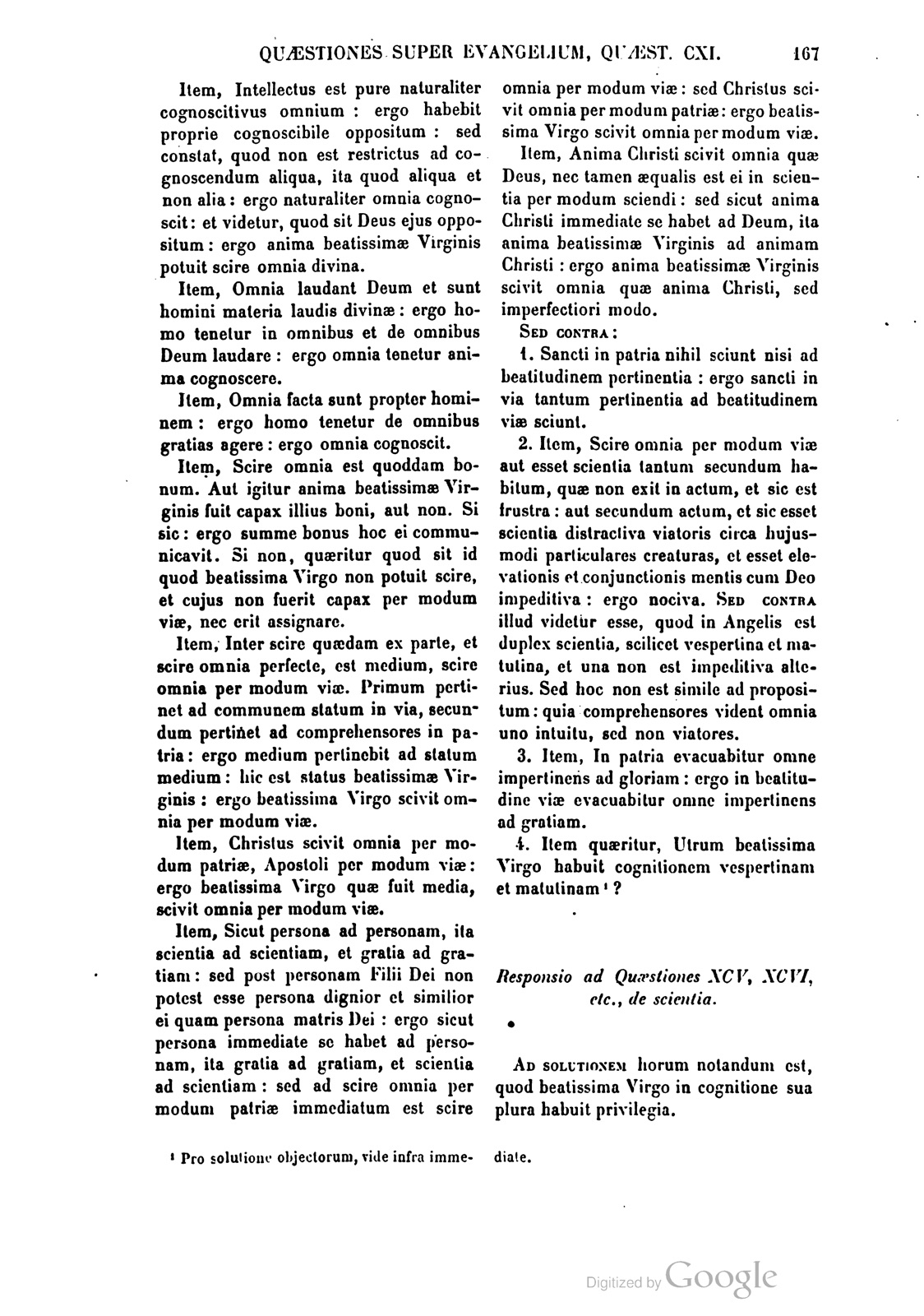
Responsio ad Quaestiones XCV, XCVI, etc., de scientia.
Ad solutionem horum notandum est, quod beatissima Virgo in cognitione sua plura habuit privilegia.
Primum est perfecta cognitio Trinitatis Dei sine medio, quam habuit in via per specialissimam gratiam.
Secundum est perfecta cognitio mysterii Incarnationis: et hanc habuit per gratiam et singularem experientiam.
Tertium est cognitio suae praedestinationis, quam habuit per revelationem et causam.
Quartum est animae suae et spirituum per proprias species cognitio, quam habuit dispositive per naturam, completive per gratiam, et per hanc vidit Angelos et animas et daemones.
Quintum est perfecta cognitio omnium ad statum viae pertinentium, quam habuit per gratiae infusionem et inspirationem: et haec comprehendit perfectam cognitionem Scripturarum, operandorum, et contemplandorum.
Sextum est cognitio omnium circa se futurorum, quam habuit per revelationem et in speculo lectionum.
Septimum est omnium ad statum patriae pertinentium cognitio, quam habuit per contemplationis revelationem.
Octavum est omnium creaturarum cognitio, quam habuit per naturam et gratiam et contemplationem.
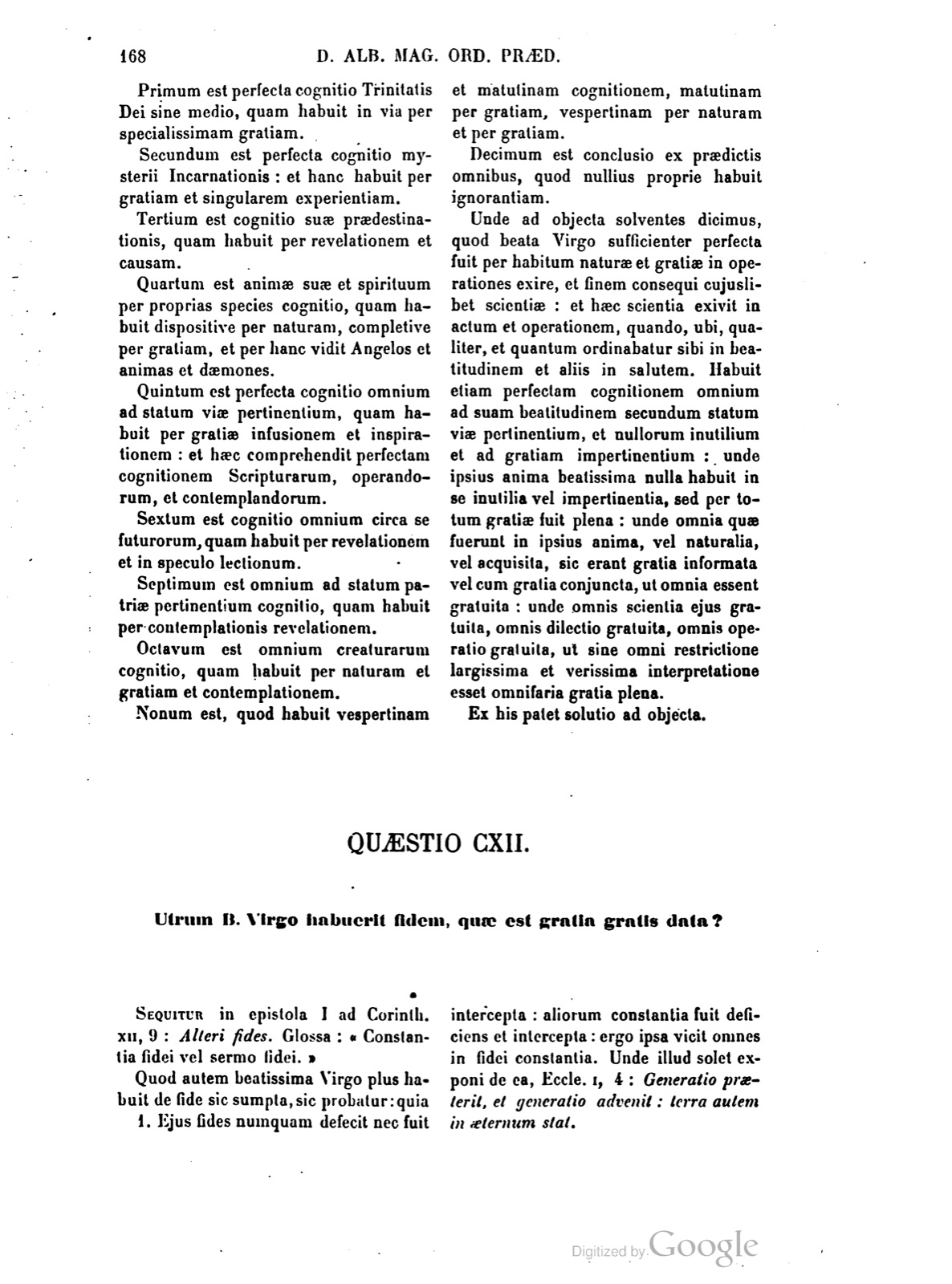
Nonum est, quod habuit vespertinam et matutinam cognitionem, matutinam per gratiam, vespertinam per naturam et per gratiam.
Response to Questions 95, 96, etc., concerning knowledge.
For the solution of these things it must be noted that the most blessed Virgin had several privileges in her cognition.
The first is perfect cognition of the Trinity of God without a medium, which she had on the way through most special grace.
The second is perfect cognition of the mystery of the Incarnation, and this she had through grace and singular experience.
The third is cognition of her own predestination, which she had through revelation and cause.
The fourth is cognition of her own soul and of spirits through their proper species, which she had dispositively through nature, completively through grace; and through this she saw Angels and souls and demons.
The fifth is perfect cognition of all things pertaining to the state of the way, which she had through the infusion and inspiration of grace; and this comprehends perfect cognition of the Scriptures, of things to be done, and of things to be contemplated.
The sixth is cognition of all future things concerning herself, which she had through revelation and in the mirror of readings.
The seventh is cognition of all things pertaining to the state of the homeland, which she had through the revelation of contemplation.
The eighth is cognition of all creatures, which she had through nature and grace and contemplation.
The ninth is that she had evening and morning cognition: morning cognition through grace, evening cognition through nature and through grace.
Decimum est conclusio ex praedictis omnibus, quod nullius proprie habuit ignorantiam.
Unde ad objecta solventes dicimus, quod beata Virgo sufficienter perfecta fuit per habitum naturae et gratiae in operationes exire, et finem consequi cujuslibet scientiae: et haec scientia exivit in actum et operationem, quando, ubi, qualiter, et quantum ordinabatur sibi in beatitudinem et aliis in salutem. Habuit etiam perfectam cognitionem omnium ad suam beatitudinem secundum statum viae pertinentium, et nullorum inutilium et ad gratiam impertinentium: unde ipsius anima beatissima nulla habuit in se inutilia vel impertinentia, sed per totum gratiae fuit plena: unde omnia quae fuerunt in ipsius anima, vel naturalia, vel acquisita, sic erant gratia informata vel cum gratia conjuncta, ut omnia essent gratuita: unde omnis scientia ejus gratuita, omnis dilectio gratuita, omnis operatio gratuita, ut sine omni restrictione largissima et verissima interpretatione esset omnifaria gratia plena.
Ex his patet solutio ad objecta.
The tenth is the conclusion from all the foregoing, that she had ignorance properly of nothing.
Hence, solving the objections, we say that the blessed Virgin was sufficiently perfect through the habit of nature and grace to go out into the operations and to attain the end of any knowledge whatever; and this knowledge went out into act and operation when, where, in what way, and to what extent it was ordered to beatitude for herself and to salvation for others. She also had perfect cognition of all things pertaining to her beatitude according to the state of the way, and of no useless things and of no things irrelevant to grace. Hence her most blessed soul had in itself nothing useless or irrelevant, but was full of grace throughout. Hence all things which were in her soul, whether natural or acquired, were so informed by grace or joined with grace that all were gratuitous. Hence all her knowledge was gratuitous, all her love gratuitous, all her operation gratuitous, so that without any restriction, by the broadest and truest interpretation, she was full of every kind of grace.
From these things the solution to the objections is clear.
If a page does not appear, its photograph has not been uploaded yet.