Works › The Mariale: Questions on “Missus est”
Volume 37 · pp. 166–167
Question 111. Whether she knew all things?
A marker with ≈ is an approximate page boundary, placed by measure of the text; the page photographs remain the authority. In the paired views, clicking a page marker brings that page into view.
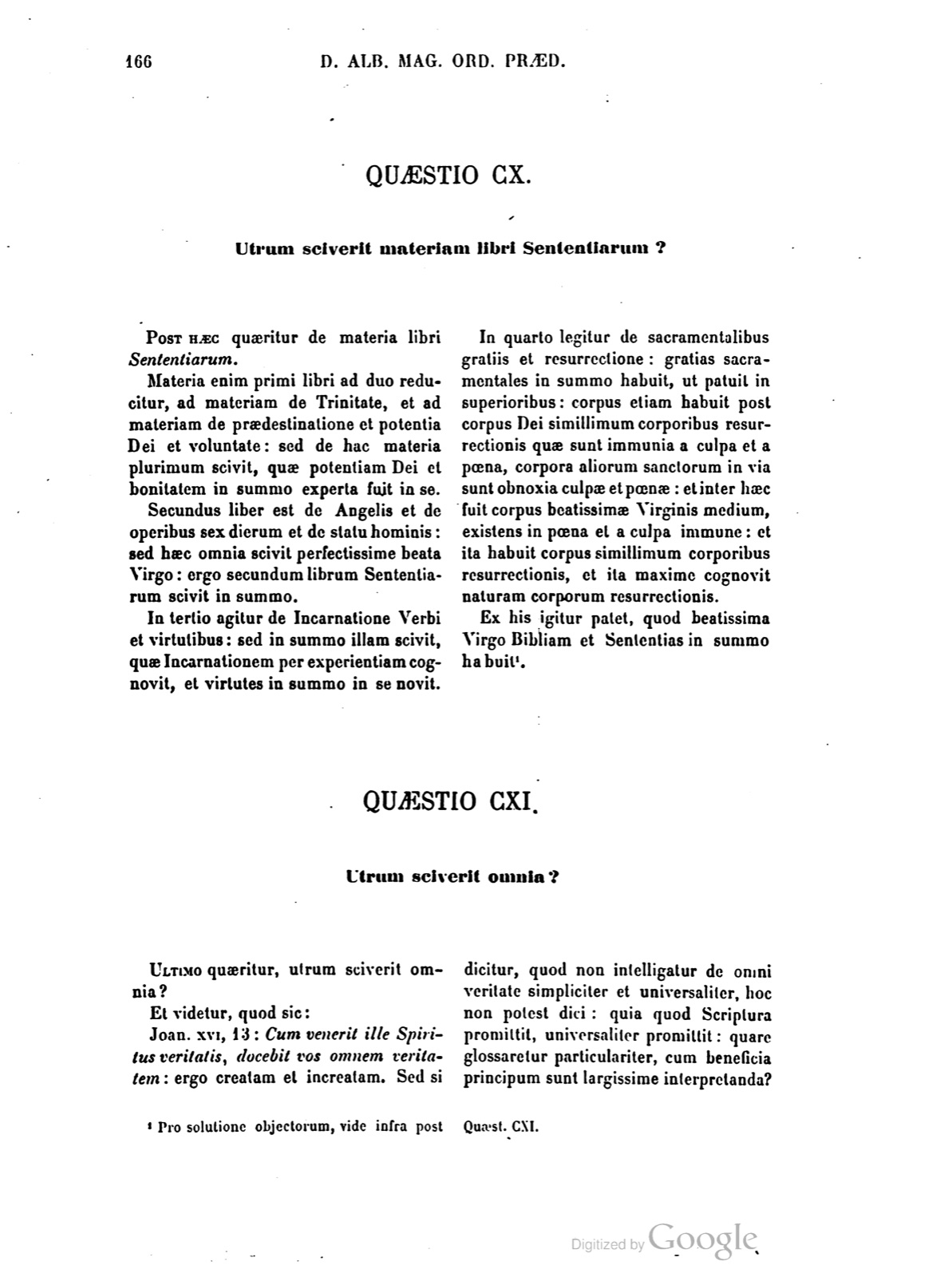
QUAESTIO CXI. Utrum sciverit omnia?
Ultimo quaeritur, utrum sciverit omnia?
Et videtur, quod sic:
Joan. XVI, 13: Cum venerit ille Spiritus veritatis, docebit vos omnem veritatem: ergo creatam et increatam. Sed si dicitur, quod non intelligatur de omni veritate simpliciter et universaliter, hoc non potest dici: quia quod Scriptura promittit, universaliter promittit: quare glossaretur particulariter, cum beneficia principum sunt largissime interpretanda?
Item, Intellectus est pure naturaliter cognoscitivus omnium: ergo habebit proprie cognoscibile oppositum: sed constat, quod non est restrictus ad cognoscendum aliqua, ita quod aliqua et non alia: ergo naturaliter omnia cognoscit: et videtur, quod sit Deus ejus oppositum: ergo anima beatissimae Virginis potuit scire omnia divina.
Item, Omnia laudant Deum et sunt homini materia laudis divinae: ergo homo tenetur in omnibus et de omnibus Deum laudare: ergo omnia tenetur anima cognoscere.
Item, Omnia facta sunt propter hominem: ergo homo tenetur de omnibus gratias agere: ergo omnia cognoscit.
Item, Scire omnia est quoddam bonum. Aut igitur anima beatissimae Virginis fuit capax illius boni, aut non. Si sic: ergo summe bonus hoc ei communicavit. Si non, quaeritur quid sit id quod beatissima Virgo non potuit scire, et cujus non fuerit capax per modum viae, nec erit assignare.
Item, Inter scire quaedam ex parte, et scire omnia perfecte, est medium, scire omnia per modum viae. Primum pertinet ad communem statum in via, secundum pertinet ad comprehensores in patria: ergo medium pertinebit ad statum medium: hic est status beatissimae Virginis: ergo beatissima Virgo scivit omnia per modum viae.
Item, Christus scivit omnia per modum patriae, Apostoli per modum viae: ergo beatissima Virgo quae fuit media, scivit omnia per modum viae.
QUESTION 111. Whether she knew all things?
Finally it is asked whether she knew all things.
And it seems that she did:
John 16:13: When that Spirit of truth shall come, he will teach you every truth. Therefore both created and uncreated truth. But if it is said that this is not understood of every truth simply and universally, this cannot be said, because what Scripture promises, it promises universally. Why should it be glossed particularly, when the benefits of princes are to be interpreted most broadly?
Likewise, the intellect is purely naturally capable of knowing all things. Therefore it will properly have a knowable opposite. But it is certain that it is not restricted to knowing some things, in such a way that it knows some and not others. Therefore naturally it knows all things. And it seems that God is its opposite. Therefore the soul of the most blessed Virgin could know all divine things.
Likewise, all things praise God and are for man material of divine praise. Therefore man is bound in all things and concerning all things to praise God. Therefore the soul is bound to know all things.
Likewise, all things were made for man. Therefore man is bound to give thanks concerning all things. Therefore he knows all things.
Likewise, to know all things is a certain good. Therefore either the soul of the most blessed Virgin was capable of that good, or not. If so, therefore the supremely good one communicated this to her. If not, it is asked what that thing is which the most blessed Virgin could not know, and of which she was not capable according to the mode of the way; and it will not be possible to assign it.
Likewise, between knowing certain things in part and knowing all things perfectly there is a middle, namely to know all things according to the mode of the way. The first pertains to the common state on the way; the second pertains to comprehensors in the homeland. Therefore the middle will pertain to a middle state. This is the state of the most blessed Virgin. Therefore the most blessed Virgin knew all things according to the mode of the way.
Likewise, Christ knew all things according to the mode of the homeland, the Apostles according to the mode of the way. Therefore the blessed Virgin, who was in the middle, knew all things according to the mode of the way.
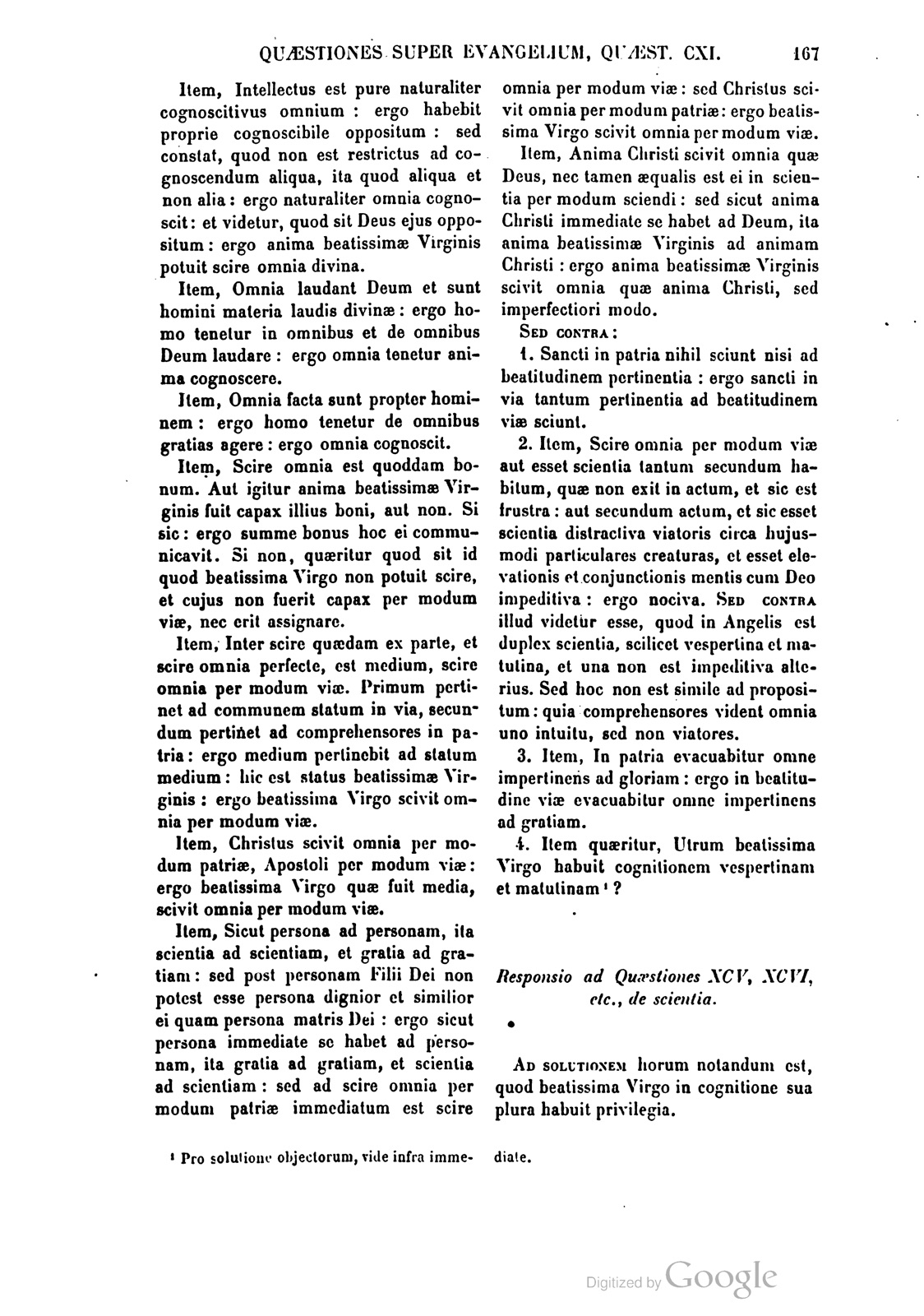
Item, Sicut persona ad personam, ita scientia ad scientiam, et gratia ad gratiam: sed post personam Filii Dei non potest esse persona dignior et similior ei quam persona matris Dei: ergo sicut persona immediate se habet ad personam, ita gratia ad gratiam, et scientia ad scientiam: sed ad scire omnia per modum patriae immediatum est scire omnia per modum viae: sed Christus scivit omnia per modum patriae: ergo beatissima Virgo scivit omnia per modum viae.
Item, Anima Christi scivit omnia quae Deus, nec tamen aequalis est ei in scientia per modum sciendi: sed sicut anima Christi immediate se habet ad Deum, ita anima beatissimae Virginis ad animam Christi: ergo anima beatissimae Virginis scivit omnia quae anima Christi, sed imperfectiori modo.
Sed contra:
1. Sancti in patria nihil sciunt nisi ad beatitudinem pertinentia: ergo sancti in via tantum pertinentia ad beatitudinem viae sciunt.
2. Item, Scire omnia per modum viae aut esset scientia tantum secundum habitum, quae non exit in actum, et sic est frustra: aut secundum actum, et sic esset scientia distractiva viatoris circa hujusmodi particulares creaturas, et esset elevationis et conjunctionis mentis cum Deo impeditiva: ergo nociva. Sed contra illud videtur esse, quod in Angelis est duplex scientia, scilicet vespertina et matutina, et una non est impeditiva alterius. Sed hoc non est simile ad propositum: quia comprehensores vident omnia uno intuitu, sed non viatores.
3. Item, In patria evacuabitur omne impertinens ad gloriam: ergo in beatitudine viae evacuabitur omne impertinens ad gratiam.
4. Item quaeritur, Utrum beatissima Virgo habuit cognitionem vespertinam et matutinam 1?
Likewise, as person is to person, so knowledge is to knowledge, and grace to grace. But after the person of the Son of God there cannot be a person more worthy and more like him than the person of the Mother of God. Therefore as person is immediately related to person, so grace is related to grace, and knowledge to knowledge. But immediately next to knowing all things according to the mode of the homeland is knowing all things according to the mode of the way. But Christ knew all things according to the mode of the homeland. Therefore the most blessed Virgin knew all things according to the mode of the way.
Likewise, the soul of Christ knew all things which God knows, and yet it is not equal to him in knowledge according to the mode of knowing. But as the soul of Christ is immediately related to God, so the soul of the most blessed Virgin is related to the soul of Christ. Therefore the soul of the most blessed Virgin knew all things which the soul of Christ knew, but in a more imperfect mode.
But to the contrary:
1. The saints in the homeland know nothing except things pertaining to beatitude. Therefore saints on the way know only things pertaining to the beatitude of the way.
2. Likewise, to know all things according to the mode of the way would either be knowledge only according to habit, which does not go out into act, and thus is vain; or according to act, and thus it would be a knowledge distracting the wayfarer concerning particular creatures of this kind, and would be an impediment to the elevation and conjunction of the mind with God. Therefore it would be harmful. But to the contrary of that there seems to be this, that in Angels there is a twofold knowledge, namely evening and morning knowledge, and one is not an impediment to the other. But this is not similar to the proposed matter, because comprehensors see all things in one gaze, but wayfarers do not.
3. Likewise, in the homeland everything irrelevant to glory will be emptied out. Therefore in the beatitude of the way everything irrelevant to grace will be emptied out.
4. Likewise it is asked whether the most blessed Virgin had evening and morning knowledge 1?
Notes
- For the solution of the objections, see below immediately. (Pro solutione objectorum, vide infra immediate.) ↩
If a page does not appear, its photograph has not been uploaded yet.