Works › The Mariale: Questions on “Missus est”
Volume 37 · p. 157
Question 96. Whether the Blessed Virgin knew all the mechanical arts?
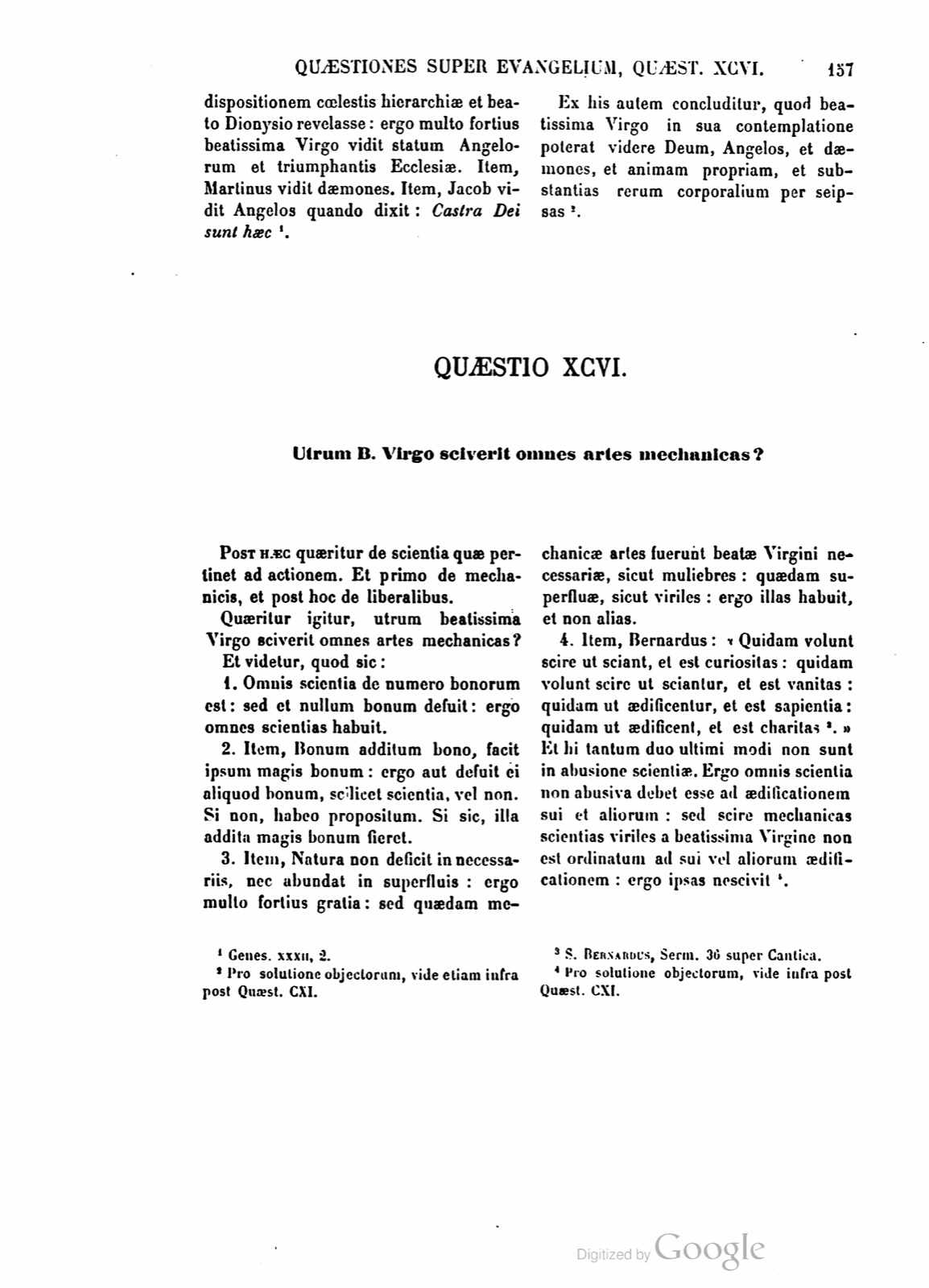
QUAESTIO XCVI. Utrum B. Virgo sciverit omnes artes mechanicas?
Post haec quaeritur de scientia quae pertinet ad actionem. Et primo de mechanicis, et post hoc de liberalibus.
Quaeritur igitur, utrum beatissima Virgo sciverit omnes artes mechanicas? Et videtur, quod sic:
1. Omnis scientia de numero bonorum est: sed ei nullum bonum defuit: ergo omnes scientias habuit.
2. Item, Bonum additum bono, facit ipsum magis bonum: ergo aut defuit ei aliquod bonum, scilicet scientia, vel non. Si non, habeo propositum. Si sic, illa addita magis bonum fieret.
3. Item, Natura non deficit in necessariis, nec abundat in superfluis: ergo multo fortius gratia: sed quaedam mechanicae artes fuerunt beatae Virgini necessariae, sicut muliebres: quaedam superfluae, sicut viriles: ergo illas habuit, et non alias.
4. Item, Bernardus: « Quidam volunt scire ut sciant, et est curiositas: quidam volunt scire ut sciantur, et est vanitas: quidam ut aedificentur, et est sapientia: quidam ut aedificent, et est charitas 1. » Et hi tantum duo ultimi modi non sunt in abusione scientiae. Ergo omnis scientia non abusiva debet esse ad aedificationem sui et aliorum: sed scire mechanicas scientias viriles a beatissima Virgine non est ordinatum ad sui vel aliorum aedificationem: ergo ipsas nescivit 2.
QUESTION 96. Whether the Blessed Virgin knew all the mechanical arts?
After this inquiry is made about the knowledge which pertains to action. And first about the mechanical arts, and after this about the liberal arts.
Therefore it is asked whether the most blessed Virgin knew all the mechanical arts? And it seems that she did:
1. Every knowledge is from the number of good things; but no good thing was lacking to her; therefore she had all knowledges.
2. Likewise, a good added to a good makes that thing more good. Therefore either some good, namely knowledge, was lacking to her, or not. If not, I have the proposed conclusion. If so, with that added she would be made more good.
3. Likewise, nature does not fail in necessary things, nor abound in superfluous things; therefore much more grace does not. But certain mechanical arts were necessary for the blessed Virgin, such as women’s arts; certain ones were superfluous, such as men’s arts. Therefore she had those, and not the others.
4. Likewise, Bernard says: “Certain persons wish to know that they may know, and it is curiosity; certain persons wish to know that they may be known, and it is vanity; certain persons wish to know that they may be built up, and it is wisdom; certain persons wish to know that they may build up, and it is charity 1.” And only these last two modes are not in the abuse of knowledge. Therefore every knowledge that is not abusive ought to be for the edification of oneself and of others. But for the most blessed Virgin to know men’s mechanical knowledges is not ordered to the edification of herself or of others. Therefore she did not know them 2.
If a page does not appear, its photograph has not been uploaded yet.