Works › The Mariale: Questions on “Missus est”
Volume 37 · p. 158
Question 97. Whether she knew the more subtle and noble women’s mechanical arts?
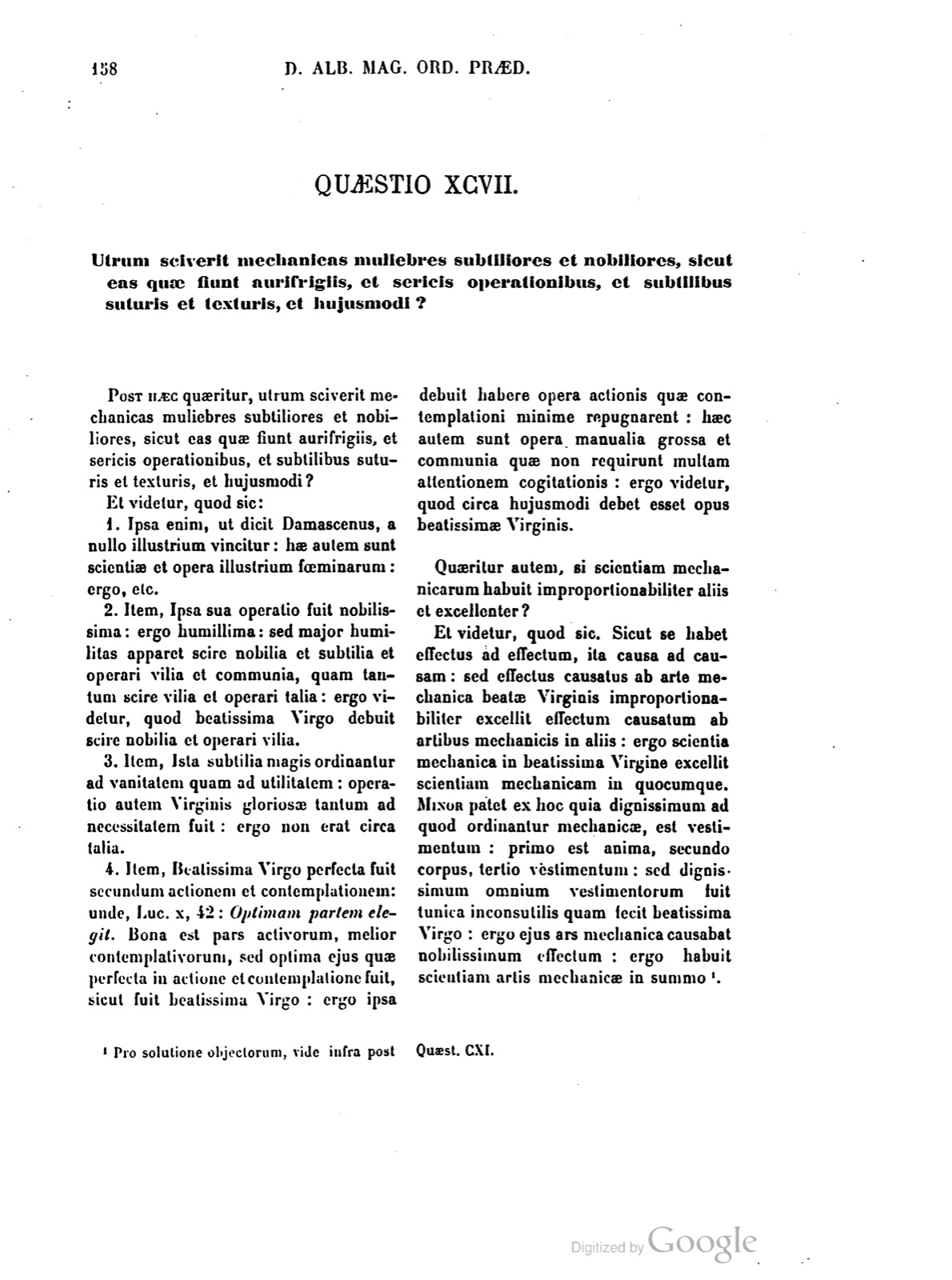
QUAESTIO XCVII. Utrum sciverit mechanicas muliebres subtiliores et nobiliores, sicut eas quae fiunt aurifrigiis, et sericis operationibus, et subtilibus suturis et texturis, et hujusmodi?
Post haec quaeritur, utrum sciverit mechanicas muliebres subtiliores et nobiliores, sicut eas quae fiunt aurifrigiis, et sericis operationibus, et subtilibus suturis et texturis, et hujusmodi?
Et videtur, quod sic:
1. Ipsa enim, ut dicit Damascenus, a nullo illustrium vincitur: hae autem sunt scientiae et opera illustrium foeminarum: ergo, etc.
2. Item, Ipsa sua operatio fuit nobilissima: ergo humillima: sed major humilitas apparet scire nobilia et subtilia et operari vilia et communia, quam tantum scire vilia et operari talia: ergo videtur, quod beatissima Virgo debuit scire nobilia et operari vilia.
3. Item, Ista subtilia magis ordinantur ad vanitatem quam ad utilitatem: operatio autem Virginis gloriosae tantum ad necessitatem fuit: ergo non erat circa talia.
4. Item, Beatissima Virgo perfecta fuit secundum actionem et contemplationem: unde, Luc. X, 42: Optimam partem elegit. Bona est pars activorum, melior contemplativorum, sed optima ejus quae perfecta in actione et contemplatione fuit, sicut fuit beatissima Virgo: ergo ipsa debuit habere opera actionis quae contemplationi minime repugnarent: haec autem sunt opera manualia grossa et communia quae non requirunt multam attentionem cogitationis: ergo videtur, quod circa hujusmodi debet esse opus beatissimae Virginis.
Quaeritur autem, si scientiam mechanicarum habuit improportionabiliter aliis et excellenter?
Et videtur, quod sic. Sicut se habet effectus ad effectum, ita causa ad causam: sed effectus causatus ab arte mechanica beatae Virginis improportionabiliter excellit effectum causatum ab artibus mechanicis in aliis: ergo scientia mechanica in beatissima Virgine excellit scientiam mechanicam in quocumque. Minor patet ex hoc quia dignissimum ad quod ordinantur mechanicae, est vestimentum: primo est anima, secundo corpus, tertio vestimentum: sed dignissimum omnium vestimentorum fuit tunica inconsutilis quam fecit beatissima Virgo: ergo ejus ars mechanica causabat nobilissimum effectum: ergo habuit scientiam artis mechanicae in summo 1.
QUESTION 97. Whether she knew the more subtle and more noble women’s mechanical arts, such as those which are done with gold embroidery, and with silk works, and with subtle sewings and weavings, and things of this kind?
After this inquiry is made whether she knew the more subtle and more noble women’s mechanical arts, such as those which are done with gold embroidery, and with silk works, and with subtle sewings and weavings, and things of this kind?
And it seems that she did:
1. For she herself, as Damascene says, is surpassed by none of the illustrious; but these are the knowledges and works of illustrious women; therefore, etc.
2. Likewise, her own operation was most noble; therefore most humble. But greater humility appears in knowing noble and subtle things and in working low and common things, than in only knowing low things and working such things. Therefore it seems that the most blessed Virgin ought to have known noble things and worked lowly things.
3. Likewise, those subtle things are ordered more to vanity than to usefulness; but the operation of the glorious Virgin was only for necessity. Therefore it was not concerned with such things.
4. Likewise, the most blessed Virgin was perfect according to action and contemplation; hence Luke 10:42: She chose the best part. The part of active persons is good, that of contemplative persons better, but best is the part of her who was perfect in action and contemplation, as the most blessed Virgin was. Therefore she herself ought to have had works of action which would least conflict with contemplation. But these are coarse and common manual works, which do not require much attention of thought. Therefore it seems that the work of the most blessed Virgin ought to be concerned with things of this kind.
But it is asked whether she had knowledge of the mechanical arts disproportionately and excellently beyond others?
And it seems that she did. As effect is related to effect, so cause is related to cause. But the effect caused by the mechanical art of the blessed Virgin surpasses disproportionately the effect caused by mechanical arts in others. Therefore mechanical knowledge in the most blessed Virgin surpasses mechanical knowledge in anyone whatever. The minor is clear from this, because the most worthy thing to which mechanical arts are ordered is clothing: first is the soul, second the body, third clothing. But the most worthy of all garments was the seamless tunic which the most blessed Virgin made. Therefore her mechanical art caused the noblest effect. Therefore she had knowledge of mechanical art in the highest degree 1.
Notes
- For the solution of the objections, see below after Question CXI. (Pro solutione objectorum, vide infra post Quaest. CXI.) ↩
If a page does not appear, its photograph has not been uploaded yet.