Works › The Mariale: Questions on “Missus est”
Volume 37 · pp. 152–153
Fuller solution, sections 4-6
A marker with ≈ is an approximate page boundary, placed by measure of the text; the page photographs remain the authority. In the paired views, clicking a page marker brings that page into view.
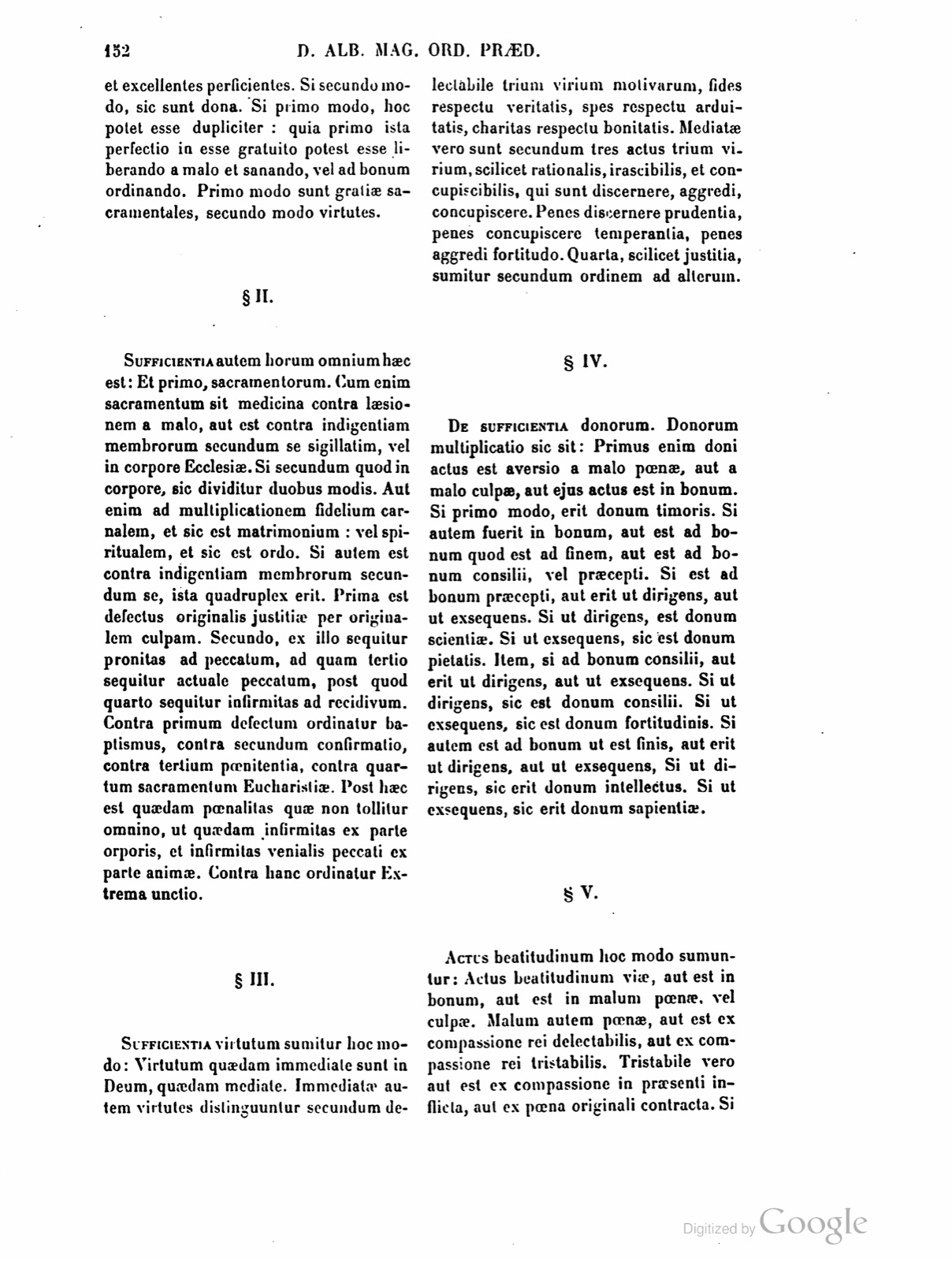
§ IV.
De sufficientia donorum. Donorum multiplicatio sic sit: Primus enim doni actus est aversio a malo poenae, aut a malo culpae, aut ejus actus est in bonum. Si primo modo, erit donum timoris. Si autem fuerit in bonum, aut est ad bonum quod est ad finem, aut est ad bonum consilii, vel praecepti. Si est ad bonum praecepti, aut erit ut dirigens, aut ut exsequens. Si ut dirigens, est donum scientiae. Si ut exsequens, sic est donum pietatis. Item, si ad bonum consilii, aut erit ut dirigens, aut ut exsequens. Si ut dirigens, sic est donum consilii. Si ut exsequens, sic est donum fortitudinis. Si autem est ad bonum ut est finis, aut erit ut dirigens, aut ut exsequens. Si ut dirigens, sic erit donum intellectus. Si ut exsequens, sic erit donum sapientiae.
§ V.
Actus beatitudinum hoc modo sumuntur: Actus beatitudinum viae, aut est in bonum, aut est in malum poenae, vel culpae. Malum autem poenae, aut est ex compassione rei delectabilis, aut ex compassione rei tristabilis. Tristabile vero aut est ex compassione in praesenti inflicta, aut ex poena originali contracta. Si autem fuerit ex compassione rei delectabilis, abdicatio ejus est beatitudo paupertatis. Si ex compassione inflicta in praesenti, sic est mititas. Si ex compassione originali contracta, sic est luctus. Si autem fuerit in bonum, aut in bonum increatum, aut in bonum creatum. Si autem fuerit in bonum increatum, aut in bonum consilii, aut in bonum praecepti. Si praecepti, sic est esuries justitiae. Si consilii, sic est misericordia. Si autem fuerit in bonum creatum, aut quantum ad intellectum, aut quantum ad affectum. Si quantum ad intellectum, sic est munditia cordis. Si quantum ad affectum, sic est pacificatio. Et sic patet sufficientia beatitudinum.
Section 4.
Concerning the sufficiency of the gifts. Let the multiplication of the gifts be in this way: for the first act of a gift is turning away from the evil of punishment, or from the evil of fault, or its act is toward good. If in the first way, it will be the gift of fear. But if it was toward good, it is either toward the good that is for the end, or it is toward the good of counsel or of precept. If it is toward the good of precept, it will be either as directing or as executing. If as directing, it is the gift of knowledge. If as executing, thus it is the gift of piety. Likewise, if toward the good of counsel, it will be either as directing or as executing. If as directing, thus it is the gift of counsel. If as executing, thus it is the gift of fortitude. But if it is toward good as it is the end, it will be either as directing or as executing. If as directing, thus it will be the gift of understanding. If as executing, thus it will be the gift of wisdom.
Section 5.
The acts of the beatitudes are taken in this way: the act of the beatitudes of the way is either toward good, or it is toward the evil of punishment or fault. Now the evil of punishment is either from compassion for a delightful thing or from compassion for a sorrowful thing. But the sorrowful thing is either from compassion with what has been inflicted in the present, or from original punishment contracted. But if it was from compassion for a delightful thing, abdication of it is the beatitude of poverty. If from compassion with what has been inflicted in the present, thus it is meekness. If from original compassion contracted, thus it is mourning. But if it was toward good, it is either toward uncreated good or toward created good. But if it was toward uncreated good, it is either toward the good of counsel or toward the good of precept. If of precept, thus it is hunger for justice. If of counsel, thus it is mercy. But if it was toward created good, either with regard to intellect or with regard to affection. If with regard to intellect, thus it is cleanness of heart. If with regard to affection, thus it is peacemaking. And thus the sufficiency of the beatitudes is plain.
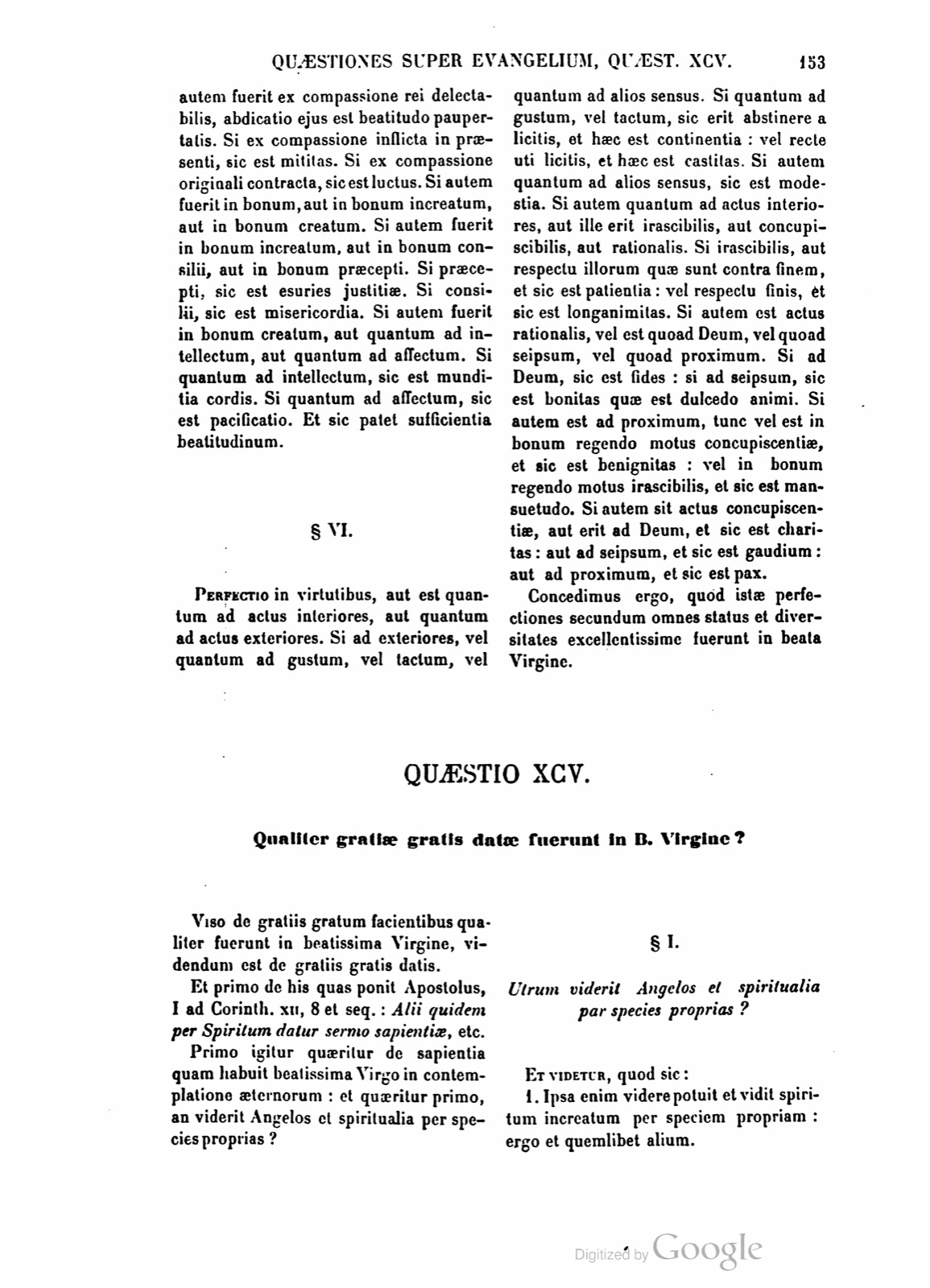
§ VI.
Perfectio in virtutibus, aut est quantum ad actus interiores, aut quantum ad actus exteriores. Si ad exteriores, vel quantum ad gustum, vel tactum, vel quantum ad alios sensus. Si quantum ad gustum, vel tactum, sic erit abstinere a licitis, et haec est continentia: vel recte uti licitis, et haec est castitas. Si autem quantum ad alios sensus, sic est modestia. Si autem quantum ad actus interiores, aut ille erit irascibilis, aut concupiscibilis, aut rationalis. Si irascibilis, aut respectu illorum quae sunt contra finem, et sic est patientia: vel respectu finis, et sic est longanimitas. Si autem est actus rationalis, vel est quoad Deum, vel quoad seipsum, vel quoad proximum. Si ad Deum, sic est fides: si ad seipsum, sic est bonitas quae est dulcedo animi. Si autem est ad proximum, tunc vel est in bonum regendo motus concupiscentiae, et sic est benignitas: vel in bonum regendo motus irascibilis, et sic est mansuetudo. Si autem sit actus concupiscentiae, aut erit ad Deum, et sic est charitas: aut ad seipsum, et sic est gaudium: aut ad proximum, et sic est pax.
Concedimus ergo, quod istae perfectiones secundum omnes status et diversitates excellentissime fuerunt in beata Virgine.
Section 6.
Perfection in virtues is either with regard to interior acts or with regard to exterior acts. If to exterior acts, either with regard to taste or touch, or with regard to the other senses. If with regard to taste or touch, thus it will be to abstain from licit things, and this is continence; or to use licit things rightly, and this is chastity. But if with regard to the other senses, thus it is modesty. But if with regard to interior acts, that act will be either irascible, concupiscible, or rational. If irascible, either with respect to those things that are against the end, and thus it is patience; or with respect to the end, and thus it is longanimity. But if it is a rational act, it is either toward God, toward oneself, or toward one's neighbor. If toward God, thus it is faith; if toward oneself, thus it is goodness, which is sweetness of soul. But if it is toward one's neighbor, then either it is toward good by governing the movements of concupiscence, and thus it is kindness; or toward good by governing the movement of the irascible power, and thus it is meekness. But if it is an act of concupiscence, it will either be toward God, and thus it is charity; or toward oneself, and thus it is joy; or toward one's neighbor, and thus it is peace.
Therefore we concede that these perfections, according to all states and diversities, were most excellently in the blessed Virgin.
If a page does not appear, its photograph has not been uploaded yet.