Works › The Mariale: Questions on “Missus est”
Volume 37 · p. 152
Fuller solution, sections 2-3
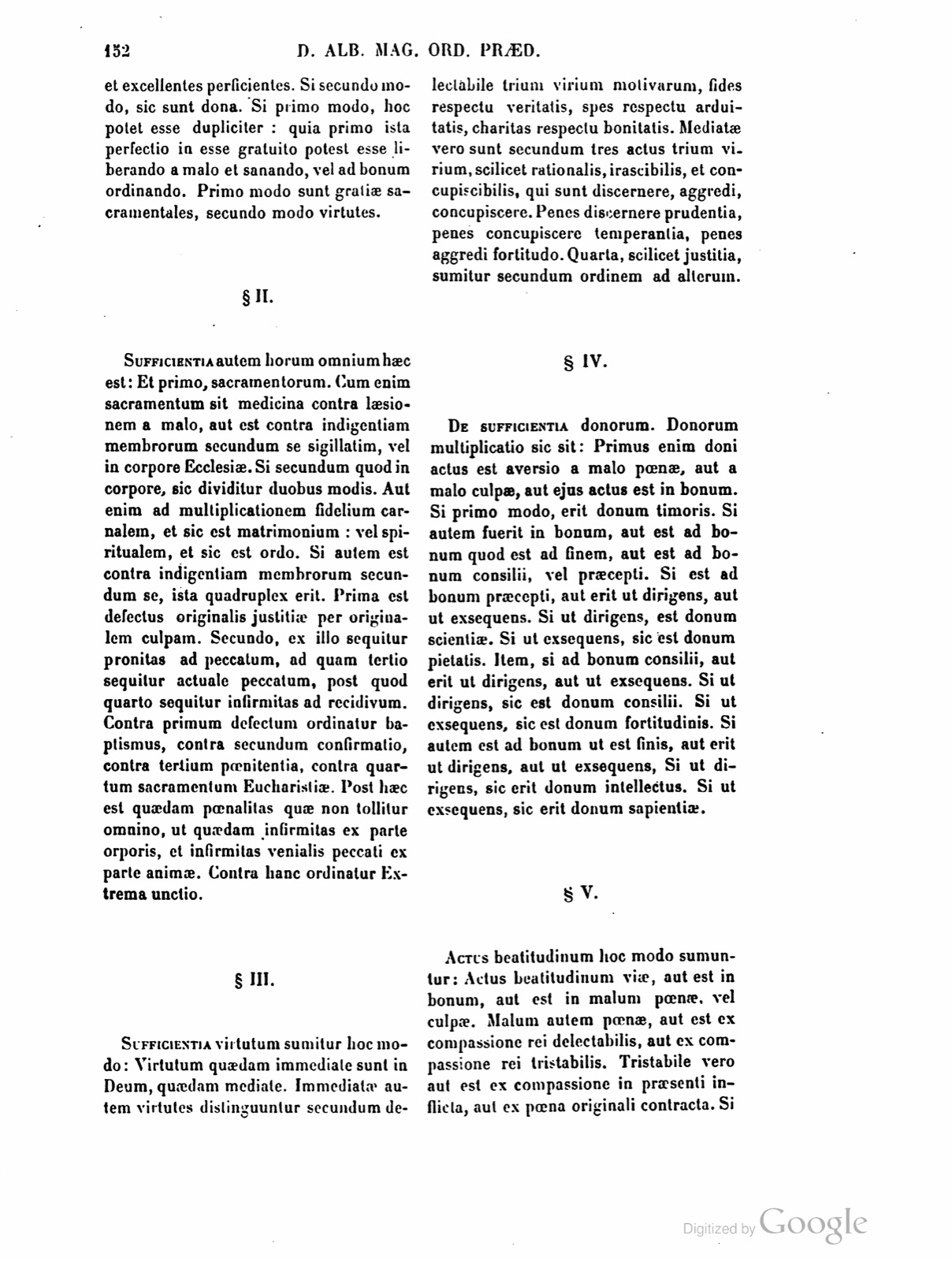
§ II.
Sufficientia autem horum omnium haec est: Et primo, sacramentorum. Cum enim sacramentum sit medicina contra laesionem a malo, aut est contra indigentiam membrorum secundum se sigillatim, vel in corpore Ecclesiae. Si secundum quod in corpore, sic dividitur duobus modis. Aut enim ad multiplicationem fidelium carnalem, et sic est matrimonium: vel spiritualem, et sic est ordo. Si autem est contra indigentiam membrorum secundum se, ista quadruplex erit. Prima est defectus originalis justitiae per originalem culpam. Secundo, ex illo sequitur pronitas ad peccatum, ad quam tertio sequitur actuale peccatum, post quod quarto sequitur infirmitas ad recidivum. Contra primum defectum ordinatur baptismus, contra secundum confirmatio, contra tertium poenitentia, contra quartum sacramentum Eucharistiae. Post haec est quaedam poenalitas quae non tollitur omnino, ut quaedam infirmitas ex parte corporis, et infirmitas venialis peccati ex parte animae. Contra hanc ordinatur Extrema unctio.
§ III.
Sufficientia virtutum sumitur hoc modo: Virtutum quaedam immediate sunt in Deum, quaedam mediate. Immediatae autem virtutes distinguuntur secundum delectabile trium virium motivarum, fides respectu veritatis, spes respectu arduitatis, charitas respectu bonitatis. Mediatae vero sunt secundum tres actus trium virium, scilicet rationalis, irascibilis, et concupiscibilis, qui sunt discernere, aggredi, concupiscere. Penes discernere prudentia, penes concupiscere temperantia, penes aggredi fortitudo. Quarta, scilicet justitia, sumitur secundum ordinem ad alterum.
Section 2.
Now the sufficiency of all these things is this: and first, of the sacraments. For since a sacrament is medicine against harm from evil, it is either against the need of the members according to themselves singly, or in the body of the Church. If according as it is in the body, then it is divided in two ways. For it is either for the carnal multiplication of the faithful, and thus it is matrimony; or for spiritual multiplication, and thus it is order. But if it is against the need of the members according to themselves, this will be fourfold. The first is the defect of original justice through original fault. Secondly, from that follows proneness to sin; upon this, thirdly, follows actual sin; after which, fourthly, follows weakness toward relapse. Against the first defect baptism is ordered; against the second, confirmation; against the third, penitence; against the fourth, the sacrament of the Eucharist. After these things there is a certain penalty that is not wholly taken away, as a certain weakness on the part of the body and a weakness of venial sin on the part of the soul. Extreme unction is ordered against this.
Section 3.
The sufficiency of the virtues is taken in this way: of the virtues, some are immediately in relation to God, some mediately. Now the immediate virtues are distinguished according to the delightful object of the three moving powers: faith with respect to truth, hope with respect to arduousness, charity with respect to goodness. But the mediate ones are according to the three acts of the three powers, namely the rational, the irascible, and the concupiscible, which are to discern, to advance against, and to desire. Prudence is with regard to discerning; temperance with regard to desiring; fortitude with regard to advancing against. The fourth, namely justice, is taken according to order toward another.
If a page does not appear, its photograph has not been uploaded yet.