Works › The Mariale: Questions on “Missus est”
Volume 37 · pp. 134–135
Question 78. Whether the aureole of martyrs was in the blessed Virgin
A marker with ≈ is an approximate page boundary, placed by measure of the text; the page photographs remain the authority. In the paired views, clicking a page marker brings that page into view.
QUAESTIO LXXVIII.
Utrum in B. Virgine fuerit aureola martyrum?
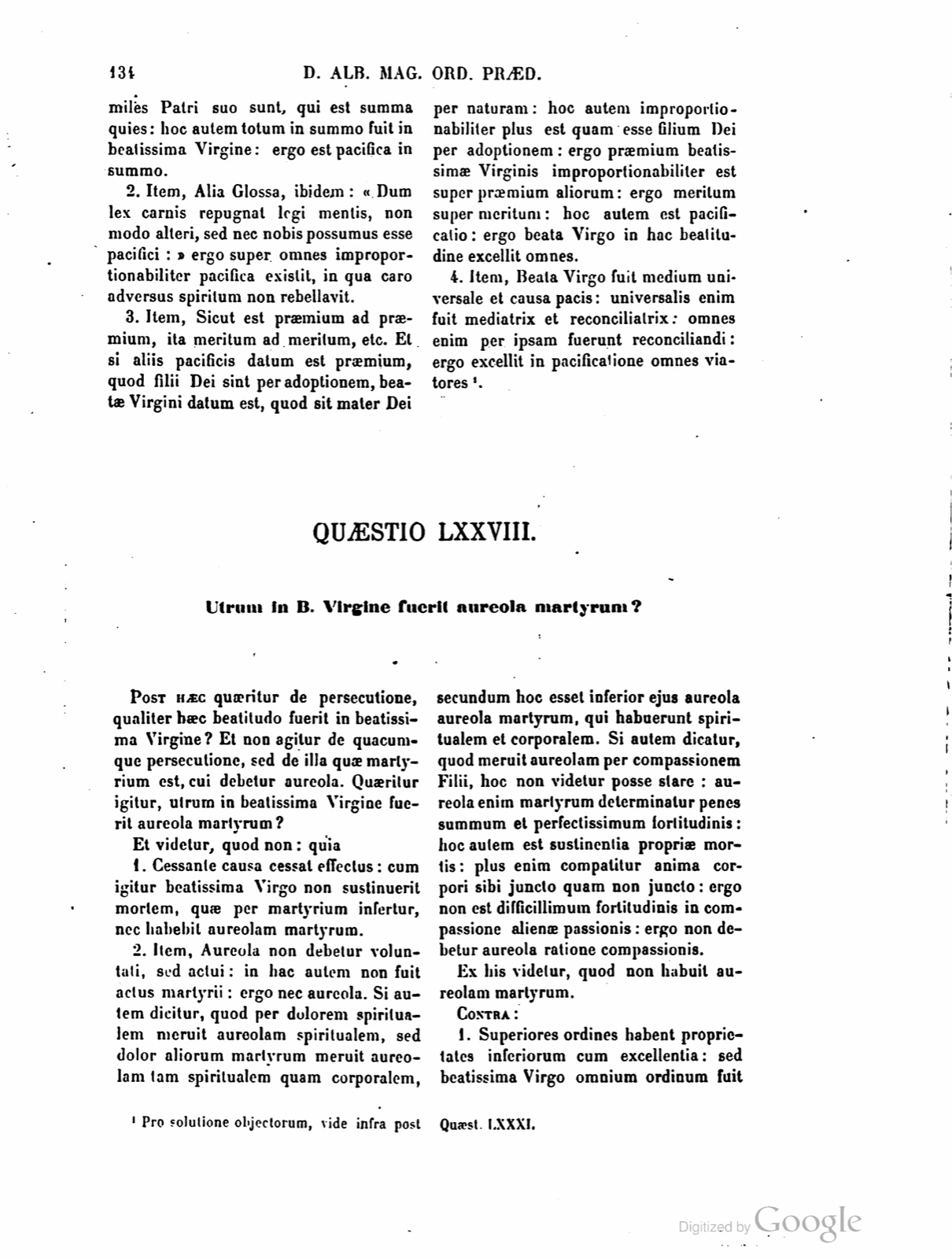
Post haec quaeritur de persecutione, qualiter haec beatitudo fuerit in beatissima Virgine? Et non agitur de quacumque persecutione, sed de illa quae martyrium est, cui debetur aureola. Quaeritur igitur, utrum in beatissima Virgine fuerit aureola martyrum?
Et videtur, quod non: quia
1. Cessante causa cessat effectus: cum igitur beatissima Virgo non sustinuerit mortem, quae per martyrium infertur, nec habebit aureolam martyrum.
2. Item, Aureola non debetur voluntati, sed actui: in hac autem non fuit actus martyrii: ergo nec aureola. Si autem dicitur, quod per dolorem spiritualem meruit aureolam spiritualem, sed dolor aliorum martyrum meruit aureolam tam spiritualem quam corporalem, secundum hoc esset inferior ejus aureola aureola martyrum, qui habuerunt spiritualem et corporalem. Si autem dicatur, quod meruit aureolam per compassionem Filii, hoc non videtur posse stare: aureola enim martyrum determinatur penes summum et perfectissimum fortitudinis: hoc autem est sustinentia propriae mortis: plus enim compatitur anima corpori sibi juncto quam non juncto: ergo non est difficillimum fortitudinis in compassione alienae passionis: ergo non debetur aureola ratione compassionis.
Ex his videtur, quod non habuit aureolam martyrum.
Contra:
1. Superiores ordines habent proprietates inferiorum cum excellentia: sed beatissima Virgo omnium ordinum fuit suprema: ergo habebit aureolam martyrum quam habent inferiores.
2. Item, Damascenus: "Haec a nullo illustrium vincitur:" sed vinceretur ab aliquo si non haberet aureolam martyrum: ergo habet aureolam martyrum.
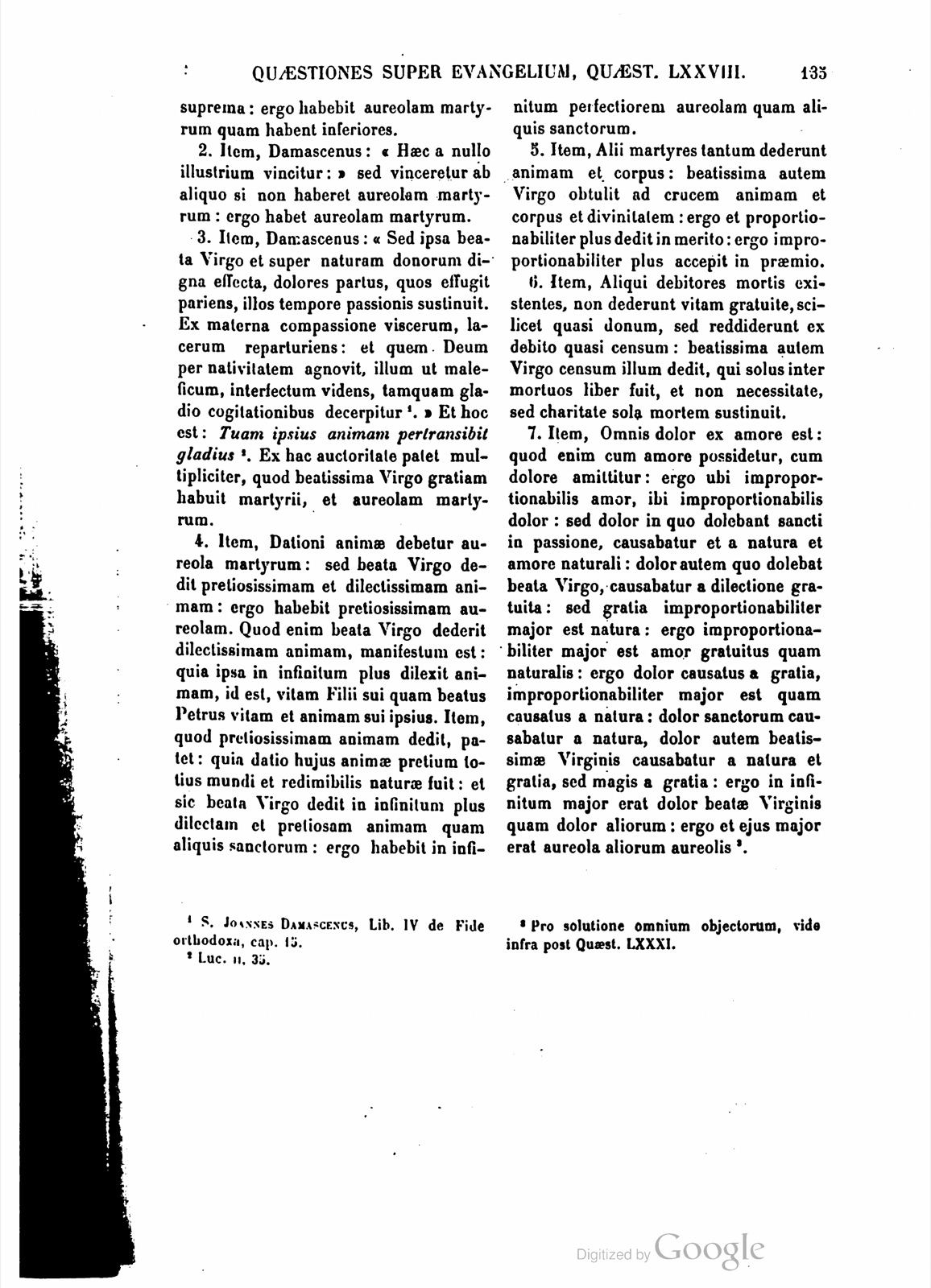
3. Item, Damascenus: "Sed ipsa beata Virgo et super naturam donorum digna effecta, dolores partus, quos effugit pariens, illos tempore passionis sustinuit. Ex materna compassione viscerum, lacerum reparturiens: et quem Deum per nativitatem agnovit, illum ut maleficum, interfectum videns, tamquam gladio cogitationibus decerpitur 1." Et hoc est: Tuam ipsius animam pertransibit gladius 2. Ex hac auctoritate patet multipliciter, quod beatissima Virgo gratiam habuit martyrii, et aureolam martyrum.
QUESTION 78.
Whether the aureole of martyrs was in the blessed Virgin.
After these things inquiry is made concerning persecution, in what way this beatitude was in the most blessed Virgin. And the discussion is not about any persecution whatever, but about that which is martyrdom, to which an aureole is owed. Therefore inquiry is made whether the aureole of martyrs was in the most blessed Virgin.
And it seems that it was not, because:
1. When the cause ceases, the effect ceases. Since therefore the most blessed Virgin did not sustain death, which is inflicted through martyrdom, neither will she have the aureole of martyrs.
2. Likewise, an aureole is owed not to will but to act. But in her there was no act of martyrdom; therefore neither was there an aureole. But if it is said that through spiritual sorrow she merited a spiritual aureole, yet the sorrow of other martyrs merited an aureole both spiritual and bodily; according to this her aureole would be inferior to the aureole of martyrs who had a spiritual and a bodily one. But if it is said that she merited the aureole through compassion for her Son, this does not seem able to stand; for the aureole of martyrs is determined according to the highest and most perfect thing of fortitude, and this is the endurance of one's own death. For the soul suffers more with the body joined to itself than with a body not joined to itself; therefore the most difficult thing of fortitude is not in compassion for another's suffering; therefore an aureole is not owed by reason of compassion.
From these things it seems that she did not have the aureole of martyrs.
On the contrary:
1. Higher orders have the properties of lower ones with excellence. But the most blessed Virgin was supreme over all orders; therefore she will have the aureole of martyrs that the lower ones have.
2. Likewise, Damascene says: "She is conquered by none of the illustrious." But she would be conquered by someone if she did not have the aureole of martyrs; therefore she has the aureole of martyrs.
3. Likewise, Damascene says: "But the blessed Virgin herself, made worthy even above the nature of gifts, sustained at the time of the passion the pains of childbirth that she escaped while giving birth. From maternal compassion of the inward parts, giving birth again to the wounded one; and seeing as a malefactor, slain, him whom she knew as God by nativity, she is torn apart in her thoughts as though by a sword 1." And this is: A sword shall pass through your own soul 2. From this authority it is clear in many ways that the most blessed Virgin had the grace of martyrdom and the aureole of martyrs.
4. Item, Dationi animae debetur aureola martyrum: sed beata Virgo dedit pretiosissimam et dilectissimam animam: ergo habebit pretiosissimam aureolam. Quod enim beata Virgo dederit dilectissimam animam, manifestum est: quia ipsa in infinitum plus dilexit animam, id est, vitam Filii sui quam beatus Petrus vitam et animam sui ipsius. Item, quod pretiosissimam animam dedit, patet: quia datio hujus animae pretium totius mundi et redimibilis naturae fuit: et sic beata Virgo dedit in infinitum plus dilectam et pretiosam animam quam aliquis sanctorum: ergo habebit in infinitum perfectiorem aureolam quam aliquis sanctorum.
5. Item, Alii martyres tantum dederunt animam et corpus: beatissima autem Virgo obtulit ad crucem animam et corpus et divinitatem: ergo et proportionabiliter plus dedit in merito: ergo improportionabiliter plus accepit in praemio.
6. Item, Aliqui debitores mortis existentes, non dederunt vitam gratuite, scilicet quasi donum, sed reddiderunt ex debito quasi censum: beatissima autem Virgo censum illum dedit, qui solus inter mortuos liber fuit, et non necessitate, sed charitate sola mortem sustinuit.
7. Item, Omnis dolor ex amore est: quod enim cum amore possidetur, cum dolore amittitur: ergo ubi improportionabilis amor, ibi improportionabilis dolor: sed dolor in quo dolebant sancti in passione, causabatur et a natura et amore naturali: dolor autem quo dolebat beata Virgo, causabatur a dilectione gratuita: sed gratia improportionabiliter major est natura: ergo improportionabiliter major est amor gratuitus quam naturalis: ergo dolor causatus a gratia, improportionabiliter major est quam causatus a natura: dolor sanctorum causabatur a natura, dolor autem beatissimae Virginis causabatur a natura et gratia, sed magis a gratia: ergo in infinitum major erat dolor beatae Virginis quam dolor aliorum: ergo et ejus major erat aureola aliorum aureolis 3.
4. Likewise, to the giving of the soul the aureole of martyrs is owed. But the blessed Virgin gave a most precious and most beloved soul; therefore she will have a most precious aureole. For that the blessed Virgin gave a most beloved soul is manifest, because she loved the soul, that is, the life, of her Son infinitely more than blessed Peter loved the life and soul of himself. Likewise, that she gave a most precious soul is clear, because the giving of this soul was the price of the whole world and of redeemable nature. And thus the blessed Virgin gave a soul infinitely more beloved and precious than any of the saints; therefore she will have an infinitely more perfect aureole than any of the saints.
5. Likewise, other martyrs gave only soul and body; but the most blessed Virgin offered at the cross soul and body and divinity. Therefore proportionally she gave more in merit, and therefore she received disproportionately more in reward.
6. Likewise, some who were debtors of death did not give life freely, namely as a gift, but returned it from debt as a tax; but the most blessed Virgin gave that tax, he who alone among the dead was free, and sustained death not by necessity but by charity alone.
7. Likewise, every sorrow is from love; for what is possessed with love is lost with sorrow. Therefore where there is disproportionate love, there is disproportionate sorrow. But the sorrow by which the saints grieved in suffering was caused both by nature and by natural love; but the sorrow by which the blessed Virgin grieved was caused by gratuitous love. But grace is disproportionately greater than nature; therefore gratuitous love is disproportionately greater than natural love; therefore sorrow caused by grace is disproportionately greater than sorrow caused by nature. The sorrow of the saints was caused by nature, but the sorrow of the most blessed Virgin was caused by nature and grace, but more by grace. Therefore the sorrow of the blessed Virgin was infinitely greater than the sorrow of others; therefore her aureole also was greater than the aureoles of others 3.
Notes
- St. John Damascene, book IV On the Orthodox Faith, chapter 15. (S. Joannes Damascenus, Lib. IV de Fide orthodoxa, cap. 15.) ↩
- Luke 2:35. (Luc. II, 35.) ↩
- For the solution of all the objections, see below after Question 81. (Pro solutione omnium objectorum, vide infra post Quaest. LXXXI.) ↩
If a page does not appear, its photograph has not been uploaded yet.