Works › The Mariale: Questions on “Missus est”
Volume 37 · p. 130
Question 73. In what way the beatitude of mourning was in her
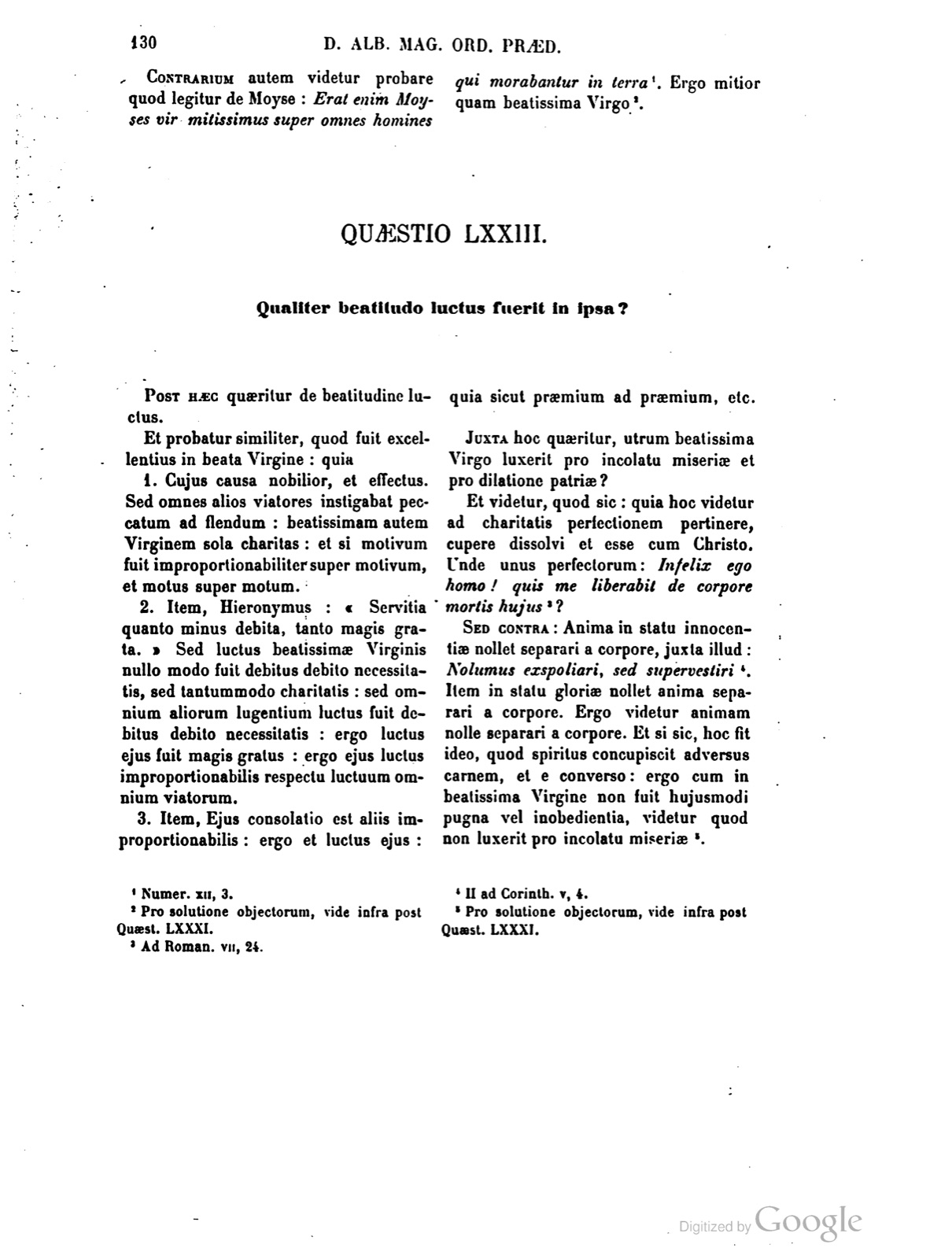
QUAESTIO LXXIII.
Qualiter beatitudo luctus fuerit in ipsa?
Post haec quaeritur de beatitudine luctus.
Et probatur similiter, quod fuit excellentius in beata Virgine: quia
1. Cujus causa nobilior, et effectus. Sed omnes alios viatores instigabat peccatum ad flendum: beatissimam autem Virginem sola charitas: et si motivum fuit improportionabiliter super motivum, et motus super motum.
2. Item, Hieronymus: "Servitia quanto minus debita, tanto magis grata." Sed luctus beatissimae Virginis nullo modo fuit debitus debito necessitatis, sed tantummodo charitatis: sed omnium aliorum lugentium luctus fuit debitus debito necessitatis: ergo luctus ejus fuit magis gratus: ergo ejus luctus improportionabilis respectu luctuum omnium viatorum.
3. Item, Ejus consolatio est aliis improportionabilis: ergo et luctus ejus: quia sicut praemium ad praemium, etc.
Juxta hoc quaeritur, utrum beatissima Virgo luxerit pro incolatu miseriae et pro dilatione patriae?
Et videtur, quod sic: quia hoc videtur ad charitatis perfectionem pertinere, cupere dissolvi et esse cum Christo. Unde unus perfectorum: Infelix ego homo! quis me liberabit de corpore mortis hujus 1?
Sed contra: Anima in statu innocentiae nollet separari a corpore, juxta illud: Nolumus exspoliari, sed supervestiri 2. Item in statu gloriae nollet anima separari a corpore. Ergo videtur animam nolle separari a corpore. Et si sic, hoc fit ideo, quod spiritus concupiscit adversus carnem, et e converso: ergo cum in beatissima Virgine non fuit hujusmodi pugna vel inobedientia, videtur quod non luxerit pro incolatu miseriae 3.
QUESTION 73.
In what way the beatitude of mourning was in her.
After these things inquiry is made concerning the beatitude of mourning.
And it is proved similarly that it was more excellently in the blessed Virgin, because:
1. Of that of which the cause is nobler, so also is the effect. But sin stirred all other wayfarers to weep, while charity alone stirred the most blessed Virgin. And if the motive was disproportionately above the motive, so too the motion was above the motion.
2. Likewise, Jerome says: "Services are the more pleasing, the less they are owed." But the mourning of the most blessed Virgin was in no way owed by the debt of necessity, but only by charity; but the mourning of all other mourners was owed by the debt of necessity. Therefore her mourning was more pleasing; therefore her mourning was disproportionate with respect to the mournings of all wayfarers.
3. Likewise, her consolation is disproportionate to others; therefore so too is her mourning, because as reward is to reward, and so forth.
Next to this inquiry is made whether the most blessed Virgin mourned on account of the habitation of misery and on account of the delay of the homeland.
And it seems that she did, because this seems to pertain to the perfection of charity, to desire to be dissolved and to be with Christ. Hence one of the perfect says: Unhappy man that I am! Who will deliver me from the body of this death 1?
But on the contrary: the soul in the state of innocence would not wish to be separated from the body, according to that saying: We do not wish to be stripped, but to be clothed over 2. Likewise in the state of glory the soul would not wish to be separated from the body. Therefore it seems that the soul does not wish to be separated from the body. And if so, this happens because the spirit desires against the flesh, and conversely. Therefore since in the most blessed Virgin there was no battle or disobedience of this kind, it seems that she did not mourn on account of the habitation of misery 3.
Notes
- Romans 7:24. (Ad Roman. VII, 24.) ↩
- 2 Corinthians 5:4. (II ad Corinth. V, 4.) ↩
- For the solution of the objections, see below after Question 81. (Pro solutione objectorum, vide infra post Quaest. LXXXI.) ↩
If a page does not appear, its photograph has not been uploaded yet.