Works › The Mariale: Questions on “Missus est”
Volume 37 · pp. 129–130
Question 72. In what way mildness and meekness were in her
A marker with ≈ is an approximate page boundary, placed by measure of the text; the page photographs remain the authority. In the paired views, clicking a page marker brings that page into view.
QUAESTIO LXXII.
Qualiter mititas et mansuetudo fuerint in ipsa?
Consequenter quaeritur de mititate et mansuetudine.
Quod autem excellentior fuit in beata Virgine, videtur
1. Per cantum Ecclesiae:
Virgo singularis, Inter omnes mitis, etc.
2. Item, Matth. V, 4: Beati mites, etc. Glossa: "Mites sunt qui malis moribus dominantur." Sed hoc dominium fuit in beata Virgine perfectissime: quia ejus dominium fuit sine pugna, et aliorum cum pugna. Ergo habuit mititatem cum excellentia.
3. Item, Alia Glossa, ibidem: "Mansuetus nec irritat, nec irritatur, nec nocet, nec nocere cogitat." Haec autem omnia fuerunt in beatissima Virgine cum improportionabili excellentia: quia nullum irritare, et omnia placare, distant improportionabili distantia. Similiter nulli nocere, et omnibus prodesse in summo. Haec autem omnia in summo fuerunt in beata Virgine. Ergo habuit mititatem super omnes alios sine proportione.
4. Item, Alia Glossa, ibidem: "Mitis est, quem non rancor vel ira afficit, sed omnia aequanimiter sustinet." Hujusmodi virtutis se fecit magistrum Dominus: quod non fecisset, nisi via summae perfectionis ista virtus esset. Sed beatissima Virgo a rancore vel ira omnibus aliis fuit improportionabiliter immunior, et magisterii divini capacior et obedientior, et in via perfectionis altior. Ergo omnibus aliis fuit mansuetior improportionabiliter.
QUESTION 72.
In what way mildness and meekness were in her.
Consequently inquiry is made concerning mildness and meekness.
That it was more excellent in the blessed Virgin appears:
1. Through the chant of the Church:
Singular Virgin, Meek among all, and so forth.
2. Likewise, Matthew 5:4: Blessed are the meek, and so forth. The Gloss says: "The meek are those who rule over evil manners." But this rule was in the blessed Virgin most perfectly, because her rule was without battle, and that of others with battle. Therefore she had mildness with excellence.
3. Likewise, another Gloss in the same place says: "The meek person neither provokes, nor is provoked, nor harms, nor thinks of harming." But all these things were in the most blessed Virgin with disproportionate excellence, because to provoke no one and to pacify all things stand at a disproportionate distance. Similarly, to harm no one and to benefit all in the highest degree. But all these things were in the highest degree in the blessed Virgin. Therefore she had mildness above all others without proportion.
4. Likewise, another Gloss in the same place says: "Mild is the one whom neither rancor nor anger affects, but who bears all things with equanimity." The Lord made himself the teacher of a virtue of this kind; he would not have done this unless this virtue were the way of highest perfection. But the most blessed Virgin was disproportionately more immune than all others from rancor or anger, and more capable of and obedient to divine teaching, and higher in the way of perfection. Therefore she was disproportionately meeker than all others.
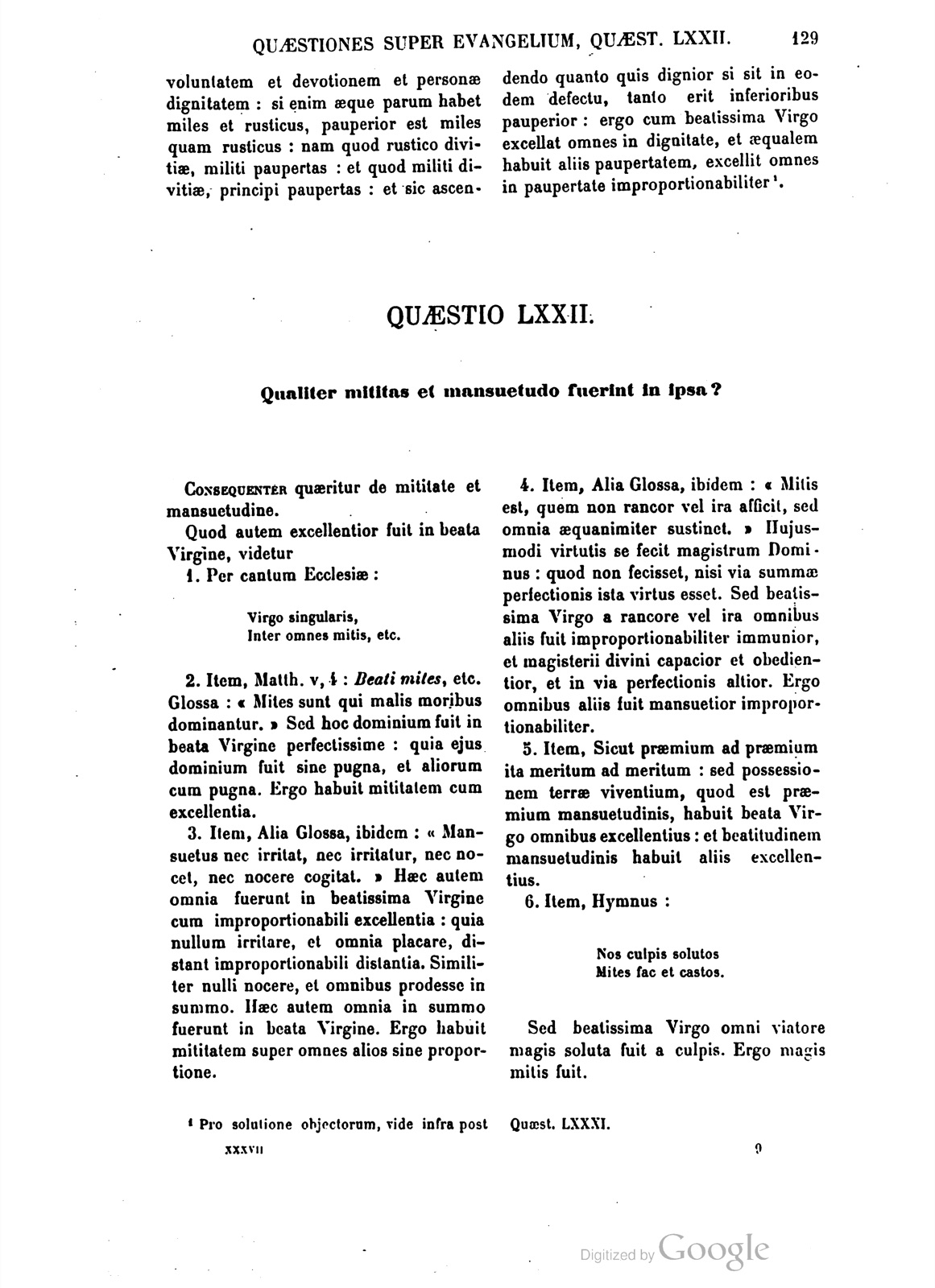
5. Item, Sicut praemium ad praemium ita meritum ad meritum: sed possessionem terrae viventium, quod est praemium mansuetudinis, habuit beata Virgo omnibus excellentius: et beatitudinem mansuetudinis habuit aliis excellentius.
6. Item, Hymnus:
Nos culpis solutos Mites fac et castos.
Sed beatissima Virgo omni viatore magis soluta fuit a culpis. Ergo magis mitis fuit.
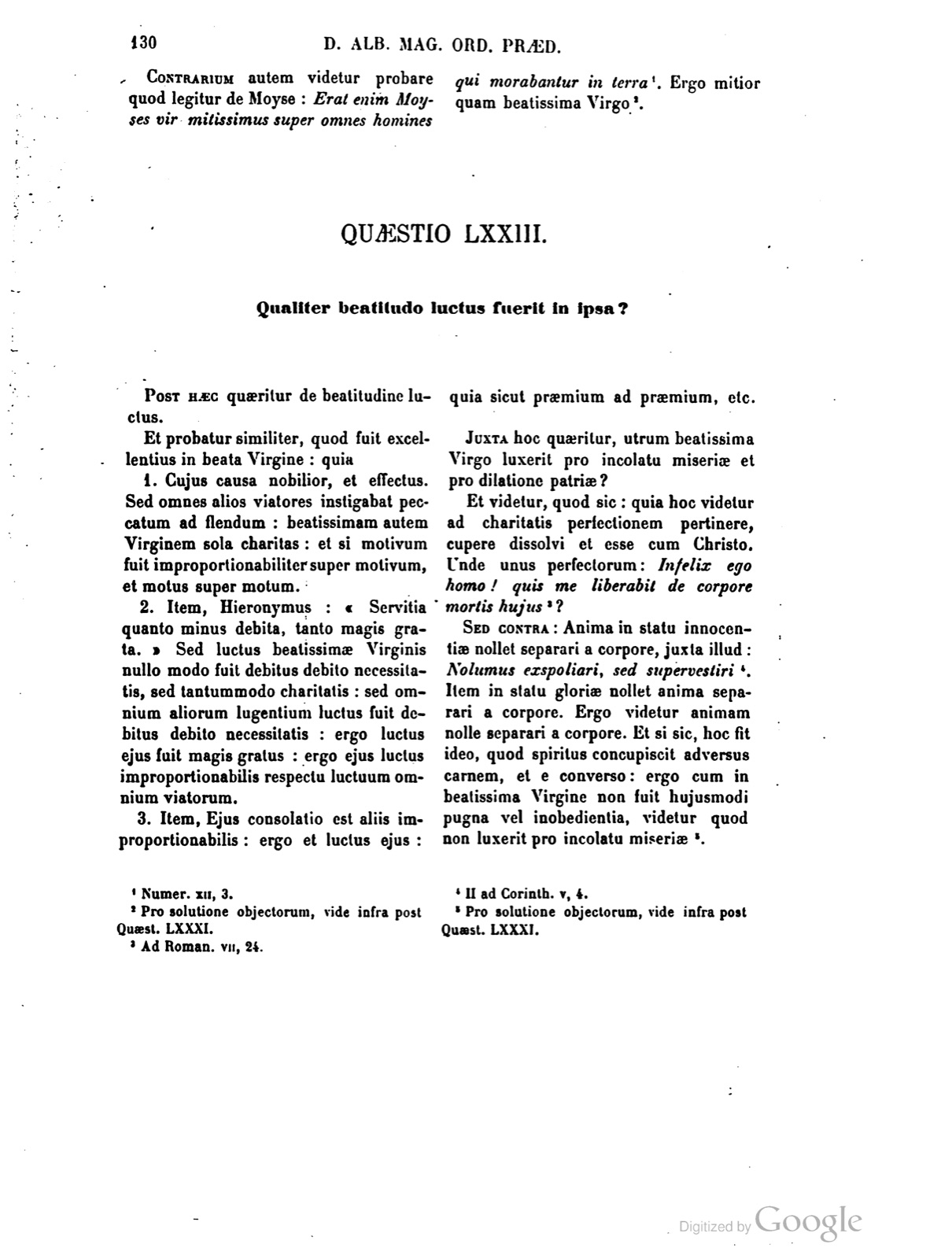
Contrarium autem videtur probare quod legitur de Moyse: Erat enim Moyses vir mitissimus super omnes homines qui morabantur in terra 1. Ergo mitior quam beatissima Virgo 2.
5. Likewise, as reward is to reward, so merit is to merit. But the blessed Virgin had the possession of the land of the living, which is the reward of meekness, more excellently than all; and she had the beatitude of meekness more excellently than others.
6. Likewise, the hymn says:
Make us, released from faults, meek and chaste.
But the most blessed Virgin was more released from faults than every wayfarer. Therefore she was more mild.
But the contrary seems proved by what is read concerning Moses: For Moses was a man most meek above all the men who dwelt on the earth 1. Therefore he was meeker than the most blessed Virgin 2.
Notes
- Numbers 12:3. (Numer. XII, 3.) ↩
- For the solution of the objections, see below after Question 81. (Pro solutione objectorum, vide infra post Quaest. LXXXI.) ↩
If a page does not appear, its photograph has not been uploaded yet.