Works › The Mariale: Questions on “Missus est”
Volume 37 · pp. 127–129
Question 71. In what way poverty was in the blessed Virgin
A marker with ≈ is an approximate page boundary, placed by measure of the text; the page photographs remain the authority. In the paired views, clicking a page marker brings that page into view.
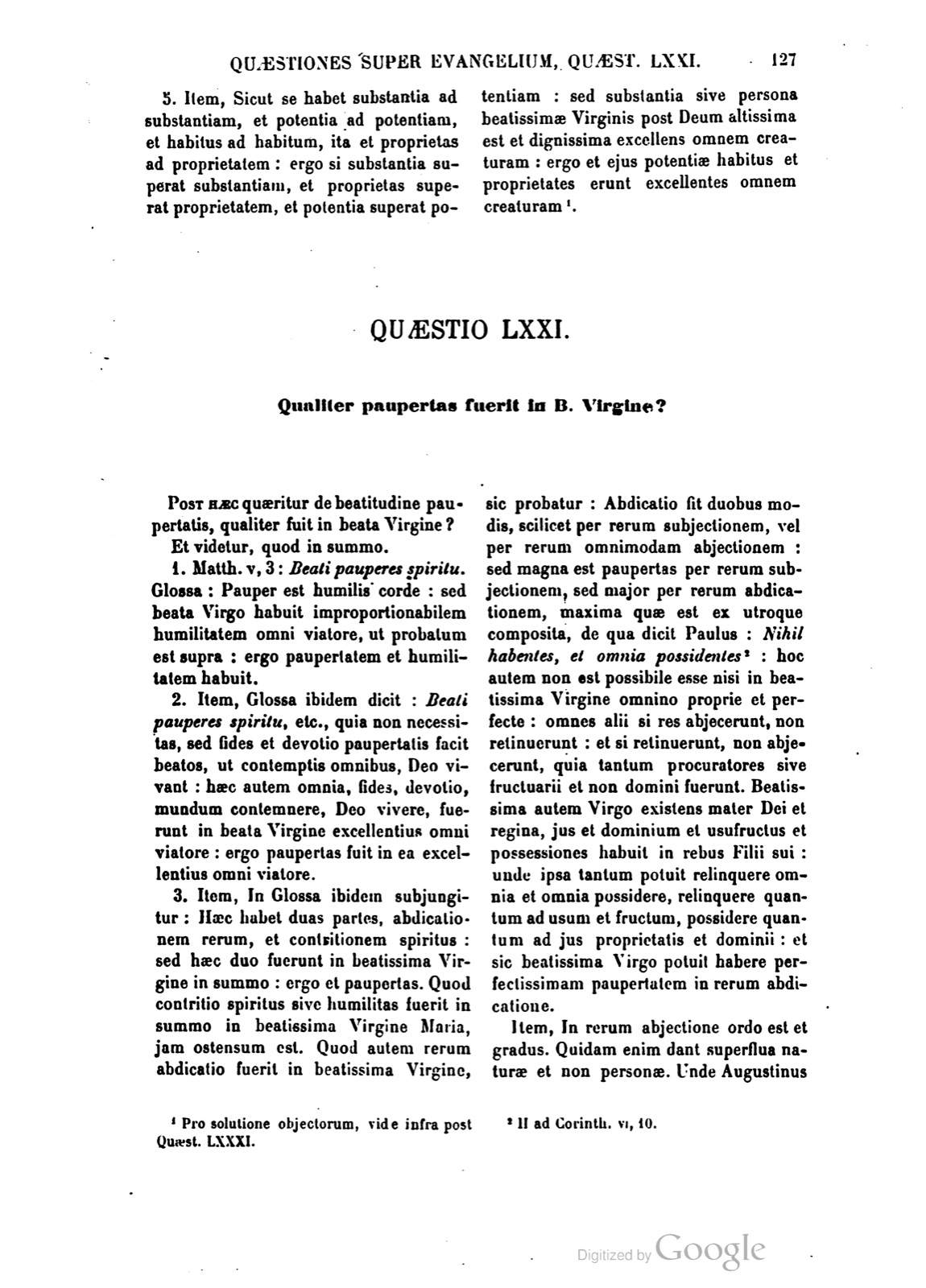
QUAESTIO LXXI.
Qualiter paupertas fuerit in B. Virgine?
Post haec quaeritur de beatitudine paupertatis, qualiter fuit in beata Virgine?
Et videtur, quod in summo.
1. Matth. V, 3: Beati pauperes spiritu. Glossa: Pauper est humilis corde: sed beata Virgo habuit improportionabilem humilitatem omni viatore, ut probatum est supra: ergo paupertatem et humilitatem habuit.
2. Item, Glossa ibidem dicit: Beati pauperes spiritu, etc., quia non necessitas, sed fides et devotio paupertatis facit beatos, ut contemptis omnibus, Deo vivant: haec autem omnia, fides, devotio, mundum contemnere, Deo vivere, fuerunt in beata Virgine excellentius omni viatore: ergo paupertas fuit in ea excellentius omni viatore.
3. Item, In Glossa ibidem subjungitur: Haec habet duas partes, abdicationem rerum, et contritionem spiritus: sed haec duo fuerunt in beatissima Virgine in summo: ergo et paupertas. Quod contritio spiritus sive humilitas fuerit in summo in beatissima Virgine Maria, jam ostensum est. Quod autem rerum abdicatio fuerit in beatissima Virgine, sic probatur: Abdicatio fit duobus modis, scilicet per rerum subjectionem, vel per rerum omnimodam abjectionem: sed magna est paupertas per rerum subjectionem, sed major per rerum abdicationem, maxima quae est ex utroque composita, de qua dicit Paulus: Nihil habentes, et omnia possidentes 1: hoc autem non est possibile esse nisi in beatissima Virgine omnino proprie et perfecte: omnes alii si res abjecerunt, non retinuerunt: et si retinuerunt, non abjecerunt, quia tantum procuratores sive fructuarii et non domini fuerunt. Beatissima autem Virgo existens mater Dei et regina, jus et dominium et usufructus et possessiones habuit in rebus Filii sui: unde ipsa tantum potuit relinquere omnia et omnia possidere, relinquere quantum ad usum et fructum, possidere quantum ad jus proprietatis et dominii: et sic beatissima Virgo potuit habere perfectissimam paupertatem in rerum abdicatione.
Item, In rerum abjectione ordo est et gradus. Quidam enim dant superflua naturae et non personae. Unde Augustinus in libro de Verbis Domini: "Utere superfluis, da pauperibus necessaria: utere pretiosis, da pauperibus vilia." Iste est primus gradus paupertatis. Alii dant superflua naturae et personae. Luc. XI, 41: Quod superest, date eleemosynam, scilicet pauperibus. Glossa: De eo quod super necessaria praeter victum et vestitum, dandum est pauperibus. Tertius gradus non tantum superflua dare, sed etiam necessaria. Unde Glossa: Non solum exteriora, sed etiam interiora et valde necessaria cum proximis dividamus. Quartus gradus est omnia superflua et necessaria simul dare, sed adhuc semetipsum retinere: quod etiam aliqui Philosophorum fecerunt, licet non propter Deum. Unde super illud: Ecce nos reliquimus omnia 2, Glossa: Non dicit tantum: Qui reliquistis omnia: hoc enim et Socrates Philosophus fecit, et multi alii, qui divitias contempserunt: sed qui secuti estis me: quod proprie est Apostolorum et credentium. Quintus gradus est omnia dare et seipsum superaddere. Unde Dominus in Evangelio: Si vis perfectus esse, vade, vende omnia quae habes et da pauperibus, et habebis thesaurum in caelo: et veni, sequere me 3. Sextus gradus est omnia dare et semetipsum relinquere, et praeterea laborare manibus, ut habeat unde tribuat necessitatem patienti, relevans ejus miserias corporales. In hunc statum attigit beatus Paulus, qui omnia reliquerat, et tamen tempore et loco laborabat manibus, ut sibi et suis subveniret 4. Septimus gradus est omnia et seipsum dare, ut pascat proximum pane spirituali: et iste gradus, ut dicit Gregorius, major est praedicto: quia majus est nutrire animam semper victuram, quam ventrem aliquando moriturum. Octavus gradus est omnia et seipsum relinquere, et de substantia sui corporis partem accipere, et ad refectionem animarum proximis dare. In isto gradu fuit beatissima Virgo, quae de purissimis carnibus et sanguinibus suis viaticum nobis fecit et confecit, panem scilicet vivum, qui de caelo descendit, qui est vere vita, quem qui gustaverit, non sentiet mortem in aeternum. Hunc autem toti mundo mendico dedit beatissima mulier, de qua dicitur in Evangelio: Mulier abscondit fermentum in farinae satis tribus, donec fermentaretur totum 5. Tria sata sunt deitas, corpus, et anima. Fermentum, ut dicit Bernardus, est fides Virginis, quae Deum humanae naturae conjunxit, et homini refectionem fecit. Idem fere dicit Augustinus in libro de Spiritu et anima: "Sive ingrediatur, sive egrediatur, pascua inveniet: intus in divinitate creatoris, foris in carne salvatoris." Nonus gradus est omnia proximo dare et corpus et animam propriam et divinitatem his unitam in cibum animae, sub specie tamen aliena. Et hoc fuit misericordiae et summum paupertatis Domini nostri Jesu Christi in via. Decimus gradus est seipsum dare totum, corpus et animam et divinitatem sub specie propria, in cibum corporis et animae simul et semper in aeterna beatitudine, de quo, Luc. XIV, 15: Beatus qui manducabit panem in regno Dei.
QUESTION 71.
In what way poverty was in the blessed Virgin.
After these things inquiry is made concerning the beatitude of poverty, in what way it was in the blessed Virgin.
And it seems that it was in the highest degree.
1. Matthew 5:3: Blessed are the poor in spirit. The Gloss says: Poor is humble of heart. But the blessed Virgin had humility disproportionate to every wayfarer, as was proved above; therefore she had poverty and humility.
2. Likewise, the Gloss in the same place says: Blessed are the poor in spirit, and so forth, because not necessity, but faith and devotion of poverty makes them blessed, so that, all things having been despised, they may live for God. But all these things, faith, devotion, despising the world, living for God, were in the blessed Virgin more excellently than in every wayfarer; therefore poverty was in her more excellently than in every wayfarer.
3. Likewise, in the Gloss in the same place it is added: This has two parts, abdication of things and contrition of spirit. But these two were in the most blessed Virgin in the highest degree; therefore so too was poverty. That contrition of spirit, or humility, was in the highest degree in the most blessed Virgin Mary has already been shown. But that abdication of things was in the most blessed Virgin is proved thus: Abdication happens in two ways, namely through the subjection of things or through the complete rejection of things. Poverty through the subjection of things is great, but through abdication of things is greater, and the greatest is that composed of both, concerning which Paul says: Having nothing, and possessing all things 1. But this cannot exist except in the most blessed Virgin wholly properly and perfectly. All others, if they rejected things, did not retain them; and if they retained them, they did not reject them, because they were only managers or usufructuaries and not owners. But the most blessed Virgin, existing as Mother of God and queen, had right, lordship, usufruct, and possessions in the things of her Son; hence she alone was able to leave all things and to possess all things: to leave them as to use and fruit, to possess them as to the right of property and lordship. And thus the most blessed Virgin could have most perfect poverty in the abdication of things.
Likewise, in the rejection of things there is order and grade. For some give the things superfluous to nature and not to person. Hence Augustine in the book On the Words of the Lord: "Use superfluous things; give necessary things to the poor. Use precious things; give cheap things to the poor." This is the first grade of poverty. Others give things superfluous to nature and to person. Luke 11:41: What remains, give as alms, namely to the poor. The Gloss says: From that which is above necessities beyond food and clothing, it must be given to the poor. The third grade is not only to give superfluous things, but also necessary things. Hence the Gloss says: Let us share with our neighbors not only exterior things, but also interior and very necessary things. The fourth grade is to give all superfluous and necessary things together, but still to retain oneself; this also some of the Philosophers did, though not for God's sake. Hence on that saying, Behold, we have left all things 2, the Gloss says: He does not say only, You who have left all things; for Socrates the Philosopher did this too, and many others who despised riches; but, you who have followed me, which properly belongs to the Apostles and believers. The fifth grade is to give all things and add oneself over and above. Hence the Lord in the Gospel says: If you wish to be perfect, go, sell all that you have and give to the poor, and you will have treasure in heaven; and come, follow me 3. The sixth grade is to give all things and leave oneself, and besides this to work with one's hands, so that one may have something from which to give to one suffering need, relieving his bodily miseries. Blessed Paul reached this state: he had left all things, and yet at time and place worked with his hands so as to provide for himself and his own 4. The seventh grade is to give all things and oneself, so as to feed one's neighbor with spiritual bread. And this grade, as Gregory says, is greater than the aforesaid one, because it is greater to nourish a soul that will always live than a belly that at some time will die. The eighth grade is to leave all things and oneself, and to take a part from the substance of one's own body, and to give it to neighbors for the refreshment of souls. The most blessed Virgin was in this grade, she who from her own purest flesh and blood made and prepared for us viaticum, namely the living bread that came down from heaven, who is truly life; whoever tastes him will not feel death forever. But the most blessed woman gave this to the whole beggarly world, concerning whom it is said in the Gospel: A woman hid leaven in three measures of flour until the whole was leavened 5. The three measures are deity, body, and soul. The leaven, as Bernard says, is the Virgin's faith, which joined God to human nature and made refreshment for man. Augustine says almost the same thing in the book On Spirit and Soul: "Whether he enters or goes out, he will find pastures: within, in the divinity of the creator; without, in the flesh of the savior." The ninth grade is to give all things to one's neighbor, and one's own body and soul and the divinity united to these, as food of the soul, yet under an alien species. And this belonged to the mercy and the highest poverty of our Lord Jesus Christ on the way. The tenth grade is to give one's whole self, body and soul and divinity, under its own species, as food of body and soul together and always in eternal beatitude, concerning which Luke 14:15 says: Blessed is the one who will eat bread in the kingdom of God.
Ex his patet, quod beatissima Virgo spiritus paupertatem quantum ad rerum abjectionem habuit excellentius omni homine, praeter Dominum Christum.
From these things it is clear that the most blessed Virgin had poverty of spirit, as to the rejection of things, more excellently than every human being, except the Lord Christ.
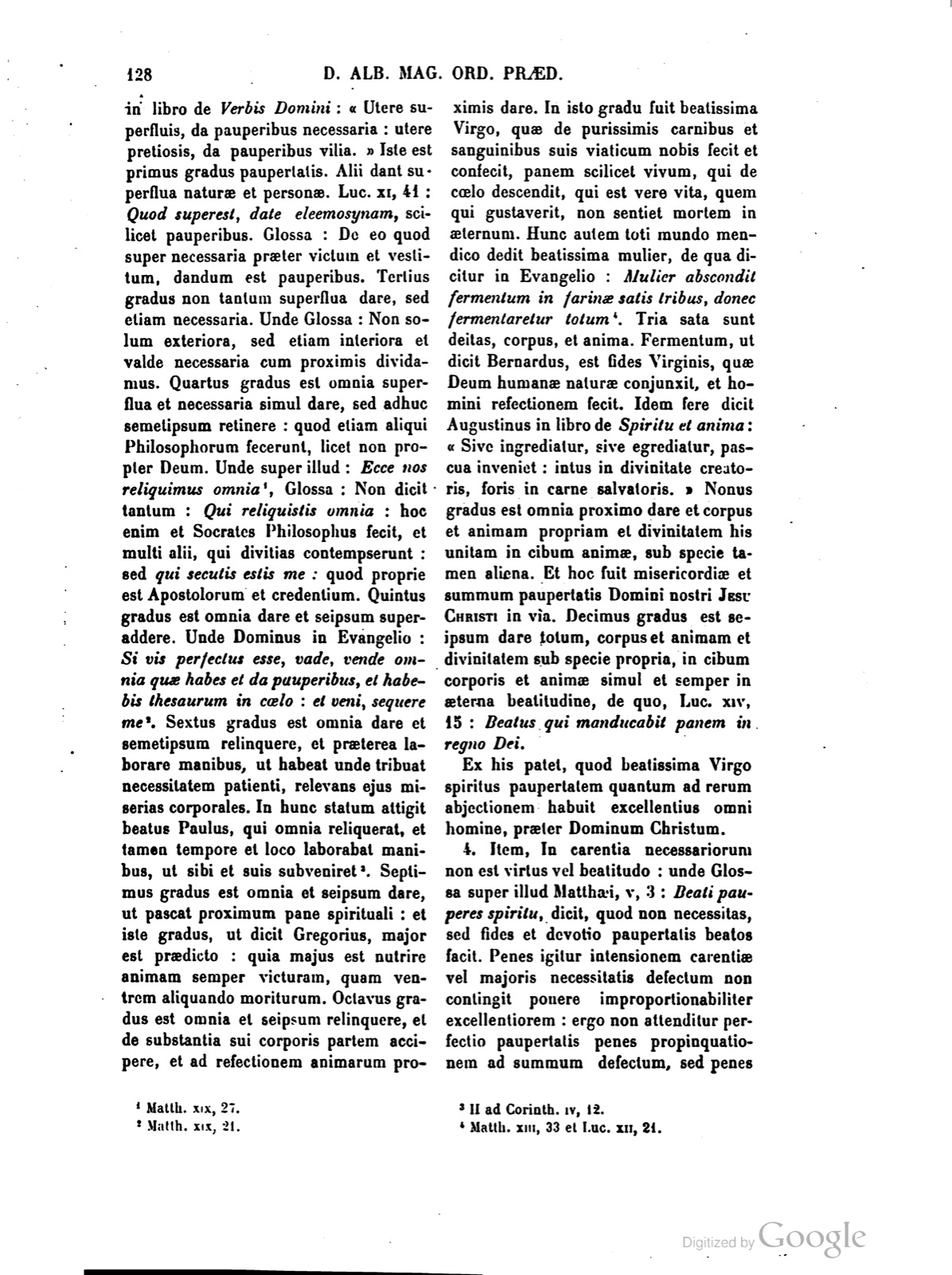
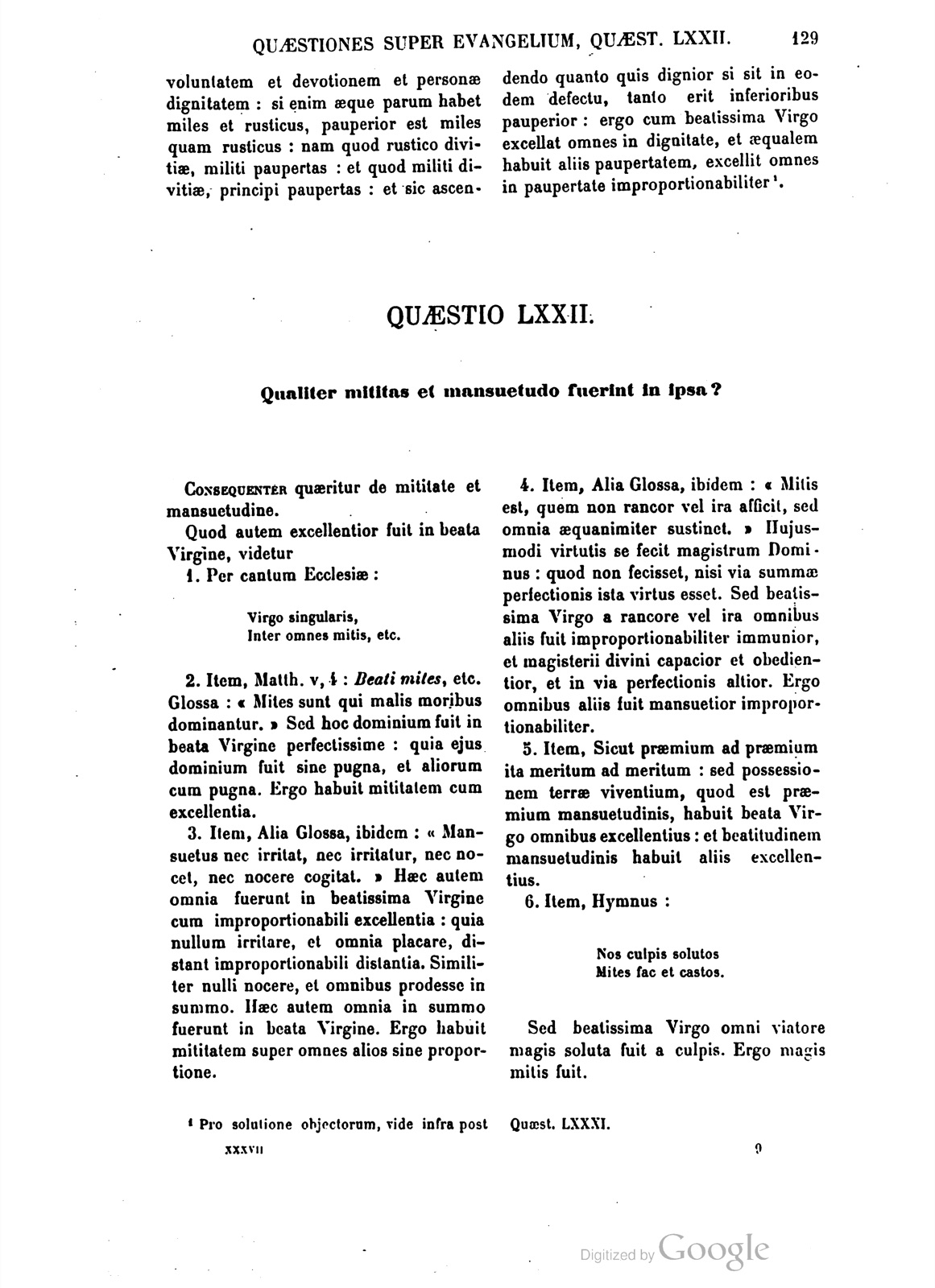
4. Item, In carentia necessariorum non est virtus vel beatitudo: unde Glossa super illud Matthaei, V, 3: Beati pauperes spiritu, dicit, quod non necessitas, sed fides et devotio paupertatis beatos facit. Penes igitur intensionem carentiae vel majoris necessitatis defectum non contingit ponere improportionabiliter excellentiorem: ergo non attenditur perfectio paupertatis penes propinquationem ad summum defectum, sed penes voluntatem et devotionem et personae dignitatem: si enim aeque parum habet miles et rusticus, pauperior est miles quam rusticus: nam quod rustico divitiae, militi paupertas: et quod militi divitiae, principi paupertas: et sic ascendendo quanto quis dignior sit in eodem defectu, tanto erit inferioribus pauperior: ergo cum beatissima Virgo excellat omnes in dignitate, et aequalem habuit aliis paupertatem, excellit omnes in paupertate improportionabiliter 6.
4. Likewise, in lack of necessary things there is no virtue or beatitude; hence the Gloss on that saying of Matthew 5:3, Blessed are the poor in spirit, says that not necessity but faith and devotion of poverty makes them blessed. Therefore according to the intensity of lack or the defect of greater necessity one cannot posit someone disproportionately more excellent. Therefore the perfection of poverty is not considered according to approach to the highest defect, but according to the will and devotion and the dignity of the person. For if a soldier and a rustic have equally little, the soldier is poorer than the rustic; for what is riches for the rustic is poverty for the soldier, and what is riches for the soldier is poverty for a prince. And so, ascending, the more worthy someone is in the same defect, the poorer he will be than inferiors. Therefore since the most blessed Virgin surpasses all in dignity and had poverty equal to others, she surpasses all in poverty disproportionately 6.
Notes
- 2 Corinthians 6:10. (II ad Corinth. VI, 10.) ↩
- Matthew 19:27. (Matth. XIX, 27.) ↩
- Matthew 19:21. (Matth. XIX, 21.) ↩
- 2 Corinthians 4:12. (II ad Corinth. IV, 12.) ↩
- Matthew 13:33 and Luke 13:21. (Matth. XIII, 33 et Luc. XIII, 21.) ↩
- For the solution of the objections, see below after Question 81. (Pro solutione objectorum, vide infra post Quaest. LXXXI.) ↩
If a page does not appear, its photograph has not been uploaded yet.