Works › The Mariale: Questions on “Missus est”
Volume 37 · pp. 119–120
Question LXIII. Whether wisdom was in the blessed Virgin?
A marker with ≈ is an approximate page boundary, placed by measure of the text; the page photographs remain the authority. In the paired views, clicking a page marker brings that page into view.
QUAESTIO LXIII. Utrum fuerit sapientia in B. Virgine?
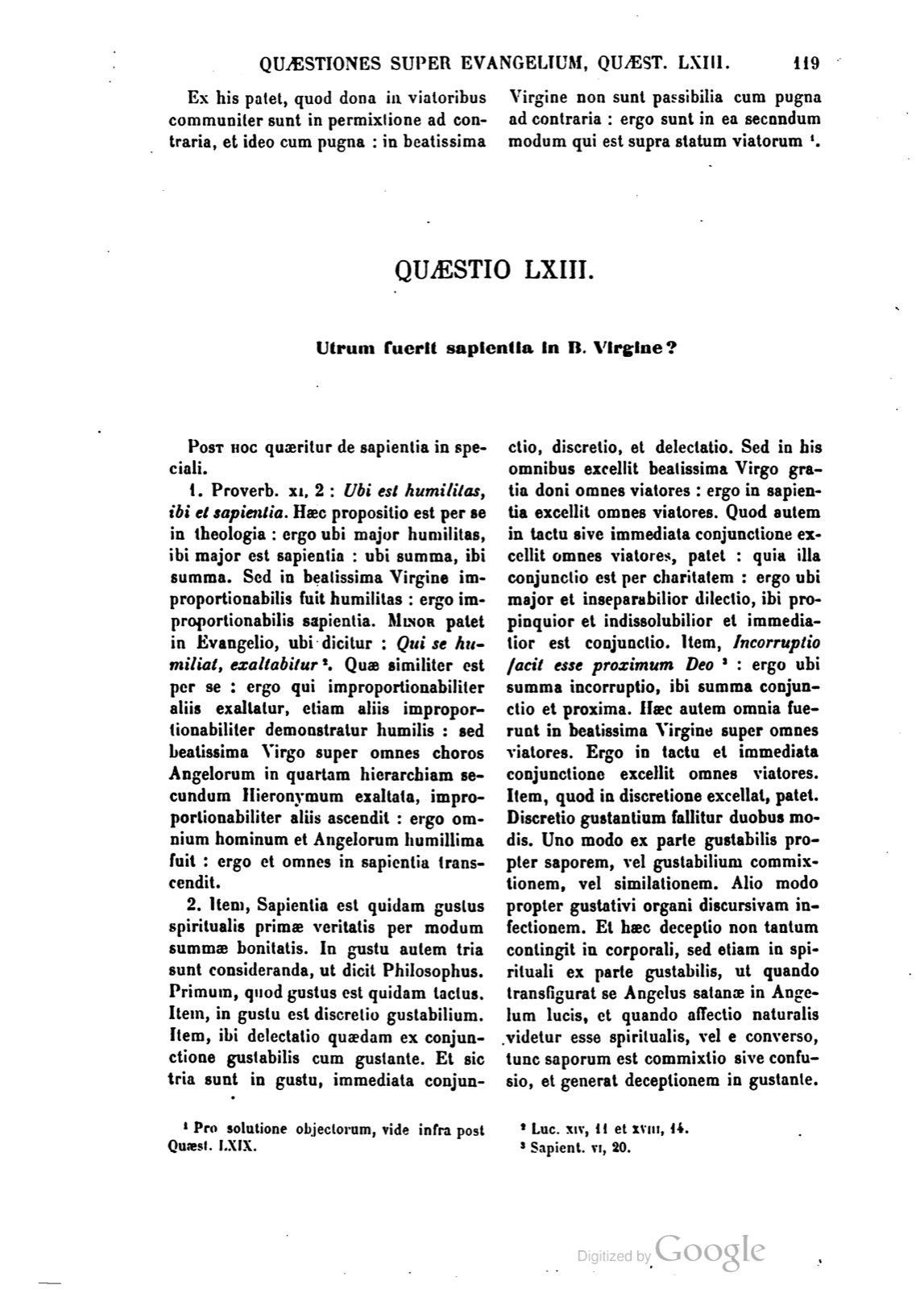
Post hoc quaeritur de sapientia in speciali.
1. Proverb. XI, 2: Ubi est humilitas, ibi et sapientia. Haec propositio est per se in theologia: ergo ubi major humilitas, ibi major est sapientia: ubi summa, ibi summa. Sed in beatissima Virgine improportionabilis fuit humilitas: ergo improportionabilis sapientia. Minor patet in Evangelio, ubi dicitur: Qui se humiliat, exaltabitur 1. Quae similiter est per se: ergo qui improportionabiliter aliis exaltatur, etiam aliis improportionabiliter demonstratur humilis: sed beatissima Virgo super omnes choros Angelorum in quartam hierarchiam secundum Hieronymum exaltata, improportionabiliter aliis ascendit: ergo omnium hominum et Angelorum humillima fuit: ergo et omnes in sapientia transcendit.
2. Item, Sapientia est quidam gustus spiritualis primae veritatis per modum summae bonitatis. In gustu autem tria sunt consideranda, ut dicit Philosophus. Primum, quod gustus est quidam tactus. Item, in gustu est discretio gustabilium. Item, ibi delectatio quaedam ex conjunctione gustabilis cum gustante. Et sic tria sunt in gustu, immediata conjunctio, discretio, et delectatio. Sed in his omnibus excellit beatissima Virgo gratia doni omnes viatores: ergo in sapientia excellit omnes viatores. Quod autem in tactu sive immediata conjunctione excellit omnes viatores, patet: quia illa conjunctio est per charitatem: ergo ubi major et inseparabilior dilectio, ibi propinquior et indissolubilior et immediatior est conjunctio. Item, Incorruptio facit esse proximum Deo 2: ergo ubi summa incorruptio, ibi summa conjunctio et proxima. Haec autem omnia fuerunt in beatissima Virgine super omnes viatores. Ergo in tactu et immediata conjunctione excellit omnes viatores. Item, quod in discretione excellat, patet. Discretio gustantium fallitur duobus modis. Uno modo ex parte gustabilis propter saporem, vel gustabilium commixtionem, vel similationem. Alio modo propter gustativi organi discursivam infectionem. Et haec deceptio non tantum contingit in corporali, sed etiam in spirituali ex parte gustabilis, ut quando transfigurat se Angelus satanae in Angelum lucis, et quando affectio naturalis videtur esse spiritualis, vel e converso, tunc saporum est commixtio sive confusio, et generat deceptionem in gustante. Ex parte autem gustativi, ut quando gustus spiritualis est infectus contraria delectatione, vel ad minus fomitis corruptione, quae sensum spiritualis delectationis impediunt et saporem diminuunt et discretionem pervertunt, ut dicat malum bonum, et bonum malum, ponens tenebras lucem, et lucem tenebras 3. Hic est enim animalis homo, qui non percipit ea quae sunt spiritus Dei 4, cujus Deus venter est, et esse sub sensibus delicias computat, manna fastidiens quod venit de coelo, murmurat pro panibus et alliis et cepe in Aegypto, ut patet de populo Israel 5. Haec autem deceptio vel decipiendi potestas licet secundum magis et minus est in omni viatore, fomitis corruptione aliquo modo remanente: sed haec tamen deceptio sive decipiendi possibilitas nullo modo fuit in beatissima Virgine, quae per omnia astutias diaboli non ignoravit, et semper ut Virgo prudentissima reprobavit malum, et elegit bonum sine errore, cujus palatum spirituale a corruptione fomitis sanum et purum fuit et spirituali dulcedine plenum: nihil enim nisi Deum et propter Deum gustavit: et sic gustus ejus spiritualis falli non potuit: ergo in discretione gustus spiritualis omnes viatores excellit. Item, quod in delectatione quae est in gustu spirituali, omnes excellat, patet. Dicit enim beatus Gregorius super Job, quod "sapientia est donum reficiens spe et certitudine": sed spes et certitudo beatae Virginis est omnibus viatoribus improportionabilis: ergo ejus refectio est improportionabilis, et inaequalis.
QUESTION LXIII. Whether wisdom was in the blessed Virgin?
After this it is asked concerning wisdom in particular.
1. Proverbs 11:2 says: Where humility is, there also is wisdom. This proposition is per se in theology. Therefore where there is greater humility, there is greater wisdom; where there is the highest humility, there is the highest wisdom. But in the most blessed Virgin there was disproportionate humility. Therefore there was disproportionate wisdom. The minor is clear in the Gospel, where it is said: He who humbles himself shall be exalted 1. This is similarly per se. Therefore one who is exalted disproportionately above others is also shown to be disproportionately humble above others. But the most blessed Virgin, exalted above all the choirs of Angels into the fourth hierarchy according to Jerome, ascended disproportionately above others. Therefore she was the humblest of all men and Angels; therefore she also transcended all in wisdom.
2. Likewise, wisdom is a certain spiritual taste of the first truth through the mode of the highest goodness. But in taste three things must be considered, as the Philosopher says. First, that taste is a certain touch. Likewise, in taste there is discretion of tasteable things. Likewise, there is there a certain delight from the conjunction of the tasteable thing with the one tasting. And thus there are three things in taste: immediate conjunction, discretion, and delight. But in all these the most blessed Virgin, by the grace of the gift, surpasses all wayfarers. Therefore in wisdom she surpasses all wayfarers. But that she surpasses all wayfarers in touch or immediate conjunction is clear, because that conjunction is through charity. Therefore where love is greater and more inseparable, there the conjunction is nearer and more indissoluble and more immediate. Likewise, Incorruption makes one nearest to God 2. Therefore where there is the highest incorruption, there is the highest and nearest conjunction. But all these things were in the most blessed Virgin above all wayfarers. Therefore in touch and immediate conjunction she surpasses all wayfarers. Likewise, that she surpasses in discretion is clear. The discretion of those tasting is deceived in two ways. In one way on the part of the tasteable thing, because of flavor, or the mixing together of tasteable things, or assimilation. In another way because of the discursive infection of the organ of tasting. And this deception happens not only in the bodily but also in the spiritual on the part of the tasteable thing, as when the Angel of Satan transforms himself into an Angel of light, and when natural affection seems to be spiritual, or conversely; then there is a mixing or confusion of flavors, and it generates deception in the one tasting. On the part of the tasting power, as when spiritual taste is infected by contrary delight, or at least by corruption of the tinder, which impede the sense of spiritual delight and lessen the flavor and pervert discretion, so that it calls evil good, and good evil, putting darkness as light, and light as darkness 3. For this is the animal man, who does not perceive the things that are of the spirit of God 4, whose God is the belly, and who counts being under the senses as delights, loathing the manna that came from heaven, murmuring for the breads and garlics and onion in Egypt, as is clear concerning the people of Israel 5. But although this deception or power of being deceived exists according to more and less in every wayfarer, since corruption of the tinder remains in some way, nevertheless this deception or possibility of being deceived was in no way in the most blessed Virgin, who in all things was not ignorant of the cunning devices of the devil, and always as a most prudent Virgin rejected evil and chose good without error. Her spiritual palate was healthy and pure from the corruption of the tinder and full of spiritual sweetness; for she tasted nothing except God and on account of God. And thus her spiritual taste could not be deceived. Therefore in the discretion of spiritual taste she surpasses all wayfarers. Likewise, that she surpasses all in the delight that is in spiritual taste is clear. For blessed Gregory says on Job that "wisdom is a gift refreshing by hope and certainty." But the hope and certainty of the blessed Virgin is disproportionate to all wayfarers. Therefore her refreshment is disproportionate and unequal.
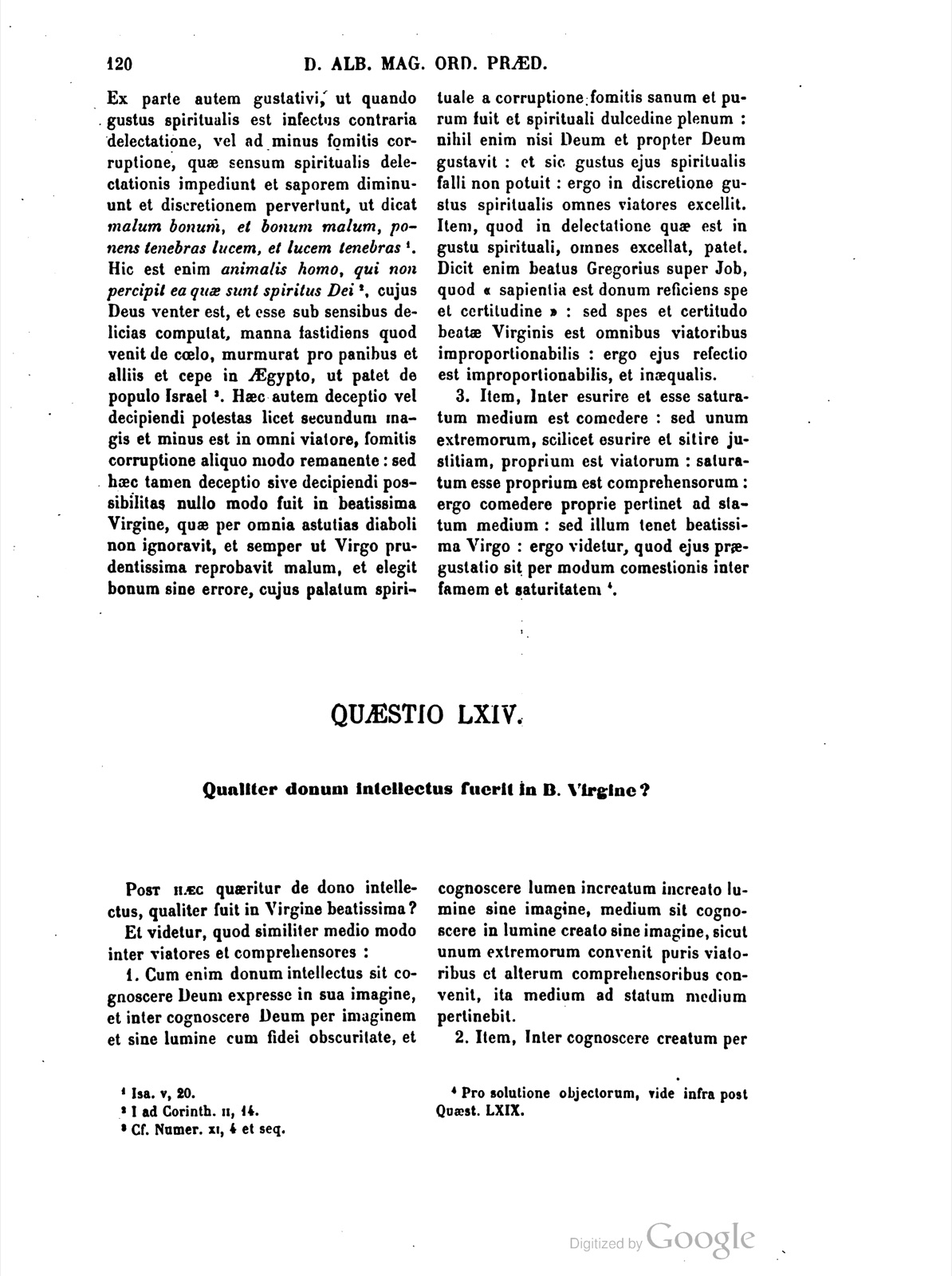
3. Item, Inter esurire et esse saturatum medium est comedere: sed unum extremorum, scilicet esurire et sitire justitiam, proprium est viatorum: saturatum esse proprium est comprehensorum: ergo comedere proprie pertinet ad statum medium: sed illum tenet beatissima Virgo: ergo videtur, quod ejus praegustatio sit per modum comestionis inter famem et saturitatem 6.
3. Likewise, between being hungry and being filled, the middle is to eat. But one extreme, namely to hunger and thirst for justice, is proper to wayfarers; to be filled is proper to comprehensors. Therefore to eat properly pertains to the middle state. But the most blessed Virgin holds that state. Therefore it seems that her foretaste is through the mode of eating, between hunger and satiety 6.
Notes
- Luke 14:11 and 18:14. (Luc. XIV, 11 et XVIII, 14.) ↩
- Wisdom 6:20. (Sapient. VI, 20.) ↩
- Isaiah 5:20. (Isa. V, 20.) ↩
- 1 Corinthians 2:14. (I ad Corinth. II, 14.) ↩
- Compare Numbers 11:4 and following. (Cf. Numer. XI, 4 et seq.) ↩
- For the solution of the objections, see below after Question LXIX. (Pro solutione objectorum, vide infra post Quaest. LXIX.) ↩
If a page does not appear, its photograph has not been uploaded yet.