Works › The Mariale: Questions on “Missus est”
Volume 37 · pp. 118–119
Question LXII. How the sevenfold fullness of grace, distributed through the sevenfold gifts, is contained in that fullness?
A marker with ≈ is an approximate page boundary, placed by measure of the text; the page photographs remain the authority. In the paired views, clicking a page marker brings that page into view.
QUAESTIO LXII. Qualiter septiformis plenitudo gratiae per septiformia dona distributa in ista plenitudine sit contenta?
Post hoc quaeritur de donis, qualiter septiformis plenitudo gratiae per septiformium donorum distributa in ista plenitudine sit contenta?
Et videtur, quod similiter secundum excellentiam, sicut dictum est de virtutibus, et hoc hac ratione:
1. Sicut se habet virtus ad virtutem, ita se habet donum ad donum: sed virtus in beatissima Virgine excellit omnes virtutes viatoris: ergo et dona.
2. Item, Quidquid superius est superiore, superius est et inferiore: sed virtutes beatissimae Virginis excellunt omnes virtutes viatorum, et dona excellunt virtutes in suis actibus: ergo beatissimae Virginis dona excellunt omnes viatores.
3. Item, In hierarchia coelesti supremus ordo est Seraphim, et qui excellit charitate quae est excellentissimum donum, excellit in omnibus aliis donis: ergo in ecclesiastica hierarchia erit sic: sed beatissima Virgo excellit omnem creaturam in charitate: ergo in aliis donis.
QUESTION LXII. How the sevenfold fullness of grace, distributed through the sevenfold gifts, is contained in that fullness?
After this it is asked concerning the gifts, how the sevenfold fullness of grace, distributed through the sevenfold gifts, is contained in that fullness.
And it seems that it is contained similarly according to excellence, as was said concerning the virtues, and this by this reason:
1. As virtue is related to virtue, so gift is related to gift. But virtue in the most blessed Virgin surpasses all virtues of a wayfarer. Therefore so do the gifts.
2. Likewise, whatever is higher than a higher thing is also higher than a lower thing. But the virtues of the most blessed Virgin surpass all virtues of wayfarers, and the gifts surpass virtues in their acts. Therefore the gifts of the most blessed Virgin surpass all wayfarers.
3. Likewise, in the heavenly hierarchy the highest order is Seraphim, and one who excels in charity, which is the most excellent gift, excels in all the other gifts. Therefore in the ecclesiastical hierarchy it will be so. But the most blessed Virgin surpasses every creature in charity. Therefore she surpasses in the other gifts.
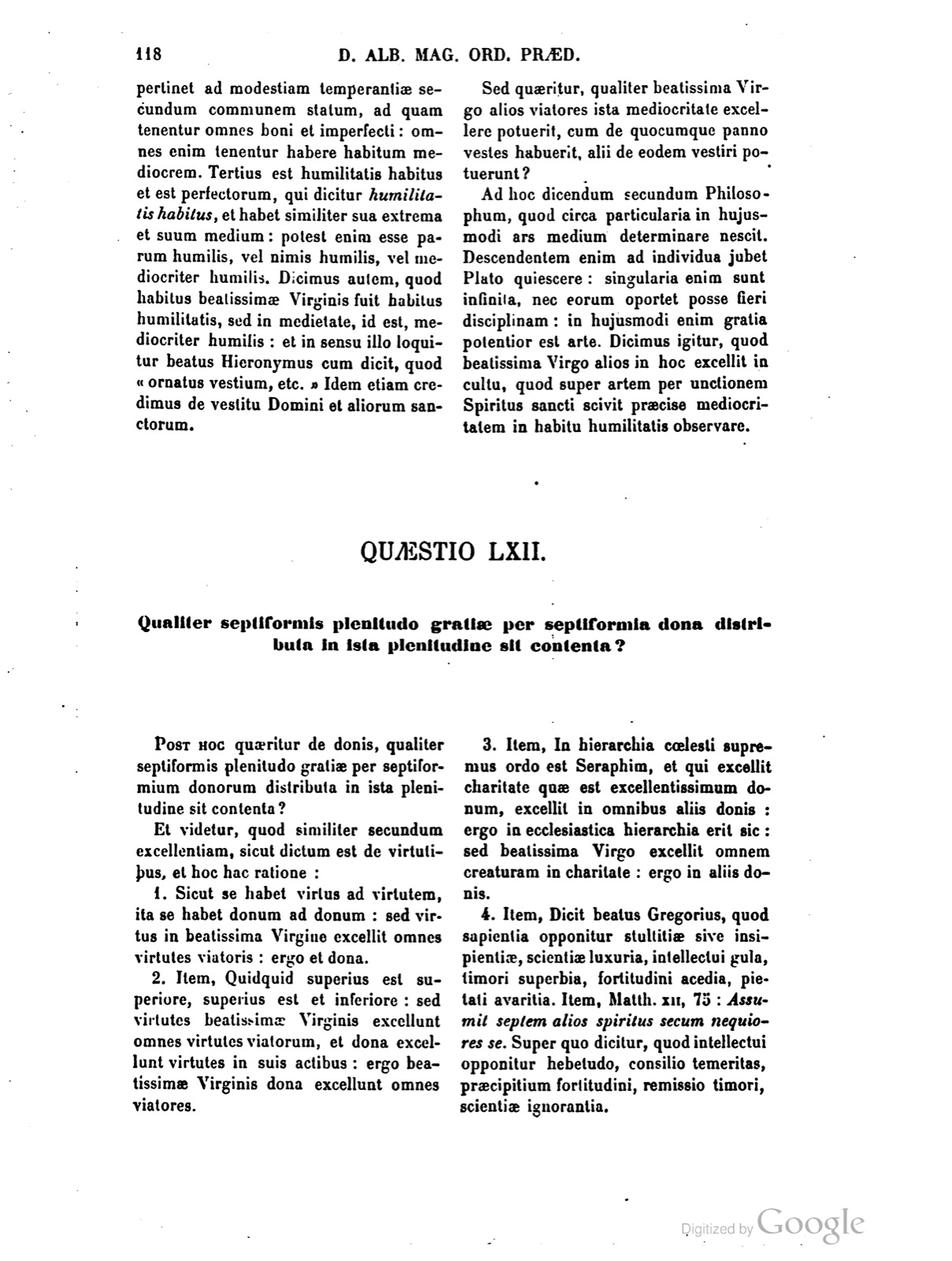
4. Item, Dicit beatus Gregorius, quod sapientia opponitur stultitiae sive insipientiae, scientiae luxuria, intellectui gula, timori superbia, fortitudini acedia, pietati avaritia. Item, Matth. XII, 45: Assumit septem alios spiritus secum nequiores se. Super quo dicitur, quod intellectui opponitur hebetudo, consilio temeritas, praecipitium fortitudini, remissio timori, scientiae ignorantia.
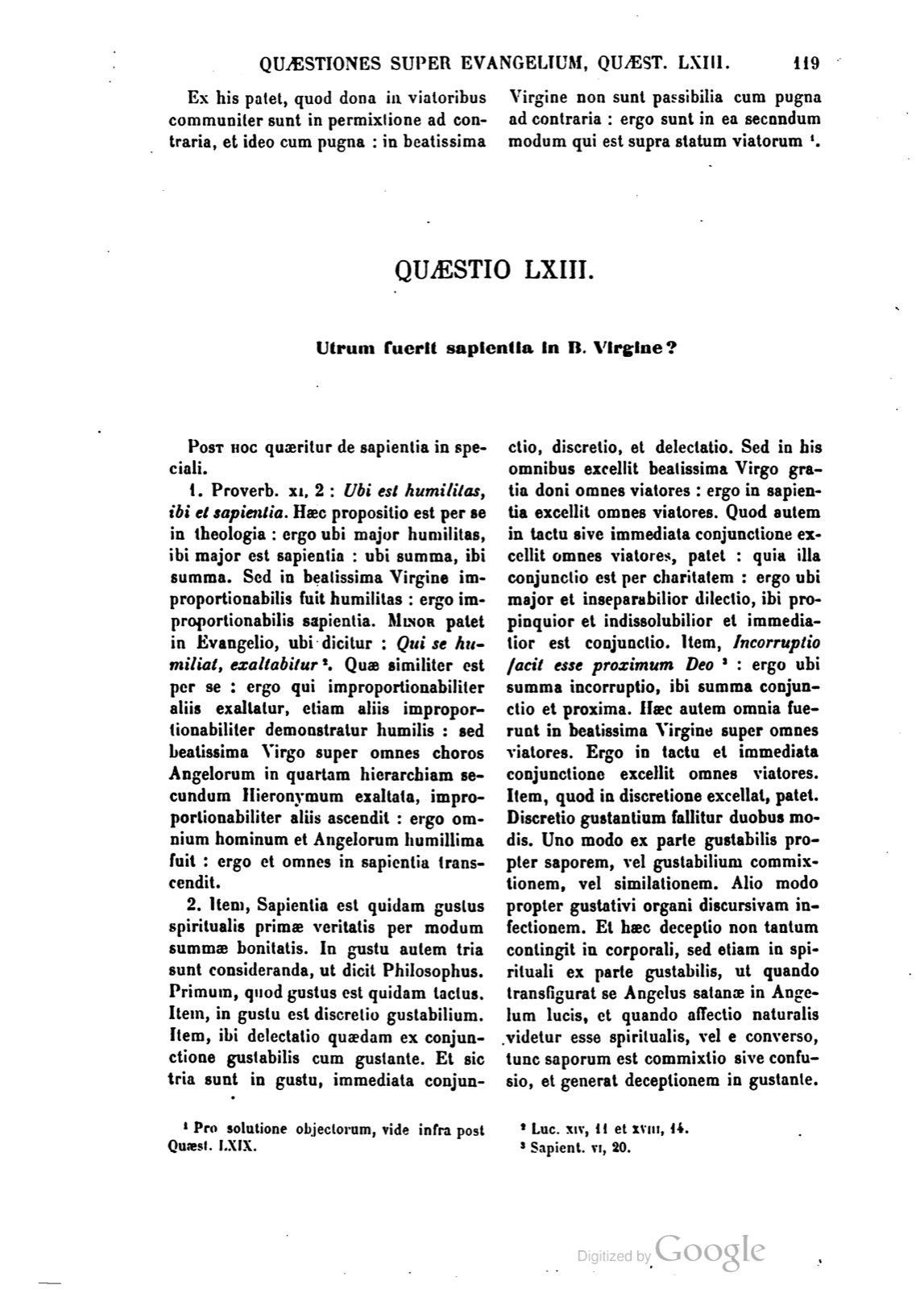
Ex his patet, quod dona in viatoribus communiter sunt in permixtione ad contraria, et ideo cum pugna: in beatissima Virgine non sunt passibilia cum pugna ad contraria: ergo sunt in ea secundum modum qui est supra statum viatorum 1.
4. Likewise, blessed Gregory says that wisdom is opposed to foolishness or unwisdom; knowledge, to luxury; understanding, to gluttony; fear, to pride; fortitude, to sloth; piety, to avarice. Likewise, Matthew 12:45 says: He takes seven other spirits with himself more wicked than himself. On this it is said that dullness is opposed to understanding; rashness to counsel; headlong haste to fortitude; slackness to fear; ignorance to knowledge.
From these things it is clear that gifts in wayfarers commonly exist in admixture with contraries, and therefore with struggle. In the most blessed Virgin they are not passible with struggle toward contraries. Therefore they are in her according to a mode that is above the state of wayfarers 1.
Notes
- For the solution of the objections, see below after Question LXIX. (Pro solutione objectorum, vide infra post Quaest. LXIX.) ↩
If a page does not appear, its photograph has not been uploaded yet.