Works › The Mariale: Questions on “Missus est”
Volume 37 · pp. 104–107
Things to be premised for the solution of the preceding Questions, § I
A marker with ≈ is an approximate page boundary, placed by measure of the text; the page photographs remain the authority. In the paired views, clicking a page marker brings that page into view.
Praemittenda ad solutionem praecedentium Quaestionum.
§ I.
Ad praedictorum omnium evidentiam, et ad objectorum pleniorem solutionem, et ad ipsius solutionis intellectum et intelligentiam faciliorem, hic quaedam sunt praemittenda.
Scribitur enim in Evangelio Marci, XVI, 15: Praedicate Evangelium omni creaturae. Glossa: Generi humano, quod habet aliquod commune cum omni creatura, esse cum entibus, sentire cum brutis, intelligere cum Angelis. Haec autem communitas est causa et aptitudo quaedam naturalis in viribus apprehensivis animae humanae ad apprehendendum universaliter species omnium creaturarum cognoscibilium. Et similiter est causa ex parte rerum cognoscibilium, ut species ipsarum praesententur ipsis viribus apprehensivis. Et sic fit naturalis cognitio cognoscibilium a cognoscente, cum ad species objectas convertuntur apprehensivae vires per similitudinem et per quoddam desiderium, quod iterum est naturale. Ipsa autem ratio in homine cum sit superior, habet actionem omnium inferiorum. Unde Philosophus: Quidquid potest virtus inferior, potest et virtus superior. Cui consonat Dionysius in libro de Coelesti hierarchia: "Ordines superiores excellenter habent inferiorum dispositionum virtutes, et non e converso." Et ideo omnium sensibilium creaturarum et intelligibilium est ratio naturaliter cognoscitiva ratione communitatis naturalis: et ipsa cum sit collativa, naturaliter cognoscit res et creaturas esse signum aliquod vel vestigium, sicut artificium artificis. Ex quo etiam ratio naturaliter est cognoscitiva creatoris, cujus creaturae sunt vestigia et signum. Et sic patet, quod ratio humana habet in sua natura, quod sit cognoscitiva sensibilium creaturarum et intelligibilium et creatoris earum, et quod habet desiderium ductivum ad cognoscendum haec. Et potest dici ductus naturalis rationis, quo ex solis bonis naturalibus ducitur tamquam ex primis motibus ex parte ipsius. Similiter ex parte affectus sunt quaedam aptitudines naturales ad bonum, quas quidam Philosophi appellant seminaria virtutum, quibus movetur anima rationalis ad bonum naturaliter.
Ipsa vero anima rationalis sic existens, est receptiva habitus multiplicis, scilicet artium et scientiarum ex parte virtutis apprehensivae: sed hujusmodi habitus non ducunt rationem extra metas vel terminos ei debitos secundum aptitudinem naturalem, sed sunt facultates 1 et directiones quaedam ad cognoscendum ea ad quae naturaliter se habent: et hi sunt habitus acquisiti per ingenium, sive dati, sive infusi. Ex parte vero virtutis motivae est receptiva habitus consuetudinalis, quo non erigitur affectus super ductum naturae vel super ea quae naturaliter ducta ratio dictat. Affectum vero secundum se habentem cognoverunt quidam Philosophi non sufficere ad beatitudinem. Unde Tullius: "Saepe dicimus, et saepe dicendum est: Naturaliter avidissimi sive appetentissimi sumus, quia honesta sunt nobis innata virtutum seminaria, ita ut si pateremur, et anhelare liceret, ad beatitudinem cum divino munere natura nosmetipsos perduceret: sed igniculos natura nobis inditos saepe retundimus."
Things to be premised for the solution of the preceding Questions.
§ I.
For the evidence of all the things said before, and for the fuller solution of the objections, and for the easier understanding and comprehension of that solution itself, certain things must be premised here.
For it is written in the Gospel of Mark 16:15: Preach the Gospel to every creature. The Gloss says: To the human race, which has something in common with every creature: existence with beings, sensation with brute animals, understanding with Angels. Now this commonality is a certain natural cause and aptitude in the apprehensive powers of the human soul for apprehending universally the species of all knowable creatures. And similarly there is a cause on the part of knowable things, that their species be presented to those apprehensive powers. And thus natural knowledge of knowable things comes about from the knower, when the apprehensive powers are turned to the objected species through likeness and through a certain desire, which again is natural. But reason itself in man, since it is superior, has the action of all the lower powers. Hence the Philosopher says: Whatever a lower power can do, a higher power can do also. Dionysius accords with this in the book On the Celestial Hierarchy: "The higher orders excellently have the virtues of the dispositions of the lower ones, and not conversely." And therefore reason is naturally cognitive of all sensible creatures and intelligible creatures by reason of natural commonality; and since it is collative, it naturally knows things and creatures to be some sign or vestige, as a work is of the craftsman. From this, reason also is naturally cognitive of the Creator, whose creatures are vestiges and a sign. And thus it is clear that human reason has in its nature that it is cognitive of sensible and intelligible creatures and of their Creator, and that it has a guiding desire for knowing these things. And it can be called the natural guidance of reason, by which it is led from natural goods alone as from first movements on its own part. Similarly, on the part of affection there are certain natural aptitudes toward the good, which certain Philosophers call seedbeds of virtues, by which the rational soul is moved naturally toward the good.
But the rational soul itself, existing in this way, is receptive of a manifold habit, namely of arts and sciences on the part of the apprehensive power. But habits of this kind do not lead reason outside the boundaries or limits owed to it according to natural aptitude; rather, they are certain faculties 1 and directions for knowing those things to which they naturally are disposed; and these are habits acquired through talent, whether given or infused. But on the part of the motive power, it is receptive of a customary habit, by which affection is not raised above the guidance of nature or above the things that naturally guided reason dictates. But certain Philosophers knew that affection, taken according to itself, does not suffice for beatitude. Hence Tully says: "We often say, and it must often be said: Naturally we are most eager or most appetitive, because honorable things are innate in us as seedbeds of virtues, so that, if we were allowed and permitted to breathe toward it, nature with the divine gift would lead us ourselves to beatitude; but we often blunt the little flames implanted in us by nature."
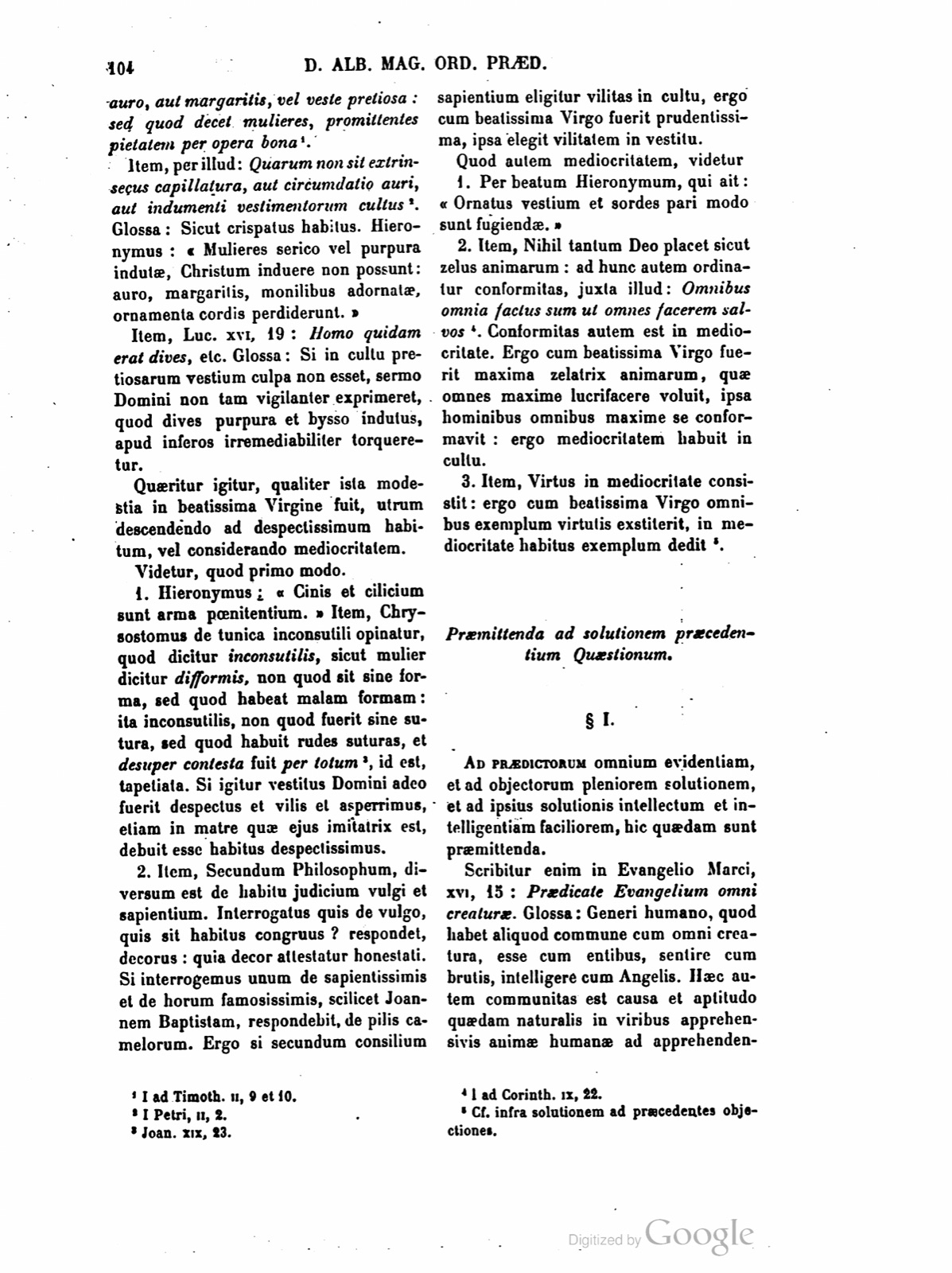
Est igitur praeter hujusmodi habitus naturalis anima susceptiva ignis fidei, quae est donum fluens a Deo, modo nobiliori et utiliori quam sit modus secundum quem fluunt naturae, et bona naturalia. Hujusmodi autem gratia ducitur anima rationalis ad cognitionem talium, ad quae non poterat ratio duci ductu suo naturali, adjuta arte vel scientia vel habitu consuetudinali. Cognita autem hujusmodi sunt Deus trinus et unus, Verbum caro factum, et hujusmodi, ad quae non sufficiunt bona naturalia sine fide: quia ad hoc est parva natura et pusilla statura, quae significatur, Luc. XIX, 2 et seq., in Zachaeo, qui cum non posset videre Jesum, ascendit in arborem sycomorum, ubi Glossa: Devotione fidei ad videndum Salvatorem, quod natura habet minus, supplet ascensu arboris. Et sic patet, quod fides sursum trahit ultra ductum rationis. Et iste duplex ductus signatur, Luc. XV, 12, de filio prodigo, qui dixit patri: Da mihi portionem substantiae quae me contingit. Iste voluit id quod seipso contingere potuit: hoc enim contingere fuit seipsum. Unde, Glossa: Iste vult sua potestate uti, ut nullo formante, nullo regente vivat. Et divisit illis substantiam, id est, bona sua. Glossa: Fidelibus suae gratiae protectionem quam desiderant impertiendo, infidelibus solum naturalis ingenii quo contenti erant beneficium concedendo.
Et sic patet qualiter anima rationalis gratiae auxilio, super suum naturale posse elevatur in cognitione divinorum, videlicet ad primam veritatem et ad summam.
Et notandum, quod in hujusmodi elevatione anima non tantum naturalem terminum supergreditur, sed super se elevatur, et suae perfectioni appropinquat meliorando, et renovatur, et hoc secundum potentias ipsius rationalis, ut talis est, sive sint apprehensivae, sive motivae, ut rationalis, vel irascibilis, et concupiscibilis. In rationabilibus enim et apprehensivis et motivis est imago Dei, et in his est renovatio per Jesum Christum. Apprehensivae enim rationales habent dilectionem suam in homine, et in Deo homine, scilicet in Christo secundum utramque naturam.
Sed nota, quod veritas se habet per speculationem, sive cognitionem ad intellectum dupliciter. Aut scilicet ut sui praesentia removeat ignorantiam: et hoc modo se habet omnis veritas ad intellectum speculativum dum apprehenditur ab illo, et tunc delectatur ratio vel intellectus. Sic delectationem convenit esse in sciendo. Aut ut ipsius praesentia non tantum removeatur ignorantia, sed etiam nobilitetur et melioretur potentia ipsius veritatis praesentia, ut clare videat et aperte sine aenigmate, quod secundum se vel in se videri non posset. Hujusmodi veritas est divina veritas, cujus praesentia se ratio sentit perfici et meliorari, ex quo habet delectationem talem et tantam, qualem et quantam habere non posset ex praesentia et in praesentia alterius veritatis. Similiter autem in Christo natura humana ex unione ad divinam habet summum suum, ut scilicet sit tantum meliorata quantum potest, et in tantum quod etiam per illum hominem ducatur ad visionem divinitatis. Unde veritas talis apprehensa a virtute cognitiva, non tantum removet ignorantiam, sed etiam videt et sentit ut sit meliorata, et etiam per illum qui est ejusdem naturae, ducitur ad visionem divinitatis. Et hoc est quod dicitur ad Corinthios: Cum tradiderit regnum Deo Patri 2, etc. Glossa: Cum perduxerit credentes ad contemplationem Dei Patris, ubi est finis omnium, et requies sempiterna, et gaudium.
Therefore besides natural habits of this kind the soul is receptive of the fire of faith, which is a gift flowing from God in a nobler and more useful mode than the mode according to which natures and natural goods flow. Moreover, by grace of this kind the rational soul is led to knowledge of such things to which reason could not be led by its own natural guidance, helped by art or science or customary habit. But things known in this way are God three and one, the Word made flesh, and things of this kind, for which natural goods without faith do not suffice; because for this nature is small and of little stature, which is signified in Luke 19:2 and following, in Zacchaeus, who, since he could not see Jesus, climbed a sycamore tree, where the Gloss says: By the devotion of faith for seeing the Savior, what nature has less of, it supplies by the ascent of the tree. And thus it is clear that faith draws upward beyond the guidance of reason. And this twofold guidance is signified in Luke 15:12, concerning the prodigal son, who said to his father: Give me the portion of substance that falls to me. He wanted what he could attain by himself; for this attaining was himself. Hence the Gloss says: He wishes to use his own power, so that he may live with no one forming him, no one ruling him. And he divided substance among them, that is, his goods. The Gloss says: By imparting to the faithful the protection of his grace which they desire, and by granting to the unfaithful only the benefit of natural talent with which they were content.
And thus it is clear how the rational soul, by the help of grace, is elevated beyond its natural power in knowledge of divine things, namely to the first truth and to the highest truth.
And it must be noted that in an elevation of this kind the soul not only passes beyond a natural limit, but is elevated above itself and approaches its perfection by being made better, and is renewed; and this is according to the powers of that rational soul, as such, whether they are apprehensive or motive, as rational, or irascible, and concupiscible. For in the rational, apprehensive, and motive powers there is the image of God, and in these there is renewal through Jesus Christ. For the rational apprehensive powers have their love in man, and in the God-man, namely in Christ according to each nature.
But note that truth is related by speculation, or knowledge, to the intellect in two ways. Either, namely, so that by its presence it removes ignorance; and in this way every truth is related to the speculative intellect when it is apprehended by it, and then reason or intellect is delighted. Thus delight fittingly exists in knowing. Or so that by its presence not only ignorance is removed, but also the power is ennobled and made better by the presence of that truth, so that it sees clearly and openly without an enigma what could not be seen according to itself or in itself. Truth of this kind is divine truth, by whose presence reason feels itself to be perfected and made better; from this it has such and so great a delight as it could not have from the presence and in the presence of another truth. Similarly, in Christ human nature from union to the divine has its highest point, namely that it is made as much better as it can be, and to such an extent that even through that man it is led to the vision of divinity. Hence such a truth, apprehended by the cognitive power, not only removes ignorance, but the power also sees and feels that it is made better, and through him who is of the same nature it is led to the vision of divinity. And this is what is said to the Corinthians: When he shall have handed over the kingdom to God the Father 2, and so forth. The Gloss says: When he shall have led believers through to the contemplation of God the Father, where there is the end of all things, and everlasting rest, and joy.
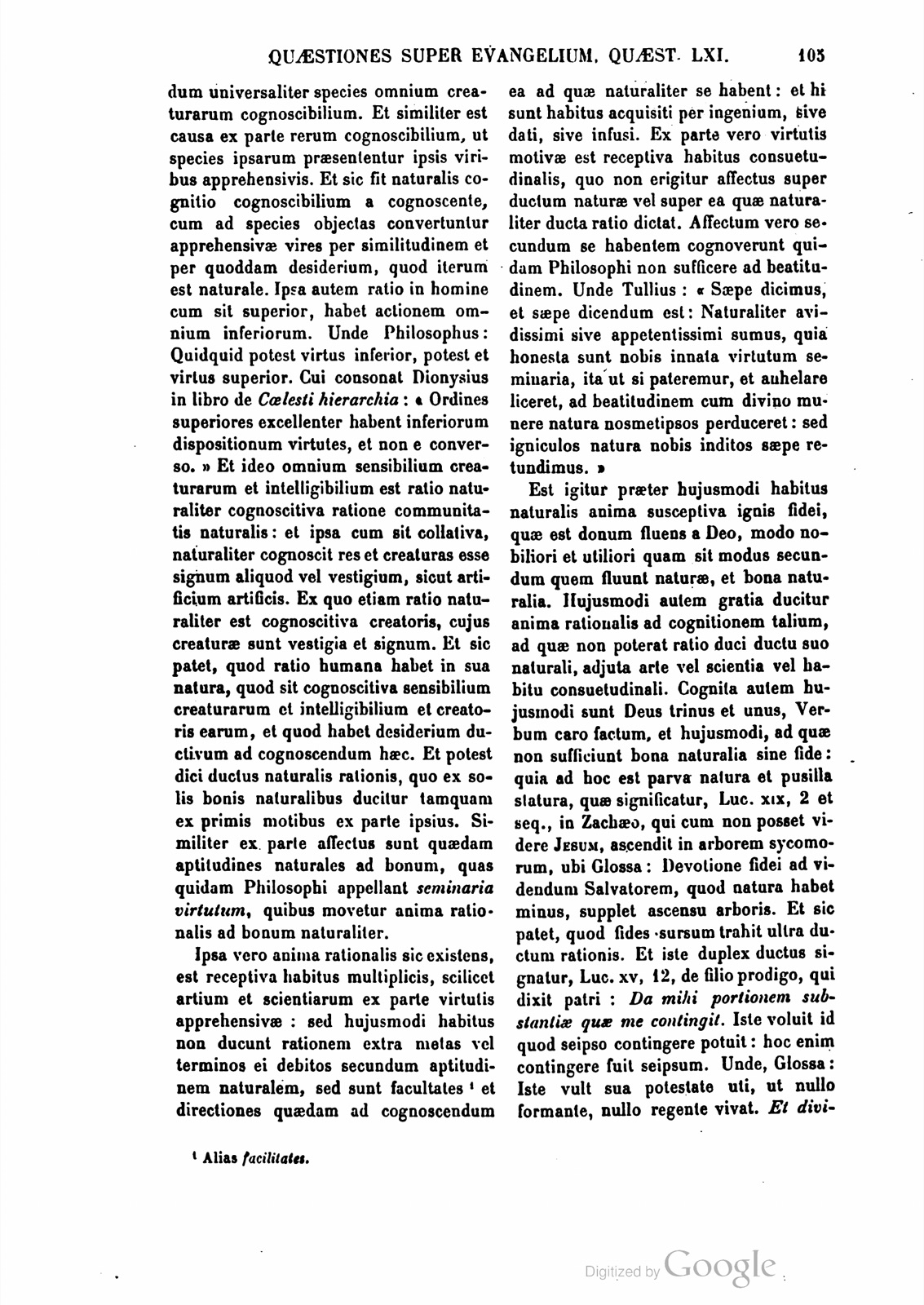
Sic ergo patet, quia anima rationalis secundum illas vires gaudet de visione deitatis tamquam de visione summi perficientis ipsam, et de visione Dei hominis, id est, Christi, tamquam de visione optimi et perfectissimi suae naturae, cujus influentia sic se meliorari videt et nobilitari, ut videat Deum: et visio ista, aeterna vita est 3, in qua summa veritas et summa bonitas. Et sic reficit rationalem vim, quod ex toto eam decorabit et alliciet, ut nihil aliud quaerat videre nisi ipsam aut propter ipsam: et ideo ibi erit continuatio visionis.
Item, Summum delectabile concupiscibile sic sua suavitate perfundet, ut nihil aliud amet aut quaerat nisi ipsum aut propter ipsum: et ideo non erit fastidium.
Item, Summe arduum summa sua immobilitate irascibile roborabit et securabit, ut nihil tenere aut tractare quaerat nisi ipsum aut propter ipsum: et ideo non est ibi fatigatio. Unde Augustinus in libro XXII de Civitate Dei: "Ego ero quaecumque ab hominibus honeste desiderantur." Et infra: "Ipse erit finis nostrorum desideriorum qui sine fine videbitur, sine fastidio amabitur, sine fatigatione laudabitur 4."
Ut autem ad hoc perveniat anima rationalis, oportet quod habitibus intermediis elevetur: in qua elevatione sunt gradus et ordines: quos ut plene cognoscas, nota quod est unum verum delectabile remotivum imperfectionis et indigentiae, et hoc secundum ordinem causae ad causatum. Item, in causato est imperfectio, et hoc respectu suae causae, et indigentia, scilicet regressibilitas in nihilum, nisi continuetur suum esse per suam causam: et hoc omnino potest cognosci: et Gentibus potest hoc contingere et cogitare in aliqua visione primae veritatis. Dicit ergo Augustinus in libro IV de Trinitate: "Nonnulli sapientes mundi potuerunt aciem mentis ultra omnem creaturam transferre, et lucem incommutabilis veritatis quantumcumque ex parte contingere 5." Hoc autem videntes et cognoscentes possunt habere dilectionem. Et sic est delectatio in scientia: quia illa veritas illis apparet sicut lucens, et sic eam amant: et non apparet eis sicut purgans. Augustinus in libro X Confessionum: "Cur veritas parit odium, nisi quia sic amatur veritas, ut quicumque aliud amant, hoc quod amant velint esse veritatem, et quia falli nollent, nolunt convinci quod falsi sint? Hi amant veritatem lucentem, oderunt eam redarguentem 6." Ecce quod illa veritas multis modis potest apparere: et cum apparet eis sicut lucens, possunt cogitare, quod per eam perficiuntur imperfectiones naturales in causato, et removentur indigentiae: et amant illam primam veritatem qui sic cognoscunt eam: et amor est naturalis inclinatio affectus ad illam veritatem sic cognitam. Sed amare non plus potest homo quam se extendit naturalis cognitio, et non potest operari sic ut attingat illam. Cujus duae causae sunt. Una, insufficientia naturae institutae: alia, imperfectio quae provenit ex destitutione naturae, scilicet miseria poenalis ex culpa originali quoad reatum. Hunc autem defectum vel imperfectionem non cognoverunt Philosophi ignorantes hominem fuisse in duplici statu: et propter hoc miserias veras esse quae contractae sunt: nec illa veritate sic lucente hoc cognoscunt. Sed si viderent illam ut redarguentem, tunc cognoscerent illam poenalitatem esse per causas a suo creatore. Appareret autem eis illa veritas si vellent credere.
Thus therefore it is clear that the rational soul according to those powers rejoices over the vision of deity as over the vision of the highest one perfecting it, and over the vision of God-man, that is, Christ, as over the vision of the best and most perfect one of its nature, by whose influence it sees itself to be made better and ennobled so that it may see God; and that vision is eternal life 3, in which are highest truth and highest goodness. And thus it refreshes the rational power, because it will adorn and allure it wholly, so that it seeks to see nothing else except it or on account of it; and therefore there will be continuity of vision there.
Likewise, the highest delightful thing for the concupiscible power will so bathe it with its sweetness that it loves or seeks nothing else except it or on account of it; and therefore there will be no weariness.
Likewise, the supremely arduous thing, by its highest immobility, will strengthen and secure the irascible power, so that it seeks to hold or handle nothing except it or on account of it; and therefore there is no fatigue there. Hence Augustine says in book XXII of The City of God: "I shall be whatever things are honorably desired by human beings." And below: "He himself will be the end of our desires, who will be seen without end, loved without weariness, praised without fatigue 4."
But so that the rational soul may come to this, it must be elevated by intermediate habits. In this elevation there are grades and orders. That you may know them fully, note that there is one true delightful thing that removes imperfection and need, and this according to the order of cause to caused. Likewise, in the caused thing there is imperfection, and this with respect to its cause, and need, namely the possibility of falling back into nothing unless its being is continued by its cause; and this can be known altogether. And it can happen to Gentiles to know and think this in some vision of the first truth. Therefore Augustine says in book IV On the Trinity: "Some wise men of the world were able to carry the gaze of the mind beyond every creature, and to touch in some way, at least in part, the light of immutable truth 5." But seeing and knowing this, they can have love. And thus there is delight in science, because that truth appears to them as shining, and so they love it; and it does not appear to them as purging. Augustine says in book X of the Confessions: "Why does truth bring forth hatred, except because truth is loved in such a way that those who love other things wish that what they love be truth, and because they would not wish to be deceived, they do not wish to be convicted that they are false? These love truth as shining; they hate it as rebuking 6." Behold, that truth can appear in many ways; and when it appears to them as shining, they can think that by it natural imperfections in the caused thing are perfected and needs are removed; and those who know that first truth in this way love it. And love is the natural inclination of affection to that truth known in this way. But man cannot love more than natural knowledge extends itself, and he cannot so work as to attain it. There are two causes of this: one, the insufficiency of instituted nature; the other, the imperfection that comes from the destitution of nature, namely penal misery from original fault as to guilt. The Philosophers did not know this defect or imperfection, being ignorant that man had been in a twofold state; and because of this they did not know that the miseries contracted are true miseries; nor do they know this when that truth is shining in this way. But if they saw it as rebuking, then they would know that that penality exists through causes from its Creator. But that truth would appear to them if they were willing to believe.
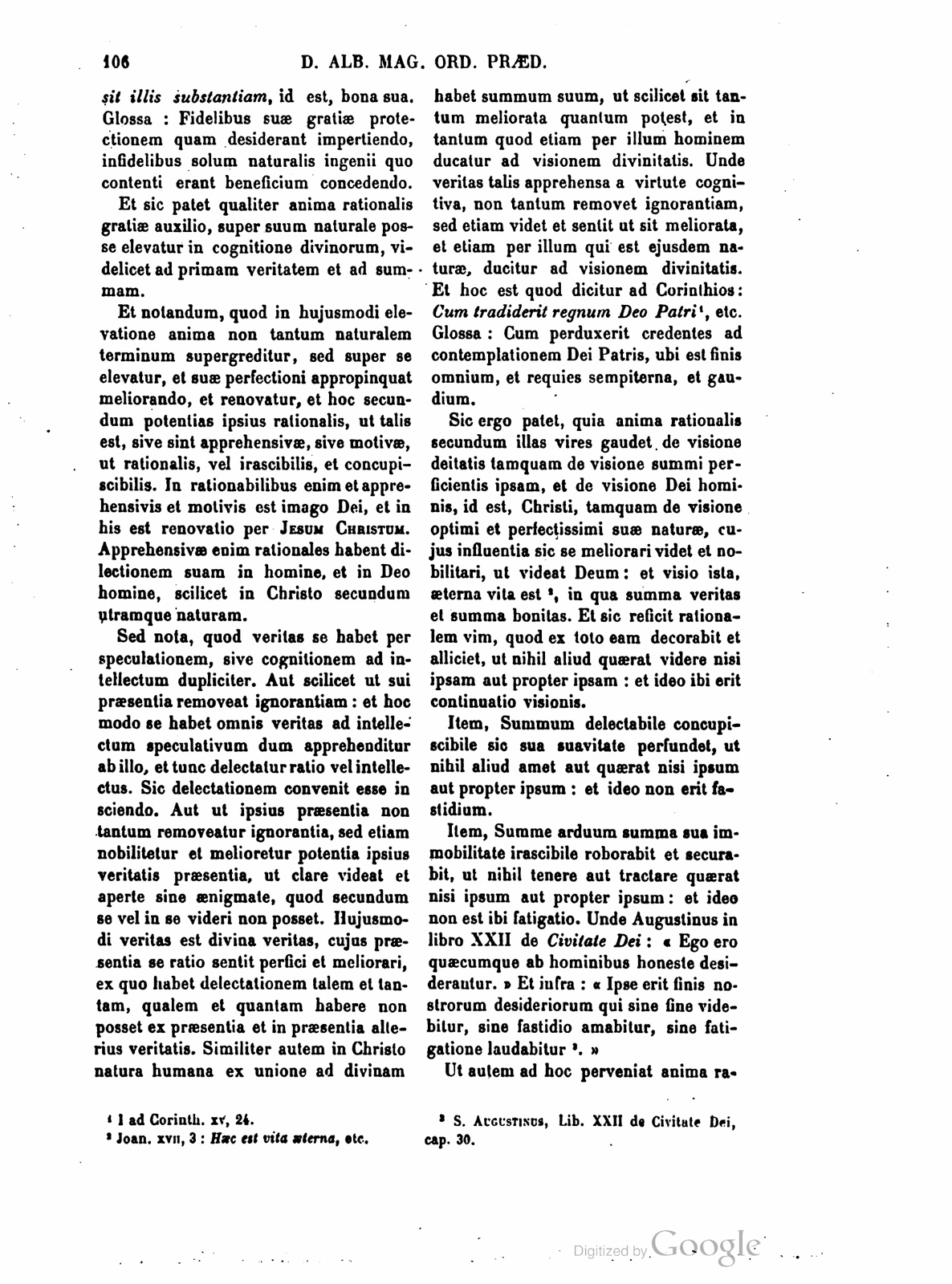
Ex quo patet, quod Gentilis non est in via: nititur enim secundum se, et ex hoc non habet spem neque formatam neque informem. Si autem spes dicitur quae non est veritas, sed confidentia ex consideratione liberalitatis divinae, non dico misericordiae, sic potest in fide infidelis habere spem, id est, confidentiam. Et haec confidentia facit naturam niti quantum potest esse secundum se: sed hoc totum parum prodest.
De fideli autem aliter.
From this it is clear that a Gentile is not on the way, for he strives according to himself, and from this he has neither formed nor unformed hope. But if hope is called something that is not truth, but confidence from consideration of divine liberality, I do not say of mercy, then in faith an unbeliever can have hope, that is, confidence. And this confidence makes nature strive as much as it can to be according to itself; but this whole thing profits little.
But concerning the faithful it is otherwise.
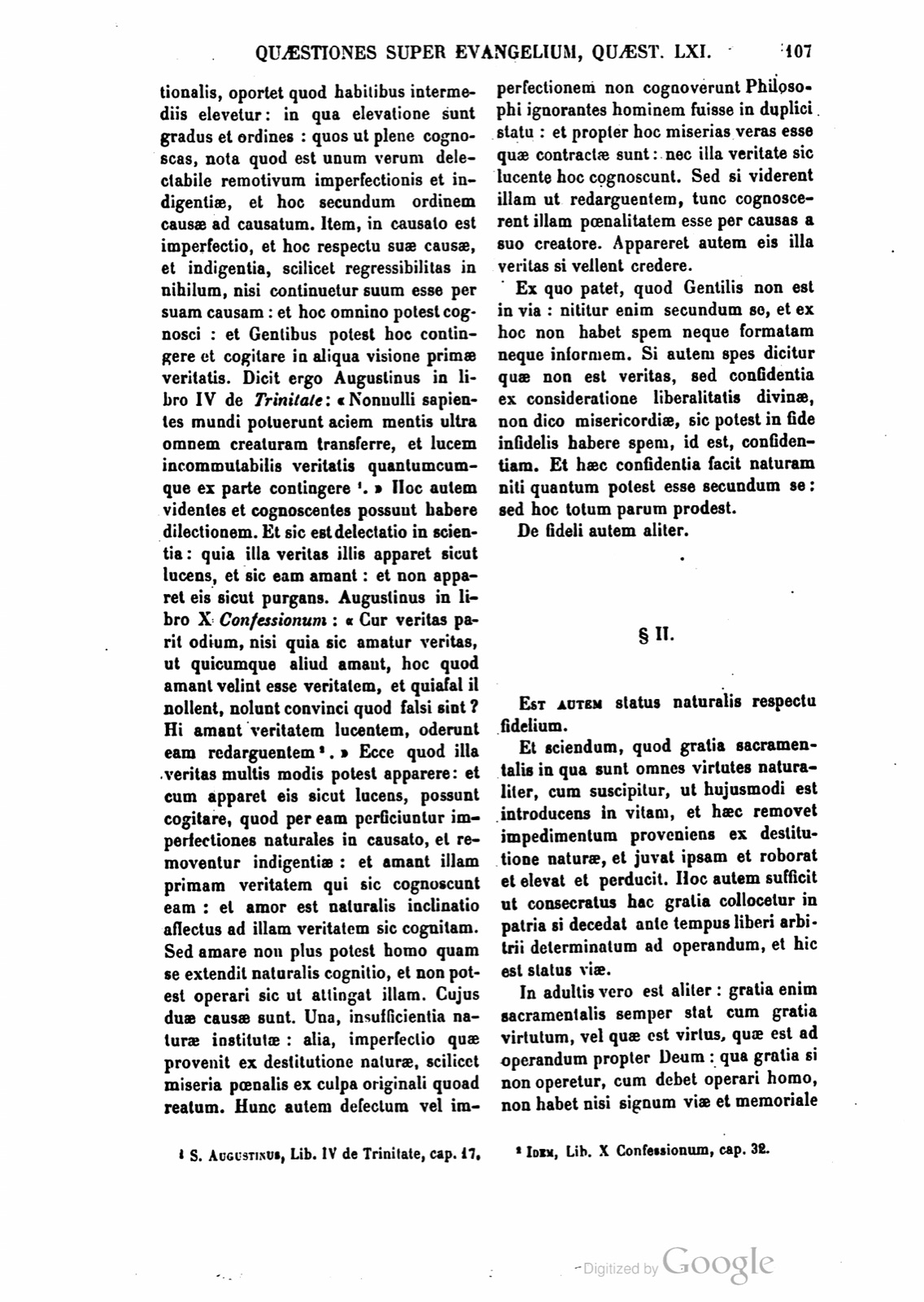
Notes
- Otherwise, facilities. (Alias facilitates.) ↩
- 1 Corinthians 15:24. (I ad Corinth. XV, 24.) ↩
- John 17:3: This is eternal life, and so forth. (Joan. XVII, 3: Haec est vita aeterna, etc.) ↩
- St. Augustine, book XXII of The City of God, chapter 30. (S. Augustinus, Lib. XXII de Civitate Dei, cap. 30.) ↩
- St. Augustine, book IV On the Trinity, chapter 17. (S. Augustinus, Lib. IV de Trinitate, cap. 17.) ↩
- The same author, book X of the Confessions, chapter 32. (Idem, Lib. X Confessionum, cap. 32.) ↩
If a page does not appear, its photograph has not been uploaded yet.