Works › The Mariale: Questions on “Missus est”
Volume 37 · pp. 107–108
Things to be premised for the solution of the preceding Questions, § II
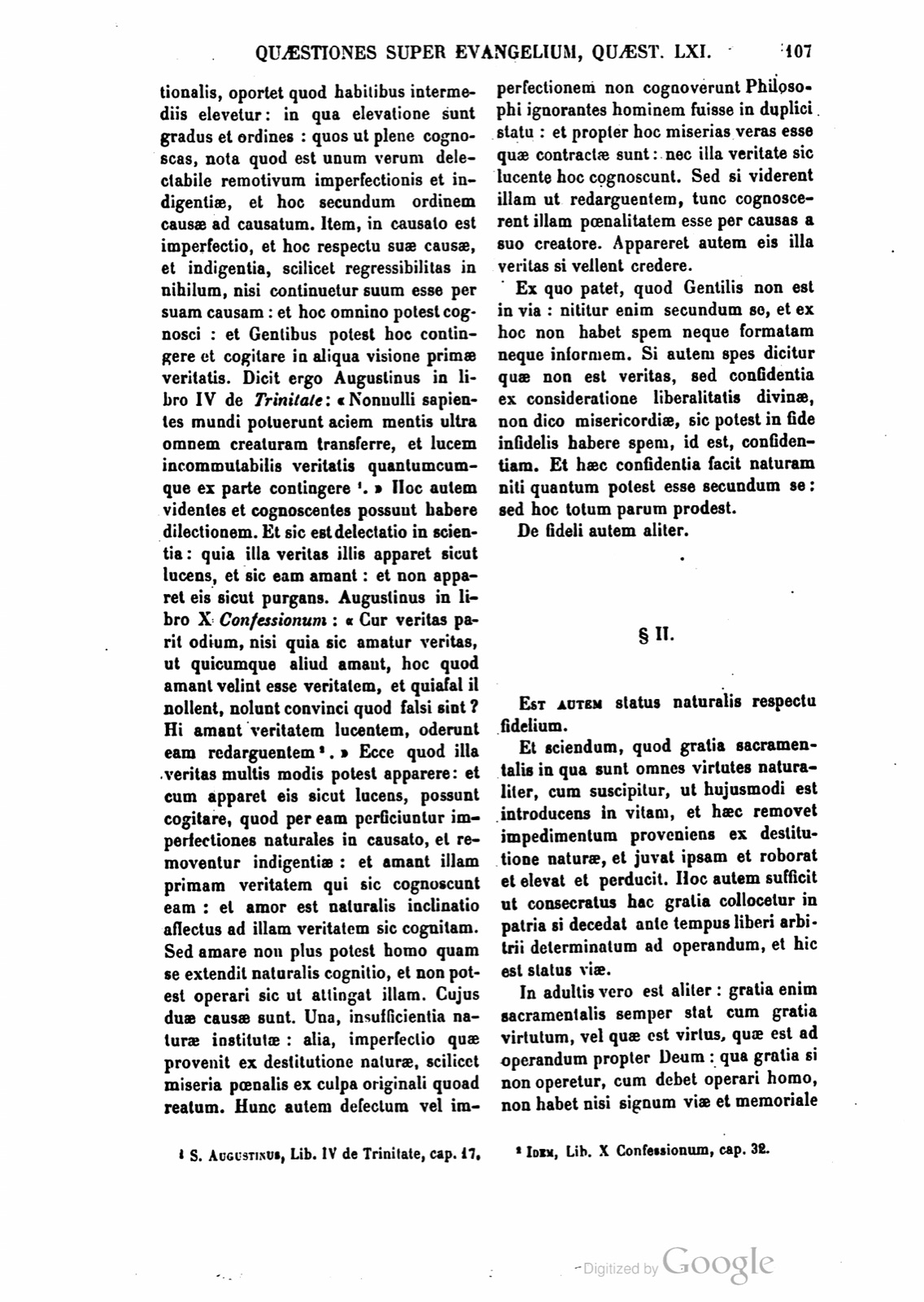
§ II.
Est autem status naturalis respectu fidelium.
Et sciendum, quod gratia sacramentalis in qua sunt omnes virtutes naturaliter, cum suscipitur, ut hujusmodi est introducens in vitam, et haec removet impedimentum proveniens ex destitutione naturae, et juvat ipsam et roborat et elevat et perducit. Hoc autem sufficit ut consecratus hac gratia collocetur in patria si decedat ante tempus liberi arbitrii determinatum ad operandum, et hic est status viae.
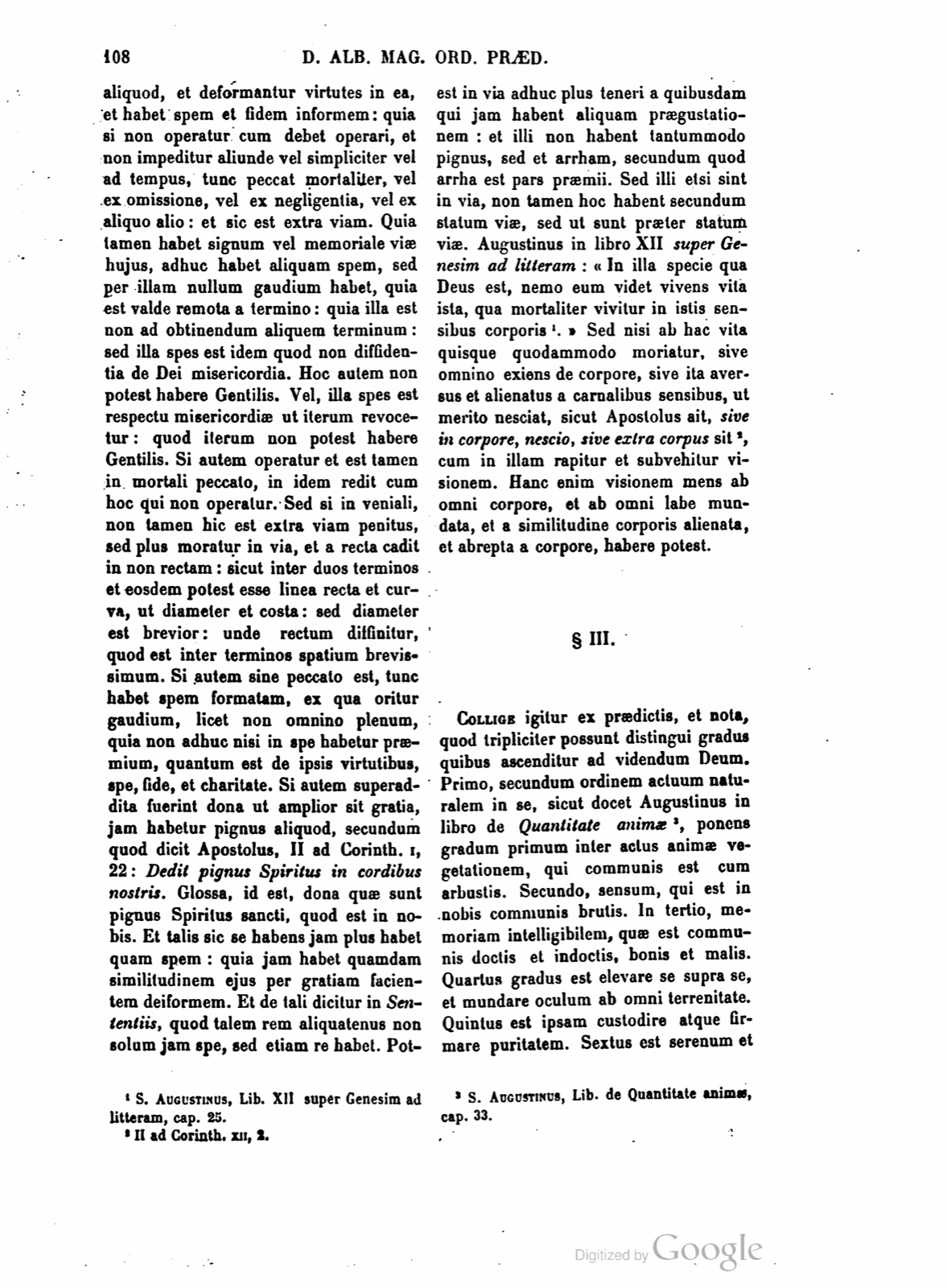
In adultis vero est aliter: gratia enim sacramentalis semper stat cum gratia virtutum, vel quae est virtus, quae est ad operandum propter Deum: qua gratia si non operetur, cum debet operari homo, non habet nisi signum viae et memoriale aliquod, et deformantur virtutes in ea, et habet spem et fidem informem: quia si non operatur cum debet operari, et non impeditur aliunde vel simpliciter vel ad tempus, tunc peccat mortaliter, vel ex omissione, vel ex negligentia, vel ex aliquo alio: et sic est extra viam. Quia tamen habet signum vel memoriale viae hujus, adhuc habet aliquam spem, sed per illam nullum gaudium habet, quia est valde remota a termino: quia illa est non ad obtinendum aliquem terminum: sed illa spes est idem quod non diffidentia de Dei misericordia. Hoc autem non potest habere Gentilis. Vel, illa spes est respectu misericordiae ut iterum revocetur: quod iterum non potest habere Gentilis. Si autem operatur et est tamen in mortali peccato, in idem redit cum hoc qui non operatur. Sed si in veniali, non tamen hic est extra viam penitus, sed plus moratur in via, et a recta cadit in non rectam: sicut inter duos terminos et eosdem potest esse linea recta et curva, ut diameter et costa: sed diameter est brevior: unde rectum diffinitur, quod est inter terminos spatium brevissimum. Si autem sine peccato est, tunc habet spem formatam, ex qua oritur gaudium, licet non omnino plenum, quia non adhuc nisi in spe habetur praemium, quantum est de ipsis virtutibus, spe, fide, et charitate. Si autem superaddita fuerint dona ut amplior sit gratia, jam habetur pignus aliquod, secundum quod dicit Apostolus, II ad Corinth. I, 22: Dedit pignus Spiritus in cordibus nostris. Glossa, id est, dona quae sunt pignus Spiritus sancti, quod est in nobis. Et talis sic se habens jam plus habet quam spem: quia jam habet quamdam similitudinem ejus per gratiam facientem deiformem. Et de tali dicitur in Sententiis, quod talem rem aliquatenus non solum jam spe, sed etiam re habet. Potest in via adhuc plus teneri a quibusdam qui jam habent aliquam praegustationem: et illi non habent tantummodo pignus, sed et arrham, secundum quod arrha est pars praemii. Sed illi etsi sint in via, non tamen hoc habent secundum statum viae, sed ut sunt praeter statum viae. Augustinus in libro XII super Genesim ad litteram: "In illa specie qua Deus est, nemo eum videt vivens vita ista, qua mortaliter vivitur in istis sensibus corporis 1." Sed nisi ab hac vita quisque quodammodo moriatur, sive omnino exiens de corpore, sive ita aversus et alienatus a carnalibus sensibus, ut merito nesciat, sicut Apostolus ait, sive in corpore, nescio, sive extra corpus sit 2, cum in illam rapitur et subvehitur visionem. Hanc enim visionem mens ab omni corpore, et ab omni labe mundata, et a similitudine corporis alienata, et abrepta a corpore, habere potest.
§ II.
Now there is a natural state with respect to the faithful.
And one must know that sacramental grace, in which all virtues are naturally present, when it is received, as such is introducing into life; and this removes the impediment coming from the destitution of nature, and helps nature itself, and strengthens and elevates and leads it through. But this suffices so that one consecrated by this grace is placed in the homeland if he dies before the time of free choice determined for working; and this is the state of the way.
But in adults it is otherwise. For sacramental grace always stands with the grace of virtues, or with the grace that is virtue, which is for working on account of God. If a man does not work by this grace when he ought to work, he has only the sign of the way and some memorial, and the virtues are deformed in it, and he has unformed hope and faith; because if he does not work when he ought to work, and is not hindered otherwise either simply or for a time, then he sins mortally, either from omission, or from negligence, or from something else; and so he is outside the way. Yet because he has the sign or memorial of this way, he still has some hope, but through it he has no joy, because it is very remote from the end; for it is not ordered to obtaining any end. Rather, that hope is the same as not distrusting God's mercy. But a Gentile cannot have this. Or, that hope is with respect to mercy, so that he may again be called back; and again a Gentile cannot have this. But if he works and nevertheless is in mortal sin, he returns to the same thing as one who does not work. But if he is in venial sin, nevertheless he is not here wholly outside the way, but lingers more on the way and falls from the straight line into a non-straight one; just as between two termini, and the same termini, there can be a straight and a curved line, as a diameter and a side; but the diameter is shorter. Hence the straight is defined as the shortest space between termini. But if he is without sin, then he has formed hope, from which joy arises, although not wholly full, because the reward is not yet had except in hope, so far as concerns the virtues themselves, hope, faith, and charity. But if gifts have been superadded, so that grace is more ample, then some pledge is now had, according as the Apostle says in 2 Corinthians 1:22: He has given the pledge of the Spirit in our hearts. The Gloss says: that is, the gifts that are the pledge of the Holy Spirit, which is in us. And one having himself in this way now has more than hope, because he now has a certain likeness of it through grace making him deiform. And concerning such a one it is said in the Sentences that to some extent he now has such a reality not only in hope but also in reality. Something further can be held on the way by certain persons who already have some foretaste; and these do not have only a pledge, but also an earnest, insofar as an earnest is a part of the reward. But although they are on the way, they nevertheless do not have this according to the state of the way, but as they are beyond the state of the way. Augustine says in book XII On Genesis according to the Letter: "In that species in which God is, no one sees him while living this life, by which one lives mortally in these senses of the body 1." But unless each person in some way dies to this life, whether by going out of the body altogether, or by being so turned away and alienated from the bodily senses that deservedly he does not know, as the Apostle says, whether he is in the body, I do not know, or outside the body 2, when he is caught up and carried upward into that vision. For the mind, cleansed from every body and from every stain, and alienated from the likeness of body, and snatched away from the body, can have this vision.
If a page does not appear, its photograph has not been uploaded yet.