Works › The Mariale: Questions on “Missus est”
Volume 37 · p. 103
Question LX. Whether she had modesty?
QUAESTIO LX. Utrum habuerit modestiam?
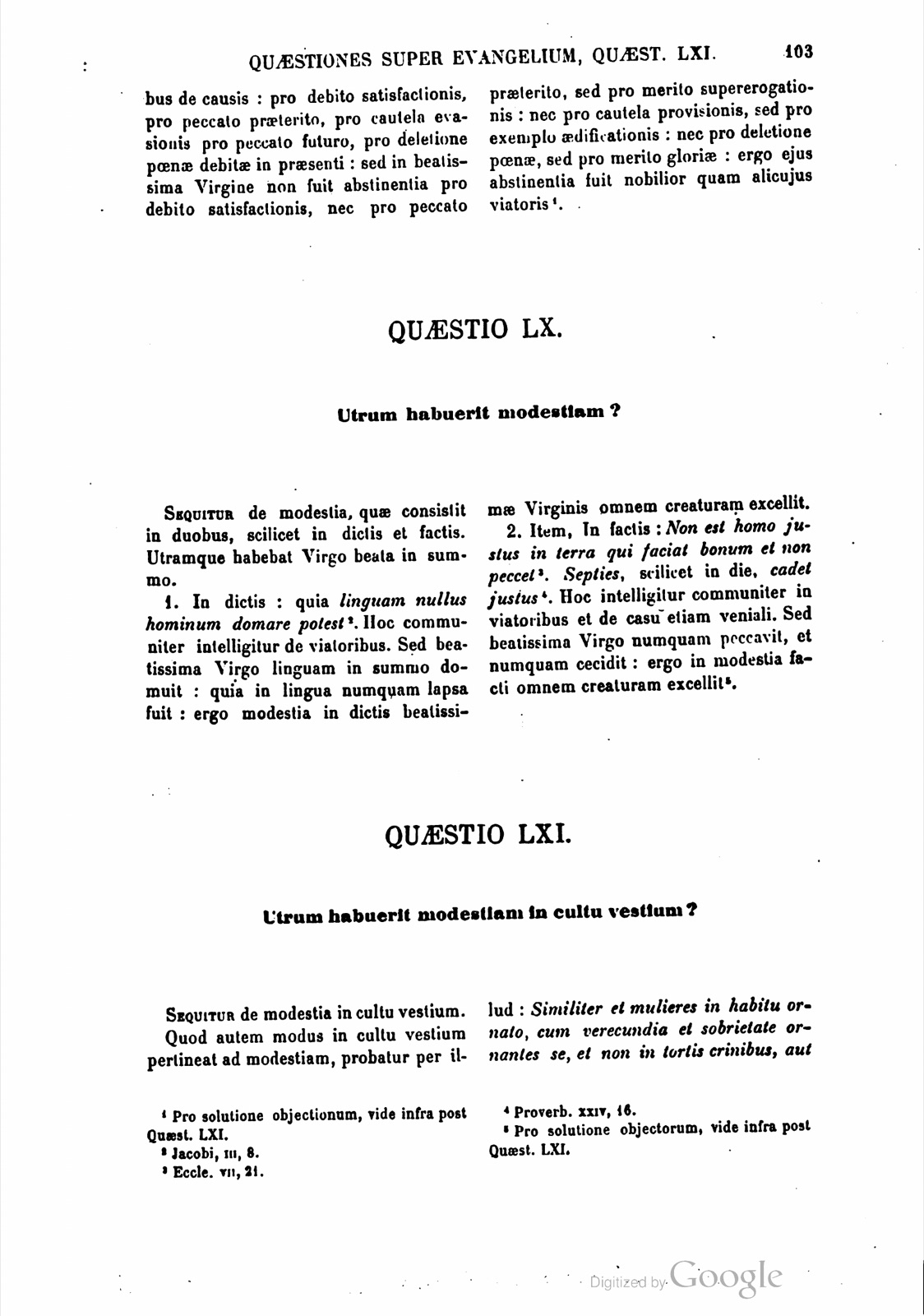
Sequitur de modestia, quae consistit in duobus, scilicet in dictis et factis. Utramque habebat Virgo beata in summo.
1. In dictis: quia linguam nullus hominum domare potest 1. Hoc communiter intelligitur de viatoribus. Sed beatissima Virgo linguam in summo domuit: quia in lingua numquam lapsa fuit: ergo modestia in dictis beatissimae Virginis omnem creaturam excellit.
2. Item, In factis: Non est homo justus in terra qui faciat bonum et non peccet 2. Septies, scilicet in die, cadet justus 3. Hoc intelligitur communiter in viatoribus et de casu etiam veniali. Sed beatissima Virgo numquam peccavit, et numquam cecidit: ergo in modestia facti omnem creaturam excellit 4.
QUESTION LX. Whether she had modesty?
There follows concerning modesty, which consists in two things, namely in words and in deeds. The blessed Virgin had both in the highest degree.
1. In words, because no man can tame the tongue 1. This is commonly understood concerning wayfarers. But the most blessed Virgin tamed the tongue in the highest degree, because she never slipped in the tongue. Therefore modesty in the words of the most blessed Virgin surpasses every creature.
2. Likewise, in deeds: There is no just man on earth who does good and does not sin 2. Seven times, namely in a day, the just man will fall 3. This is commonly understood among wayfarers and also concerning a venial fall. But the most blessed Virgin never sinned and never fell. Therefore in modesty of deed she surpasses every creature 4.
Notes
- James 3:8. (Jacobi, III, 8.) ↩
- Ecclesiastes 7:21. (Eccle. VII, 21.) ↩
- Proverbs 24:16. (Proverb. XXIV, 16.) ↩
- For the solution of the objections, see below after Question LXI. (Pro solutione objectorum, vide infra post Quaest. LXI.) ↩
If a page does not appear, its photograph has not been uploaded yet.