Works › The Mariale: Questions on “Missus est”
Volume 37 · pp. 102–103
Question LIX. Whether she had sobriety?
A marker with ≈ is an approximate page boundary, placed by measure of the text; the page photographs remain the authority. In the paired views, clicking a page marker brings that page into view.
QUAESTIO LIX. Utrum habuerit sobrietatem?
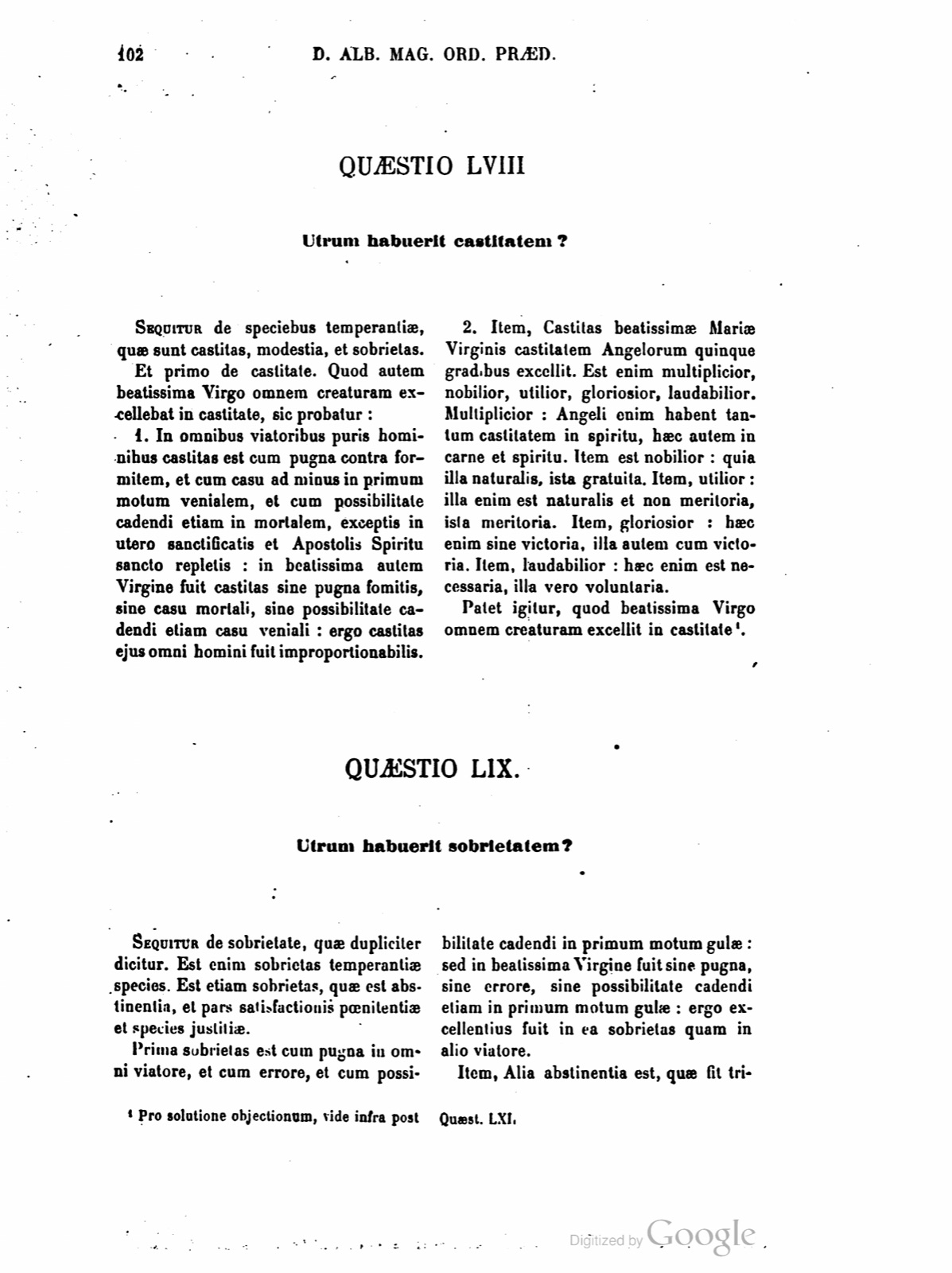
Sequitur de sobrietate, quae dupliciter dicitur. Est enim sobrietas temperantiae species. Est etiam sobrietas, quae est abstinentia, et pars satisfactionis poenitentiae et species justitiae.
Prima sobrietas est cum pugna in omni viatore, et cum errore, et cum possibilitate cadendi in primum motum gulae: sed in beatissima Virgine fuit sine pugna, sine errore, sine possibilitate cadendi etiam in primum motum gulae: ergo excellentius fuit in ea sobrietas quam in alio viatore.
QUESTION LIX. Whether she had sobriety?
There follows concerning sobriety, which is spoken of in two ways. For sobriety is a species of temperance. There is also sobriety that is abstinence, both a part of the satisfaction of penitence and a species of justice.
The first sobriety exists with struggle in every wayfarer, and with error, and with the possibility of falling into the first movement of gluttony. But in the most blessed Virgin it was without struggle, without error, without the possibility of falling even into the first movement of gluttony. Therefore sobriety was in her more excellently than in another wayfarer.
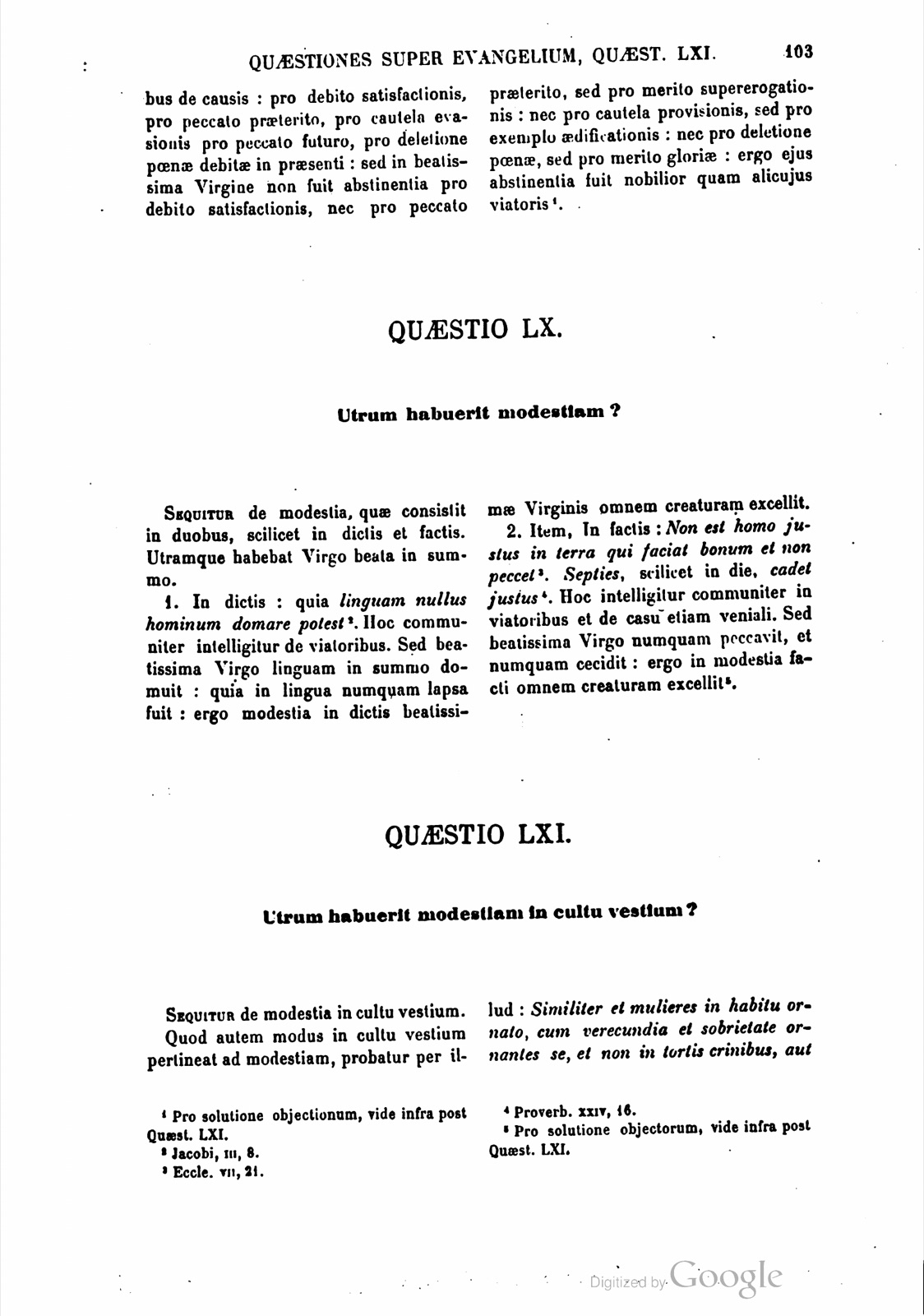
Item, Alia abstinentia est, quae fit tribus de causis: pro debito satisfactionis, pro peccato praeterito, pro cautela evasionis pro peccato futuro, pro deletione poenae debitae in praesenti: sed in beatissima Virgine non fuit abstinentia pro debito satisfactionis, nec pro peccato praeterito, sed pro merito supererogationis: nec pro cautela provisionis, sed pro exemplo aedificationis: nec pro deletione poenae, sed pro merito gloriae: ergo ejus abstinentia fuit nobilior quam alicujus viatoris 1.
Likewise, there is another abstinence, which comes about for three causes: for the debt of satisfaction, for past sin, for the caution of escaping future sin, and for the deletion of punishment owed in the present. But in the most blessed Virgin there was not abstinence for the debt of satisfaction, nor for past sin, but for the merit of supererogation; not for the caution of provision, but for the example of edification; not for the deletion of punishment, but for the merit of glory. Therefore her abstinence was nobler than that of any wayfarer 1.
Notes
- For the solution of the objections, see below after Question LXI. (Pro solutione objectionum, vide infra post Quaest. LXI.) ↩
If a page does not appear, its photograph has not been uploaded yet.