Works › The Mariale: Questions on “Missus est”
Volume 37 · pp. 80–81
Question XLII. Why are women not promoted to sacred orders?
A marker with ≈ is an approximate page boundary, placed by measure of the text; the page photographs remain the authority. In the paired views, clicking a page marker brings that page into view.
QUAESTIO XLII. Quare mulieres ad sacros ordines non promoveantur?
Juxta hoc quaeritur, Quare mulieres ad sacros ordines non promoveantur?
Si dicitur, quod hoc est propter originem culpae per Hevam transmissae, non videtur, quod hoc stare possit: quia pro illa culpa beata Virgo satisfecit: ergo non consurget duplex tribulatio, et Deus bis in idipsum non judicabit.
Si autem dicitur, quod hoc fit propter sexus indignitatem et naturae, hoc non potest dici: quia major est indignitas culpae quam naturae: et tamen peccatum mortale non impedit, quin possit vir, licet non debeat, in peccato mortali promoveri. Item, Si hoc esset propter sexus inferioritatem, propter hoc etiam non deberent mulieres communicare, cum majus sit hoc sacramentum percipere quam dare alii.
Item quaeritur, Cum Dominus nusquam videatur prohibere mulieres a sacramento ordinum, qualiter hoc Ecclesia per se ausa fuerit invenire?
Quod autem beatissima Virgo non debuit aliquos ordines habere, probatur hoc modo:
1. Quando Dominus in coena discipulis corpus suum tradidit, et potestatem conficiendi contulit, non exprimitur quod aliquibus nisi discipulis dederit; sed in talibus quod uni concessum invenitur, aliis est prohibitum: ergo tantum est collata potestas conficiendi discipulis et eorum successoribus.
QUESTION XLII. Why are women not promoted to sacred orders?
Next to this it is asked why women are not promoted to sacred orders.
If it is said that this is because of the origin of fault transmitted through Eve, it does not seem that this can stand, because the blessed Virgin made satisfaction for that fault. Therefore a double tribulation will not rise up, and God will not judge twice into the same thing.
But if it is said that this is done because of the unworthiness of sex and of nature, this cannot be said, because the unworthiness of fault is greater than that of nature; and yet mortal sin does not prevent a man from being able, although he ought not, to be promoted in mortal sin. Likewise, if this were because of the inferiority of sex, then because of this women also ought not to communicate, since to receive this sacrament is greater than to give it to another.
Likewise it is asked: since the Lord nowhere seems to prohibit women from the sacrament of orders, how did the Church dare to discover this by itself?
But that the most blessed Virgin ought not to have had any orders is proved in this way:
1. When the Lord at supper delivered his body to the disciples and conferred the power of confecting, it is not expressed that he gave it to any except the disciples. But in such matters what is found to have been granted to one is prohibited to others. Therefore the power of confecting was conferred only on the disciples and their successors.
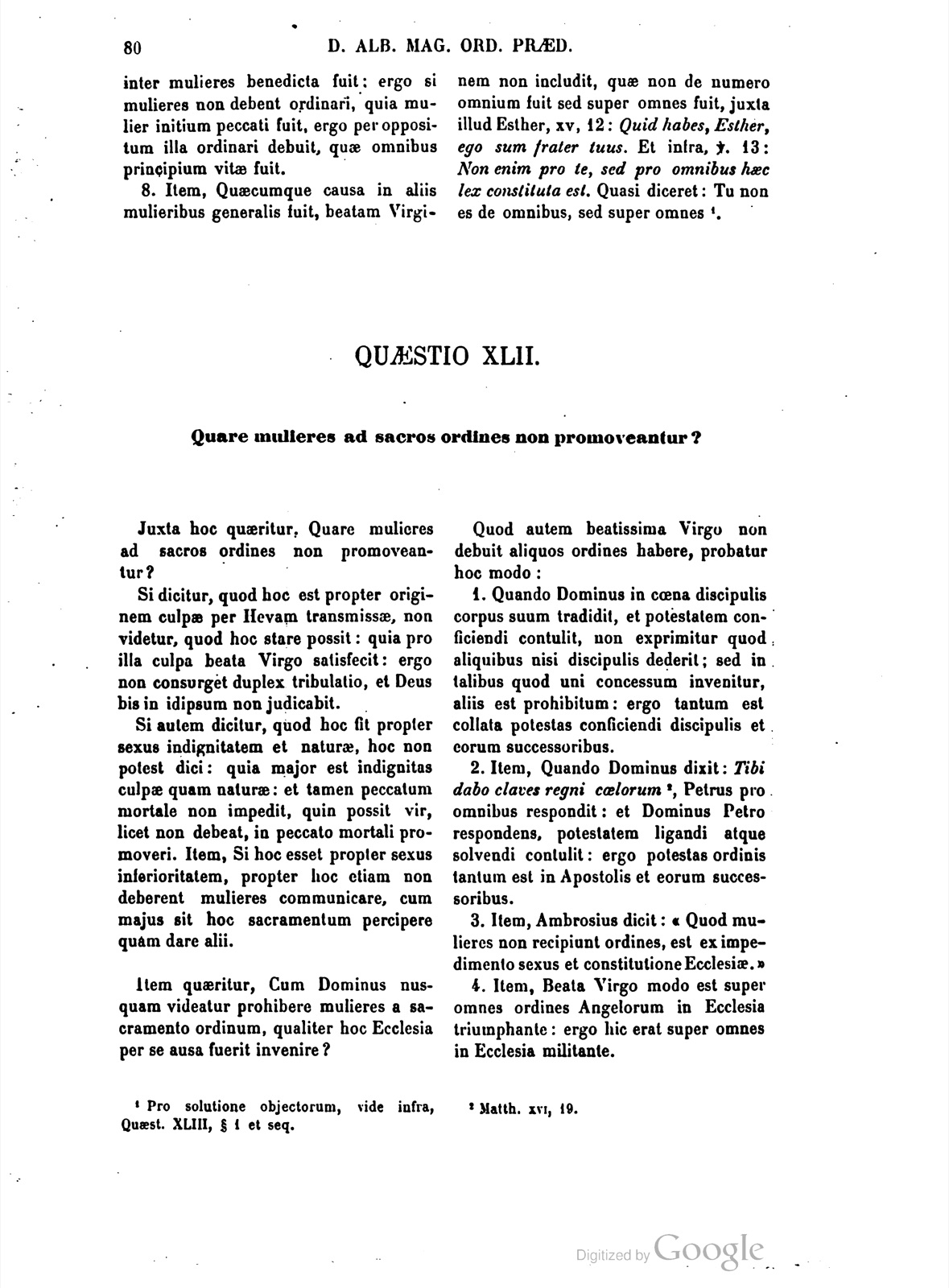
2. Item, Quando Dominus dixit: Tibi dabo claves regni coelorum 1, Petrus pro omnibus respondit: et Dominus Petro respondens, potestatem ligandi atque solvendi contulit: ergo potestas ordinis tantum est in Apostolis et eorum successoribus.
3. Item, Ambrosius dicit: « Quod mulieres non recipiunt ordines, est ex impedimento sexus et constitutione Ecclesiae. »
4. Item, Beata Virgo modo est super omnes ordines Angelorum in Ecclesia triumphante: ergo hic erat super omnes in Ecclesia militante.
5. Item, Omnes ordines Ecclesiae sunt in ministerium: unde etiam pastores nominantur, quibus per Prophetam dicitur: Constitui te hodie super gentes et regna 2. Beata autem Virgo non est assumpta in ministerium a Domino, sed in consortium et adjutorium, juxta illud: Faciamus ei adjutorium simile sibi 3. Sed si hoc est, non debuit aliquem habere ordinem: summus enim in ordine Ecclesiae Papa est, qui est vicarius Jesu Christi. Beata autem Virgo non est vicaria, sed coadjutrix et socia, particeps in regno quae fuit particeps passionum pro genere humano, quando omnibus ministris fugientibus et discipulis, sola sub cruce perstitit, et vulnera quae Christus corpore, ipsa corde suscepit: unde et gladius tunc ipsius animam pertransivit 4.
2. Likewise, when the Lord said, I will give to you the keys of the kingdom of heaven 1, Peter responded on behalf of all; and the Lord, responding to Peter, conferred the power of binding and loosing. Therefore the power of order is only in the Apostles and their successors.
3. Likewise, Ambrose says: "That women do not receive orders is from the impediment of sex and the constitution of the Church."
4. Likewise, the blessed Virgin now is above all the orders of Angels in the Church triumphant. Therefore here she was above all in the Church militant.
5. Likewise, all orders of the Church are for ministry; hence they are also named pastors, to whom it is said through the Prophet: I have appointed you today over nations and kingdoms 2. But the blessed Virgin was not assumed by the Lord into ministry, but into fellowship and help, according to that saying: Let us make a helper like himself for him 3. But if this is so, she ought not to have had any order: for the highest in the order of the Church is the Pope, who is the vicar of Jesus Christ. But the blessed Virgin is not vicar, but co-helper and companion, sharing in the kingdom, she who was a sharer of sufferings for the human race, when, all ministers and disciples fleeing, she alone stood beneath the cross, and the wounds that Christ received in body, she received in heart. Hence also at that time the sword passed through her own soul 4.
Notes
- Matthew 16:19. (Matth. XVI, 19.) ↩
- Jeremiah 1:10. (Jerem. I, 10.) ↩
- Genesis 2:18. (Genes. II, 18.) ↩
- For the solution of the objections, see below after Question XLIII, § 1 and following. (Pro solutione objectorum, vide infra post Quaest. XLIII, § 1 et seq.) ↩
If a page does not appear, its photograph has not been uploaded yet.