Works › The Mariale: Questions on “Missus est”
Volume 37 · pp. 79–80
Question XLI. Whether the blessed Virgin's fullness completes that grace which is conferred under the sacrament of Order?
A marker with ≈ is an approximate page boundary, placed by measure of the text; the page photographs remain the authority. In the paired views, clicking a page marker brings that page into view.
QUAESTIO XLI. Utrum B. Virginis plenitudo compleat illam gratiam quae confertur sub Ordinis sacramento?
Post hoc quaeritur de sacramento Ordinum, Utrum ista beatissimae Virginis plenitudo comprehendat et illam gratiam quae confertur sub ordinum sacramento?
Et videtur, quod sic.
1. Ordo enim est ad multiplicationem fidelium spiritualem: sed multiplicatio spiritualis pertinet ad matrem spiritualem: beata autem Virgo est spiritualis mater omnium fidelium: ergo ipsa debuit habere Ordinis sacramentum.
2. Item, Penes Ordines distinguuntur in Ecclesia dignitates, ut patet in Papa, Archiepiscopis, etc.: sed beatissima Virgo in Ecclesia continet summam dignitatem: ergo et supremum habuit ordinem.
3. Item, Ecclesiastica hierarchia est ad exemplar coelestis hierarchiae formata: sed in coelesti hierarchia, ut dicit Dyonisius, omnes superiores habent proprietates inferiorum et excellentius: ergo in Ecclesiastica hierarchia sic erit: sed beata Virgo in Ecclesiastica hierarchia fuit suprema et dignissima persona: ergo habebit dignitates et proprietates inferiorum: et sic habebit omnes ordines.
4. Item, Character ordinum est character excellentiae: ergo potissime inerit ei quae omnes creaturas excellit dignitate.
5. Item, Apostolus: Omnis anima potestatibus sublimioribus subdita sit 1. Sed beata Virgo nulli potestati humanae subdita tenebatur esse. Ergo fuit suprema ordine et dignitate.
QUESTION XLI. Whether the blessed Virgin's fullness completes that grace which is conferred under the sacrament of Order?
After this it is asked concerning the sacrament of Orders, whether that fullness of the most blessed Virgin comprehends also that grace which is conferred under the sacrament of orders.
And it seems that it does.
1. For order is for the spiritual multiplication of the faithful. But spiritual multiplication pertains to a spiritual mother. Now the blessed Virgin is the spiritual mother of all the faithful. Therefore she ought to have had the sacrament of Order.
2. Likewise, dignities in the Church are distinguished according to Orders, as is clear in the Pope, Archbishops, and so forth. But the most blessed Virgin contains the highest dignity in the Church. Therefore she also had the highest order.
3. Likewise, the ecclesiastical hierarchy is formed after the exemplar of the heavenly hierarchy. But in the heavenly hierarchy, as Dionysius says, all superiors have the properties of inferiors, and more excellently. Therefore it will be so in the ecclesiastical hierarchy. But the blessed Virgin was the highest and most worthy person in the ecclesiastical hierarchy. Therefore she will have the dignities and properties of inferiors; and thus she will have all orders.
4. Likewise, the character of orders is a character of excellence. Therefore it will belong especially to her who excels all creatures in dignity.
5. Likewise, the Apostle says: Let every soul be subject to higher powers 1. But the blessed Virgin was bound to be subject to no human power. Therefore she was highest in order and dignity.
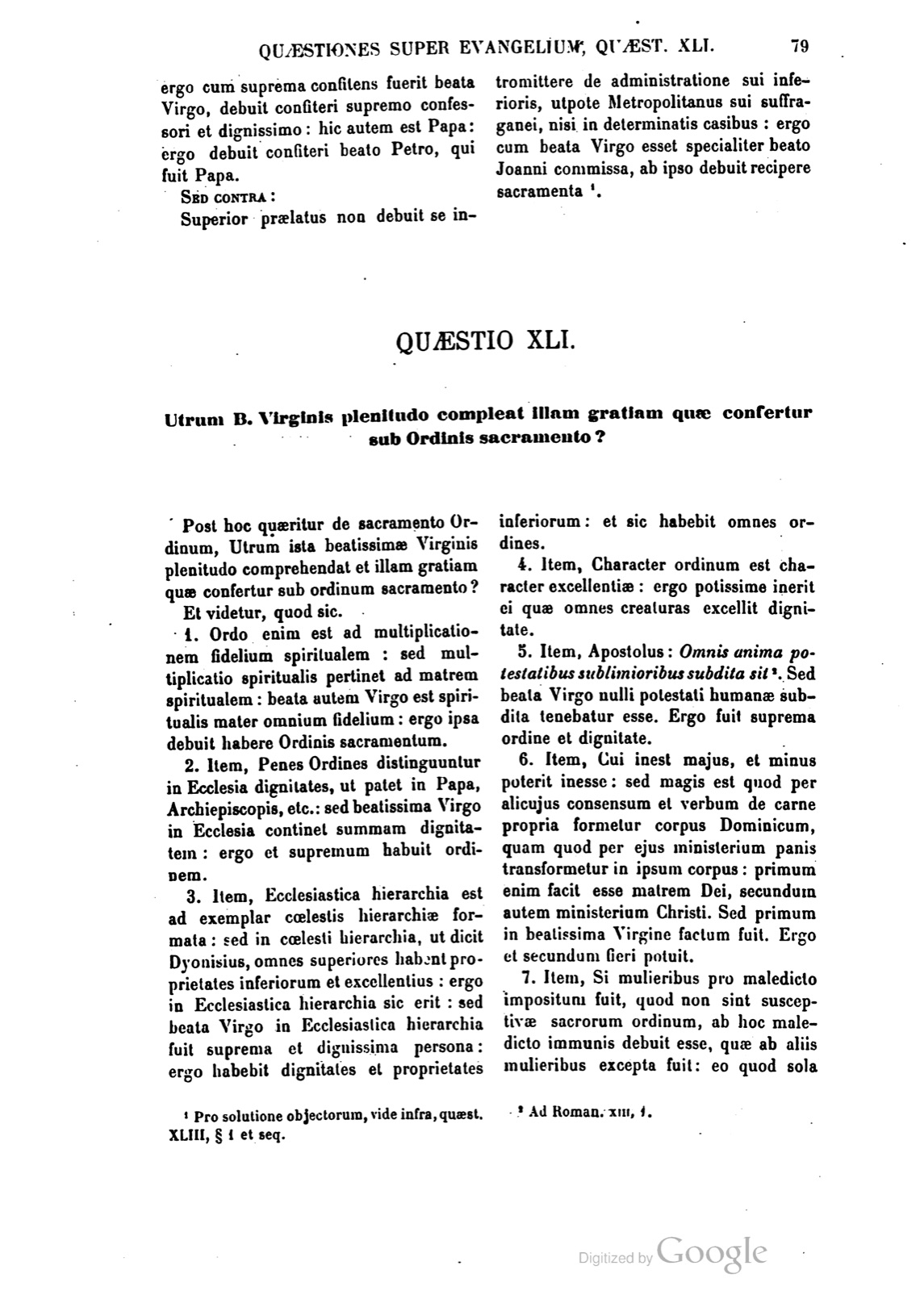
6. Item, Cui inest majus, et minus poterit inesse: sed magis est quod per alicujus consensum et verbum de carne propria formetur corpus Dominicum, quam quod per ejus ministerium panis transformetur in ipsum corpus: primum enim facit esse matrem Dei, secundum autem ministerium Christi. Sed primum in beatissima Virgine factum fuit. Ergo et secundum fieri potuit.
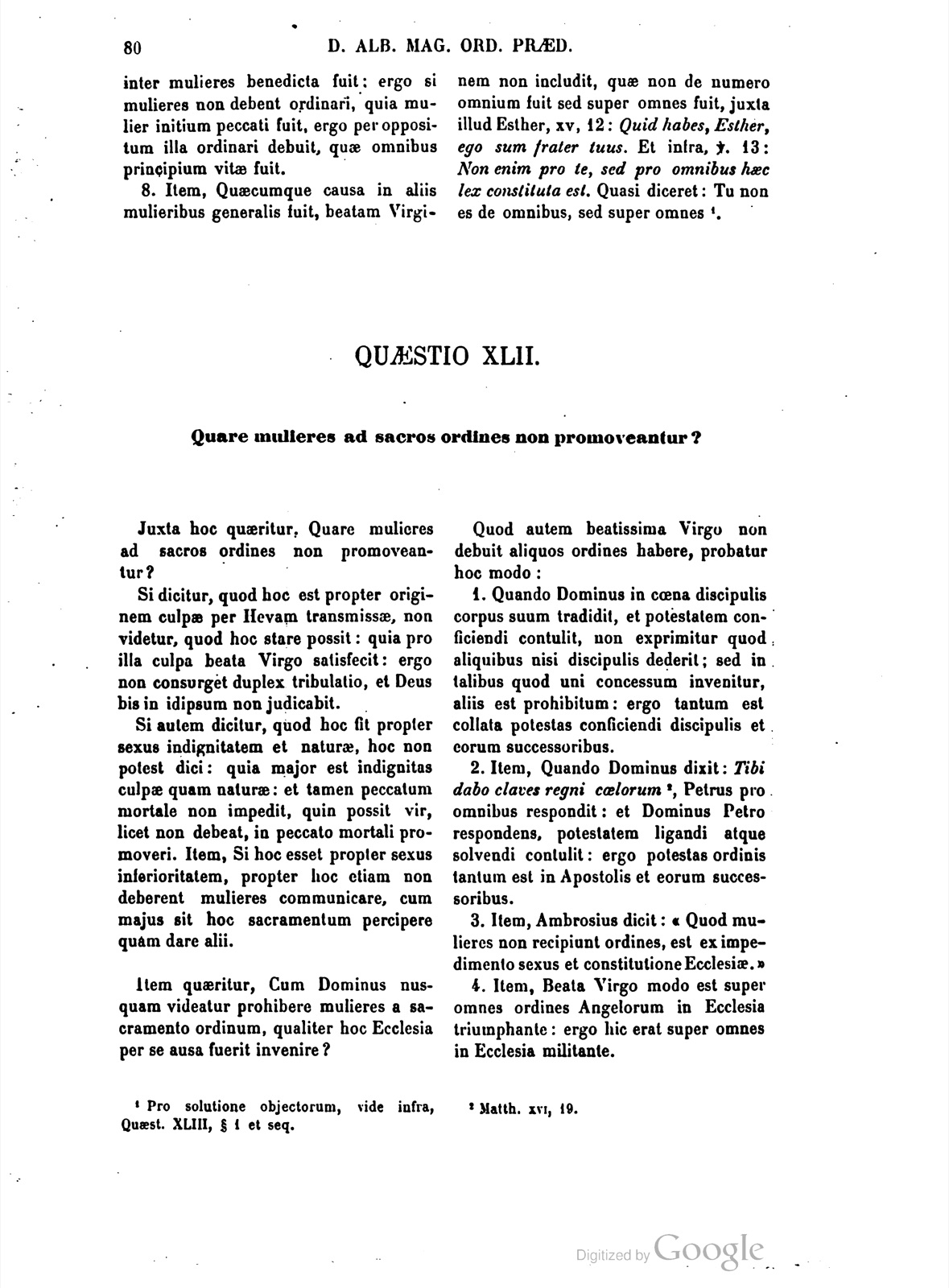
7. Item, Si mulieribus pro maledicto impositum fuit, quod non sint susceptivae sacrorum ordinum, ab hoc maledicto immunis debuit esse, quae ab aliis mulieribus excepta fuit: eo quod sola inter mulieres benedicta fuit: ergo si mulieres non debent ordinari, quia mulier initium peccati fuit, ergo per oppositum illa ordinari debuit, quae omnibus principium vitae fuit.
8. Item, Quaecumque causa in aliis mulieribus generalis fuit, beatam Virginem non includit, quae non de numero omnium fuit sed super omnes fuit, juxta illud Esther, XV, 12: Quid habes, Esther, ego sum frater tuus. Et infra, v. 13: Non enim pro te, sed pro omnibus haec lex constituta est. Quasi diceret: Tu non es de omnibus, sed super omnes 2.
6. Likewise, the one in whom the greater is present will also be capable of having the lesser. But it is greater that by someone's consent and word the Lord's body be formed from her own flesh, than that through her ministry bread be transformed into that body itself. For the first makes one to be the mother of God, but the second makes one a minister of Christ. But the first was done in the most blessed Virgin. Therefore the second also could have been done.
7. Likewise, if it was imposed on women as a curse that they should not be receptive of sacred orders, she ought to have been immune from this curse, who was excepted from other women, in that she alone among women was blessed. Therefore if women ought not to be ordained because woman was the beginning of sin, then by opposition she ought to have been ordained who was the beginning of life for all.
8. Likewise, whatever cause was general in other women does not include the blessed Virgin, who was not of the number of all but was above all, according to that saying in Esther 15:12: What is it, Esther? I am your brother. And below, verse 13: For this law has been established not for you, but for all. As if he said: You are not of all, but above all 2.
Notes
- To the Romans 13:1. (Ad Roman. XIII, 1.) ↩
- For the solution of the objections, see below, Question XLIII, § 1 and following. (Pro solutione objectorum, vide infra, Quaest. XLIII, § 1 et seq.) ↩
If a page does not appear, its photograph has not been uploaded yet.