Works › The Mariale: Questions on “Missus est”
Volume 37 · pp. 73–74
Question XXXIV, remainder
A marker with ≈ is an approximate page boundary, placed by measure of the text; the page photographs remain the authority. In the paired views, clicking a page marker brings that page into view.
Stephanus plenus gratia et fortitudine 1, id est, fide et operibus. Alias enim mala esset copulatio inter fortitudinem et gratiam, et inter bona opera et eleemosynam, nisi hoc quod est operibus bonis, supponeret pro omnibus bonis interioribus per charitatem, eleemosyna pro exterioribus bonis per fidem operantem per dilectionem. Sic igitur differunt istae plenitudines substantialiter et originaliter. Est enim prima istarum plenitudinum quasi fontis plenitudo, secunda quasi plenitudo fluminis, tertia quasi plenitudo rivi a flumine descendentis. De prima, Esther, XI, 10: Fons parvus crevit in fluvium maximum. Beatissima igitur Virgo Maria dicitur fons propter gratiarum abundantiam, parvus propter humilitatis excellentiam, et propter hoc crevit in fluvium maximum quando genuit Dominum nostrum Jesum Christum, qui dicit in Ecclesiastico, XXIV, 41: Sicut aquaeductus exivi de paradiso, scilicet Dei: Et ab isto flumine descendit plenitudo sanctorum quasi quidam rivus, quia de plenitudine ejus nos omnes accepimus 2. Prima istarum plenitudinum omnium privat vacuitatem, secunda negat particularitatem, tertia importat redundantiam. Plenitudo beatissimae Virginis privat vacuitatem: quamdiu enim vas potest recipere aliquid, tamdiu habet aliquid de vacuitate. Unde omnis creatura alia habet aliquid vacuitatis: quia majorem gratiam potest recipere. Ipsa autem sola gratia plena, quia majorem gratiam non potuit habere: nisi enim ipsa divinitati uniretur, major gratia non potuit intelligi, quam quod de ipsa acciperetur quod uniretur: hoc enim est, nisi ipsa est Deus, non posset major gratia intelligi, quam quod ipsa esset Dei mater. Unde Bernardus: « Legimus in Actibus Apostolorum, et Stephanum plenum gratia et fortitudine, et Apostolos fuisse repletos Spiritu sancto, sed longe dissimiliter a Maria. Alioquin nec in illo plenitudo divinitatis corporaliter, quemadmodum in Maria habitavit: ecce illi conceperunt de Spiritu sancto quo modo Maria 3. » Et sic plenitudo beatissimae Virginis privat vacuitatem, plenitudo Christi privat particularitatem: non enim ad mensuram dedit Deus Spiritum sanctum. Glossa: « Non particulariter, neque per subdivisiones, sed generaliter et universaliter. »
Stephen was full of grace and fortitude 1, that is, of faith and works. For otherwise the joining would be bad between fortitude and grace, and between good works and alms, unless this expression, good works, stood for all interior goods through charity, and alms for exterior goods through faith working through love. Therefore these fullnesses differ substantially and originally in this way. For the first of those fullnesses is as it were the fullness of a fountain, the second as it were the fullness of a river, the third as it were the fullness of a stream descending from a river. Concerning the first, Esther 11:10 says: A little fountain grew into a very great river. Therefore the most blessed Virgin Mary is called a fountain because of the abundance of graces, little because of the excellence of humility, and because of this she grew into a very great river when she bore our Lord Jesus Christ, who says in Ecclesiasticus 24:41: As an aqueduct I came forth from paradise, namely from God's paradise. And from that river the fullness of the saints descended as a certain stream, because from his fullness we all have received 2. The first of these fullnesses removes every emptiness; the second denies partiality; the third imports overflowing. The fullness of the most blessed Virgin removes emptiness: for as long as a vessel can receive something, so long it has something of emptiness. Hence every other creature has something of emptiness, because it can receive greater grace. But she alone is full of grace, because she could not have greater grace: for unless she herself were united to the divinity, no greater grace could be understood than that from her there should be received what would be united. For this is the matter: unless she herself is God, no greater grace could be understood than that she herself should be the mother of God. Hence Bernard says: "We read in the Acts of the Apostles both that Stephen was full of grace and fortitude, and that the Apostles were filled with the Holy Spirit, but in a manner far unlike Mary. Otherwise neither did the fullness of the divinity dwell bodily in him in the way in which it dwelt in Mary: behold, they conceived of the Holy Spirit in what way Mary did 3." And thus the fullness of the most blessed Virgin removes emptiness; the fullness of Christ removes partiality, for God did not give the Holy Spirit by measure. The Gloss says: "Not partially, nor by subdivisions, but generally and universally."
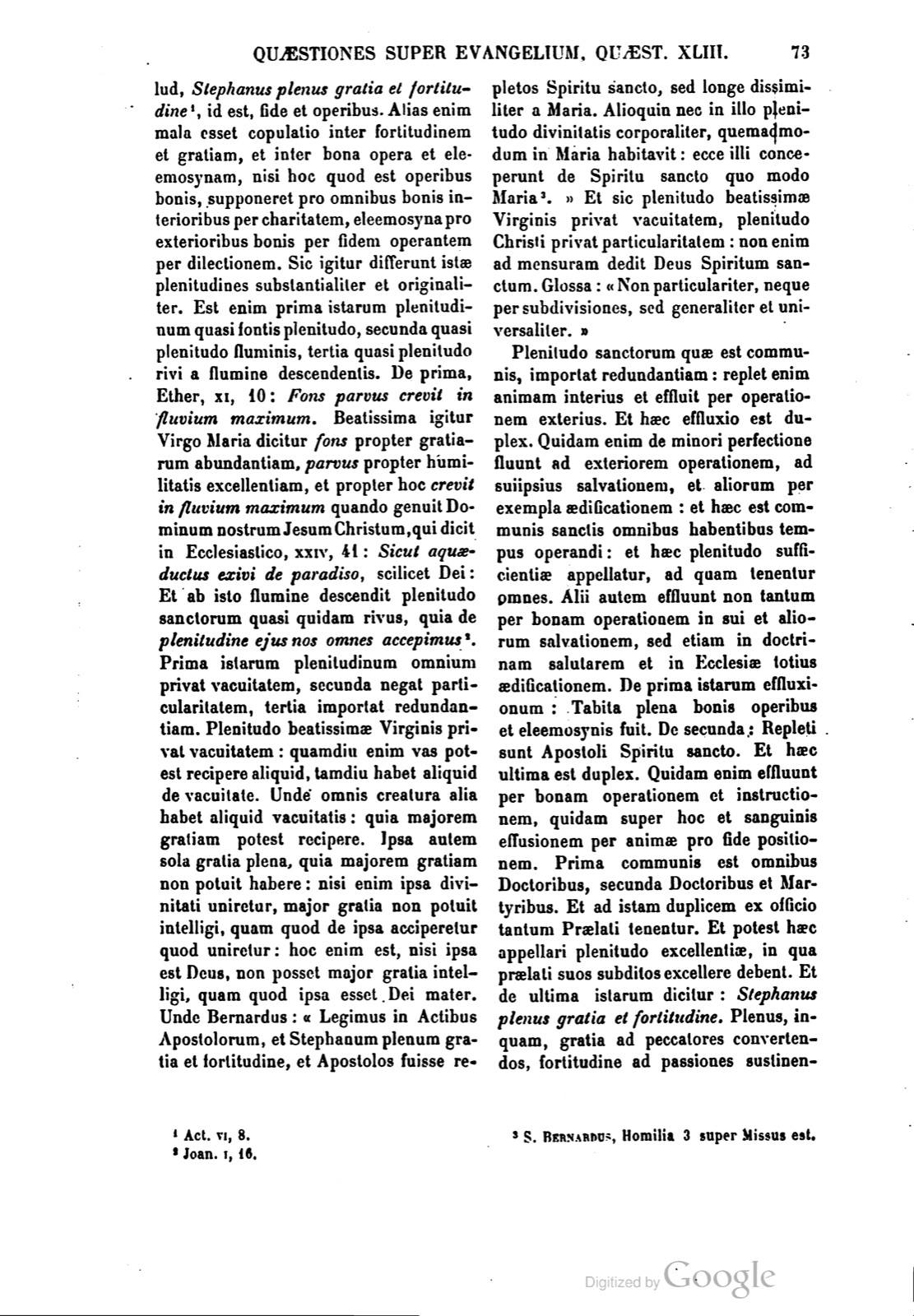
Plenitudo sanctorum quae est communis, importat redundantiam: replet enim animam interius et effluit per operationem exterius. Et haec effluxio est duplex. Quidam enim de minori perfectione fluunt ad exteriorem operationem, ad suiipsius salvationem, et aliorum per exempla aedificationem: et haec est communis sanctis omnibus habentibus tempus operandi: et haec plenitudo sufficientiae appellatur, ad quam tenentur omnes. Alii autem effluunt non tantum per bonam operationem in sui et aliorum salvationem, sed etiam in doctrinam salutarem et in Ecclesiae totius aedificationem. De prima istarum effluxionum: Tabita plena bonis operibus et eleemosynis fuit. De secunda: Repleti sunt Apostoli Spiritu sancto. Et haec ultima est duplex. Quidam enim effluunt per bonam operationem et instructionem, quidam super hoc et sanguinis effusionem per animae pro fide positionem. Prima communis est omnibus Doctoribus, secunda Doctoribus et Martyribus. Et ad istam duplicem ex officio tantum Praelati tenentur. Et potest haec appellari plenitudo excellentiae, in qua praelati suos subditos excellere debent. Et de ultima istarum dicitur: Stephanus plenus gratia et fortitudine. Plenus, inquam, gratia ad peccatores convertendos, fortitudine ad passiones sustinendas.
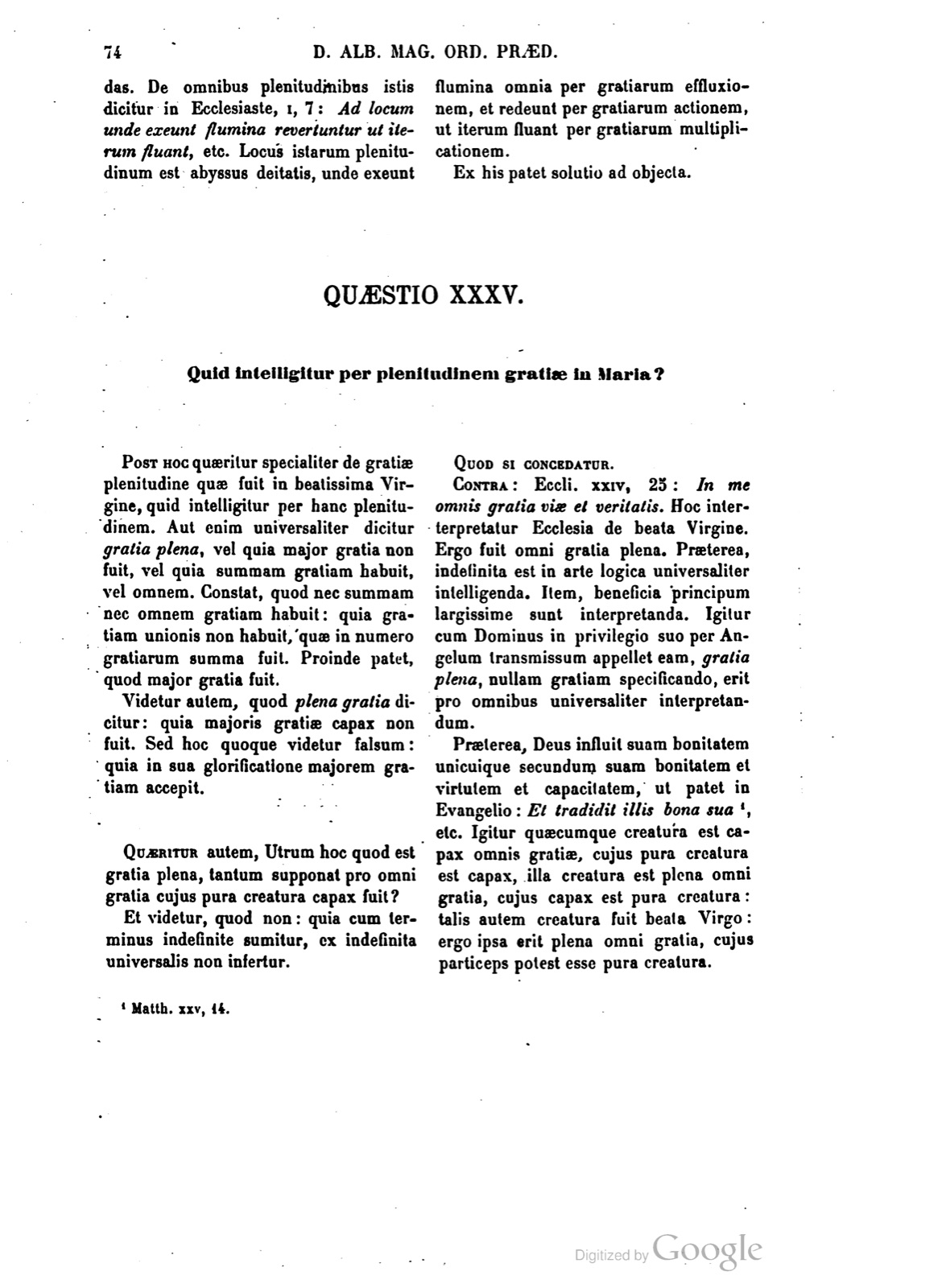
De omnibus plenitudinibus istis dicitur in Ecclesiaste, I, 7: Ad locum unde exeunt flumina revertuntur ut iterum fluant, etc. Locus istarum plenitudinum est abyssus deitatis, unde exeunt flumina omnia per gratiarum effluxionem, et redeunt per gratiarum actionem, ut iterum fluant per gratiarum multiplicationem.
Ex his patet solutio ad objecta.
The fullness of the saints, which is common, imports overflowing: for it fills the soul inwardly and flows outwardly through operation. And this outflow is twofold. For some from a lesser perfection flow out to exterior operation, to the salvation of themselves and to the edification of others through examples; and this is common to all saints who have time for working, and this is called the fullness of sufficiency, to which all are bound. But others flow out not only through good operation unto the salvation of themselves and others, but also unto saving doctrine and the edification of the whole Church. Concerning the first of these outflows: Tabitha was full of good works and alms. Concerning the second: The Apostles were filled with the Holy Spirit. And this last is twofold. For some flow out through good operation and instruction, some beyond this also through the pouring out of blood by laying down the soul for the faith. The first is common to all Doctors; the second to Doctors and Martyrs. And to this double fullness, by office, Prelates alone are bound. And this can be called the fullness of excellence, in which prelates ought to excel their subjects. And concerning the last of these it is said: Stephen full of grace and fortitude. Full, I say, of grace for converting sinners, of fortitude for sustaining sufferings.
Concerning all these fullnesses it is said in Ecclesiastes 1:7: To the place from which the rivers go forth they return, that they may flow again, and so forth. The place of those fullnesses is the abyss of deity, from which all rivers go forth through an outflow of graces, and they return through thanksgiving, that they may flow again through the multiplication of graces.
From these things the solution to the objections is clear.
If a page does not appear, its photograph has not been uploaded yet.