Works › The Mariale: Questions on “Missus est”
Volume 37 · pp. 68–69
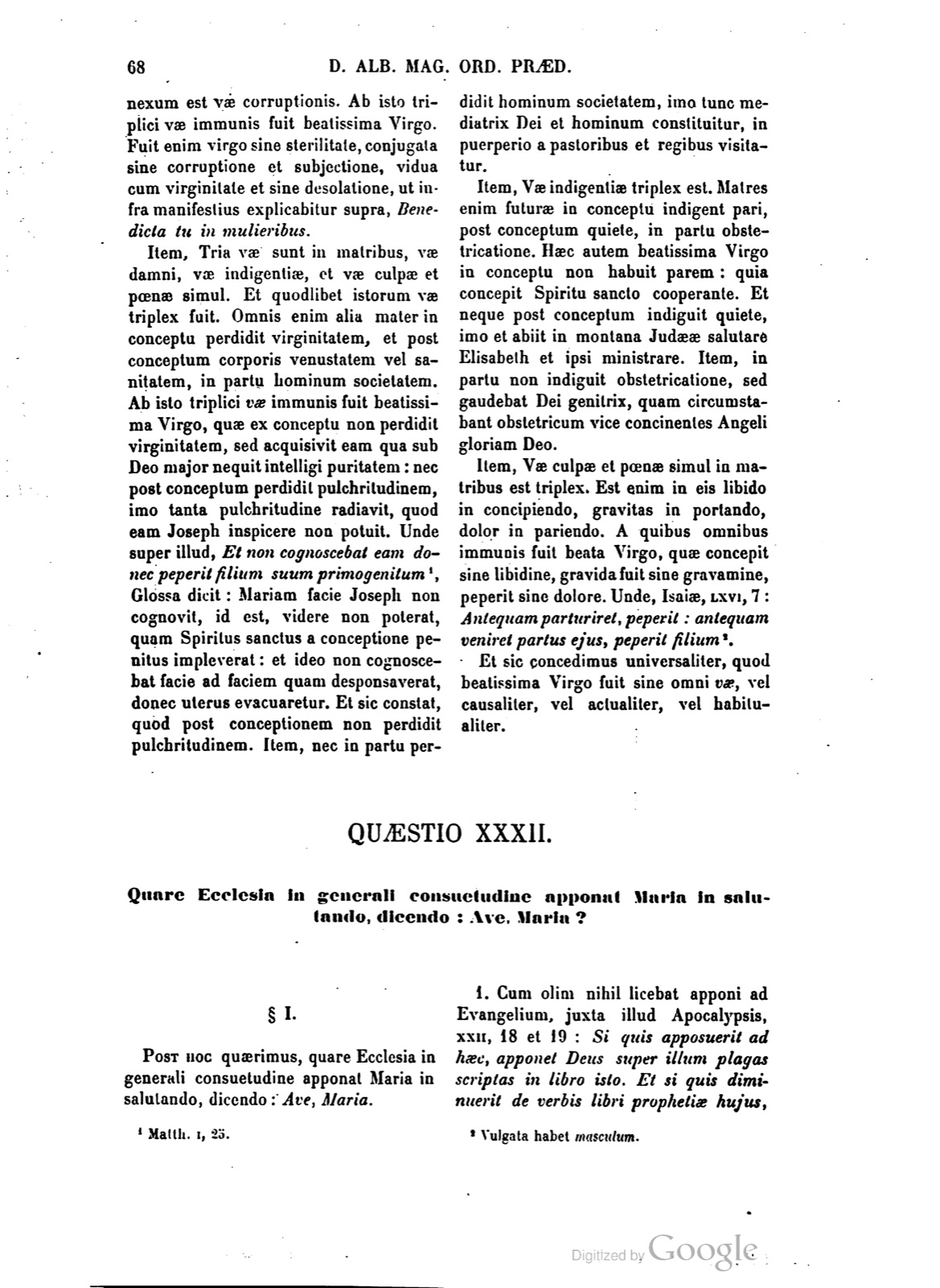
Question XXXII. Why in general custom the Church adds Mary in greeting, saying: Hail, Mary?
A marker with ≈ is an approximate page boundary, placed by measure of the text; the page photographs remain the authority. In the paired views, clicking a page marker brings that page into view.
QUAESTIO XXXII. Quare Ecclesia in generali consuetudine apponat Maria in salutando, dicendo: Ave, Maria?
§ I. Post hoc quaerimus, quare Ecclesia in generali consuetudine apponat Maria in salutando, dicendo: Ave, Maria.
1. Cum olim nihil licebat apponi ad Evangelium, juxta illud Apocalypsis, XXII, 18 et 19: Si quis apposuerit ad haec, apponet Deus super illum plagas scriptas in libro isto. Et si quis diminuerit de verbis libri prophetiae hujus, auferet Deus partem ejus de libro vitae. Et simile habetur in Deuteronomio 1.
2. Item, Damascenus: «Omnia quae tradita sunt per legem, Prophetas, Apostolos et Evangelistas, suscipimus et veneramur et cognoscimus, nihil ultra hoc inquirentes.» Ergo cum Evangelista non apposuerit Maria, nos non debemus apponere.
3. Item, Angelus dimisit vel propter causam, vel sine causa. Si sine causa: ergo male fecit dimittendo. Si autem propter causam omisit: ergo nos male facimus apponendo. Videtur autem, quod Angelus male omisit: quia propria nomina in salutationibus apponere est consuetudo.
4. Item, In collatione magnarum dignitatum solet fieri mutatio nominum, ut patet in Papa. Unde Dominus ad Petrum: Tu es Simon, filius Joan: tu vocaberis Cephas 2. Videtur igitur, quod in ista collatione summae dignitatis collatae beatissimae Virgini, nomen ejus digne debuit mutari.
§ II. Ad hoc dicimus, quod ad Evangelium apponere, est falsa veris componere vel commiscere, vel contraria his quae in Evangelio sunt praedicare: unde Apostolus, ad Galat. I, 8: Sed licet nos, aut Angelus de coelo evangelizet vobis praeterquam quod evangelizavimus vobis, anathema sit. Et sic intelliguntur aliae auctoritates consimiles.
QUESTION XXXII. Why in general custom the Church adds Mary in greeting, saying: Hail, Mary?
§ I. After this we ask why in general custom the Church adds Mary in greeting, saying: Hail, Mary.
1. Since once nothing was permitted to be added to the Gospel, according to that saying of Apocalypse 22:18 and 19: If anyone shall add to these things, God will add upon him the plagues written in this book. And if anyone shall diminish from the words of the prophecy of this book, God will take away his part from the book of life. And something similar is found in Deuteronomy 1.
2. Likewise, Damascene says: "All things that have been handed down through the law, Prophets, Apostles, and Evangelists, we receive and venerate and know, seeking nothing beyond this." Therefore, since the Evangelist did not add Mary, we ought not to add it.
3. Likewise, the Angel omitted it either for a cause or without a cause. If without a cause, then he did badly in omitting it. But if he omitted it because of a cause, then we do badly by adding it. It seems, however, that the Angel omitted it badly, because it is customary to add proper names in greetings.
4. Likewise, in the conferring of great dignities there is usually a change of names, as is clear in the Pope. Hence the Lord said to Peter: You are Simon, son of John; you shall be called Cephas 2. Therefore it seems that in that conferring of the highest dignity conferred on the most blessed Virgin, her name ought worthily to have been changed.
§ II. To this we say that to add to the Gospel is to compose or mix false things with true things, or to preach things contrary to those that are in the Gospel. Hence the Apostle, Galatians 1:8: But even if we, or an Angel from heaven, should evangelize to you beyond what we have evangelized to you, let him be anathema. And thus other similar authorities are understood.
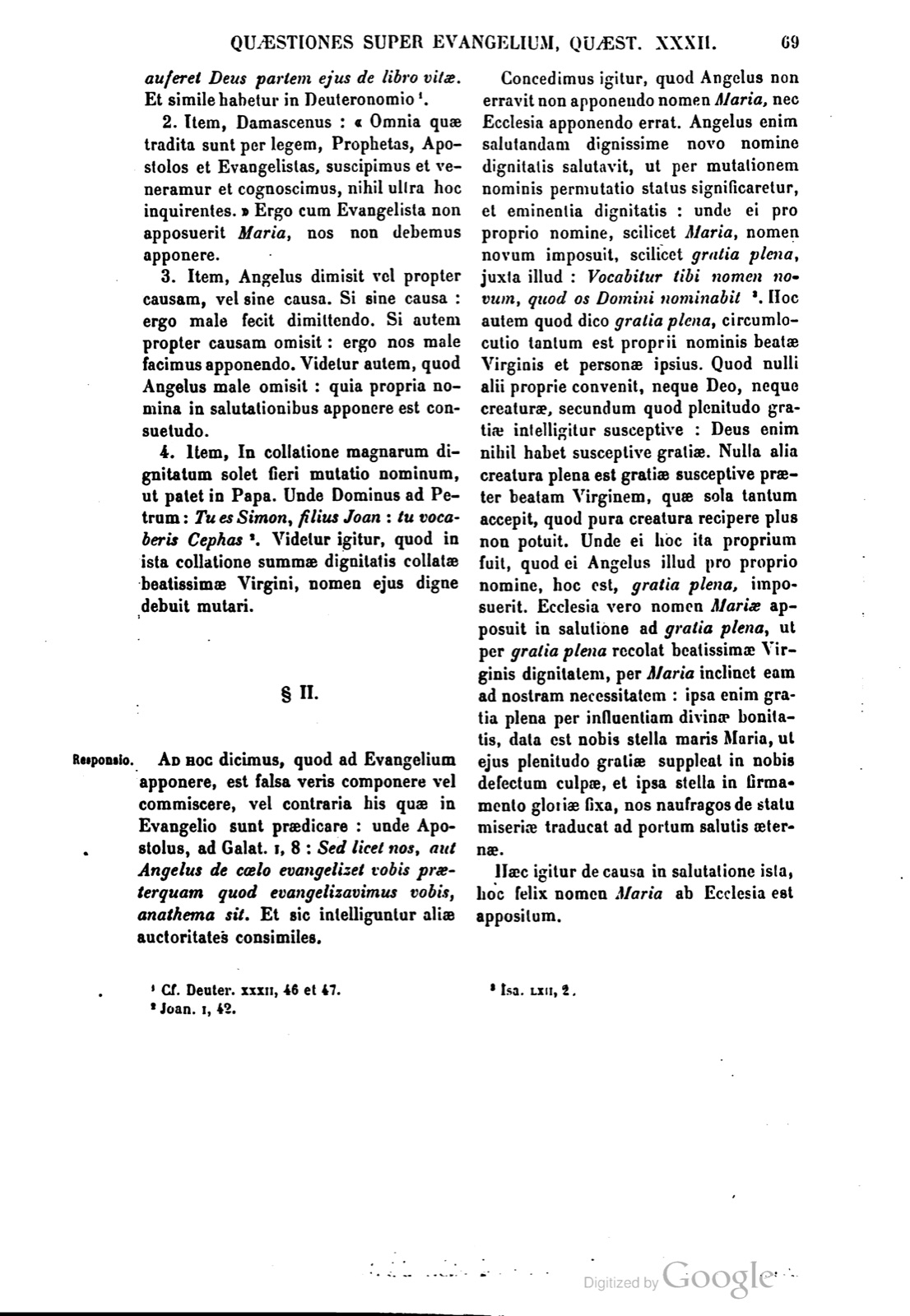
Concedimus igitur, quod Angelus non erravit non apponendo nomen Maria, nec Ecclesia apponendo errat. Angelus enim salutandam dignissime novo nomine dignitatis salutavit, ut per mutationem nominis permutatio status significaretur, et eminentia dignitatis: unde ei pro proprio nomine, scilicet Maria, nomen novum imposuit, scilicet gratia plena, juxta illud: Vocabitur tibi nomen novum, quod os Domini nominabit 3. Hoc autem quod dico gratia plena, circumlocutio tantum est proprii nominis beatae Virginis et personae ipsius. Quod nulli alii proprie convenit, neque Deo, neque creaturae, secundum quod plenitudo gratiae intelligitur susceptive: Deus enim nihil habet susceptive gratiae. Nulla alia creatura plena est gratiae susceptive praeter beatam Virginem, quae sola tantum accepit, quod pura creatura recipere plus non potuit. Unde ei hoc ita proprium fuit, quod ei Angelus illud pro proprio nomine, hoc est, gratia plena, imposuerit. Ecclesia vero nomen Mariae apposuit in salutatione ad gratia plena, ut per gratia plena recolat beatissimae Virginis dignitatem, per Maria inclinet eam ad nostram necessitatem: ipsa enim gratia plena per influentiam divinae bonitatis, data est nobis stella maris Maria, ut ejus plenitudo gratiae suppleat in nobis defectum culpae, et ipsa stella in firmamento gloriae fixa, nos naufragos de statu miseriae traducat ad portum salutis aeternae.
Haec igitur de causa in salutatione ista, hoc felix nomen Maria ab Ecclesia est appositum.
Therefore we concede that the Angel did not err by not adding the name Mary, nor does the Church err by adding it. For the Angel most worthily greeted the one to be greeted with a new name of dignity, so that by the change of name a change of state and eminence of dignity might be signified. Hence instead of her proper name, namely Mary, he imposed upon her a new name, namely full of grace, according to that saying: A new name shall be called to you, which the mouth of the Lord shall name 3. But what I say, full of grace, is only a circumlocution of the proper name of the blessed Virgin and of her own person. This properly fits no other, neither God nor creature, according as fullness of grace is understood receptively; for God has nothing of grace receptively. No other creature is full of grace receptively except the blessed Virgin, who alone received so much that a pure creature could not receive more. Hence this was so proper to her that the Angel imposed it upon her as a proper name, that is, full of grace. But the Church added the name Mary in the greeting to full of grace, so that through full of grace it may recall the dignity of the most blessed Virgin, and through Mary it may incline her to our need; for she herself, full of grace through the influence of divine goodness, was given to us as Mary, star of the sea, so that the fullness of her grace might supply in us the defect of fault, and she herself, the star fixed in the firmament of glory, might carry us shipwrecked persons from the state of misery to the harbor of eternal salvation.
Therefore for this cause, in that greeting, this happy name Mary is added by the Church.
If a page does not appear, its photograph has not been uploaded yet.