Works › The Mariale: Questions on “Missus est”
Volume 37 · p. 70
Question XXXIII. Whether the Blessed Virgin is fittingly called full of grace?
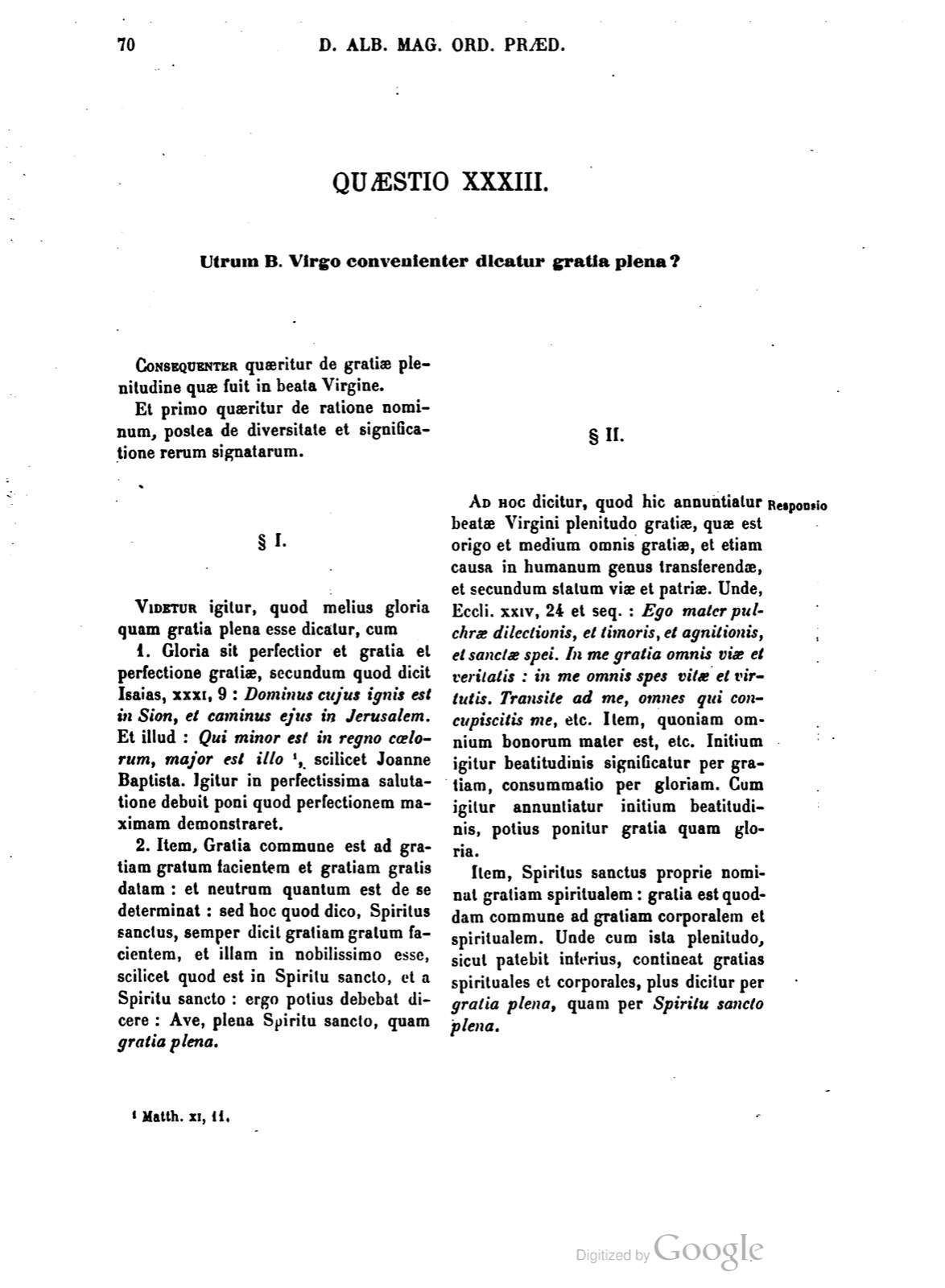
QUAESTIO XXXIII. Utrum B. Virgo convenienter dicatur gratia plena?
Consequenter quaeritur de gratiae plenitudine quae fuit in beata Virgine. Et primo quaeritur de ratione nominum, postea de diversitate et significatione rerum signatarum.
§ I. Videtur igitur, quod melius gloria quam gratia plena esse dicatur, cum 1. Gloria sit perfectior et gratia et perfectione gratiae, secundum quod dicit Isaias, XXXI, 9: Dominus cujus ignis est in Sion, et caminus ejus in Jerusalem. Et illud: Qui minor est in regno caelorum, major est illo 1, scilicet Joanne Baptista. Igitur in perfectissima salutatione debuit poni quod perfectionem maximam demonstraret.
2. Item, Gratia commune est ad gratiam gratum facientem et gratiam gratis datam: et neutrum quantum est de se determinat: sed hoc quod dico, Spiritus sanctus, semper dicit gratiam gratum facientem, et illam in nobilissimo esse, scilicet quod est in Spiritu sancto, et a Spiritu sancto: ergo potius debebat dicere: Ave, plena Spiritu sancto, quam gratia plena.
§ II. Ad hoc dicitur, quod hic annuntiatur beatae Virgini plenitudo gratiae, quae est origo et medium omnis gratiae, et etiam causa in humanum genus transferendae, et secundum statum viae et patriae. Unde, Eccli. XXIV, 24 et seq.: Ego mater pulchrae dilectionis, et timoris, et agnitionis, et sanctae spei. In me gratia omnis viae et veritatis: in me omnis spes vitae et virtutis. Transite ad me, omnes qui concupiscitis me, etc. Item, quoniam omnium bonorum mater est, etc. Initium igitur beatitudinis significatur per gratiam, consummatio per gloriam. Cum igitur annuntiatur initium beatitudinis, potius ponitur gratia quam gloria.
Item, Spiritus sanctus proprie nominat gratiam spiritualem: gratia est quoddam commune ad gratiam corporalem et spiritualem. Unde cum ista plenitudo, sicut patebit inferius, contineat gratias spirituales et corporales, plus dicitur per gratia plena, quam per Spiritu sancto plena.
QUESTION XXXIII. Whether the Blessed Virgin is fittingly called full of grace?
Consequently inquiry is made concerning the fullness of grace that was in the blessed Virgin. And first inquiry is made concerning the account of the names, afterwards concerning the diversity and signification of the things signified.
§ I. Therefore it seems that she is better said to be full of glory than full of grace, since 1. Glory is more perfect than grace and than the perfection of grace, according as Isaiah 31:9 says: The Lord, whose fire is in Zion and whose furnace is in Jerusalem. And that saying: He who is lesser in the kingdom of heaven is greater than he 1, namely John the Baptist. Therefore in the most perfect greeting there ought to have been placed what would demonstrate the greatest perfection.
2. Likewise, grace is common to grace making pleasing and grace freely given, and neither, so far as it is of itself, determines the matter. But what I say, Holy Spirit, always says grace making pleasing, and that it is in the noblest thing, namely what is in the Holy Spirit and from the Holy Spirit. Therefore he ought rather to have said: Hail, full of the Holy Spirit, than full of grace.
§ II. To this it is said that here there is announced to the blessed Virgin the fullness of grace, which is the origin and medium of every grace, and also the cause of grace to be transferred into the human race, both according to the state of the way and of the homeland. Hence Ecclesiasticus 24:24 and following: I am the mother of beautiful love, and of fear, and of knowledge, and of holy hope. In me is every grace of way and truth; in me every hope of life and virtue. Come over to me, all who desire me, etc. Likewise, because she is the mother of all goods, etc. Therefore the beginning of beatitude is signified through grace, the consummation through glory. Therefore, since the beginning of beatitude is announced, grace rather than glory is placed.
Likewise, Holy Spirit properly names spiritual grace; grace is something common to bodily and spiritual grace. Hence since that fullness, as will be clear below, contains spiritual and bodily graces, more is said through full of grace than through full of the Holy Spirit.
Notes
- Matthew 11:11. (Matth. XI, 11.) ↩
If a page does not appear, its photograph has not been uploaded yet.