Works › The Mariale: Questions on “Missus est”
Volume 37 · pp. 65–68
Question XXXI. Whether the Gospel greeting fittingly begins with Ave?
A marker with ≈ is an approximate page boundary, placed by measure of the text; the page photographs remain the authority. In the paired views, clicking a page marker brings that page into view.
QUAESTIO XXXI. Utrum Evangelica salutatio congrue incipit ab Ave?
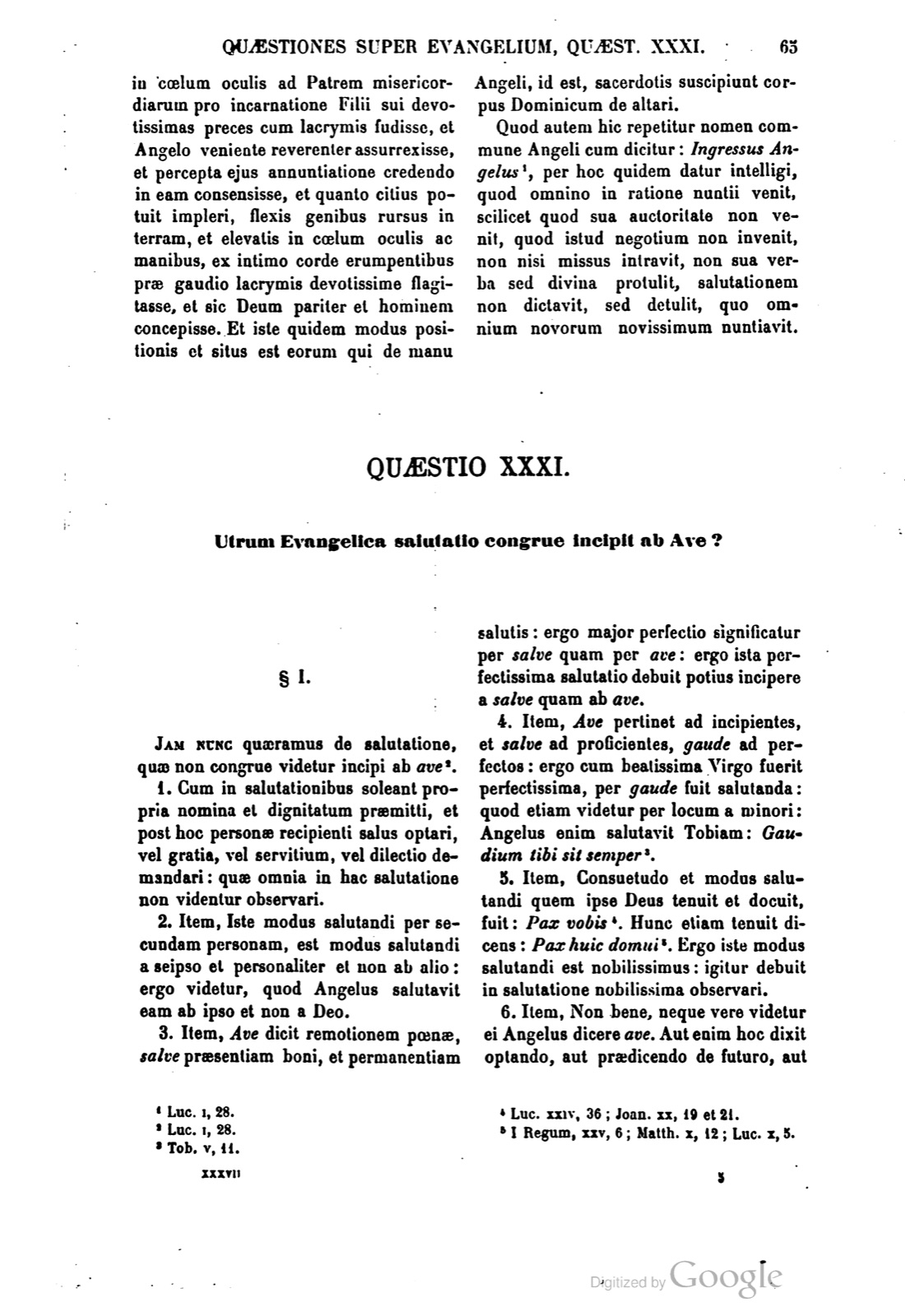
§ I. Jam nunc quaeramus de salutatione, quae non congrue videtur incipi ab ave 1. 1. Cum in salutationibus soleant propria nomina et dignitatum praemitti, et post hoc personae recipienti salus optari, vel gratia, vel servitium, vel dilectio demandari: quae omnia in hac salutatione non videntur observari.
2. Item, Iste modus salutandi per secundam personam, est modus salutandi a seipso et personaliter et non ab alio: ergo videtur, quod Angelus salutavit in eam ab ipso et non a Deo.
3. Item, Ave dicit remotionem poenae, salve praesentiam boni, et permanentiam salutis: ergo major perfectio significatur per salve quam per ave: ergo ista perfectissima salutatio debuit potius incipere a salve quam ab ave.
4. Item, Ave pertinet ad incipientes, et salve ad proficientes, gaude ad perfectos: ergo cum beatissima Virgo fuerit perfectissima, per gaude fuit salutanda: quod etiam videtur per locum a minori: Angelus enim salutavit Tobiam: Gaudium tibi sit semper 2.
5. Item, Consuetudo et modus salutandi quem ipse Deus tenuit et docuit, fuit: Pax vobis 3. Hunc etiam tenuit dicens: Pax huic domui 4. Ergo iste modus salutandi est nobilissimus: igitur debuit in salutatione nobilissima observari.
6. Item, Non bene, neque vere videtur ei Angelus dicere ave. Aut enim hoc dixit optando, aut praedicendo de futuro, aut narrando de praesenti. Si narrando de praesenti, falsum dixit: quia adhuc sine vae non fuit. Si optavit, ergo voluntatem suam voluntati divinae non conformavit: quia eam multa pati voluit. Si autem futura praedixit, non salutavit, sed prophetavit, quod praemium est commune omnium salvandorum, quia quandoque erunt sine vae.
§ II. In contrarium objicitur et probatur, quod beatissima Virgo fuit sine vae. Seneca probat, quod sapiens non turbatur, hoc modo: «Validius est quod laedit eo quod laeditur: fortior non est virtute nequitia, sed infirmior: sed non laeditur quis nisi a malis: igitur non laeditur 5.» Item dicit: «Quidquid in sapientem fit petulanter, proterve, superbe, frustra tentatur.» Item, Idem in eodem: «Divinitati non nocetur: sed omnis sapiens in participatione Deus est: igitur sapienti non nocetur.» Item, «Omnis injuria est alicujus rei quae perdi potest: sapiens nihil perdere potest: omnia in se reposuit, nihil credidit fortunae, bona sua habuit in solido: nihil eripit fortuna, nisi quod dedit: virtutem autem non eripit, quia non dedit 6.» Ex istis autem concludit, quod nulla turbatio cadit in sapientem: sed citra Deum in statu viae beatissima Virgo fuit omni sapiente sapientior: ergo debuit esse sine omni vae.
QUESTION XXXI. Whether the Gospel greeting fittingly begins with Ave?
§ I. Now let us ask about the greeting, which does not seem fittingly to begin with ave 1. 1. Since in greetings proper names and dignities are usually set first, and after this health, or grace, or service, or love is wished or requested for the person receiving, all these things do not seem to be observed in this greeting.
2. Likewise, this mode of greeting through the second person is a mode of greeting from oneself and personally, and not from another; therefore it seems that the Angel greeted her from himself and not from God.
3. Likewise, ave says removal of punishment, salve the presence of good and permanence of salvation; therefore greater perfection is signified by salve than by ave; therefore that most perfect greeting ought rather to begin from salve than from ave.
4. Likewise, ave belongs to beginners, salve to the proficient, gaude to the perfect; therefore, since the most blessed Virgin was most perfect, she ought to have been greeted by gaude. This also seems so by an argument from the lesser, for the Angel greeted Tobias: May joy be always to you 2.
5. Likewise, the custom and mode of greeting that God himself held and taught was: Peace to you 3. He also held this when saying: Peace to this house 4. Therefore this mode of greeting is most noble; therefore it ought to have been observed in the most noble greeting.
6. Likewise, the Angel does not seem to say ave to her well or truly. For either he said this by wishing, or by predicting the future, or by narrating the present. If by narrating the present, he spoke falsely, because she was not yet without woe. If he wished it, then he did not conform his will to the divine will, because God willed her to suffer many things. But if he predicted future things, he did not greet but prophesied, which is the common reward of all those to be saved, because at some time they will be without woe.
§ II. To the contrary it is objected and proved that the most blessed Virgin was without woe. Seneca proves that the wise person is not disturbed in this way: "What harms is stronger than that which is harmed; wickedness is not stronger than virtue, but weaker; but no one is harmed except by evils; therefore he is not harmed 5." Likewise he says: "Whatever is done insolently, wantonly, proudly against the wise man is attempted in vain." Likewise, the same author in the same place says: "Divinity is not harmed; but every wise person is God by participation; therefore the wise person is not harmed." Likewise: "Every injury belongs to something that can be lost; the wise person can lose nothing; he has placed all things back in himself, has entrusted nothing to fortune, has held his goods in solidity; fortune snatches away nothing except what it gave; but it does not snatch away virtue, because it did not give it 6." From these, however, he concludes that no disturbance falls into the wise person; but below God in the state of the way the most blessed Virgin was wiser than every wise person; therefore she ought to have been without every woe.
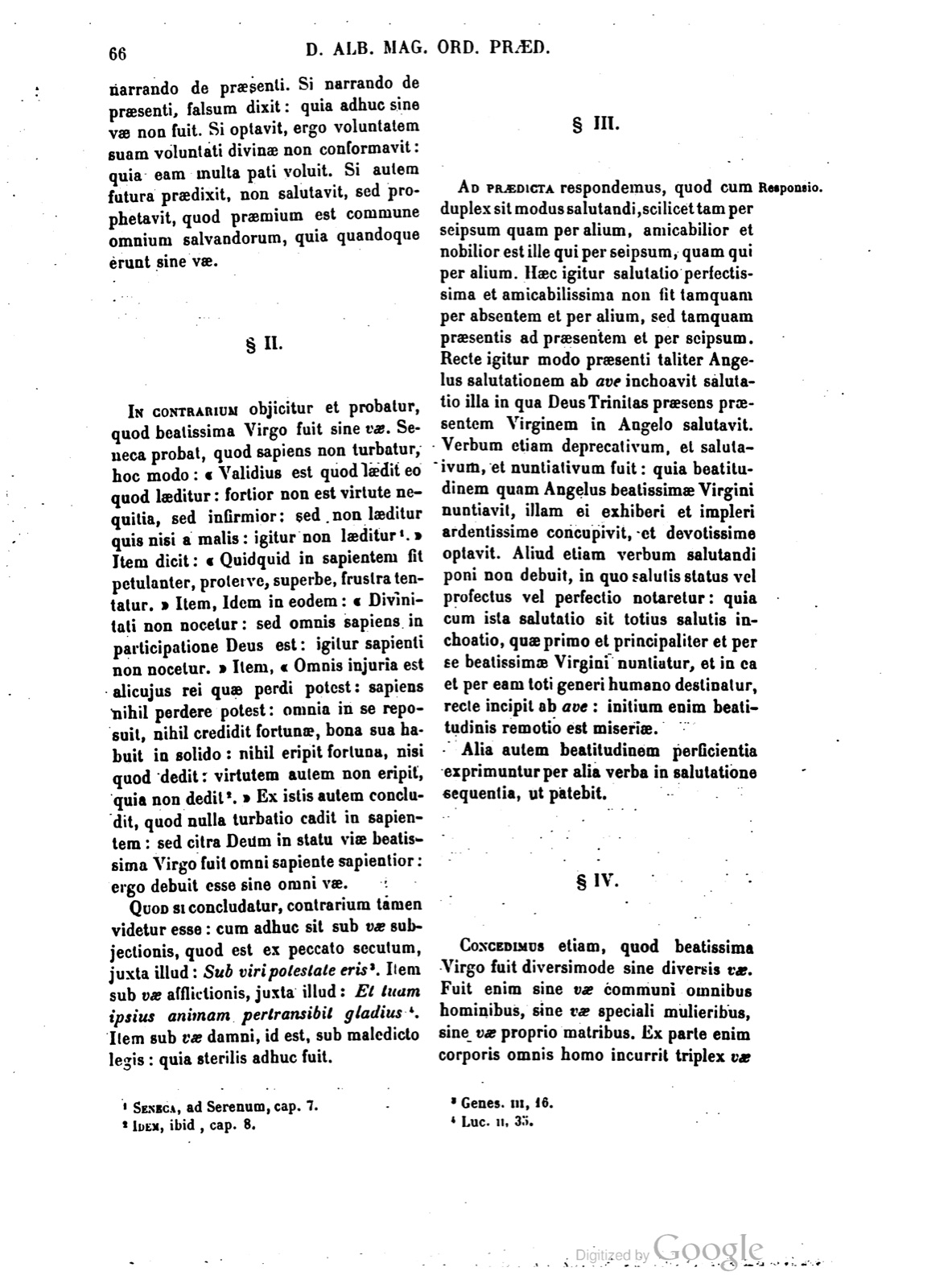
Quod si concludatur, contrarium tamen videtur esse: cum adhuc sit sub vae subjectionis, quod est ex peccato secutum, juxta illud: Sub viri potestate eris 7. Item sub vae afflictionis, juxta illud: Et tuam ipsius animam pertransibit gladius 8. Item sub vae damni, id est, sub maledicto legis: quia sterilis adhuc fuit.
§ III. Ad praedicta respondemus, quod cum duplex sit modus salutandi, scilicet tam per seipsum quam per alium, amicabilior et nobilior est ille qui per seipsum, quam qui per alium. Haec igitur salutatio perfectissima et amicabilissima non fit tamquam per absentem et per alium, sed tamquam praesentis ad praesentem et per seipsum. Recte igitur modo praesenti taliter Angelus salutationem ab ave inchoavit salutatio illa in qua Deus Trinitas praesens praesentem Virginem in Angelo salutavit. Verbum etiam deprecativum, et salutativum, et nuntiativum fuit: quia beatitudinem quam Angelus beatissimae Virgini nuntiavit, illam ei exhiberi et impleri ardentissime concupivit, et devotissime optavit. Aliud etiam verbum salutandi poni non debuit, in quo salutis status vel profectus vel perfectio notaretur: quia cum ista salutatio sit totius salutis inchoatio, quae primo et principaliter et per se beatissimae Virgini nuntiatur, et in ea et per eam toti generi humano destinatur, recte incipit ab ave: initium enim beatitudinis remotio est miseriae. Alia autem beatitudinem perficientia exprimuntur per alia verba in salutatione sequentia, ut patebit.
§ IV. Concedimus etiam, quod beatissima Virgo fuit diversimode sine diversis vae. Fuit enim sine vae communi omnibus hominibus, sine vae speciali mulieribus, sine vae proprio matribus. Ex parte enim corporis omnis homo incurrit triplex vae per peccatum, scilicet ipsius corporis discrasiam sive distemperationem, et naturalium appetituum inordinationem. Item, ipsius ante mortem corporis ad animam repugnantiam secundum quod caro concupiscit adversus spiritum. Item post mortem corporis incinerationem. De isto triplici vae legitur, Genes. III, 17 et seq.: Maledicta terra in opere tuo: in laboribus comedes ex ea cunctis diebus vitae tuae. Spinas et tribulos germinabit tibi, et comedes herbam terrae. In sudore vultus tui vesceris pane, donec revertaris in terram de qua sumptus es: quia pulvis es, et in pulverem reverteris. In maledictione operum notatur inordinatio appetituum naturalium, in spinis et tribulis concupiscentia contra spiritum, in labore et sudore distemperatio corporis, per reversionem in pulverem incineratio. Sine isto triplici vae fuit ista beatissima Virgo in corpore, quae et corpus habuit eucraticum, cum spiritu per omnia pacificum, et numquam in cineres resolvendum.
But if this is concluded, still the contrary seems to be true, since she is still under the woe of subjection, which followed from sin, according to that saying: You shall be under the power of the man 7. Likewise under the woe of affliction, according to that saying: And a sword shall pass through your own soul 8. Likewise under the woe of loss, that is, under the curse of the law, because she was still barren.
§ III. To the aforesaid we respond that since there is a twofold mode of greeting, namely both through oneself and through another, that one which is through oneself is more friendly and more noble than the one which is through another. Therefore this most perfect and most friendly greeting is not made as by an absent person and through another, but as of one present to one present and through himself. Therefore rightly, in such a present mode, the Angel began that greeting from ave, that greeting in which God the Trinity, present, greeted the present Virgin in the Angel. The word was also deprecative, salutatory, and annunciatory, because the beatitude that the Angel announced to the most blessed Virgin, he most ardently desired and most devoutly wished to be shown and fulfilled in her. Nor ought another word of greeting to have been placed, in which the state, progress, or perfection of salvation would be marked, because, since this greeting is the beginning of all salvation, which is announced first and principally and through itself to the most blessed Virgin, and in her and through her is destined for the whole human race, rightly it begins from ave: for the beginning of beatitude is the removal of misery. But the other things perfecting beatitude are expressed through the other words in the following greeting, as will be clear.
§ IV. We also concede that the most blessed Virgin was in diverse ways without diverse woes. For she was without the woe common to all men, without the woe special to women, without the woe proper to mothers. For on the part of the body every man incurs a threefold woe through sin: namely the dyscrasia or distempering of the body itself, and the disordering of natural appetites; likewise, before death, the repugnance of the body itself against the soul, according as the flesh desires against the spirit; likewise after death, the reducing of the body to ashes. Of this threefold woe it is read in Genesis 3:17 and following: Cursed is the earth in your work; in labors you shall eat from it all the days of your life. Thorns and thistles it shall bring forth for you, and you shall eat the herb of the earth. In the sweat of your face you shall eat bread, until you return into the earth from which you were taken; because you are dust, and into dust you shall return. In the curse of works is marked the disordering of natural appetites; in thorns and thistles, concupiscence against the spirit; in labor and sweat, the distempering of the body; through the return into dust, reduction to ashes. Without this threefold woe in body was that most blessed Virgin, who both had a well-tempered body, peaceful with the spirit in all things, and never to be resolved into ashes.
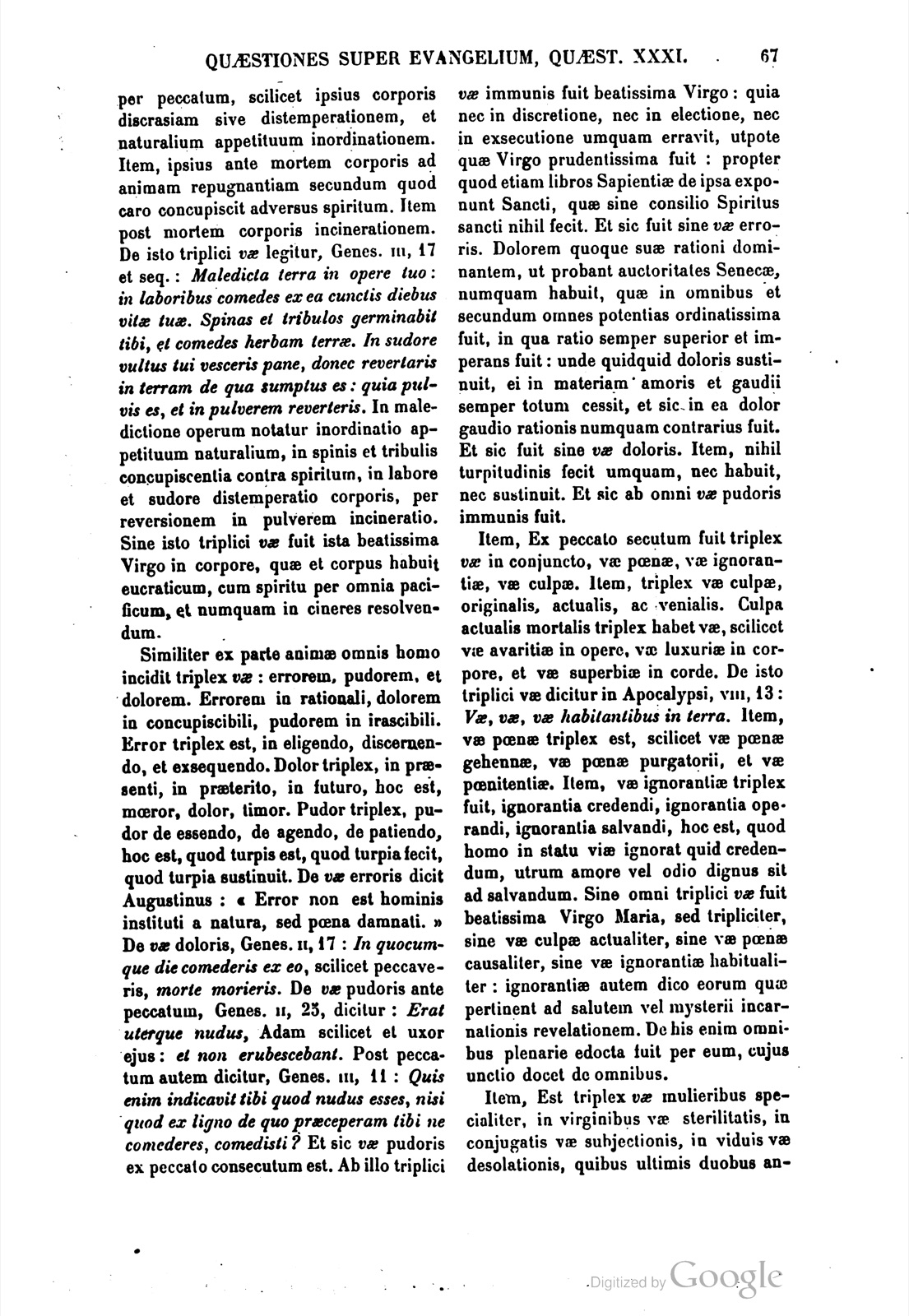
Similiter ex parte animae omnis homo incidit triplex vae: errorem, pudorem, et dolorem. Errorem in rationali, dolorem in concupiscibili, pudorem in irascibili. Error triplex est, in eligendo, discernendo, et exsequendo. Dolor triplex, in praesenti, in praeterito, in futuro, hoc est, moeror, dolor, timor. Pudor triplex, pudor de essendo, de agendo, de patiendo, hoc est, quod turpis est, quod turpia fecit, quod turpia sustinuit. De vae erroris dicit Augustinus: «Error non est hominis ad instituti a natura, sed poena damnati.» De vae doloris, Genes. II, 17: In quocumque die comederis ex eo, scilicet peccaveris, morte morieris. De vae pudoris ante peccatum, Genes. II, 25, dicitur: Erat uterque nudus, Adam scilicet et uxor ejus: et non erubescebant. Post peccatum autem dicitur, Genes. III, 11: Quis enim indicavit tibi quod nudus esses, nisi quod ex ligno de quo praeceperam tibi ne comederes, comedisti? Et sic vae pudoris ex peccato consecutum est. Ab illo triplici vae immunis fuit beatissima Virgo: quia nec in discretione, nec in electione, nec in exsecutione umquam erravit, utpote quae Virgo prudentissima fuit: propter quod etiam libros Sapientiae de ipsa exponunt Sancti, quae sine consilio Spiritus sancti nihil fecit. Et sic fuit sine vae erroris. Dolorem quoque suae rationi dominantem, ut probant auctoritates Senecae, numquam habuit, quae in omnibus et secundum omnes potentias ordinatissima fuit, in qua ratio semper superior et imperans fuit: unde quidquid doloris sustinuit, ei in materiam amoris et gaudii semper totum cessit, et sic in ea dolor gaudio rationis numquam contrarius fuit. Et sic fuit sine vae doloris. Item, nihil turpitudinis fecit umquam, nec habuit, nec sustinuit. Et sic ab omni vae pudoris immunis fuit.
Item, Ex peccato secutum fuit triplex vae in conjuncto, vae poenae, vae ignorantiae, vae culpae. Item, triplex vae culpae, originalis, actualis, ac venialis. Culpa actualis mortalis triplex habet vae, scilicet vae avaritiae in opere, vae luxuriae in corpore, et vae superbiae in corde. De isto triplici vae dicitur in Apocalypsi, VI, 13: Vae, vae, vae habitantibus in terra. Item, vae poenae triplex est, scilicet vae poenae gehennae, vae poenae purgatorii, et vae poenitentiae. Item, vae ignorantiae triplex fuit, ignorantia credendi, ignorantia operandi, ignorantia salvandi, hoc est, quod homo in statu viae ignorat quid credendum, utrum amore vel odio dignus sit ad salvandum. Sine omni triplici vae fuit beatissima Virgo Maria, sed tripliciter, sine vae culpae actualiter, sine vae poenae causaliter, sine vae ignorantiae habitualiter: ignorantiae autem dico eorum quae pertinent ad salutem vel mysterii incarnationis revelationem. De his enim omnibus plenarie edocta fuit per eum, cujus unctio docet de omnibus.
Similarly, on the part of the soul every man falls into threefold woe: error, shame, and sorrow; error in the rational power, sorrow in the concupiscible, shame in the irascible. Error is threefold: in choosing, in discerning, and in executing. Sorrow is threefold: in the present, in the past, in the future, that is, grief, sorrow, fear. Shame is threefold: shame concerning being, concerning acting, and concerning undergoing, that is, that one is shameful, that one has done shameful things, that one has endured shameful things. Concerning the woe of error Augustine says: "Error is not of man as established by nature, but is the punishment of the condemned." Concerning the woe of sorrow, Genesis 2:17 says: On whatever day you eat from it, that is, sin, you shall die by death. Concerning the woe of shame before sin, Genesis 2:25 says: Each was naked, namely Adam and his wife, and they were not ashamed. But after sin it is said, Genesis 3:11: For who indicated to you that you were naked, unless you have eaten from the tree from which I commanded you not to eat? And thus the woe of shame followed from sin. From that threefold woe the most blessed Virgin was immune, because neither in discretion, nor in election, nor in execution did she ever err, as she who was the most prudent Virgin; for this reason also the Saints expound the books of Wisdom concerning her, she who did nothing without the counsel of the Holy Spirit. And thus she was without the woe of error. She also never had sorrow dominating her reason, as the authorities of Seneca prove, she who in all things and according to all powers was most ordered, in whom reason was always superior and commanding. Hence whatever sorrow she sustained always wholly yielded for her into the matter of love and joy; and thus in her sorrow was never contrary to the joy of reason. And thus she was without the woe of sorrow. Likewise, she never did, or had, or endured anything of shamefulness. And thus she was immune from every woe of shame.
Likewise, from sin there followed a threefold woe in the composite: woe of punishment, woe of ignorance, woe of fault. Likewise, a threefold woe of fault: original, actual, and venial. Actual mortal fault has a threefold woe, namely the woe of avarice in work, the woe of lust in the body, and the woe of pride in the heart. Of this threefold woe it is said in Apocalypse 6:13: Woe, woe, woe to those dwelling on earth. Likewise, the woe of punishment is threefold, namely the woe of the punishment of Gehenna, the woe of the punishment of purgatory, and the woe of penance. Likewise, the woe of ignorance was threefold: ignorance of believing, ignorance of acting, ignorance of being saved, that is, that man in the state of the way is ignorant what is to be believed, whether he is worthy of love or hatred with respect to being saved. The most blessed Virgin Mary was without every threefold woe, but in a threefold way: without the woe of fault actually, without the woe of punishment causally, without the woe of ignorance habitually. I mean ignorance, however, of those things that pertain to salvation or to the revelation of the mystery of the incarnation. For she was fully taught about all these things by him whose anointing teaches concerning all things.
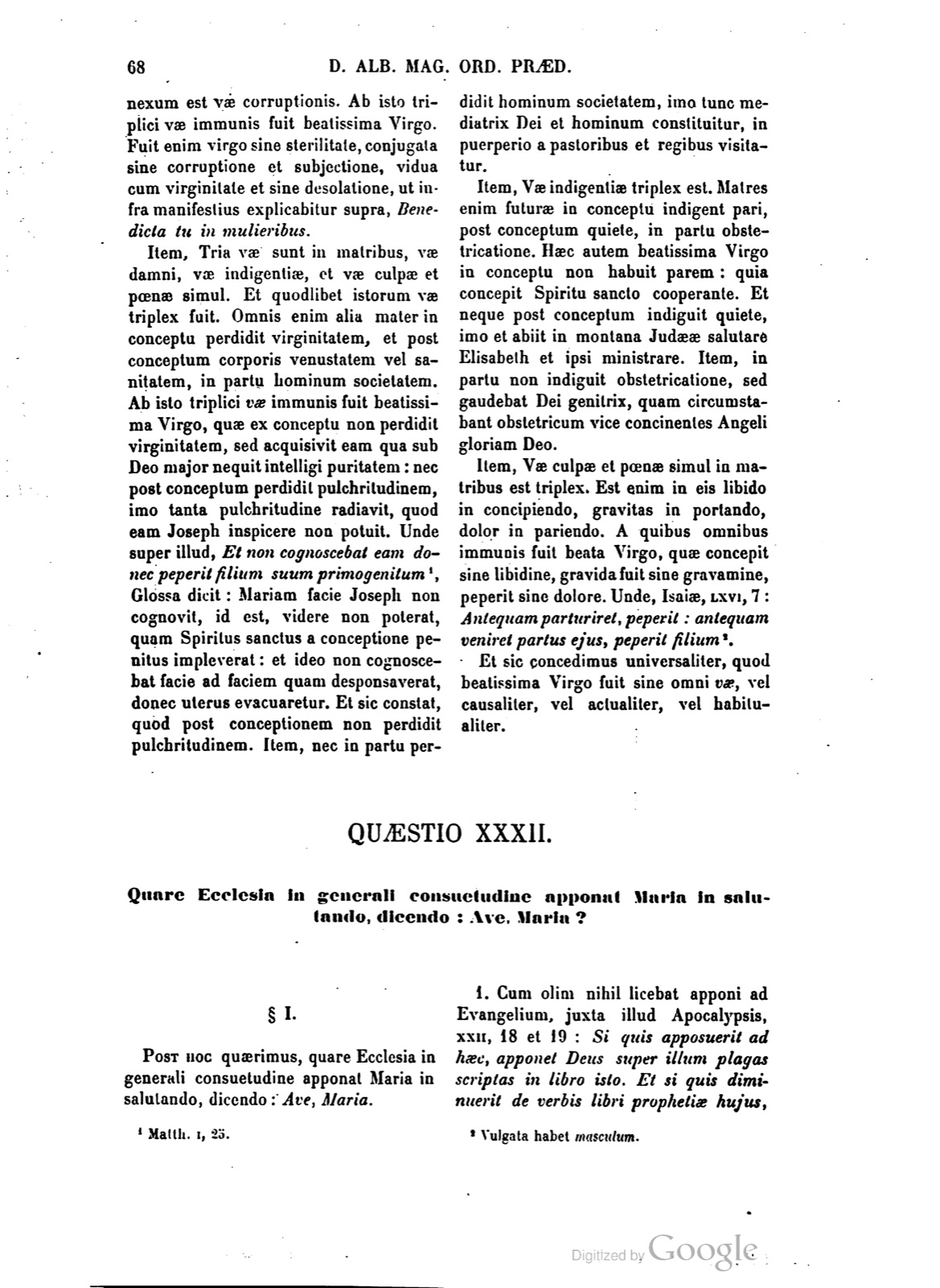
Item, Est triplex vae mulieribus specialiter, in virginibus vae sterilitatis, in conjugatis vae subjectionis, in viduis vae desolationis, quibus ultimis duobus annexum est vae corruptionis. Ab isto triplici vae immunis fuit beatissima Virgo. Fuit enim virgo sine sterilitate, conjugata sine corruptione et subjectione, vidua cum virginitate et sine desolatione, ut infra manifestius explicabitur supra, Benedicta tu in mulieribus.
Item, Tria vae sunt in matribus, vae damni, vae indigentiae, et vae culpae et poenae simul. Et quodlibet istorum vae triplex fuit. Omnis enim alia mater in conceptu perdidit virginitatem, et post conceptum corporis venustatem vel sanitatem, in partu hominum societatem. Ab isto triplici vae immunis fuit beatissima Virgo, quae ex conceptu non perdidit virginitatem, sed acquisivit eam qua sub Deo major nequit intelligi puritatem: nec post conceptum perdidit pulchritudinem, imo tanta pulchritudine radiavit, quod eam Joseph inspicere non potuit. Unde super illud, Et non cognoscebat eam donec peperit filium suum primogenitum 9, Glossa dicit: Mariam facie Joseph non cognovit, id est, videre non poterat, quam Spiritus sanctus a conceptione penitus impleverat: et ideo non cognoscebat facie ad faciem quam desponsaverat, donec uterus evacuaretur. Et sic constat, quod post conceptionem non perdidit pulchritudinem. Item, nec in partu perdidit hominum societatem, imo tunc mediatrix Dei et hominum constituitur, in puerperio a pastoribus et regibus visitatur.
Item, Vae indigentiae triplex est. Matres enim futurae in conceptu indigent pari, post conceptum quiete, in partu obstetricatione. Haec autem beatissima Virgo in conceptu non habuit parem: quia concepit Spiritu sancto cooperante. Et neque post conceptum indiguit quiete, imo et abiit in montana Judaeae salutare Elisabeth et ipsi ministrare. Item, in partu non indiguit obstetricatione, sed gaudebat Dei genitrix, quam circumstabant obstetricum vice concinentes Angeli gloriam Deo.
Item, Vae culpae et poenae simul in matribus est triplex. Est enim in eis libido in concipiendo, gravitas in portando, dolor in pariendo. A quibus omnibus immunis fuit beata Virgo, quae concepit sine libidine, gravida fuit sine gravamine, peperit sine dolore. Unde, Isaiae, LXVI, 7: Antequam parturiret, peperit: antequam veniret partus ejus, peperit filium 10. Et sic concedimus universaliter, quod beatissima Virgo fuit sine omni vae, vel causaliter, vel actualiter, vel habitualiter.
Likewise, there is a threefold woe specially for women: in virgins, the woe of sterility; in the married, the woe of subjection; in widows, the woe of desolation, to which last two the woe of corruption is annexed. From this threefold woe the most blessed Virgin was immune. For she was a virgin without sterility, married without corruption and subjection, a widow with virginity and without desolation, as will be explained more manifestly below on Blessed are you among women.
Likewise, there are three woes in mothers: woe of loss, woe of need, and woe of fault and punishment together. And each of these woes was threefold. For every other mother in conception lost virginity, and after conception the beauty or health of the body, and in birth the company of men. From this threefold woe the most blessed Virgin was immune, because by conception she did not lose virginity, but acquired that purity greater than which under God cannot be understood; nor after conception did she lose beauty, but rather she shone with so great a beauty that Joseph could not gaze upon her. Hence on that saying, And he did not know her until she brought forth her firstborn son 9, the Gloss says: Joseph did not know Mary by face, that is, he was not able to see her whom the Holy Spirit had utterly filled from conception; and therefore he did not know face to face the one whom he had betrothed until the womb was emptied. And thus it is clear that after conception she did not lose beauty. Likewise, she did not lose the company of men in birth; indeed then she is constituted mediatrix of God and men, and in childbirth she is visited by shepherds and kings.
Likewise, the woe of need is threefold. For future mothers in conception need an equal, after conception rest, and in birth an obstetrical service. But this most blessed Virgin in conception did not have an equal, because she conceived with the Holy Spirit cooperating. Nor after conception did she need rest; indeed she went into the hill country of Judea to greet Elizabeth and minister to her. Likewise, in birth she did not need obstetrical service, but the God-bearing woman rejoiced, around whom Angels stood in place of midwives, singing glory to God.
Likewise, the woe of fault and punishment together in mothers is threefold. For in them there is lust in conceiving, weight in carrying, pain in giving birth. From all these the blessed Virgin was immune, because she conceived without lust, was pregnant without burden, gave birth without pain. Hence Isaiah 66:7: Before she travailed, she gave birth; before her labor came, she gave birth to a son 10. And thus we concede universally that the most blessed Virgin was without every woe, either causally, or actually, or habitually.
Notes
- Luke 1:28. (Luc. I, 28.) ↩
- Tobit 5:11. (Tob. V, 11.) ↩
- Luke 24:36; John 20:19 and 21. (Luc. XXIV, 36; Joan. XX, 19 et 21.) ↩
- First Kings 25:6; Matthew 10:12; Luke 10:5. (I Regum XXV, 6; Matth. X, 12; Luc. X, 5.) ↩
- Seneca, To Serenus, chapter 7. (Seneca, ad Serenum, cap. 7.) ↩
- The same author, in the same place, chapter 8. (Idem, ibid., cap. 8.) ↩
- Genesis 3:16. (Genes. III, 16.) ↩
- Luke 2:35. (Luc. II, 35.) ↩
- Matthew 1:25. (Matth. I, 25.) ↩
- The Vulgate has male. (Vulgata habet masculum.) ↩
If a page does not appear, its photograph has not been uploaded yet.