Works › The Mariale: Questions on “Missus est”
Volume 37 · pp. 58–60
Questions XXVI-XXIX opening
A marker with ≈ is an approximate page boundary, placed by measure of the text; the page photographs remain the authority. In the paired views, clicking a page marker brings that page into view.
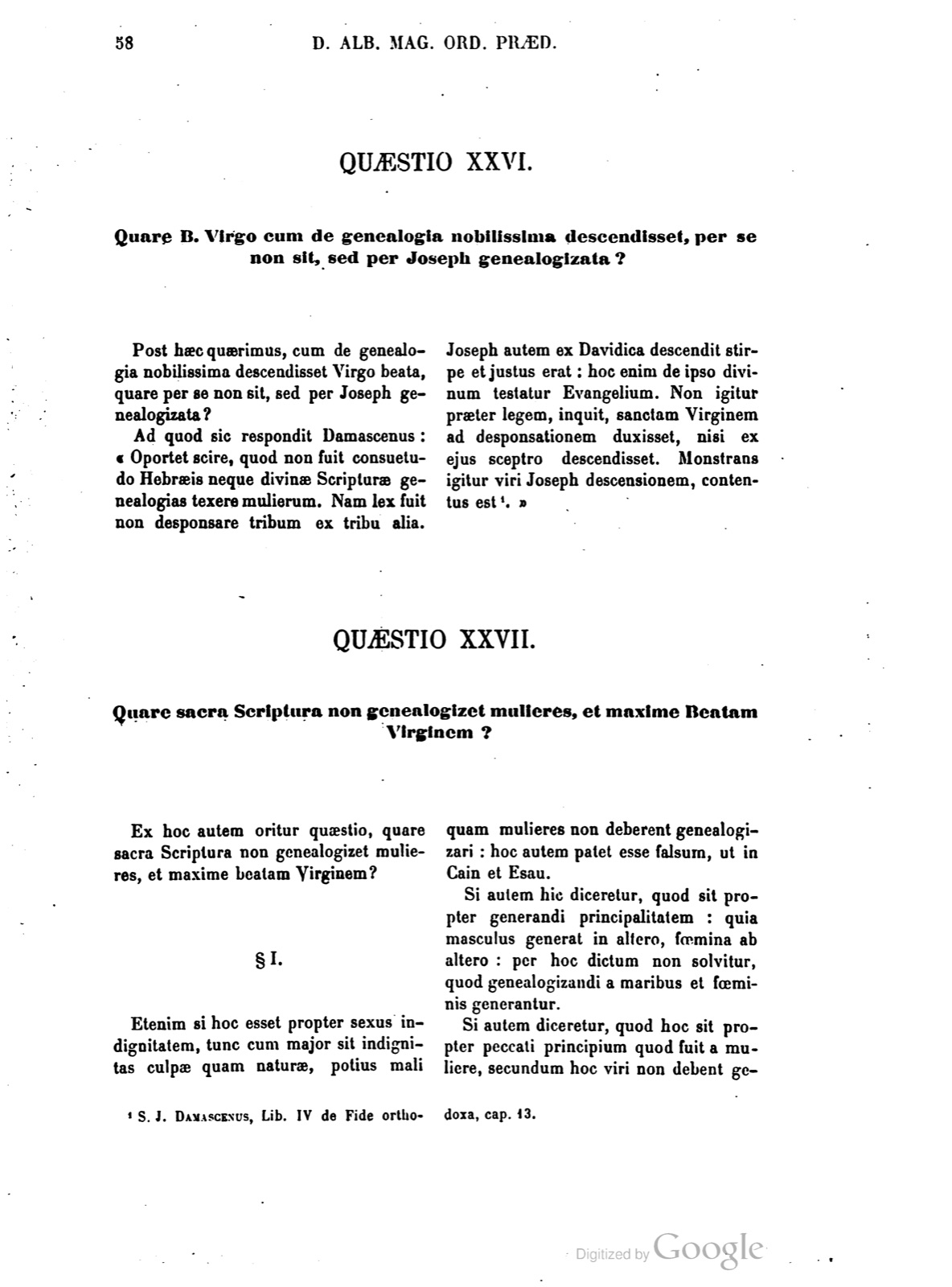
QUAESTIO XXVI. Quare B. Virgo cum de genealogia nobilissima descendisset, per se non sit, sed per Joseph genealogizata?
Post haec quaerimus, cum de genealogia nobilissima descendisset Virgo beata, quare per se non sit, sed per Joseph genealogizata?
Ad quod sic respondit Damascenus: «Oportet scire, quod non fuit consuetudo Hebraeis neque divinae Scripturae genealogias texere mulierum. Nam lex fuit non desponsare tribum ex tribu alia. Joseph autem ex Davidica descendit stirpe et justus erat: hoc enim de ipso divinum testatur Evangelium. Non igitur praeter legem, inquit, sanctam Virginem ad desponsationem duxisset, nisi ex ejus sceptro descendisset. Monstrans igitur viri Joseph descensionem, contentus est 1.»
QUAESTIO XXVII. Quare sacra Scriptura non genealogizet mulieres, et maxime Beatam Virginem?
Ex hoc autem oritur quaestio, quare sacra Scriptura non genealogizet mulieres, et maxime beatam Virginem?
§ I. Etenim si hoc esset propter sexus indignitatem, tunc cum major sit indignitas culpae quam naturae, potius mali quam mulieres non deberent genealogizari: hoc autem patet esse falsum, ut in Cain et Esau.
Si autem hic diceretur, quod sit propter generandi principalitatem: quia masculus generat in altero, foemina ab altero: per hoc dictum non solvitur, quod genealogizandi a maribus et foeminis generantur.
Si autem diceretur, quod hoc sit propter peccati principium quod fuit a muliere, secundum hoc viri non debent genealogizari: quia per virum transmissum est peccatum originale: quia in Adam omnes peccaverunt: non enim peccatum originale contraxissemus, si Adam non peccasset et per aliam generasset.
Item, Si dicitur quod hoc est propter mysterium: quia filii signant opera virtutum, filiae opera infirmitatis: hoc etiam sufficere non videretur, cum mali filii directius et expressius opera mala significent, quam filiae. Et sic nulla videtur causa, quod mulieres non genealogizentur in sacra Scriptura.
Item, Constat quod hoc ipsum quod non genealogizantur, fit in aliquam poenam mulierum: ergo quidquid fiet de aliis, illa benedicta inter mulieres exempta est ab omni peccato muliebri: quare cessante causa maledicti, debuit genealogizari.
QUESTION XXVI. Why the Blessed Virgin, although she had descended from a most noble genealogy, was not genealogized by herself, but through Joseph?
After these things we ask: since the blessed Virgin had descended from a most noble genealogy, why was she not genealogized by herself, but through Joseph?
To this Damascene responded thus: "It is necessary to know that it was not the custom for the Hebrews, nor for divine Scripture, to weave genealogies of women. For the law was not to betroth a tribe from another tribe. But Joseph descended from Davidic stock and was just; for the divine Gospel testifies this about him. Therefore, he says, he would not have led the holy Virgin to betrothal contrary to the law unless she had descended from his scepter. Therefore, showing the descent of the man Joseph, he was content 1."
QUESTION XXVII. Why sacred Scripture does not genealogize women, and especially the Blessed Virgin?
From this, however, a question arises: why does sacred Scripture not genealogize women, and especially the blessed Virgin?
§ I. For if this were because of the unworthiness of sex, then, since the unworthiness of fault is greater than that of nature, evil persons rather than women ought not to be genealogized; but this is clearly false, as in Cain and Esau.
But if it were said here that it is because of principalness in generating, since the male generates in another and the female from another, by this statement it is not solved, because those to be genealogized are generated from males and females.
But if it were said that this is because of the beginning of sin, which was from a woman, according to this men ought not to be genealogized, because original sin was transmitted through a man: because in Adam all sinned; for we would not have contracted original sin if Adam had not sinned and had generated through another woman.
Likewise, if it is said that this is because of mystery, since sons signify works of virtues, daughters works of infirmity, this also would not seem sufficient, since bad sons signify evil works more directly and expressly than daughters do. And thus no cause appears why women are not genealogized in sacred Scripture.
Likewise, it is clear that this very fact that they are not genealogized is done as some punishment of women; therefore, whatever may be done concerning others, that woman blessed among women is exempt from every feminine sin; wherefore, with the cause of the curse ceasing, she ought to have been genealogized.
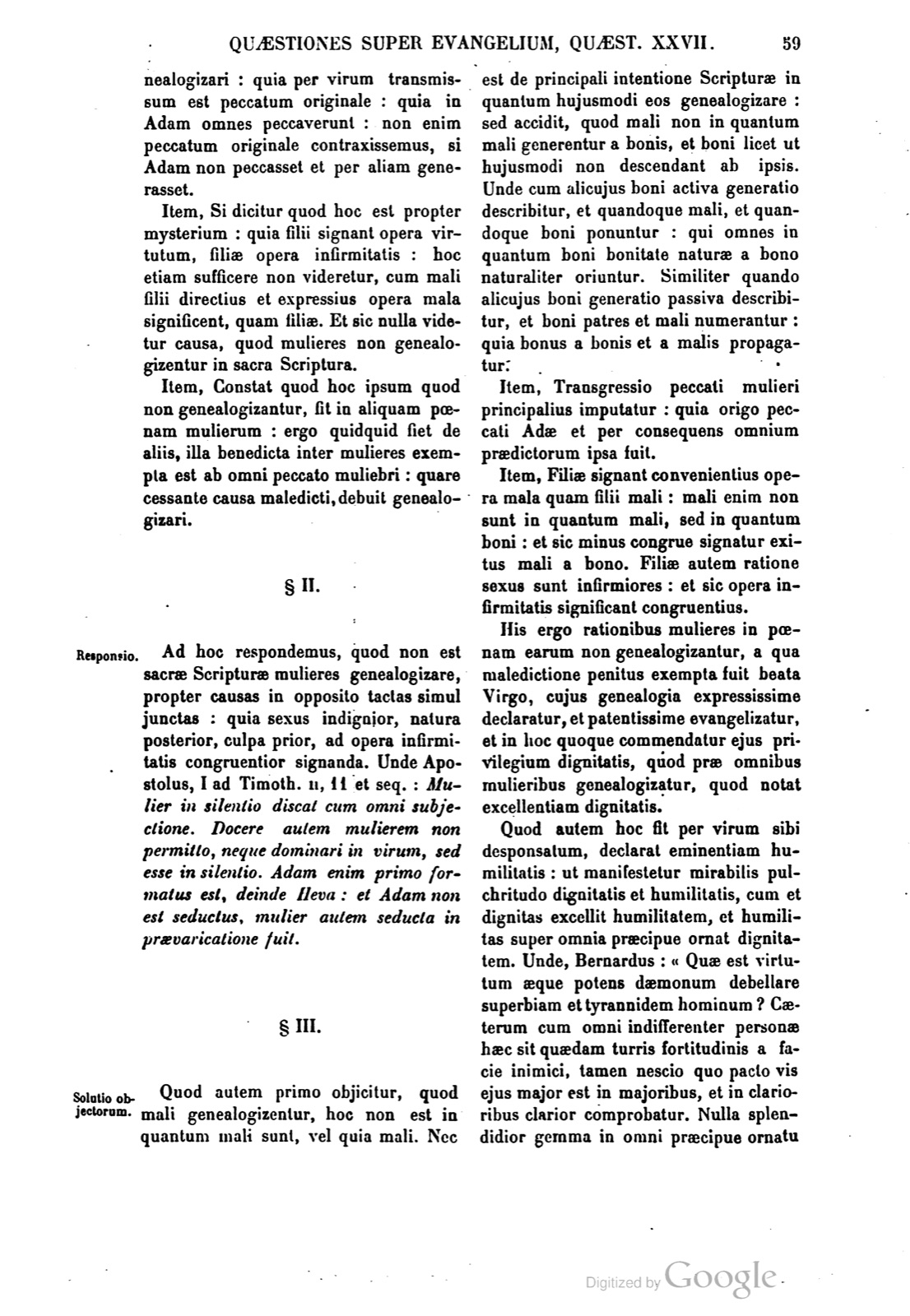
§ II. Ad hoc respondemus, quod non est sacrae Scripturae mulieres genealogizare, propter causas in opposito tactas simul junctas: quia sexus indignior, natura posterior, culpa prior, ad opera infirmitatis congruentior signanda. Unde Apostolus, I ad Timoth. II, 11 et seq.: Mulier in silentio discat cum omni subjectione. Docere autem mulierem non permitto, neque dominari in virum, sed esse in silentio. Adam enim primo formatus est, deinde Heva: et Adam non est seductus, mulier autem seducta in praevaricatione fuit.
§ III. Quod autem primo objicitur, quod mali genealogizentur, hoc non est in quantum mali sunt, vel quia mali. Nec est de principali intentione Scripturae in quantum hujusmodi eos genealogizare: sed accidit, quod mali non in quantum mali generentur a bonis, et boni licet ut hujusmodi non descendant ab ipsis. Unde cum alicujus boni activa generatio describitur, et quandoque mali, et quandoque boni ponuntur: qui omnes in quantum boni bonitate naturae a bono naturaliter oriuntur. Similiter quando alicujus boni generatio passiva describitur, et boni patres et mali numerantur: quia bonus a bonis et a malis propagatur.
Item, Transgressio peccati mulieri principalius imputatur: quia origo peccati Adae et per consequens omnium praedictorum ipsa fuit.
Item, Filiae signant convenientius opera mala quam filii mali: mali enim non sunt in quantum mali, sed in quantum boni: et sic minus congrue signatur exitus mali a bono. Filiae autem ratione sexus sunt infirmiores: et sic opera infirmitatis significant congruentius.
His ergo rationibus mulieres in poenam earum non genealogizantur, a qua maledictione penitus exempta fuit beata Virgo, cujus genealogia expressissime declaratur, et patentissime evangelizatur, et in hoc quoque commendatur ejus privilegium dignitatis, quod prae omnibus mulieribus genealogizatur, quod notat excellentiam dignitatis.
Quod autem hoc fit per virum sibi desponsatum, declarat eminentiam humilitatis: ut manifestetur mirabilis pulchritudo dignitatis et humilitatis, cum et dignitas excellit humilitatem, et humilitas super omnia praecipue ornat dignitatem. Unde, Bernardus: «Quae est virtutum aeque potens daemonum debellare superbiam et tyrannidem hominum? Caeterum cum omni indifferenter personae haec sit quaedam turris fortitudinis a facie inimici, tamen nescio quo pacto vis ejus major est in majoribus, et in clarioribus clarior comprobatur. Nulla splendidior gemma in omni praecipue ornatu summi pontificis. Quae enim celsior caeteris, eo humilitate apparet illustrior et seipso 2.» Sic ergo privilegiavit Dominus matrem suam super omnes mulieres in eo quod genealogizatur: et humilitate ornavit secundum quod haec genealogia ad ipsam per virum descendere denuntiatur.
§ II. To this we respond that it does not belong to sacred Scripture to genealogize women because of the causes touched on in the opposite when joined together: because the sex is lower, later in nature, prior in fault, and more suitable for signifying works of infirmity. Hence the Apostle, 1 Timothy 2:11 and following: Let a woman learn in silence with all subjection. But I do not permit a woman to teach, nor to have dominion over a man, but to be in silence. For Adam was formed first, then Eve; and Adam was not seduced, but the woman, being seduced, was in prevarication.
§ III. As to what is first objected, that evil persons are genealogized: this is not insofar as they are evil, or because they are evil. Nor is it of the principal intention of Scripture to genealogize them insofar as they are such; but it happens that the evil, not insofar as they are evil, are generated from the good, and the good, although as such they do not descend from them. Hence when the active generation of some good person is described, sometimes evil persons and sometimes good persons are placed there, all of whom, insofar as they are good, naturally arise by the goodness of nature from the good. Similarly, when the passive generation of some good person is described, both good fathers and evil are numbered, because a good person is propagated from good and evil persons.
Likewise, the transgression of sin is imputed more principally to the woman, because she was the origin of Adam's sin and consequently of all the aforesaid things.
Likewise, daughters signify evil works more fittingly than evil sons do; for evil persons are not insofar as they are evil, but insofar as they are good, and thus the issue of evil from good is less fittingly signified. But daughters, by reason of sex, are weaker, and thus they signify works of infirmity more fittingly.
Therefore for these reasons women are not genealogized as a punishment of them; from this curse the blessed Virgin was wholly exempt, whose genealogy is most expressly declared and most openly evangelized, and in this also the privilege of her dignity is commended, because she is genealogized before all women, which marks the excellence of dignity.
But that this is done through the man betrothed to her declares the eminence of humility, so that the wonderful beauty of dignity and humility may be manifested, since both dignity surpasses humility and humility above all things especially adorns dignity. Hence Bernard says: "Which of the virtues is equally powerful to fight down the pride of demons and the tyranny of men? Besides, although this is, indifferently for every person, a certain tower of strength before the face of the enemy, nevertheless I do not know in what way its force is greater in the greater, and in the more illustrious it is proved more illustrious. No gem is more splendid in all the chief adornment of the supreme pontiff. For the higher it is than the rest, by that much it appears more illustrious in humility and in itself 2." Thus therefore the Lord privileged his mother above all women in that she is genealogized; and he adorned her with humility according as this genealogy is announced as descending to her through a man.
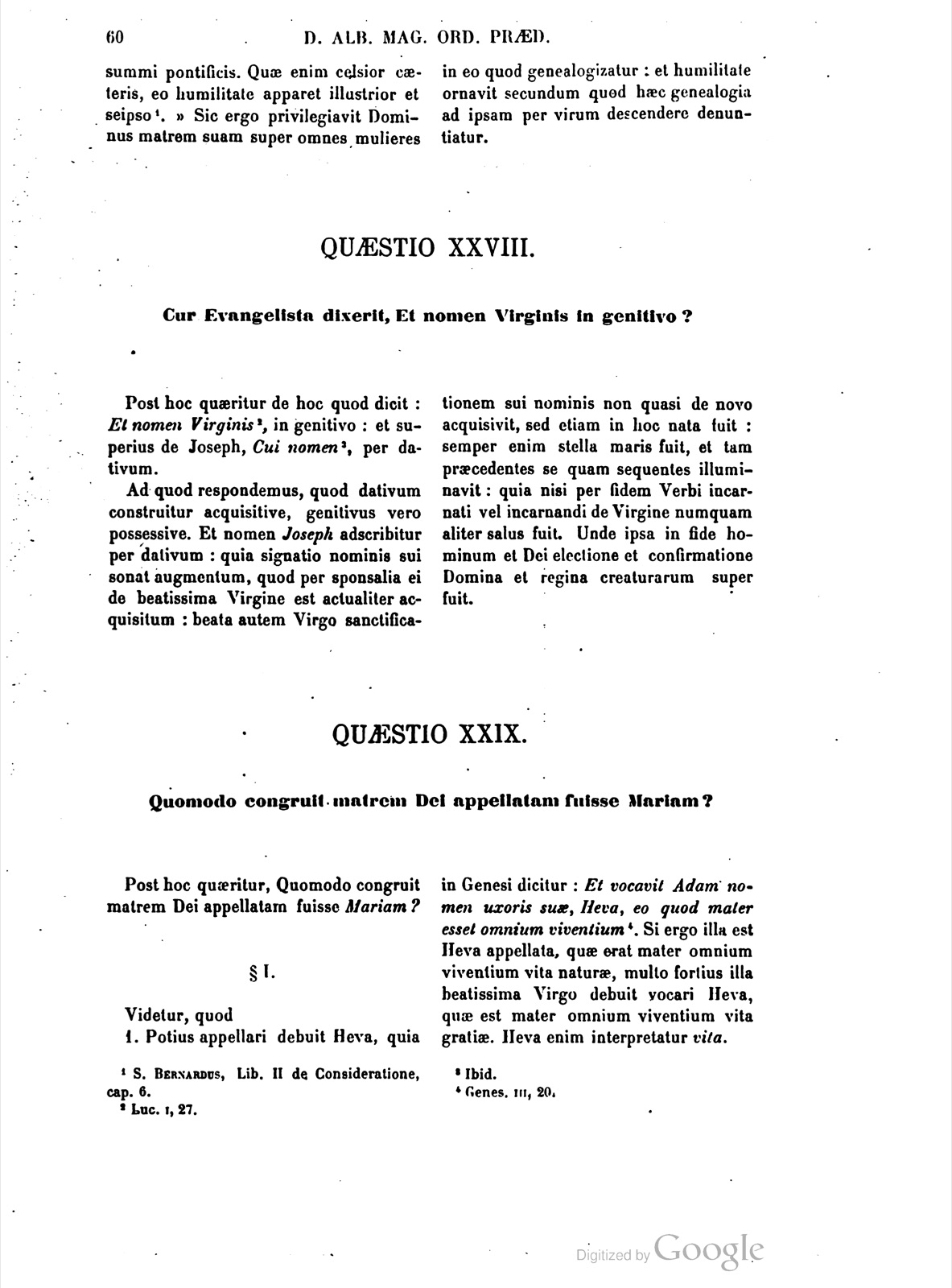
QUAESTIO XXVIII. Cur Evangelista dixerit, Et nomen Virginis in genitivo?
Post hoc quaeritur de hoc quod dicit: Et nomen Virginis 3, in genitivo: et superius de Joseph, Cui nomen, per dativum.
Ad quod respondemus, quod dativum construitur acquisitive, genitivus vero possessive. Et nomen Joseph adscribitur per dativum: quia signatio nominis sui sonat augmentum, quod per sponsalia ei de beatissima Virgine est actualiter acquisitum: beata autem Virgo sanctificationem sui nominis non quasi de novo acquisivit, sed etiam in hoc nata fuit: semper enim stella maris fuit, et tam praecedentes se quam sequentes illuminavit: quia nisi per fidem Verbi incarnati vel incarnandi de Virgine numquam aliter salus fuit. Unde ipsa in fide hominum et Dei electione et confirmatione Domina et regina creaturarum superfuit.
QUAESTIO XXIX. Quomodo congruit matrem Dei appellatam fuisse Mariam?
Post hoc quaeritur, Quomodo congruit matrem Dei appellatam fuisse Mariam?
§ I. Videtur, quod 1. Potius appellari debuit Heva, quia in Genesi dicitur: Et vocavit Adam nomen uxoris suae, Heva, eo quod mater esset omnium viventium 4. Si ergo illa est Heva appellata, quae erat mater omnium viventium vita naturae, multo fortius illa beatissima Virgo debuit vocari Heva, quae est mater omnium viventium vita gratiae. Heva enim interpretatur vita.
QUESTION XXVIII. Why the Evangelist said, And the name of the Virgin, in the genitive?
After this inquiry is made concerning what he says: And the name of the Virgin 3, in the genitive, and above concerning Joseph, whose name, by the dative.
To this we respond that the dative is construed acquisitively, but the genitive possessively. And the name Joseph is ascribed by the dative because the signification of his name sounds increase, which was actually acquired for him by the betrothal from the most blessed Virgin; but the blessed Virgin did not acquire the sanctification of her name as if anew, but was born even in this: for she was always the star of the sea, and illumined both those preceding her and those following her, because never otherwise was there salvation except through faith in the Word incarnate or to be incarnate from the Virgin. Hence she herself, in the faith of men and the election and confirmation of God, stood above as Lady and queen of creatures.
QUESTION XXIX. How is it fitting that the mother of God was called Mary?
After this inquiry is made: how is it fitting that the mother of God was called Mary?
§ I. It seems that 1. She ought rather to have been called Eve, because in Genesis it is said: And Adam called the name of his wife Eve, because she was the mother of all living 4. Therefore if that woman was called Eve because she was the mother of all living by the life of nature, much more ought that most blessed Virgin to have been called Eve, because she is the mother of all living by the life of grace. For Eve is interpreted life.
If a page does not appear, its photograph has not been uploaded yet.