Works › The Mariale: Questions on “Missus est”
Volume 37 · pp. 61–63
Question XXIX, remainder
A marker with ≈ is an approximate page boundary, placed by measure of the text; the page photographs remain the authority. In the paired views, clicking a page marker brings that page into view.
2. Item, Numquam invenitur in Veteri Testamento per aliquam mulierem hujusmodi nominis significata: ergo videtur, quod potius debuit vocari Rachel, vel Rebecca, vel Judith, vel Esther, per quas fuit beatissima Virgo figurata.
3. Item, Cum ista Virgo fuit singularis inter omnes, quae nec primam similem visa est nec habere sequentem in re: ergo nec similem habere debuit in nomine: ergo cum multae ante et post fuerint Mariae, Domina nostra non debuit illud nomen habere.
4. Item, Sicut se habet res ad rem, ita nomen ad nomen: sed beata Virgo post Filium Dominum nostrum Jesum Christum ei simillima fuit in re: ergo et nomine: ergo videtur, quod a Christo Christiana debuit vocari, vel a recreatione recreatrix appellari, vel aliud dignissimum nomen cogitari.
5. Item, Cantat Ecclesia:
Sumens illud ave, Mutans Hevae nomen.
Ergo videtur, quod beatissima Virgo deberet Ave appellari.
§ II. Ad hoc respondemus, quod nomen Maria in hoc loco beatissimae Virgini congruentissime adaptatur, et propter rei perfectionem quae in nomine denotatur, et ad exprimendam proprietatem conceptionis quae hic annuntiatur, et ad statum designandum mediationis beatissimae Virginis, qua mediante genus humanum per mare hujus saeculi ad portum coeli exemplo, suffragio, et merito revocatur. Unde, Bernardus: «Loquamur pauca et super hoc nomine quod interpretatur maris stella, et matri Virgini congruenter aptatur. Ipsa namque aptissime sideri comparatur: quia sicut sine sui corruptione sidus emittit radium, sic absque sui laesione Virgo parturivit Filium. Nec sideri radius suam minuit claritatem, nec Virgini Filius suam integritatem. Ipsa est igitur nobilis stella ex Jacob orta 1, cujus radius universum orbem illuminat, cujus splendor et praefulget in supernis, et inferos penetrat, terras etiam perlustrans, et calefaciens magis mentes quam corpora, fovet virtutes, excoquit vitia. Ipsa, inquam, est praeclara et eximia stella super hoc mare magnum et spatiosum necessario sublevata, micans meritis, illustrans exemplis. O quisquis te intelligis in hujus saeculi profluvio, magis inter procellas et tempestates fluctuare, quam per terram ambulare: ne avertas oculos a fulgore hujus sideris, si non vis obrui procellis. Si insurgant venti tentationum, si incurras scopulos tribulationum: respice stellam, voca Mariam. Si jactaris superbiae undis, si ambitionis, si detractionis, si aemulationis: respice stellam, voca Mariam. Si iracundia, aut avaritia, aut carnis illecebra naviculam concusserit mentis, respice ad Mariam. Si criminum immanitate turbatus, conscientiae foeditate confusus, judicii terrore perterritus, barathro incipias absorberi tristitiae, et desperationis abysso: cogita Mariam. In periculis, in angustiis, in rebus dubiis, Mariam cogita, Mariam invoca. Non recedat ab ore, non recedat a corde: et ut impetres ejus orationis suffragium, non differas conversationis exemplum. Ipsam sequens non devias: ipsam rogans non desperas: ipsam cogitans non erras. Ipsa tenente non corruis, ipsa protegente non metuis, ipsa duce non fatigaris, ipsa propitia pervenis: et sic in temetipso experiris quam merito dictum sit: Et nomen Virginis Maria 2.» Maria enim interpretatur Domina, stella maris, illuminata, illuminatrix, amarum mare.
2. Likewise, never in the Old Testament is she found signified by any woman of this sort of name; therefore it seems that she ought rather to have been called Rachel, or Rebecca, or Judith, or Esther, by whom the most blessed Virgin was figured.
3. Likewise, since that Virgin was singular among all, who seems neither to have had a first like herself nor to have a following one like herself in reality, therefore neither ought she to have had one like herself in name. Therefore, since there were many Marys before and after, our Lady ought not to have had that name.
4. Likewise, as thing is related to thing, so name is related to name; but the blessed Virgin, after the Son, our Lord Jesus Christ, was most like him in reality; therefore also in name. Therefore it seems that from Christ she ought to have been called Christian, or from recreation called recreatrix, or another most worthy name ought to have been thought of.
5. Likewise, the Church sings:
Taking that ave, Changing Eve's name.
Therefore it seems that the most blessed Virgin ought to have been called Ave.
§ II. To this we respond that the name Mary is most fittingly adapted to the most blessed Virgin in this place, both because of the perfection of the thing that is denoted in the name, and for expressing the property of the conception that is announced here, and for designating the state of mediation of the most blessed Virgin, through whose mediation the human race is recalled through the sea of this age to the harbor of heaven by example, suffrage, and merit. Hence Bernard says: "Let us speak a few things also about this name, which is interpreted star of the sea, and is fittingly adapted to the Virgin mother. For she herself is most aptly compared to a star, because just as a star sends forth a ray without corruption of itself, so without injury of herself the Virgin brought forth the Son. Nor does the ray diminish its brightness for the star, nor the Son his integrity for the Virgin. Therefore she herself is the noble star arisen from Jacob 1, whose ray illumines the whole world, whose splendor both shines forth in the heavens and penetrates the lower regions, also traversing the earth and warming minds more than bodies, fostering virtues and boiling away vices. She herself, I say, is the bright and eminent star necessarily lifted above this great and spacious sea, shining with merits, illuminating by examples. O whoever you are who understand yourself, in the flood of this age, to be tossed more among storms and tempests than to walk upon land: do not turn your eyes away from the brightness of this star if you do not wish to be overwhelmed by storms. If the winds of temptations arise, if you run upon the rocks of tribulations, look to the star, call upon Mary. If you are tossed by the waves of pride, of ambition, of detraction, of rivalry, look to the star, call upon Mary. If anger, or avarice, or the enticement of the flesh has shaken the little ship of your mind, look to Mary. If, troubled by the enormity of crimes, confused by the foulness of conscience, terrified by the terror of judgment, you begin to be swallowed by the pit of sadness and by the abyss of desperation, think of Mary. In dangers, in straits, in doubtful matters, think Mary, invoke Mary. Let her not recede from the mouth, let her not recede from the heart; and that you may obtain the help of her prayer, do not put off the example of her way of life. Following her, you do not deviate; asking her, you do not despair; thinking of her, you do not err. With her holding you, you do not fall; with her protecting you, you do not fear; with her leading, you do not grow weary; with her propitious, you arrive. And thus in yourself you experience how deservedly it was said: And the name of the Virgin was Mary 2." For Mary is interpreted Lady, star of the sea, illumined, illuminatrix, bitter sea.
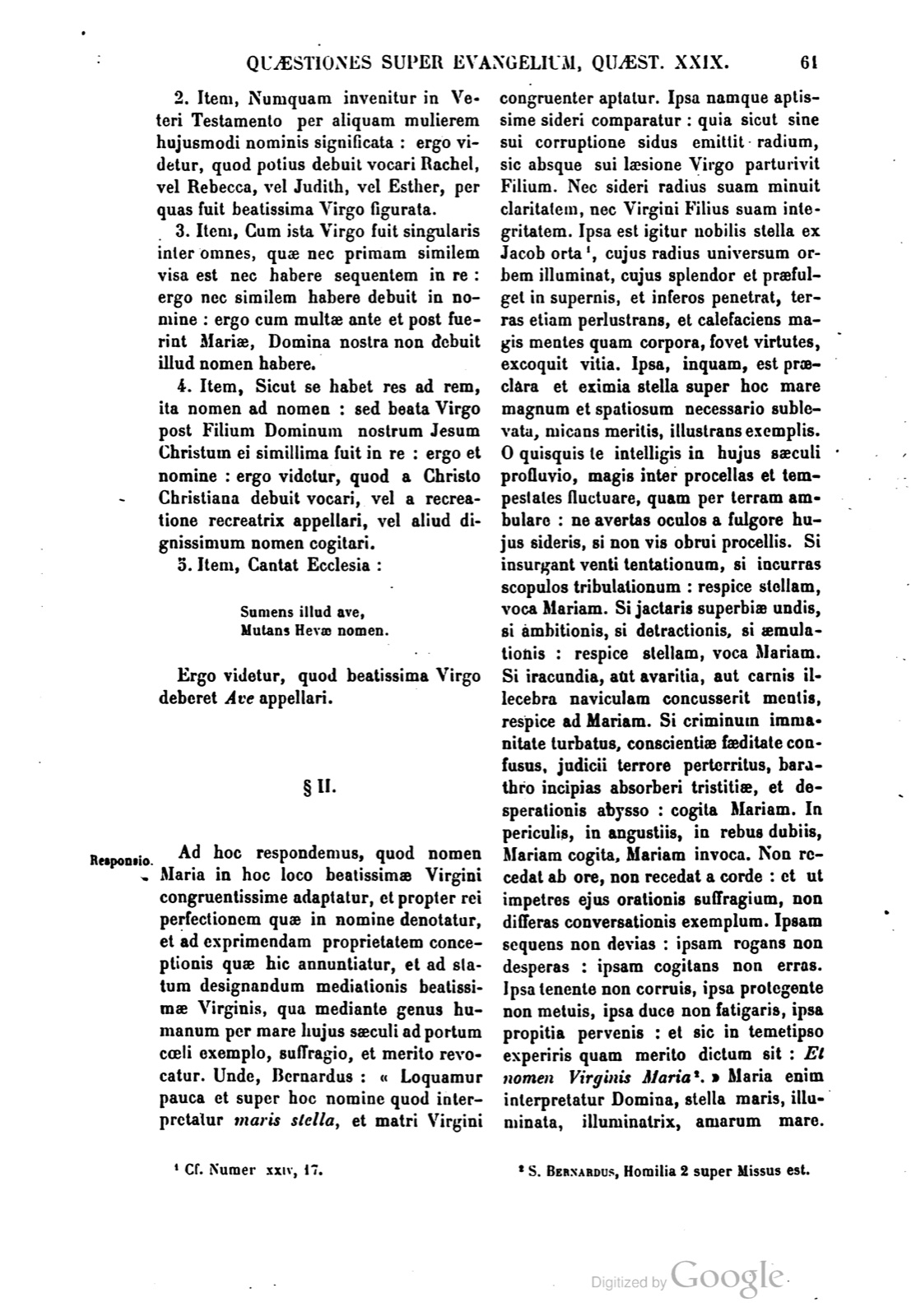
Ipsa enim omnium quorum Deus dominus est, domina est. In quo notatur singularis excellentia veri solis, sine corruptione, vel diminutione, vel sui degeneratione: in quo exprimuntur proprietates conceptionis. Ipsa enim est divinarum illuminationum immediate susceptiva, ipsa omnium bonitatum universaliter distributiva. Inde dicitur stella maris: quia omnibus praesentis vitae gratiis semper plenissima. Inde dicitur Maria: quia sicut in mari est congregatio omnium aquarum, ita in ipsa est aggregatio omnium gratiarum. Unde, Genes. I, 10: Congregationes aquarum vocavit maria. Locus autem gratiarum omnium vocatur Maria. Ipsa enim in sui ipsius conversatione per totum amara, in Filii passione amarissima, omnibus de amaritudine exeuntibus, ipsa exemplum fuit et causa. His autem rationibus beatissima Virgo Maria hic appellatur Maria.
§ III. Non autem hic Heva debuit appellari, eo quod sit mater omnium viventium per generationem spiritualem, cum de illa per se hic non agatur, sed de carnali ejus generatione, qua ex castissimis carnibus et sanguinibus genuit Filium Dei unigenitum et omnium redemptorem. Haec igitur in Filii conceptione sine dolore antequam parturiret, peperit masculum Filium suum primogenitum Jesum Christum. Postea vero tempore passionis parturivit terra in die una, et parturiebatur gens simul, quia parturivit et filios suos peperit. Haec autem quia non parit nisi Filium suum primogenitum sine dolore, sine corruptione, sine diminutione, congruenter designatur nomine stellae. Et sicut sidus radium parit, Virgo Filium pari forma: neque sidus radio, neque Virgo Filio est corrupta. Tempore vero passionis ubi mater misericordiae, Patri misericordiarum in operatione summae misericordiae affuit, et dolorem passionis secum sustinuit, nam ipsius animam pertransivit gladius, et consors passionis, adjutrix facta est redemptionis, et mater regenerationis: unde ibi propter foecunditatem spiritualem qua totius generis humani mater spiritualis effecta est, non sine parturitione doloris omnes nos in vitam aeternam in Filio et per Filium vocavit et regeneravit, mulier merito dicta fuit. Nomine autem Hevae vocari non debuit, cum in re et effectu contraria ei fuit per omnia: illa enim damnavit, ista salvavit: unde et ipsa nomen Hevae mutavit non voce quidem, sed re: illa quidem omnes generavit in mundum, ista in caelos: illa mater carnalis, ista mater misericordiae: illa principium mortalitatis, ista principium regenerationis: illa gratiam perdidit, ista gratiam invenit: illa transivit et nos transire fecit de gratia in culpam, ista surrexit et nos surgere fecit secum de culpa in gratiam: illa de latere viri dormientis facta est, ista de corde Dei vigilantis: illa viro suo occasio perditionis, haec viro adjutorium redemptionis: illa desponsatur mater et origo corruptarum, haec desponsatur mansura mater et Virgo virginum: illa prima virginitatem perdidit, ista prima virginitatem Deo consecravit: illa a diabolo decepta, haec ab Angelo edocta: illam diabolus vicit per superbiam, ista vicit diabolum per humilitatem.
For she herself is Lady of all those whose Lord God is. In this is marked the singular excellence of the true sun, without corruption, or diminution, or degeneration of itself; in this are expressed the properties of the conception. For she herself is immediately receptive of divine illuminations; she herself universally distributive of all goodnesses. Hence she is called star of the sea, because she is always most full of all the graces of the present life. Hence she is called Mary, because as in the sea there is the gathering of all waters, so in her there is the aggregation of all graces. Hence Genesis 1:10: He called the gatherings of the waters seas. But the place of all graces is called Mary. For she herself in her own manner of life was bitter throughout, in the passion of the Son most bitter, and for all who go out from bitterness she herself was the example and the cause. For these reasons, then, the most blessed Virgin Mary is here called Mary.
§ III. But here she ought not to have been called Eve because she is the mother of all living through spiritual generation, since here it is not about that generation of hers in itself, but about her carnal generation, by which from most chaste flesh and blood she generated the only-begotten Son of God and redeemer of all. Therefore in the conception of the Son, without pain before she gave birth, she brought forth a male, her firstborn Son Jesus Christ. But afterwards in the time of the passion she brought forth the earth in one day, and a nation was brought forth at once, because she brought forth and bore her sons. But because this woman gives birth only to her firstborn Son without pain, without corruption, without diminution, she is fittingly designated by the name of star. And as a star gives birth to a ray, the Virgin gives birth to the Son in equal form; neither is the star corrupted by the ray, nor the Virgin by the Son. But in the time of the passion, where the mother of mercy was present to the Father of mercies in the work of highest mercy, and sustained the sorrow of the passion with him, for a sword passed through her own soul, and she, having become companion of the passion, was made the helper of redemption and the mother of regeneration; hence there, because of the spiritual fruitfulness by which she was made the spiritual mother of the whole human race, not without the birth-giving of sorrow she called and regenerated all of us into eternal life in the Son and through the Son, she was deservedly called woman. But she ought not to have been called by the name Eve, since in reality and effect she was contrary to her in all things: for the former condemned, this one saved; hence she herself changed the name of Eve, not indeed in word, but in reality: the former generated all into the world, this one into the heavens; the former was a carnal mother, this one the mother of mercy; the former the beginning of mortality, this one the beginning of regeneration; the former lost grace, this one found grace; the former passed and made us pass from grace into fault, this one rose and made us rise with her from fault into grace; the former was made from the side of the sleeping man, this one from the heart of the wakeful God; the former was an occasion of perdition to her man, this one a help of redemption to her man; the former is betrothed as mother and origin of corrupted women, this one is betrothed as the one who would remain mother and Virgin of virgins; the former first lost virginity, this one first consecrated virginity to God; the former was deceived by the devil, this one taught by the Angel; the devil conquered the former through pride, this one conquered the devil through humility.
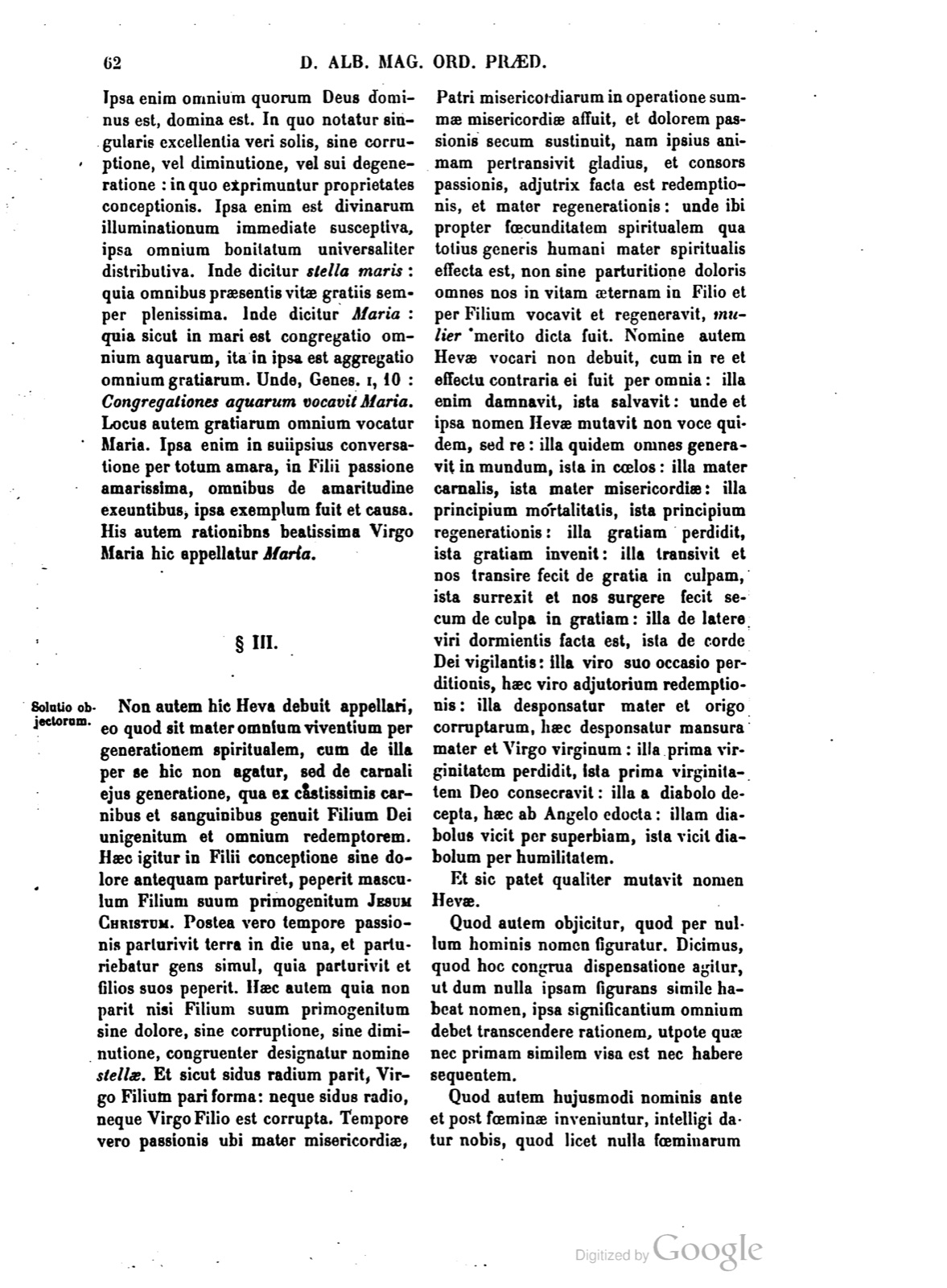
Et sic patet qualiter mutavit nomen Hevae.
Quod autem objicitur, quod per nullum hominis nomen figuratur. Dicimus, quod hoc congrua dispensatione agitur, ut dum nulla ipsam figurans simile habeat nomen, ipsa significantium omnium debet transcendere rationem, utpote quae nec primam similem visa est nec habere sequentem.
Quod autem hujusmodi nominis ante et post foeminae inveniuntur, intelligi datur nobis, quod licet nulla foeminarum ei similetur per aequiparantiam, nulla tamen ab ejus participatione excluditur. In signum igitur quod res sui nominis omnibus communicare desiderat per effectum, et nihil sibi retinere cupiens private proprium, communicat aliis etiam suum nomen.
Item, Non debuit ei esse aliquod nomen a creatore vel a Christo: quia in ista annuntiatione non agitur qualiter ipsa a Christo, sed qualiter Christus ab ea procedit: Christiani nomen non erat ei specialiter imponendum quod erat ad omnes generaliter derivandum. Et si aliquod nomen ei aptari potuerit excellentioris dignitatis, tamen nullum a majori negotii de quo agitur proprietate, ut patet per supra dicta verba beati Bernardi.
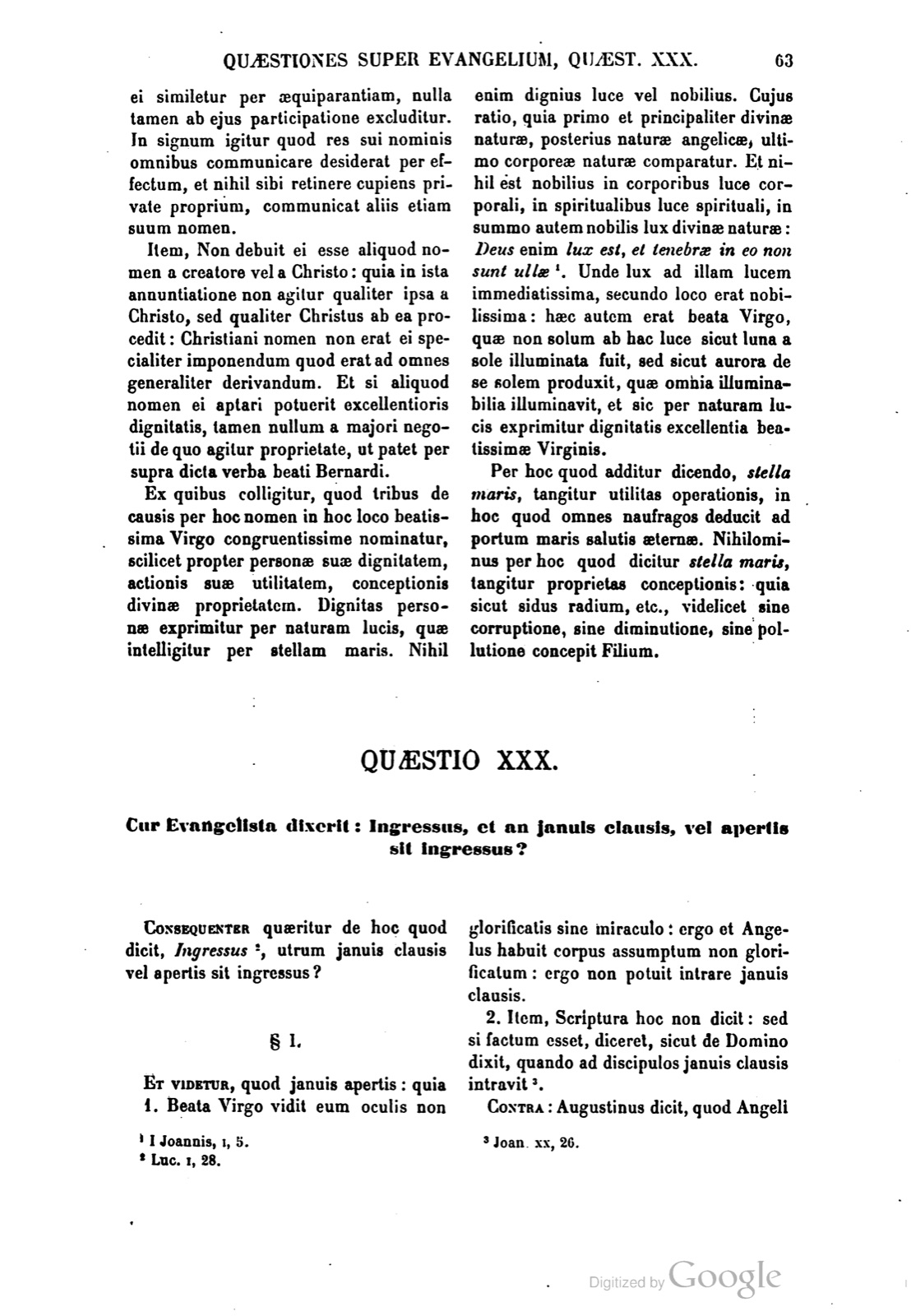
Ex quibus colligitur, quod tribus de causis per hoc nomen in hoc loco beatissima Virgo congruentissime nominatur, scilicet propter personae suae dignitatem, actionis suae utilitatem, conceptionis divinae proprietatem. Dignitas personae exprimitur per naturam lucis, quae intelligitur per stellam maris. Nihil enim dignius luce vel nobilius. Cujus ratio, quia primo et principaliter divinae naturae, posterius naturae angelicae, ultimo corporeae naturae comparatur. Et nihil est nobilius in corporibus luce corporali, in spiritualibus luce spirituali, in summo autem nobilis lux divinae naturae: Deus enim lux est, et tenebrae in eo non sunt ullae 3. Unde lux ad illam lucem immediatissima, secundo loco erat nobilissima: haec autem erat beata Virgo, quae non solum ab hac luce sicut luna a sole illuminata fuit, sed sicut aurora de se solem produxit, qui omnia illuminabilia illuminavit, et sic per naturam lucis exprimitur dignitatis excellentia beatissimae Virginis.
Per hoc quod additur dicendo, stella maris, tangitur utilitas operationis, in hoc quod omnes naufragos deducit ad portum maris salutis aeternae. Nihilominus per hoc quod dicitur stella maris, tangitur proprietas conceptionis: quia sicut sidus radium, etc., videlicet sine corruptione, sine diminutione, sine pollutione concepit Filium.
And thus it is clear how she changed the name of Eve.
As to what is objected, that she is figured by no name of a human being, we say that this is done by a fitting dispensation, so that, while no one figuring her has a similar name, she herself ought to transcend the reckoning of all those signifying her, as one who seems neither to have had a first like herself nor to have a following one.
But as to the fact that women of this sort of name are found before and after, we are given to understand that although no woman is likened to her by equality, nevertheless none is excluded from participation in her. Therefore, as a sign that the reality of her name desires to communicate itself to all by effect, and, wishing to retain nothing private and proper to herself, she communicates even her name to others.
Likewise, there ought not to have been for her any name from the Creator or from Christ, because in this annunciation it is not being treated how she proceeds from Christ, but how Christ proceeds from her. The name Christian was not to be imposed specially upon her, since it was to be derived generally to all. And if some name of more excellent dignity could have been adapted to her, nevertheless none could have been adapted from a greater property of the business under discussion, as is clear through the words of blessed Bernard stated above.
From these things it is gathered that for three causes, through this name in this place, the most blessed Virgin is most fittingly named: namely because of the dignity of her person, the utility of her action, and the property of the divine conception. The dignity of the person is expressed through the nature of light, which is understood through star of the sea. For nothing is worthier or nobler than light. The reason is that it is compared first and principally to the divine nature, afterwards to angelic nature, and lastly to corporeal nature. And nothing is nobler in bodies than corporeal light, in spiritual things than spiritual light, while at the summit the noble light is of the divine nature: for God is light, and in him there is no darkness 3. Hence the light nearest to that light was most noble in the second place; but this was the blessed Virgin, who was not only illumined by this light as the moon by the sun, but as the dawn produced the sun from herself, who illumined all things capable of being illumined; and thus through the nature of light the excellence of dignity of the most blessed Virgin is expressed.
Through what is added by saying star of the sea, the utility of operation is touched, in that she leads all the shipwrecked to the harbor of the sea of eternal salvation. Nonetheless, through what is said, star of the sea, the property of conception is touched, because as a star conceives a ray, etc., namely without corruption, without diminution, without pollution, she conceived the Son.
If a page does not appear, its photograph has not been uploaded yet.