Works › The Mariale: Questions on “Missus est”
Volume 37 · pp. 53–57
Question XXV. Whether it is fitting that the mother of God be noble according to the flesh?
A marker with ≈ is an approximate page boundary, placed by measure of the text; the page photographs remain the authority. In the paired views, clicking a page marker brings that page into view.
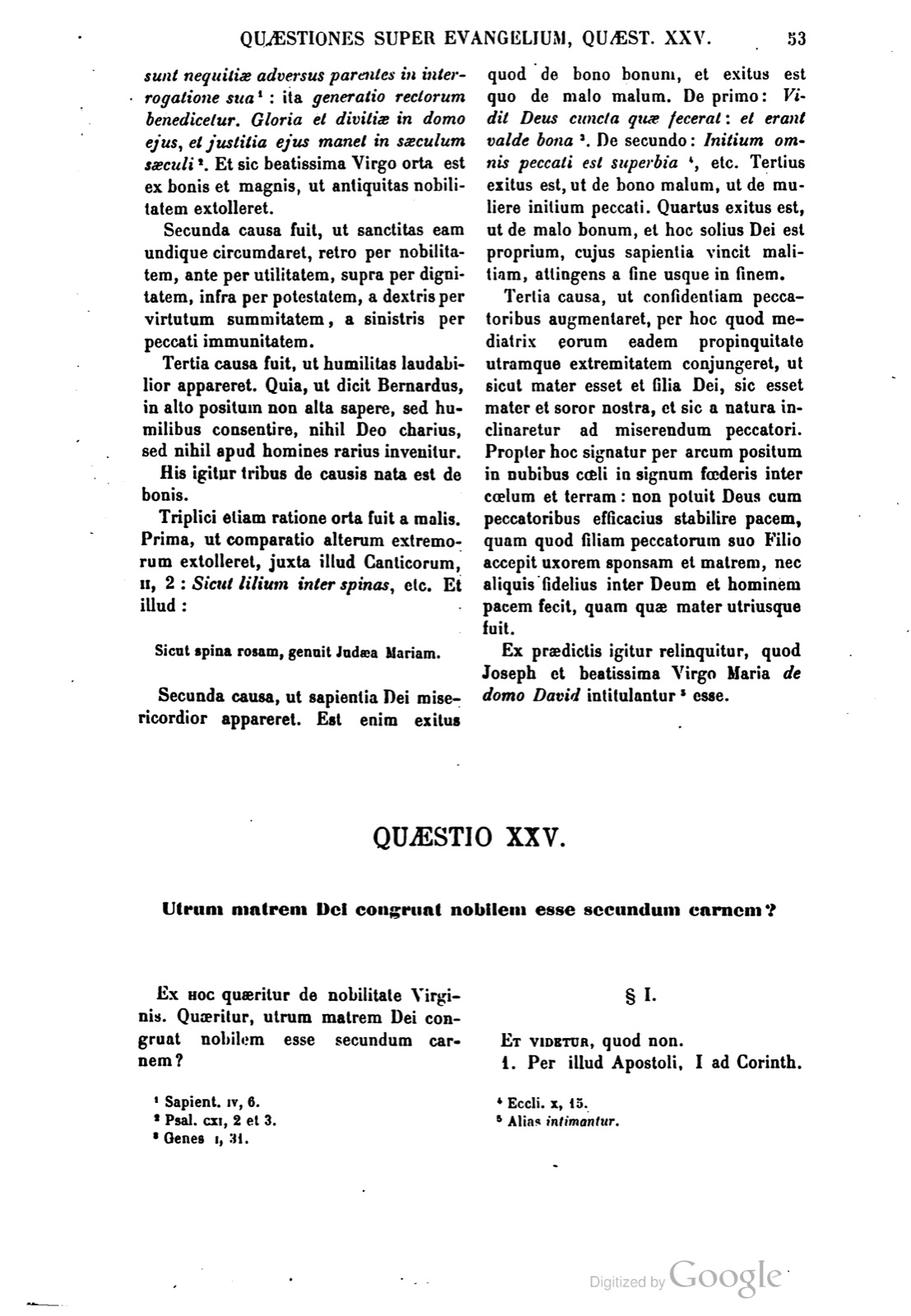
QUAESTIO XXV. Utrum matrem Dei congruat nobilem esse secundum carnem?
Ex hoc quaeritur de nobilitate Virginis. Quaeritur, utrum matrem Dei congruat nobilem esse secundum carnem?
§ I. Et videtur, quod non. 1. Per illud Apostoli, I ad Corinth. 1, 26: Non multi sapientes secundum carnem, non multi potentes, non multi nobiles, etc. Sed beatissimam Virginem maxime elegit et praelegit. Ergo debuit esse ignobilis.
2. Item, Glossa super illud: «Venit enim humilis Deus quaerens humiles, non altos.»
3. Item, Ibidem: «Non elegit reges, vel senatores, vel oratores, sed plebeios, pauperes, indoctos, piscatores.» Ergo cum beatissima Virgo prae omnibus istis sit electa, prae omnibus debuit esse ignobilis, et paupercula, et plebeia.
4. Item, Major videtur humiliatio ex parte Dei de ignobili, quam de nobili incarnari.
Quod si concedatur. Contra: 1. Quanto plus est aliquid elevatum sursum, tanto plus potest deprimi in deorsum: quanto enim mons altior, tanto vallis profundior: ergo quanto aliquid magis elevatum est sursum per nobilitatem et dignitatem, tanto magis potest descendere per humilitatem: sed beatissima Virgo fuit profundissimae humilitatis: ergo debuit esse supremae dignitatis et nobilitatis. Unde Augustinus: «Numquam fuisset super omnes choros Angelorum exaltata, nisi fuisset super omnes homines humiliata.»
2. Item, Bernardus: «In alto positus non alta sapere, ut supra.» Sed beatissima Virgo fuit Deo charissima: ideo debuit esse alta, et non sapere alta, sed humilibus consentire.
3. Item, Bernardus: «Quis non feret tolerabilius superbiam in divite quam in paupere?» Sed humilitas est nobilior in divite quam in paupere: sed humilitas in beatissima Virgine fuit laudabilissima: ergo si humilitas est nobilior in divite quam in paupere: ergo fuit in nobili et divite.
4. Item, Hieronymus dicit quod servitia minus sunt grata, quanto magis sunt debita. Sed servitia magis sunt debita in servis quam in ingenuis. Ergo minus sunt grata in illis quam in istis, et plus in ingenuis. Sed servitia beatissimae Virginis quae erant maximae servitutis, ut census solutio, et professio, et similia, erant Deo gratissima: ergo erant in persona nobilissima.
Ex his videtur, quod congruit, quod beatissima Virgo fuerit nobilissima. Quod autem sic fuerit, manifestum est: Nobilitas rei consistit et consideratur in tribus, in causa, substantia, et efficientia. In causa si a nobili origine principium ducat, in substantia si nobilem substantiam et proprietatem in se possideat, in efficientia si nobiles effectus de se producat. Beatissima igitur Virgo fuit nobilissima, utpote filia principis, in quo sibi Deus populum elegit peculiarem et distinxit ab aliis, Abraham scilicet, a quo ipsa quadragesima et una descendit generatione. In substantia: quia et naturae perfectionem et gratiae plenitudinem in se habuit. In efficientia: quia ipsum Deum de se generavit. Ergo beatissima Virgo in omnibus in quibus nobilitas consideratur, in summo nobilis invenitur.
QUESTION XXV. Whether it is fitting that the mother of God be noble according to the flesh?
From this inquiry is made concerning the nobility of the Virgin. It is asked whether it is fitting that the mother of God be noble according to the flesh.
§ I. And it seems that not. 1. By that saying of the Apostle, 1 Corinthians 1:26: Not many wise according to the flesh, not many powerful, not many noble, etc. But he chose and pre-chose the most blessed Virgin especially. Therefore she ought to have been ignoble.
2. Likewise, the Gloss on that saying: "For the humble God came seeking the humble, not the high."
3. Likewise, in the same place: "He did not choose kings, or senators, or orators, but commoners, poor men, unlearned men, fishermen." Therefore, since the most blessed Virgin was chosen before all these, before all these she ought to have been ignoble, poor, and plebeian.
4. Likewise, it seems a greater humiliation on God's part to be incarnate from an ignoble woman than from a noble one.
But if this is conceded. On the contrary: 1. The more something is elevated upward, the more it can be pressed downward; for the higher the mountain, the deeper the valley; therefore the more something has been elevated upward by nobility and dignity, the more it can descend through humility. But the most blessed Virgin was of the deepest humility; therefore she ought to have been of the highest dignity and nobility. Hence Augustine says: "She would never have been exalted above all the choirs of Angels unless she had been humbled beneath all men."
2. Likewise, Bernard says: "For one placed on high not to think high things," as above. But the most blessed Virgin was most dear to God; therefore she ought to have been high and not to think high things, but to consent to the lowly.
3. Likewise, Bernard says: "Who would not bear pride more tolerably in a rich person than in a poor person?" But humility is nobler in a rich person than in a poor person; but humility in the most blessed Virgin was most praiseworthy. Therefore, if humility is nobler in a rich person than in a poor person, then she was among the noble and rich.
4. Likewise, Jerome says that services are less pleasing the more they are owed. But services are more owed in servants than in freeborn persons. Therefore they are less pleasing in the former than in the latter, and more in the freeborn. But the services of the most blessed Virgin, which were of the greatest servitude, such as payment of census, profession, and the like, were most pleasing to God; therefore they were in a most noble person.
From these things it seems that it is fitting that the most blessed Virgin was most noble. That she was so is manifest: the nobility of a thing consists and is considered in three things, in cause, substance, and efficacy. In cause, if it takes its beginning from a noble origin; in substance, if it possesses a noble substance and property in itself; in efficacy, if it produces noble effects from itself. Therefore the most blessed Virgin was most noble, as the daughter of the prince, in whom God chose for himself a peculiar people and distinguished it from others, namely Abraham, from whom she herself descended in the forty-first generation. In substance, because she had in herself both the perfection of nature and the fullness of grace. In efficacy, because she generated God himself from herself. Therefore in all things in which nobility is considered, the most blessed Virgin is found noble in the highest degree.
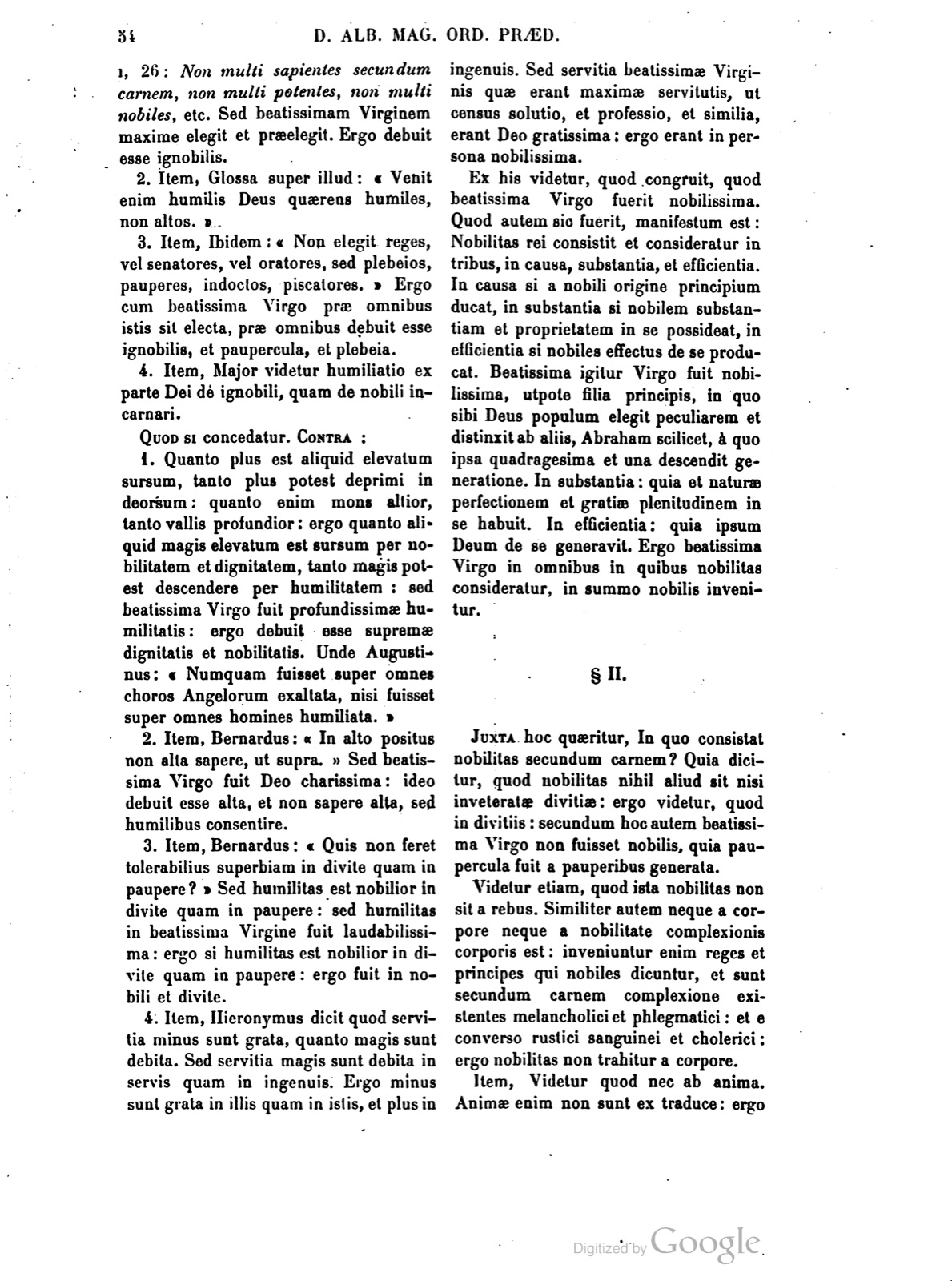
§ II. Juxta hoc quaeritur, In quo consistat nobilitas secundum carnem? Quia dicitur, quod nobilitas nihil aliud sit nisi inveteratae divitiae: ergo videtur, quod in divitiis: secundum hoc autem beatissima Virgo non fuisset nobilis, quia paupercula fuit a pauperibus generata.
Videtur etiam, quod ista nobilitas non sit a rebus. Similiter autem neque a corpore neque a nobilitate complexionis corporis est: inveniuntur enim reges et principes qui nobiles dicuntur, et sunt secundum carnem complexione existentes melancholici et phlegmatici: et e converso rustici sanguinei et cholerici: ergo nobilitas non trahitur a corpore.
Item, Videtur quod nec ab anima. Animae enim non sunt ex traduce: ergo anima filii nihil nobilitatis a patre habet vel ab anima patris.
Item, Seneca dicit, quod non facit nobilitatem atrium plenum majorum imaginibus: quia quod ante nos est, nostrum non est, non enim vixerunt ad nostram gloriam. Et vult probare, sicut omnes qui loquuntur in hac materia, quod tantum nobilis est ille quem nobilitat sua virtus. Nobilitas sola est animum quae moribus ornat. Et sic videtur, quod nobilitas secundum carnem nihil est.
§ III. Ad hoc dicimus, quod beata Virgo secundum omnem dignitatis et perfectionis et nobilitatis modum esse debuit et fuit nobilissima et dignissima in summo.
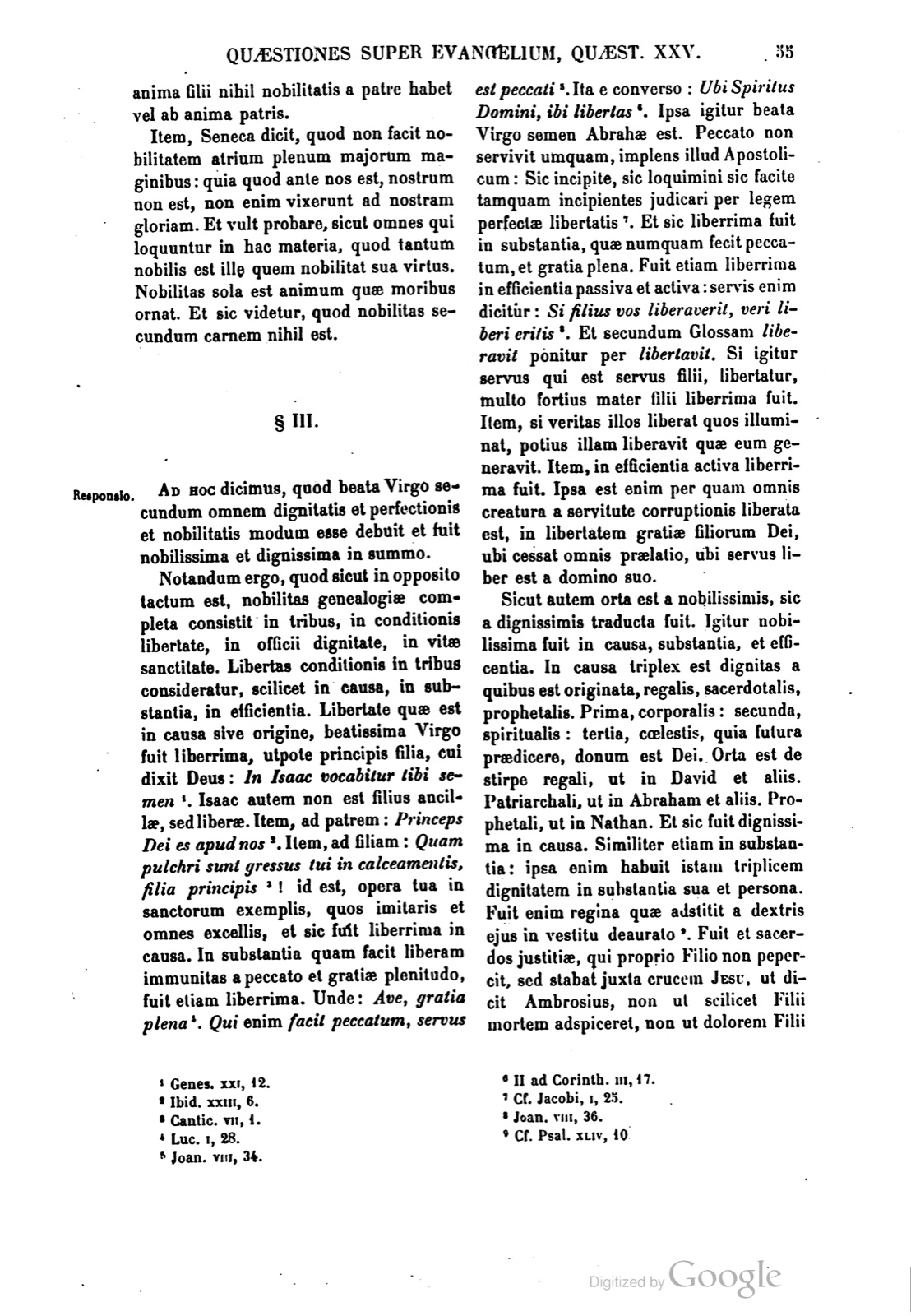
Notandum ergo, quod sicut in opposito tactum est, nobilitas genealogiae completa consistit in tribus, in conditionis libertate, in officii dignitate, in vitae sanctitate. Libertas conditionis in tribus consideratur, scilicet in causa, in substantia, in efficientia. Libertate quae est in causa sive origine, beatissima Virgo fuit liberrima, utpote principis filia, cui dixit Deus: In Isaac vocabitur tibi semen 1. Isaac autem non est filius ancillae, sed liberae. Item, ad patrem: Princeps Dei es apud nos 2. Item, ad filiam: Quam pulchri sunt gressus tui in calceamentis, filia principis 3! id est, opera tua in sanctorum exemplis, quos imitaris et omnes excellis, et sic fuit liberrima in causa. In substantia quam facit liberam immunitas a peccato et gratiae plenitudo, fuit etiam liberrima. Unde: Ave, gratia plena 4. Qui enim facit peccatum, servus est peccati 5. Ita e converso: Ubi Spiritus Domini, ibi libertas 6. Ipsa igitur beata Virgo semen Abrahae est. Peccato non servivit umquam, implens illud Apostolicum: Sic incipite, sic loquimini sic facite tamquam incipientes judicari per legem perfectae libertatis 7. Et sic liberrima fuit in substantia, quae numquam fecit peccatum, et gratia plena. Fuit etiam liberrima in efficientia passiva et activa: servis enim dicitur: Si filius vos liberaverit, veri liberi eritis 8. Et secundum Glossam liberavit ponitur per libertavit. Si igitur servus qui est servus filii, libertatur, multo fortius mater filii liberrima fuit. Item, si veritas illos liberat quos illuminat, potius illam liberavit quae eum generavit. Item, in efficientia activa liberrima fuit. Ipsa est enim per quam omnis creatura a servitute corruptionis liberata est, in libertatem gratiae filiorum Dei, ubi cessat omnis praelatio, ubi servus liber est a domino suo.
§ II. Alongside this it is asked: in what does nobility according to the flesh consist? Because it is said that nobility is nothing other than aged riches; therefore it seems that it consists in riches. According to this, however, the most blessed Virgin would not have been noble, because she was poor and generated from poor parents.
It also seems that this nobility is not from things. Likewise it is neither from the body nor from nobility of bodily complexion; for kings and princes are found who are called noble and yet, according to the flesh, exist with a melancholic and phlegmatic complexion; and conversely, peasants are sanguine and choleric. Therefore nobility is not drawn from the body.
Likewise, it seems not from the soul either. For souls are not from the stock; therefore the soul of the son has nothing of nobility from the father or from the soul of the father.
Likewise, Seneca says that an atrium full of images of ancestors does not make nobility, because what is before us is not ours, for they did not live for our glory. And he wishes to prove, as all who speak in this matter do, that only he is noble whom his own virtue ennobles. Nobility alone is that which adorns the soul with morals. And thus it seems that nobility according to the flesh is nothing.
§ III. To this we say that the blessed Virgin, according to every mode of dignity, perfection, and nobility, ought to be and was most noble and most worthy in the highest degree.
Therefore it should be noted that, as was touched on in the opposite, the complete nobility of genealogy consists in three things: in liberty of condition, in dignity of office, in holiness of life. Liberty of condition is considered in three things, namely in cause, in substance, and in efficacy. With the liberty that is in cause or origin, the most blessed Virgin was most free, as the daughter of the prince to whom God said: In Isaac shall your seed be called 1. But Isaac is not the son of the handmaid, but of the free woman. Likewise, to the father: You are a prince of God among us 2. Likewise, to the daughter: How beautiful are your steps in sandals, daughter of the prince 3! that is, your works in the examples of the saints, whom you imitate and surpass all; and thus she was most free in cause. In substance, which immunity from sin and fullness of grace make free, she was also most free. Hence: Hail, full of grace 4. For he who commits sin is the slave of sin 5. So conversely: Where the Spirit of the Lord is, there is liberty 6. Therefore the blessed Virgin herself is the seed of Abraham. She never served sin, fulfilling that Apostolic saying: So begin, so speak, so act as those beginning to be judged by the law of perfect liberty 7. And thus she was most free in substance, she who never committed sin and was full of grace. She was also most free in passive and active efficacy; for it is said to servants: If the Son shall free you, you will be truly free 8. And according to the Gloss liberavit is put for libertavit. Therefore if a servant who is the servant of the Son is set free, much more was the mother of the Son most free. Likewise, if truth frees those whom it illumines, it freed rather her who generated him. Likewise, in active efficacy she was most free. For she is the one through whom every creature has been freed from the servitude of corruption into the liberty of the grace of the sons of God, where every lordship ceases, where the servant is free from his lord.
Sicut autem orta est a nobilissimis, sic a dignissimis traducta fuit. Igitur nobilissima fuit in causa, substantia, et efficientia. In causa triplex est dignitas a quibus est originata, regalis, sacerdotalis, prophetalis. Prima, corporalis: secunda, spiritualis: tertia, coelestis, quia futura praedicere, donum est Dei. Orta est de stirpe regali, ut in David et aliis. Patriarchali, ut in Abraham et aliis. Prophetali, ut in Nathan. Et sic fuit dignissima in causa. Similiter etiam in substantia: ipsa enim habuit istam triplicem dignitatem in substantia sua et persona. Fuit enim regina quae adstitit a dextris ejus in vestitu deaurato 9. Fuit et sacerdos justitiae, qui proprio Filio non pepercit, sed stabat juxta crucem Jesu, ut dicit Ambrosius, non ut scilicet Filii mortem adspiceret, non ut dolorem Filii consideraret, sed ut salutem humani generis exspectaret. Fuit etiam prophetissa sapientiae. Accessi, inquit Isaias, ad prophetissam 10, etc. Et sic fuit dignissima in substantia. Fuit etiam dignissima in efficientia: ipsa enim triplicem dignitatem originaliter transmisit in Filium principaliter, specialiter in nos, post hoc generaliter Filium genuit, qui rex et sacerdos et propheta fuit. Rex qui habet in vestimento et in femore suo scriptum: Rex regum, et Dominus dominantium 11. De quo solo sapientes reges quaesierunt dicentes: Ubi est qui natus est rex Judaeorum 12? Sacerdos qui est sacerdos justitiae qui est secundum ordinem Melchisedech, qui per proprium sanguinem introivit semel in Sancta, aeterna redemptione inventa 13. Ipse propheta potens fuit in opere et sermone 14. Istam triplicem dignitatem beata Virgo in nos transmisit, quae nos Deo fecit regnum et sacerdotium, imo regale sacerdotium et sacerdotale regnum, de quo dicitur, Luc. 1, 32: Regnabit in domo Jacob, etc. Sic ergo patet, quod nobilissimae genealogiae beata Virgo fuit.
But as she arose from the most noble, so she was drawn from the most worthy. Therefore she was most noble in cause, substance, and efficacy. In cause there is a threefold dignity from which she was originated: royal, priestly, prophetical. The first is bodily; the second, spiritual; the third, heavenly, because to foretell future things is a gift of God. She arose from royal stock, as in David and others; patriarchal, as in Abraham and others; prophetical, as in Nathan. And thus she was most worthy in cause. Likewise also in substance: for she herself had this threefold dignity in her own substance and person. For she was the queen who stood at his right hand in gilded clothing 9. She was also a priest of justice, who did not spare her own Son but stood beside the cross of Jesus, as Ambrose says, not so that she might behold the death of the Son, not so that she might consider the sorrow of the Son, but so that she might await the salvation of the human race. She was also the prophetess of wisdom. I approached, says Isaiah, the prophetess 10, etc. And thus she was most worthy in substance. She was also most worthy in efficacy: for she transmitted the threefold dignity originally into the Son principally, specially into us, and after this generally; she generated the Son, who was king and priest and prophet. A king, who has written on his garment and on his thigh: King of kings and Lord of lords 11. About whom alone the wise kings asked, saying: Where is he who has been born king of the Jews 12? A priest, who is the priest of justice, who is according to the order of Melchizedek, who through his own blood entered once into the Holy Places, eternal redemption having been found 13. He was a prophet powerful in work and speech 14. This threefold dignity the blessed Virgin transmitted into us, she who made us a kingdom and priesthood for God, indeed a royal priesthood and a priestly kingdom, of which it is said, Luke 1:32: He shall reign in the house of Jacob, etc. Thus therefore it is clear that the blessed Virgin was of the most noble genealogy.
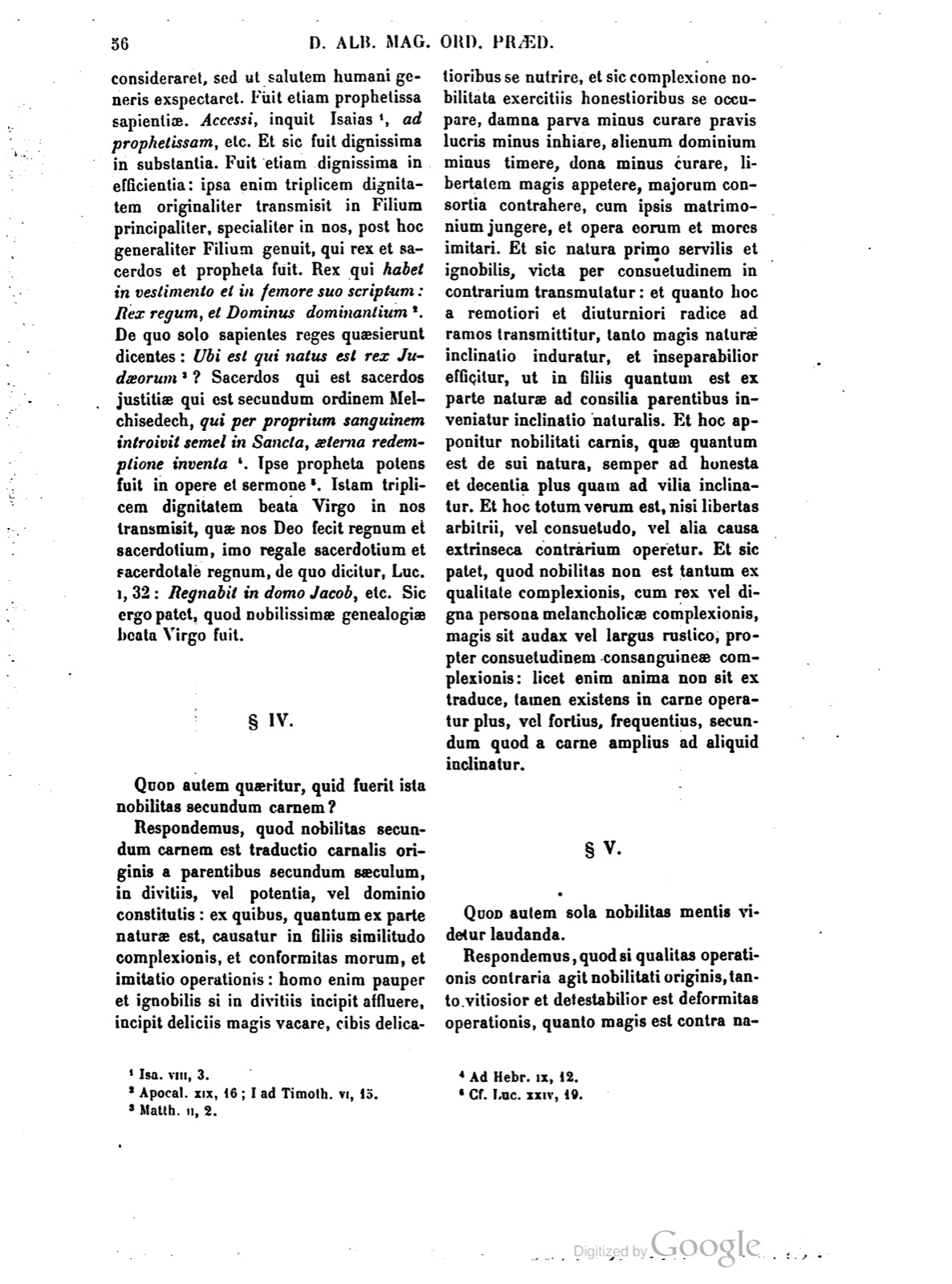
§ IV. Quod autem quaeritur, quid fuerit ista nobilitas secundum carnem? Respondemus, quod nobilitas secundum carnem est traductio carnalis originis a parentibus secundum saeculum, in divitiis, vel potentia, vel dominio constitutis: ex quibus, quantum ex parte naturae est, causatur in filiis similitudo complexionis, et conformitas morum, et imitatio operationis: homo enim pauper et ignobilis si in divitiis incipit affluere, incipit deliciis magis vacare, cibis delicatioribus se nutrire, et sic complexione nobilitata exercitiis honestioribus se occupare, damna parva minus curare pravis lucris minus inhiare, alienum dominium minus timere, dona minus curare, libertatem magis appetere, majorum consortia contrahere, cum ipsis matrimonium jungere, et opera eorum et mores imitari. Et sic natura primo servilis et ignobilis, victa per consuetudinem in contrarium transmutatur: et quanto hoc a remotiori et diuturniori radice ad ramos transmittitur, tanto magis naturae inclinatio induratur, et inseparabilior efficitur, ut in filiis quantum est ex parte naturae ad consilia parentibus inveniatur inclinatio naturalis. Et hoc apponitur nobilitati carnis, quae quantum est de sui natura, semper ad honesta et decentia plus quam ad vilia inclinatur. Et hoc totum verum est, nisi libertas arbitrii, vel consuetudo, vel alia causa extrinseca contrarium operetur. Et sic patet, quod nobilitas non est tantum ex qualitate complexionis, cum rex vel digna persona melancholicae complexionis, magis sit audax vel largus rustico, propter consuetudinem consanguineae complexionis: licet enim anima non sit ex traduce, tamen existens in carne operatur plus, vel fortius, frequentius, secundum quod a carne amplius ad aliquid inclinatur.
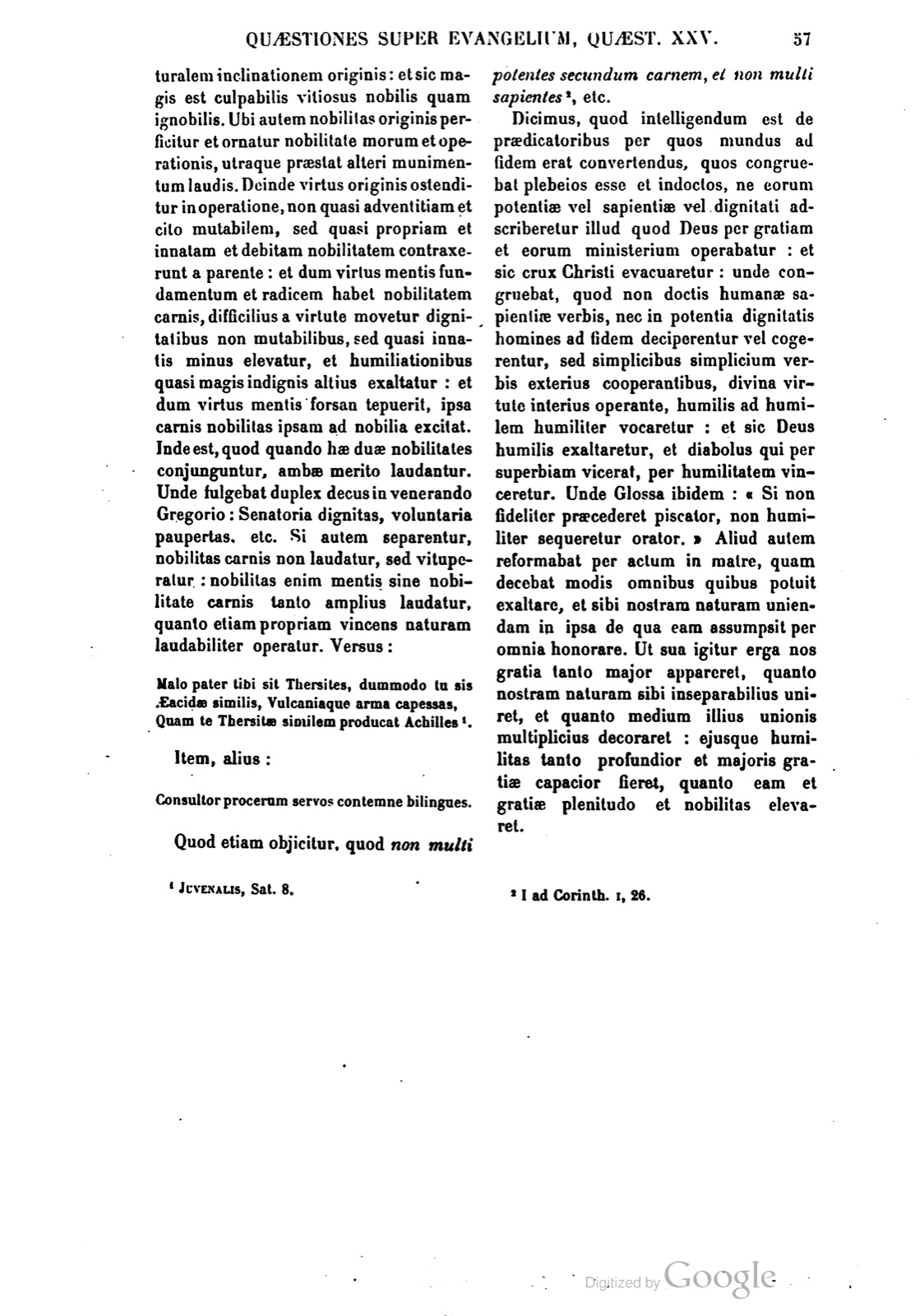
§ V. Quod autem sola nobilitas mentis videtur laudanda. Respondemus, quod si qualitas operationis contraria agit nobilitati originis, tanto vitiosior et detestabilior est deformitas operationis, quanto magis est contra naturalem inclinationem originis: et sic magis est culpabilis vitiosus nobilis quam ignobilis. Ubi autem nobilitas originis perficitur et ornatur nobilitate morum et operationis, utraque praestat alteri munimentum laudis. Deinde virtus originis ostenditur in operatione, non quasi adventitiam et cito mutabilem, sed quasi propriam et innatam et debitam nobilitatem contraxerunt a parente: et dum virtus mentis fundamentum et radicem habet nobilitatem carnis, difficilius a virtute movetur dignitatibus non mutabilibus, sed quasi innatis minus elevatur, et humiliationibus quasi magis indignis altius exaltatur: et dum virtus mentis forsan tepuerit, ipsa carnis nobilitas ipsam ad nobilia excitat. Inde est, quod quando hae duae nobilitates conjunguntur, ambae merito laudantur. Unde fulgebat duplex decus in venerando Gregorio: Senatoria dignitas, voluntaria paupertas, etc. Si autem separentur, nobilitas carnis non laudatur, sed vituperatur: nobilitas enim mentis sine nobilitate carnis tanto amplius laudatur, quanto etiam propriam vincens naturam laudabiliter operatur. Versus: Malo pater tibi sit Thersites, dummodo tu sis Eacidae similis, Vulcaniaque arma capessas, Quam te Thersitae similem producat Achilles 15.
§ IV. But as to what is asked, what was that nobility according to the flesh: we respond that nobility according to the flesh is the transmission of carnal origin from parents according to the world, established in riches, or power, or dominion; from these, so far as it is on the part of nature, there is caused in children a likeness of complexion, conformity of morals, and imitation of action. For a poor and ignoble man, if he begins to abound in riches, begins to have more leisure for pleasures, to nourish himself with more delicate foods, and thus, with his complexion ennobled, to occupy himself with more honorable exercises, to care less for small losses, to pant less after depraved profits, to fear another's dominion less, to care less about gifts, to desire liberty more, to enter the companionships of greater persons, to join in marriage with them, and to imitate their works and morals. And thus a nature first servile and ignoble, conquered by custom, is transformed into the contrary; and the more this is transmitted from a more remote and longer-lasting root to branches, the more the inclination of nature is hardened and becomes more inseparable, so that in the children, so far as it is on the part of nature, a natural inclination toward the counsels of the parents is found. And this is added to the nobility of the flesh, which, so far as it is of its own nature, is always inclined more toward honorable and fitting things than toward base things. And this whole is true, unless freedom of judgment, or custom, or another extrinsic cause works the contrary. And thus it is clear that nobility is not only from quality of complexion, since a king or worthy person of melancholic complexion may be more bold or generous than a peasant, because of the custom of a consanguineous complexion; for although the soul is not from the stock, nevertheless existing in flesh it works more, or more strongly, more frequently, according as it is inclined more by the flesh toward something.
§ V. As to what is said, that only nobility of mind seems praiseworthy: we respond that if the quality of operation acts contrary to the nobility of origin, the deformity of operation is more vicious and more detestable, the more it is against the natural inclination of origin; and thus the vicious noble is more culpable than the ignoble. But where nobility of origin is perfected and adorned by nobility of morals and operation, each supplies the other with a defense of praise. Then the virtue of origin is shown in operation, not as if they contracted from the parent an adventitious and quickly changeable nobility, but as if they contracted a proper, innate, and owed nobility; and when virtue of mind has nobility of flesh as foundation and root, it is moved from virtue with more difficulty by dignities that are not changeable, but as if innate it is less elevated, and by humiliations that are as if more unworthy it is exalted higher; and when perhaps the virtue of mind has grown lukewarm, that nobility of flesh itself stirs it to noble things. Hence it is that when these two nobilities are joined, both are deservedly praised. Hence a double honor shone in venerable Gregory: senatorial dignity, voluntary poverty, etc. But if they are separated, nobility of flesh is not praised but blamed; for nobility of mind without nobility of flesh is praised so much the more as, also conquering its own nature, it acts laudably. A verse: I prefer that your father be Thersites, provided that you yourself are like the descendant of Aeacus and take up Vulcanian arms, than that Achilles produce you like Thersites 15.
Item, alius: Consultor procerum servos contemne bilingues.
Quod etiam objicitur, quod non multi potentes secundum carnem, et non multi sapientes, etc. 16. Dicimus, quod intelligendum est de praedicatoribus per quos mundus ad fidem erat convertendus, quos congruebat plebeios esse et indoctos, ne eorum potentiae vel sapientiae vel dignitati adscriberetur illud quod Deus per gratiam et eorum ministerium operabatur: et sic crux Christi evacuaretur: unde congruebat, quod non doctis humanae sapientiae verbis, nec in potentia dignitatis homines ad fidem deciperentur vel cogerentur, sed simplicibus simplicium verbis exterius cooperantibus, divina virtute interius operante, humilis ad humilem humiliter vocaretur: et sic Deus humilis exaltaretur, et diabolus qui per superbiam vicerat, per humilitatem vinceretur. Unde Glossa ibidem: «Si non fideliter praecederet piscator, non humiliter sequeretur orator.» Aliud autem reformabat per actum in matre, quam decebat modis omnibus quibus potuit exaltare, et sibi nostram naturam uniendam in ipsa de qua eam assumpsit per omnia honorare. Ut sua igitur erga nos gratia tanto major appareret, quanto nostram naturam sibi inseparabilius uniret, et quanto medium illius unionis multiplicius decoraret: ejusque humilitas tanto profundior et majoris gratiae capacior fieret, quanto eam et gratiae plenitudo et nobilitas elevaret.
Likewise, another: Counselor of nobles, despise double-tongued slaves.
As to what is also objected, that not many powerful according to the flesh and not many wise, etc. 16, we say that this must be understood of the preachers through whom the world was to be converted to the faith; it was fitting that they be plebeian and unlearned, lest that which God worked through grace and their ministry be ascribed to their power, or wisdom, or dignity, and thus the cross of Christ be emptied. Hence it was fitting that men not be deceived or compelled to the faith by learned words of human wisdom, nor by power of dignity, but by the simple words of simple persons cooperating outwardly, with divine power working inwardly, the humble one might be called humbly to the humble one; and thus the humble God would be exalted, and the devil who had conquered through pride would be conquered through humility. Hence the Gloss in the same place: "If the fisherman had not faithfully gone before, the orator would not humbly have followed." But he was reforming another thing through act in the mother, whom it befitted him to exalt in all the ways in which he could, and in her, from whom he assumed it, to honor in every way the nature to be united to himself. Therefore, so that his grace toward us might appear so much greater, the more inseparably he united our nature to himself, and the more multiply he adorned the medium of that union, and so that her humility would become so much deeper and more capable of greater grace, the more both fullness of grace and nobility elevated her.
Notes
- Genesis 21:12. (Genes. XXI, 12.) ↩
- The same, 23:6. (Ibid. XXIII, 6.) ↩
- Song of Songs 7:1. (Cantic. VII, 1.) ↩
- Luke 1:28. (Luc. I, 28.) ↩
- John 8:34. (Joan. VIII, 34.) ↩
- Second Corinthians 3:17. (II ad Corinth. III, 17.) ↩
- Compare James 1:25. (Cf. Jacobi, I, 25.) ↩
- John 8:36. (Joan. VIII, 36.) ↩
- Compare Psalm 44:10. (Cf. Psal. XLIV, 10.) ↩
- Isaiah 8:3. (Isa. VIII, 3.) ↩
- Revelation 19:16; First Timothy 6:15. (Apocal. XIX, 16; I ad Timoth. VI, 15.) ↩
- Matthew 2:2. (Matth. II, 2.) ↩
- To the Hebrews 9:12. (Ad Hebr. IX, 12.) ↩
- Compare Luke 24:19. (Cf. Luc. XXIV, 19.) ↩
- Juvenal, Satire 8. (Juvenalis, Sat. 8.) ↩
- First Corinthians 1:26. (I ad Corinth. I, 26.) ↩
If a page does not appear, its photograph has not been uploaded yet.