Works › The Mariale: Questions on “Missus est”
Volume 37 · pp. 47–48
Questions XXI-XXII
A marker with ≈ is an approximate page boundary, placed by measure of the text; the page photographs remain the authority. In the paired views, clicking a page marker brings that page into view.
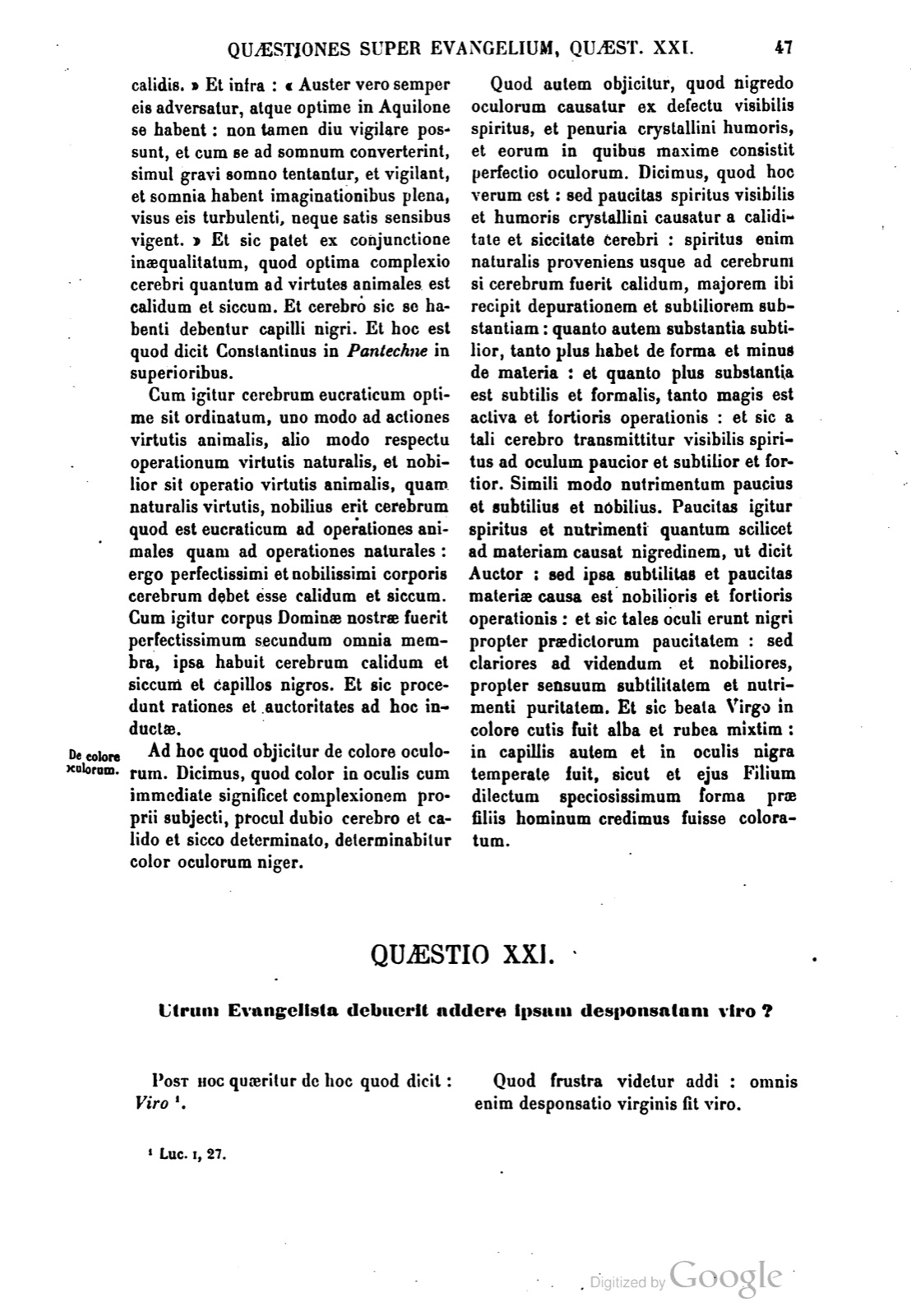
Quaestio XXI. Utrum Evangelista debuerit addere ipsam desponsatam viro?
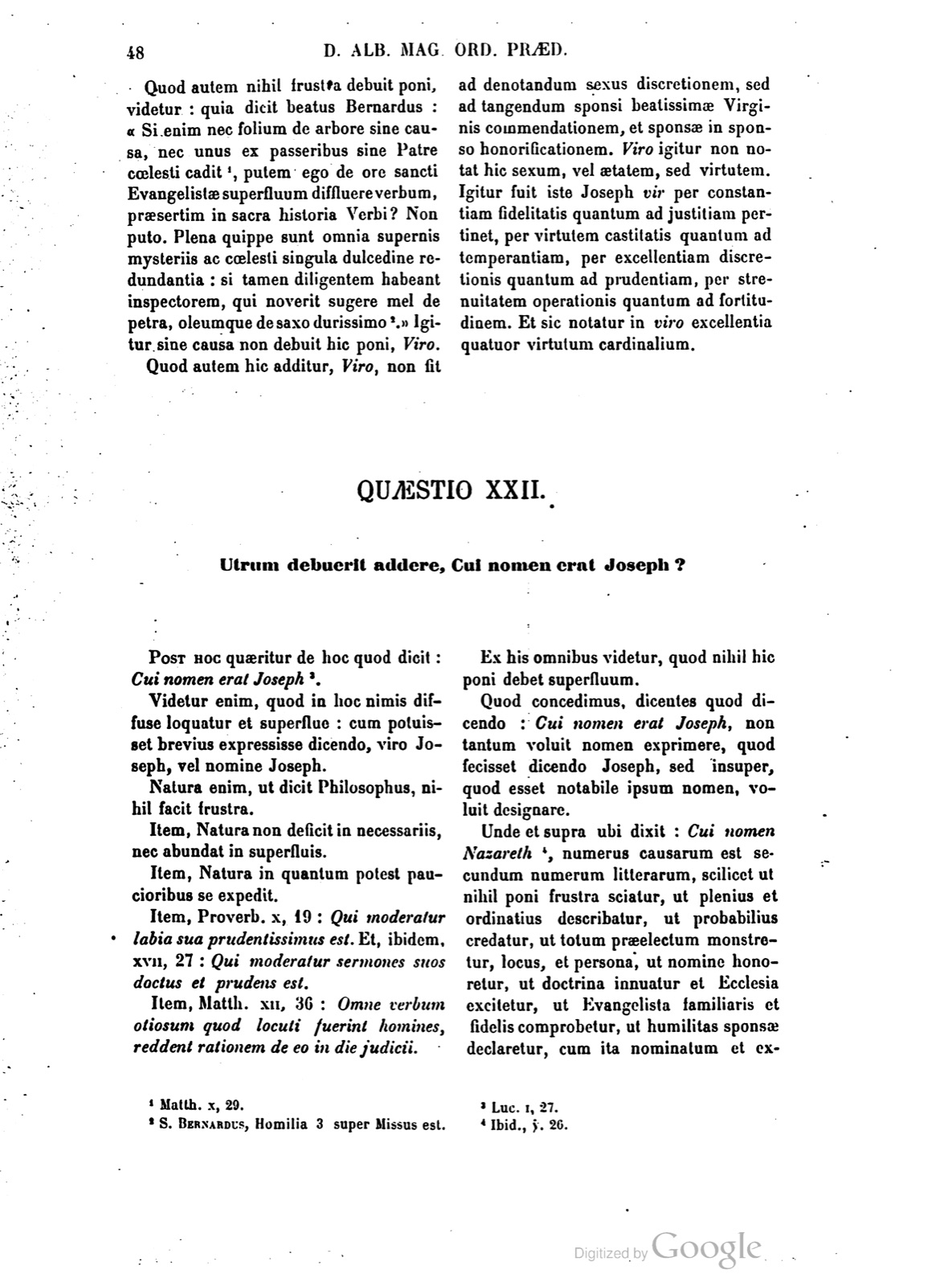
Post hoc quaeritur de hoc quod dicit: Viro 1. Quod frustra videtur addi: omnis enim desponsatio virginis fit viro. Quod autem nihil frustra debuit poni, videtur: quia dicit beatus Bernardus: «Si enim nec folium de arbore sine causa, nec unus ex passeribus sine Patre caelesti cadit 2, putem ego de ore sancti Evangelistae superfluum diffluere verbum, praesertim in sacra historia Verbi? Non puto. Plena quippe sunt omnia supernis mysteriis ac caelesti singula dulcedine redundantia: si tamen diligentem habeant inspectorem, qui noverit sugere mel de petra, oleumque de saxo durissimo 3.» Igitur sine causa non debuit hic poni, Viro. Quod autem hic additur, Viro, non fit ad denotandum sexus discretionem, sed ad tangendum sponsi beatissimae Virginis commendationem, et sponsae in sponso honorificationem. Viro igitur non notat hic sexum, vel aetatem, sed virtutem. Igitur fuit iste Joseph vir per constantiam fidelitatis quantum ad justitiam pertinet, per virtutem castitatis quantum ad temperantiam, per excellentiam discretionis quantum ad prudentiam, per strenuitatem operationis quantum ad fortitudinem. Et sic notatur in viro excellentia quatuor virtutum cardinalium.
Quaestio XXII. Utrum debuerit addere, Cui nomen erat Joseph?
Post hoc quaeritur de hoc quod dicit: Cui nomen erat Joseph 4. Videtur enim, quod in hoc nimis diffuse loquatur et superflue: cum potuisset brevius expressisse dicendo, viro Joseph, vel nomine Joseph. Natura enim, ut dicit Philosophus, nihil facit frustra. Item, Natura non deficit in necessariis, nec abundat in superfluis. Item, Natura in quantum potest paucioribus se expedit. Item, Proverb. X, 19: Qui moderatur labia sua prudentissimus est. Et, ibidem, XVII, 27: Qui moderatur sermones suos doctus et prudens est. Item, Matth. XII, 36: Omne verbum otiosum quod locuti fuerint homines, reddent rationem de eo in die judicii. Ex his omnibus videtur, quod nihil hic poni debet superfluum.
Question XXI. Whether the Evangelist ought to have added that she was espoused to a man.
After this inquiry is made about what he says: To a man 1. This seems to be added in vain, for every espousal of a virgin is made to a man. But that nothing ought to have been placed in vain seems so because blessed Bernard says: "For if neither a leaf from a tree without cause, nor one of the sparrows falls without the heavenly Father 2, shall I think that a superfluous word flows from the mouth of the holy Evangelist, especially in the sacred history of the Word? I do not think so. Indeed all things are full of heavenly mysteries, and each thing overflows with celestial sweetness, if nevertheless they have a diligent inspector who knows how to suck honey from the rock and oil from the hardest stone 3." Therefore To a man ought not to have been placed here without cause. But that To a man is added here is not done to denote distinction of sex, but to touch upon the commendation of the spouse of the most blessed Virgin, and the honoring of the bride in the bridegroom. Therefore To a man does not here note sex or age, but virtue. Therefore this Joseph was a man by constancy of faithfulness as pertains to justice, by the virtue of chastity as to temperance, by the excellence of discretion as to prudence, and by strenuousness of operation as to fortitude. And thus in man the excellence of the four cardinal virtues is noted.
Question XXII. Whether he ought to have added, Whose name was Joseph.
After this inquiry is made about what he says: Whose name was Joseph 4. For it seems that in this he speaks too diffusely and superfluously, since he could have expressed it more briefly by saying, to a man Joseph, or by the name Joseph. For nature, as the Philosopher says, does nothing in vain. Likewise, nature does not fail in necessities nor abound in superfluities. Likewise, nature, insofar as it can, accomplishes itself with fewer things. Likewise, Proverbs X, 19: He who moderates his lips is most prudent. And in the same place, XVII, 27: He who moderates his words is learned and prudent. Likewise, Matthew XII, 36: Every idle word that human beings have spoken, they shall render an account of it on the day of judgment. From all these things it seems that nothing superfluous ought to be placed here.
Quod concedimus, dicentes quod dicendo: Cui nomen erat Joseph, non tantum voluit nomen exprimere, quod fecisset dicendo Joseph, sed insuper, quod esset notabile ipsum nomen, voluit designare. Unde et supra ubi dixit: Cui nomen Nazareth 5, numerus causarum est secundum numerum litterarum, scilicet ut nihil poni frustra sciatur, ut plenius et ordinatius describatur, ut probabilius credatur, ut totum praelectum monstretur, locus, et persona, ut nomine honoretur, ut doctrina innuatur et Ecclesia excitetur, ut Evangelista familiaris et fidelis comprobetur, ut humilitas sponsae declaretur, cum ita nominatum et expresse
This we concede, saying that by saying Whose name was Joseph, he wished not only to express the name, which he would have done by saying Joseph, but in addition wished to designate that the name itself was notable. Hence also above, where he said, Whose name was Nazareth 5, the number of causes is according to the number of letters, namely so that it may be known that nothing is placed in vain, so that it may be described more fully and more orderly, so that it may be believed more probably, so that the whole thing selected beforehand may be shown, the place and the person, so that it may be honored by name, so that doctrine may be insinuated and the Church stirred up, so that the Evangelist may be proved familiar and faithful, so that the humility of the bride may be declared, since the spouse so named and expressly
If a page does not appear, its photograph has not been uploaded yet.