Works › The Mariale: Questions on “Missus est”
Volume 37 · pp. 41–47
Questions XVIII-XX
A marker with ≈ is an approximate page boundary, placed by measure of the text; the page photographs remain the authority. In the paired views, clicking a page marker brings that page into view.
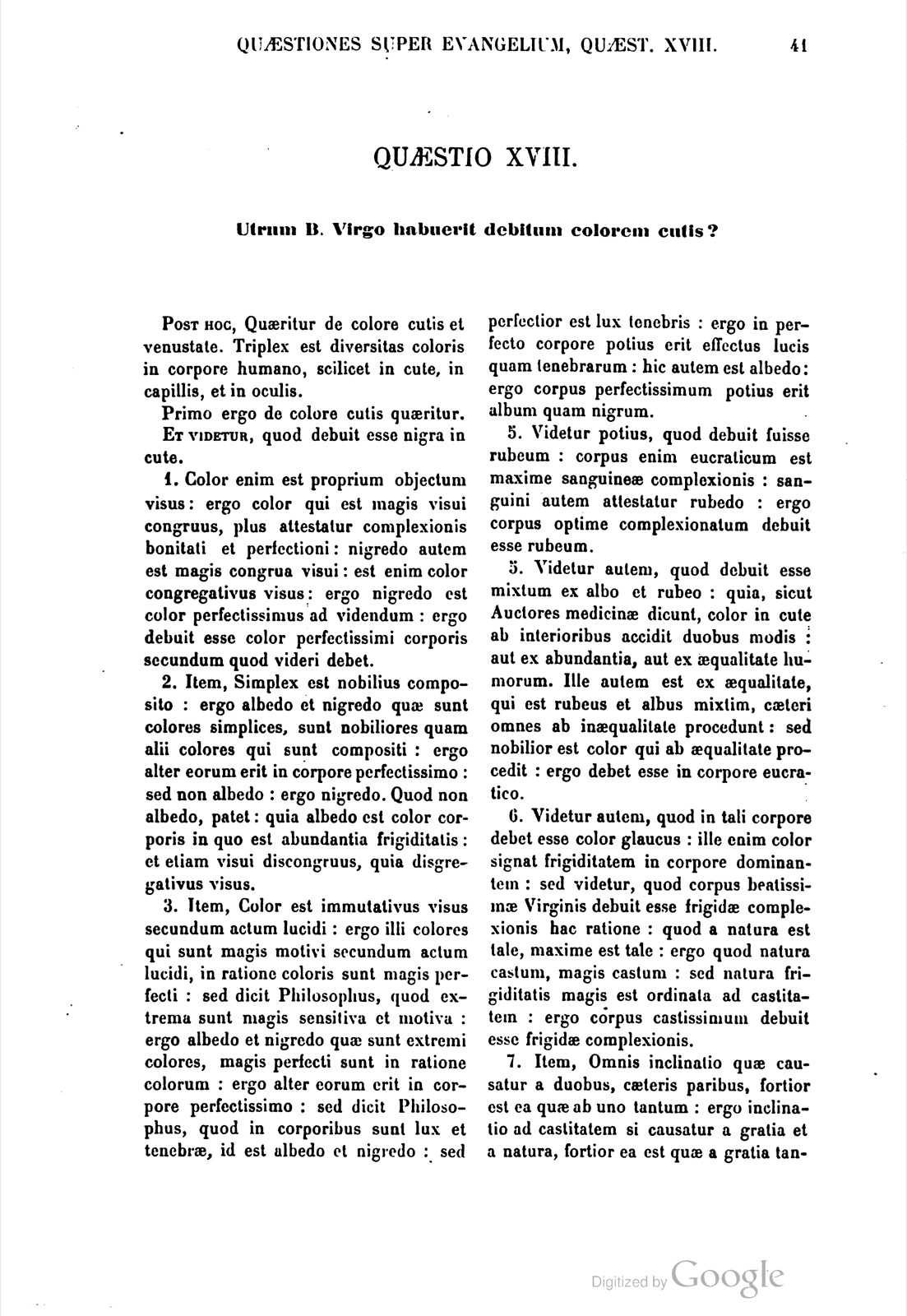
Quaestio XVIII. Utrum B. Virgo habuerit debitum colorem cutis?
Post hoc, Quaeritur de colore cutis et venustate. Triplex est diversitas coloris in corpore humano, scilicet in cute, in capillis, et in oculis. Primo ergo de colore cutis quaeritur. Et videtur, quod debuit esse nigra in cute. 1. Color enim est proprium objectum visus: ergo color qui est magis visui congruus, plus attestatur complexionis bonitati et perfectioni: nigredo autem est magis congrua visui: est enim color congregativus visus: ergo nigredo est color perfectissimus ad videndum: ergo debuit esse color perfectissimi corporis secundum quod videri debet. 2. Item, Simplex est nobilius composito: ergo albedo et nigredo quae sunt colores simplices, sunt nobiliores quam alii colores qui sunt compositi: ergo alter eorum erit in corpore perfectissimo: sed non albedo: ergo nigredo. Quod non albedo, patet: quia albedo est color corporis in quo est abundantia frigiditatis: et etiam visui discongruus, quia disgregativus visus. 3. Item, Color est immutativus visus secundum actum lucidi: ergo illi colores qui sunt magis motivi secundum actum lucidi, in ratione coloris sunt magis perfecti: sed dicit Philosophus, quod extrema sunt magis sensitiva et motiva: ergo albedo et nigredo quae sunt extremi colores, magis perfecti sunt in ratione colorum: ergo alter eorum erit in corpore perfectissimo: sed dicit Philosophus, quod in corporibus sunt lux et tenebrae, id est albedo et nigredo: sed perfectior est lux tenebris: ergo in perfecto corpore potius erit effectus lucis quam tenebrarum: hic autem est albedo: ergo corpus perfectissimum potius erit album quam nigrum. 5. Videtur potius, quod debuit fuisse rubeum: corpus enim eucraticum est maxime sanguineae complexionis: sanguini autem attestatur rubedo: ergo corpus optime complexionatum debuit esse rubeum. 5. Videtur autem, quod debuit esse mixtum ex albo et rubeo: quia, sicut Auctores medicinae dicunt, color in cute ab interioribus accidit duobus modis: aut ex abundantia, aut ex aequalitate humorum. Ille autem est ex aequalitate, qui est rubeus et albus mixtim, caeteri omnes ab inaequalitate procedunt: sed nobilior est color qui ab aequalitate procedit: ergo debet esse in corpore eucratico. 6. Videtur autem, quod in tali corpore debet esse color glaucus: ille enim color signat frigiditatem in corpore dominantem: sed videtur, quod corpus beatissimae Virginis debuit esse frigidae complexionis hac ratione: quod a natura est tale, maxime est tale: ergo quod natura castum, magis castum: sed natura frigiditatis magis est ordinata ad castitatem: ergo corpus castissimum debuit esse frigidae complexionis. 7. Item, Omnis inclinatio quae causatur a duobus, caeteris paribus, fortior est ea quae ab uno tantum: ergo inclinatio ad castitatem si causatur a gratia et a natura, fortior ea est quae a gratia tantum: ergo corpus castissimum debuit causari a gratia et natura: ergo debuit frigidae complexionis esse. 8. Item, Bonum additum bono naturae facit magis bonum: ergo bonum gratiae additum bono naturae, facit ipsum magis bonum: ergo plena secundum gratiam, debuit esse perfectissima secundum naturam: ergo debuit esse frigidae complexionis. 9. Item, Magis manifestatur potentia e contrario secundum naturam et contra naturalem inclinationem elicere contrarium, quam de tali tale: sed perfectius et nobilius est, in quo magis manifestatur potentia: ergo perfectior et nobilior est castitas in calidum quam in frigidum: sed castitas beatissimae Virginis fuit perfectissima: ergo fuit calidae complexionis. 10. Item, Ubi est magis de contrarietate, ibi est major actio et pugna: sed ubi major pugna, ibi difficilior victoria: ubi autem est difficilior victoria, major gloria: ergo de primo ad ultimum, ubi major pugna, ibi major gloria: ergo gloriosior est castitas in calidum quam in frigidum. 11. Item, Philosophus: Incontinens est, qui patitur et deducitur: continens autem, qui patitur nec deducitur: insensibilis, qui nec patitur nec deducitur: sed medium virtutis est pati nec deduci: ergo virtuosior est castitas, ubi major passio a contrario: hoc autem est in calidis: ergo, etc. 1.
Question XVIII. Whether the blessed Virgin had due color of skin.
After this inquiry is made about color of skin and loveliness. There is a threefold diversity of color in the human body, namely in the skin, in the hair, and in the eyes. First, therefore, inquiry is made about the color of skin. And it seems that she ought to have been black in skin. 1. For color is the proper object of sight; therefore the color that is more fitting to sight attests more to the goodness and perfection of complexion. But blackness is more fitting to sight, for it is a color that gathers sight together. Therefore blackness is the most perfect color for seeing; therefore it ought to have been the color of the most perfect body insofar as it ought to be seen. 2. Likewise, the simple is nobler than the composite; therefore whiteness and blackness, which are simple colors, are nobler than other colors, which are composite. Therefore one of them will be in the most perfect body. But not whiteness; therefore blackness. That it is not whiteness is clear, because whiteness is the color of a body in which there is an abundance of coldness, and it is also unfitting to sight, because it scatters sight. 3. Likewise, color changes sight according to the act of the luminous; therefore those colors that are more motive according to the act of the luminous are more perfect in the account of color. But the Philosopher says that extremes are more sensitive and motive; therefore whiteness and blackness, which are extreme colors, are more perfect in the account of colors. Therefore one of them will be in the most perfect body. But the Philosopher says that in bodies there are light and darkness, that is, whiteness and blackness; but light is more perfect than darkness. Therefore in a perfect body there will rather be the effect of light than of darkness; and this is whiteness. Therefore the most perfect body will rather be white than black. 5. It seems rather that it ought to have been red, for a well-tempered body is especially of sanguine complexion, and redness attests to blood; therefore a body of the best complexion ought to have been red. 5. But it seems that it ought to have been mixed from white and red, because, as the authors of medicine say, color in the skin happens from interior things in two ways: either from abundance or from equality of humors. But that color is from equality which is red and white in mixture; all the others proceed from inequality. But the color that proceeds from equality is nobler; therefore it ought to be in a well-tempered body. 6. But it seems that in such a body there ought to be a glaucous color, for that color signifies coldness dominating in the body. But it seems that the body of the most blessed Virgin ought to have been of cold complexion for this reason: what is such by nature is most such; therefore what is chaste by nature is more chaste. But the nature of coldness is more ordered to chastity; therefore the most chaste body ought to have been of cold complexion. 7. Likewise, every inclination that is caused by two things, other things being equal, is stronger than one caused by one alone; therefore an inclination to chastity, if caused by grace and by nature, is stronger than one that is from grace alone. Therefore the most chaste body ought to be caused by grace and nature; therefore it ought to have been of cold complexion. 8. Likewise, a good added to a good of nature makes it better; therefore a good of grace added to a good of nature makes it better. Therefore she who was full according to grace ought to have been most perfect according to nature; therefore she ought to have been of cold complexion. 9. Likewise, power is more manifested in eliciting the contrary from a contrary according to nature and against natural inclination, than in producing such from such. But that in which power is more manifested is more perfect and nobler; therefore chastity is more perfect and nobler in a warm body than in a cold one. But the chastity of the most blessed Virgin was most perfect; therefore she was of warm complexion. 10. Likewise, where there is more contrariety, there is greater action and struggle; but where there is greater struggle, there is more difficult victory; and where victory is more difficult, glory is greater. Therefore from first to last, where there is greater struggle, there is greater glory; therefore chastity is more glorious in a warm body than in a cold one. 11. Likewise, the Philosopher says: the incontinent person is one who suffers and is led away; the continent one, who suffers and is not led away; the insensible one, who neither suffers nor is led away. But the mean of virtue is to suffer and not be led away. Therefore chastity is more virtuous where there is greater passion from the contrary; but this is in warm bodies; therefore, etc. 1.
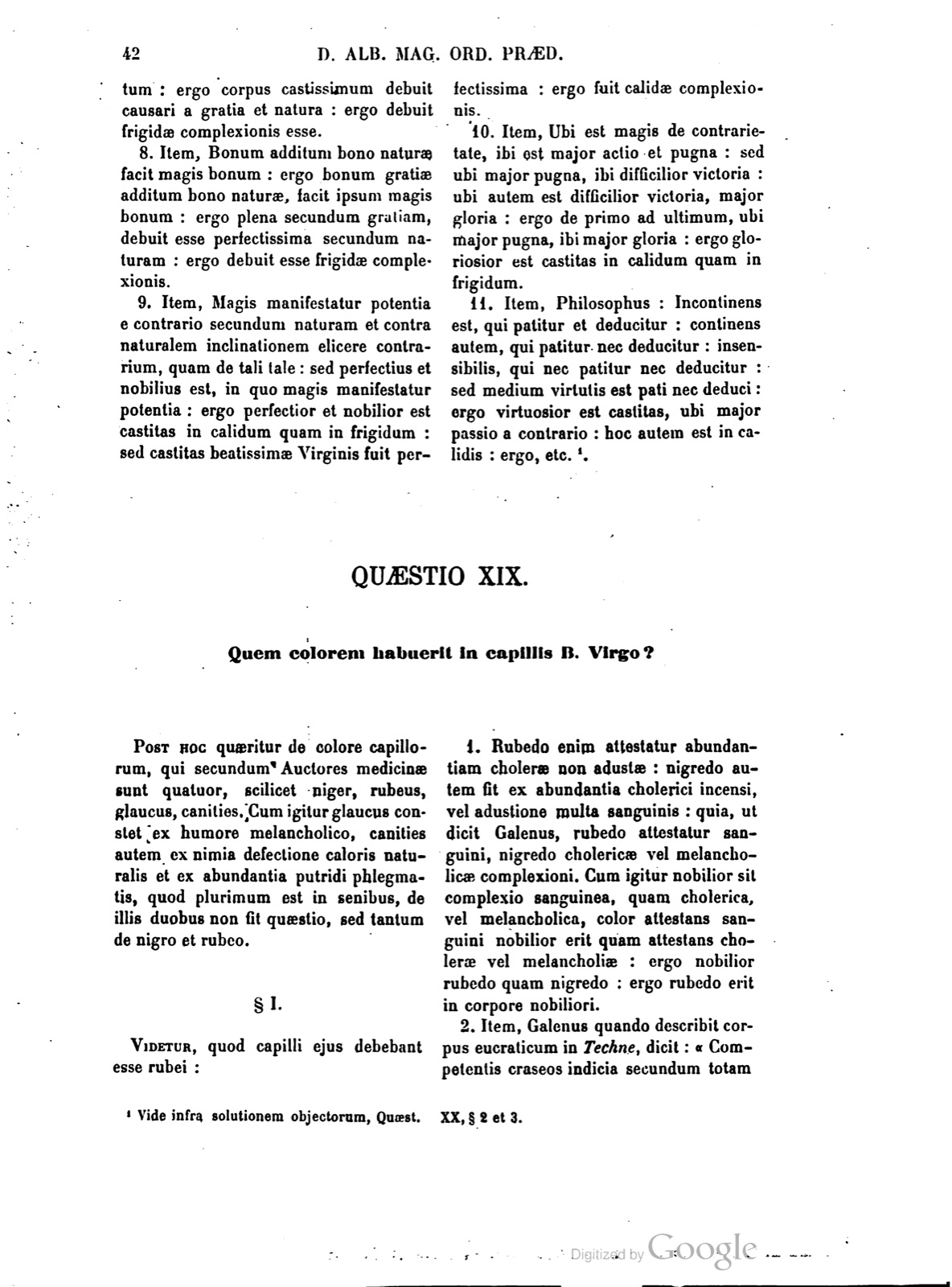
Quaestio XIX. Quem colorem habuerit in capillis B. Virgo?
Post hoc quaeritur de colore capillorum, qui secundum Auctores medicinae sunt quatuor, scilicet niger, rubeus, glaucus, canities. Cum igitur glaucus constet ex humore melancholico, canities autem ex nimia defectione caloris naturalis et ex abundantia putridi phlegmatis, quod plurimum est in senibus, de illis duobus non fit quaestio, sed tantum de nigro et rubeo.
§ I. Videtur, quod capilli ejus debebant esse rubei: 1. Rubedo enim attestatur abundantiam cholerae non adustae: nigredo autem fit ex abundantia cholerici incensi, vel adustione multa sanguinis: quia, ut dicit Galenus, rubedo attestatur sanguini, nigredo cholericae vel melancholicae complexioni. Cum igitur nobilior sit complexio sanguinea, quam cholerica, vel melancholica, color attestans sanguini nobilior erit quam attestans cholerae vel melancholiae: ergo nobilior rubedo quam nigredo: ergo rubedo erit in corpore nobiliori. 2. Item, Galenus quando describit corpus eucraticum in Techne, dicit: «Competentis craseos indicia secundum totam animalis habitudinem haec sunt, scilicet color ex albo et rubeo mixtus, capilli vero flavi mediocriter et crispi in pluribus, etc.» Ergo in corpore eucratico capilli debent esse rubei. 3. Item, In eodem: «Nam si eucraticum cerebrum existat secundum quatuor qualitates, omnia quae dicta sunt habebit cum medio, et superfluitates quaecumque per palatum, vel aures, vel oculos vel nares purgantur, haec habebit moderate, et minime laedetur ab omnibus quae extrinsecus calefaciunt, vel infrigidant, vel siccant, vel humectant.» Taliter igitur capilli capitis cum adhuc sunt infantes, subfulvi. Ergo in optimo sibi complexionato cerebro capilli debent esse rubei: hoc est autem cerebrum nostrae Dominae: ergo, etc.
Question XIX. What color the blessed Virgin had in her hair.
After this inquiry is made about the color of hair, which according to the authors of medicine is fourfold, namely black, red, glaucous, and grayness. Since, therefore, glaucous consists from melancholic humor, and grayness from excessive deficiency of natural heat and from an abundance of putrid phlegm, which is especially in old persons, no question is made about those two, but only about black and red.
§ I. It seems that her hair ought to have been red. 1. For redness attests to an abundance of non-burnt choler; but blackness comes from an abundance of inflamed choleric humor or from much burning of blood, because, as Galen says, redness attests to blood, blackness to choleric or melancholic complexion. Since, therefore, sanguine complexion is nobler than choleric or melancholic complexion, the color attesting to blood will be nobler than that attesting to choler or melancholy; therefore redness is nobler than blackness; therefore redness will be in the nobler body. 2. Likewise, when Galen describes a well-tempered body in the Techne, he says: "The signs of a fitting mixture according to the whole animal disposition are these, namely color mixed from white and red, but hair moderately blond and curly in most persons, etc." Therefore in a well-tempered body the hair ought to be red. 3. Likewise, in the same place: "For if the brain exists as well-tempered according to the four qualities, it will have all things that have been said with a mean, and whatever superfluities are purged through the palate, or ears, or eyes, or nostrils, it will have these moderately, and will be least harmed by all things that heat, cool, dry, or moisten from outside." Therefore in this way, while they are still infants, the hairs of the head are somewhat tawny. Therefore in the brain best complexioned for itself the hair ought to be red. But this is the brain of our Lady; therefore, etc.
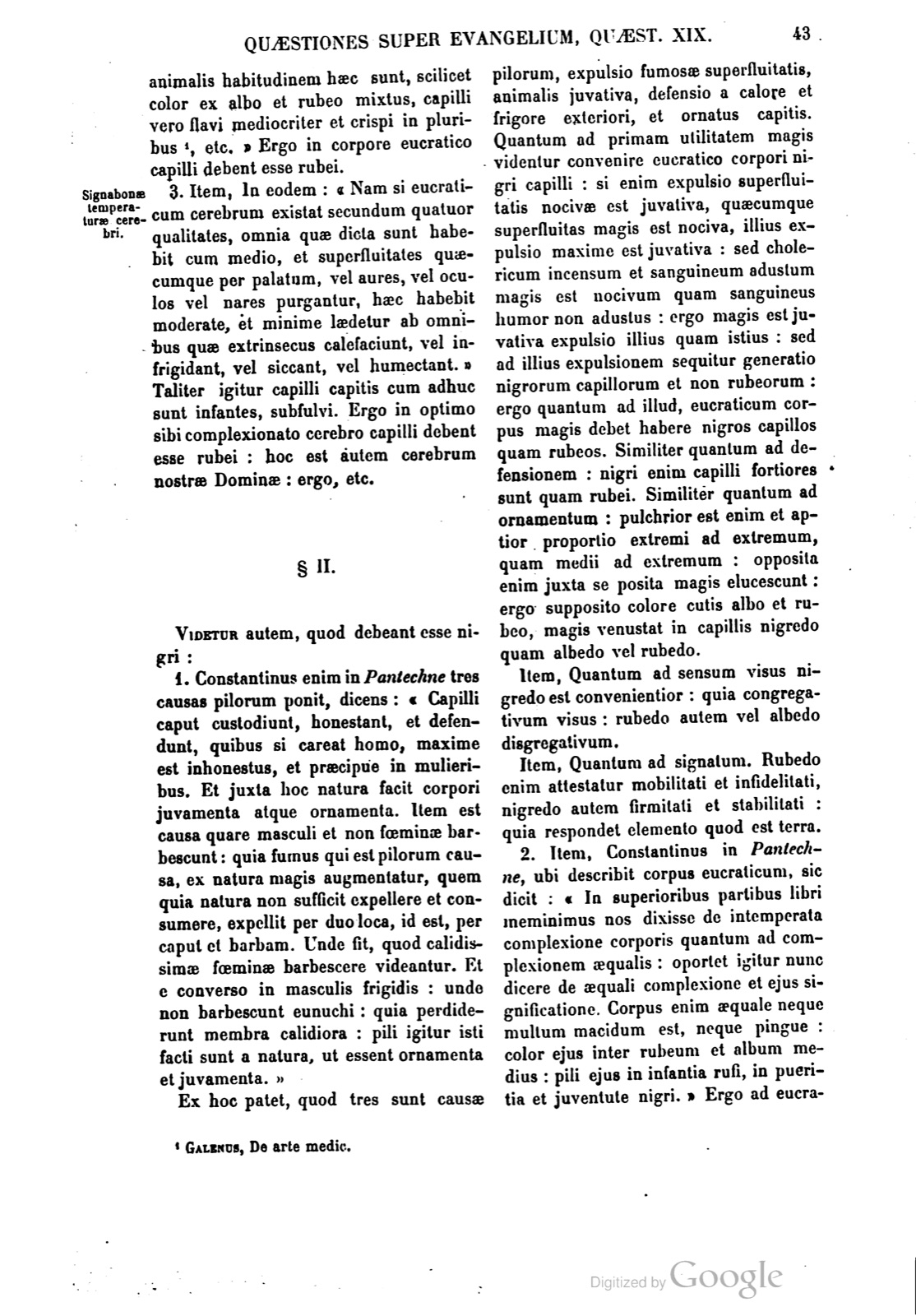
§ II. Videtur autem, quod debeant esse nigri: 1. Constantinus enim in Pantechne tres causas pilorum ponit, dicens: «Capilli caput custodiunt, honestant, et defendunt, quibus si careat homo, maxime est inhonestus, et praecipue in mulieribus. Et juxta hoc natura facit corpori juvamenta atque ornamenta. Item est causa quare masculi et non feminae barbescunt: quia fumus qui est pilorum causa, ex natura magis augmentatur, quem quia natura non sufficit expellere et consumere, expellit per duo loca, id est, per caput et barbam. Unde fit, quod calidissimae feminae barbescere videantur. Et e converso in masculis frigidis: unde non barbescunt eunuchi: quia perdiderunt membra calidiora: pili igitur isti facti sunt a natura, ut essent ornamenta et juvamenta.» Ex hoc patet, quod tres sunt causae pilorum, expulsio fumosae superfluitatis, animalis juvativa, defensio a calore et frigore exteriori, et ornatus capitis. Quantum ad primam utilitatem magis videntur convenire eucratico corpori nigri capilli: si enim expulsio superfluitatis nocivae est juvativa, quaecumque superfluitas magis est nociva, illius expulsio maxime est juvativa: sed cholericum incensum et sanguineum adustum magis est nocivum quam sanguineus humor non adustus: ergo magis est juvativa expulsio illius quam istius: sed ad illius expulsionem sequitur generatio nigrorum capillorum et non rubeorum: ergo quantum ad illud, eucraticum corpus magis debet habere nigros capillos quam rubeos. Similiter quantum ad defensionem: nigri enim capilli fortiores sunt quam rubei. Similiter quantum ad ornamentum: pulchrior est enim et aptior proportio extremi ad extremum, quam medii ad extremum: opposita enim juxta se posita magis elucescunt: ergo supposito colore cutis albo et rubeo, magis venustat in capillis nigredo quam albedo vel rubedo. Item, Quantum ad sensum visus nigredo est convenientior: quia congregativum visus: rubedo autem vel albedo disgregativum. Item, Quantum ad signatum. Rubedo enim attestatur mobilitati et infidelitati, nigredo autem firmitati et stabilitati: quia respondet elemento quod est terra. 2. Item, Constantinus in Pantechne, ubi describit corpus eucraticum, sic dicit: «In superioribus partibus libri meminimus nos dixisse de intemperata complexione corporis quantum ad complexionem aequalis: oportet igitur nunc dicere de aequali complexione et ejus significatione. Corpus enim aequale neque multum macidum est, neque pingue: color ejus inter rubeum et album medius: pili ejus in infantia rufi, in pueritia et juventute nigri.» Ergo ad eucraticum corpus pertinet nigredo in capillis secundum Constantinum. Et sic etiam videtur controversia inter Constantinum et Galenum: cum hic nigrum capillorum colorem ponat in aequali corpore, ille autem rubeum. 3. Item, Eadem contrarietas invenitur inter illos qui loquuntur de corporis pulchritudine, quorum unus sic dicit: «Feminenum plene si vis formare decorem, praeformet capiti naturae circinus orbem, crinibus irrutilet nitor et aurum.» Ergo vult, quod capilli debent esse aurei coloris. Alter autem dicit sic: «Spectandum nigris oculis, etc.» 4. Item in Canticis, ubi describitur pulchritudo spiritualis per exteriorem pulchritudinem, dicitur sic: Comae ejus sunt sicut elatae palmarum, nigrae quasi corvus 2. Ergo videtur, quod ad exteriorem pulchritudinem per quam interior describitur, pertineat nigredo in capillis. Quia, ut dicit Magister Richardus de sancto Victore super illud Genesis XLIX, 21: Nephthali cervus emissus, et dans eloquia pulchritudinis, pulchre hominem interiorem eisdem verbis reficit, et exteriorem, dum per exteriora visibilia ad invisibilem pulchritudinem intellectum traducit. Ergo ad exteriorem pulchritudinem, per quam hujusmodi intellectus traducitur ad interiorem, pertinet nigredo in capillis. 5. Item, Secundum complexionem innatam soboles solent assimilari parentibus, et e contra: sed videmus, quod genus Judaeorum ut in pluribus habet nigros capillos: ergo et Domina nostra cum fuit de progenie Judaeorum. 6. Item, Veronica praetendit nigram barbam et nigros fuisse crines in Domino: ergo in Domina nostra, cum maxima fuerit similitudo inter ipsos 3.
§ II. But it seems that they ought to be black. 1. For Constantine in the Pantechne sets down three causes of hairs, saying: "Hairs guard, adorn, and defend the head; if a human being lacks them, he is especially dishonored, and particularly in women. And according to this, nature makes helps and ornaments for the body. Likewise there is a reason why males and not females grow beards: because the smoke that is the cause of hairs is more increased from nature; since nature is not sufficient to expel and consume it, it expels it through two places, that is, through the head and the beard. Hence it happens that very warm women seem to grow beards. And conversely in cold males; hence eunuchs do not grow beards because they have lost the warmer members. Therefore these hairs were made by nature so that they would be ornaments and helps." From this it is clear that there are three causes of hairs: the expulsion of smoky superfluity, aid to the animal power, defense from exterior heat and cold, and adornment of the head. As to the first usefulness, black hairs seem more fitting for a well-tempered body. For if expulsion of harmful superfluity is helpful, the more harmful any superfluity is, the more helpful is its expulsion. But inflamed choleric humor and burnt sanguine humor are more harmful than sanguine humor not burnt; therefore the expulsion of the former is more helpful than of the latter. But the generation of black hairs and not red ones follows the expulsion of the former. Therefore as to this, a well-tempered body ought to have black hair rather than red hair. Similarly as to defense, for black hairs are stronger than red. Similarly as to ornament, for the proportion of extreme to extreme is more beautiful and more apt than that of middle to extreme; for opposites placed next to one another shine out more. Therefore, supposing the color of skin white and red, blackness in the hair gives more loveliness than whiteness or redness. Likewise, as to the sense of sight, blackness is more fitting, because it gathers sight together, but redness or whiteness scatters it. Likewise, as to the thing signified, redness attests to mobility and unfaithfulness, but blackness to firmness and stability, because it corresponds to the element that is earth. 2. Likewise, Constantine in the Pantechne, where he describes a well-tempered body, says thus: "In the earlier parts of the book we remember having spoken about the intemperate complexion of the body in comparison with an equal complexion; therefore now we must speak about equal complexion and its signification. For an equal body is neither very thin nor fat; its color is intermediate between red and white; its hairs are red in infancy, black in boyhood and youth." Therefore, according to Constantine, blackness in hairs belongs to a well-tempered body. And thus there also seems to be a controversy between Constantine and Galen, since the former sets down black color of hairs in an equal body, but the latter red. 3. Likewise, the same contrariety is found among those who speak about bodily beauty, of whom one says thus: "If you wish fully to form feminine beauty, let the compass of nature shape the circle for the head; let brightness and gold glow red in the hair." Therefore he means that the hair ought to be of golden color. But another says thus: "One must look with black eyes, etc." 4. Likewise in Canticles, where spiritual beauty is described through exterior beauty, it is said thus: His locks are like lifted palm-branches, black as a raven 2. Therefore it seems that blackness in the hair pertains to exterior beauty through which interior beauty is described. Because, as Master Richard of Saint Victor says on Genesis XLIX, 21, Naphtali is a stag let loose and giving words of beauty, he beautifully refreshes the inner man and the outer with the same words, while through exterior visible things he leads the understanding across to invisible beauty. Therefore blackness in the hair pertains to exterior beauty through which understanding of this sort is led across to interior beauty. 5. Likewise, according to innate complexion offspring are accustomed to be like parents, and conversely; but we see that the race of the Jews in most cases has black hair; therefore also our Lady, since she was from the stock of the Jews. 6. Likewise, Veronica presents that the beard was black and the hairs were black in the Lord; therefore also in our Lady, since there was the greatest likeness between them 3.
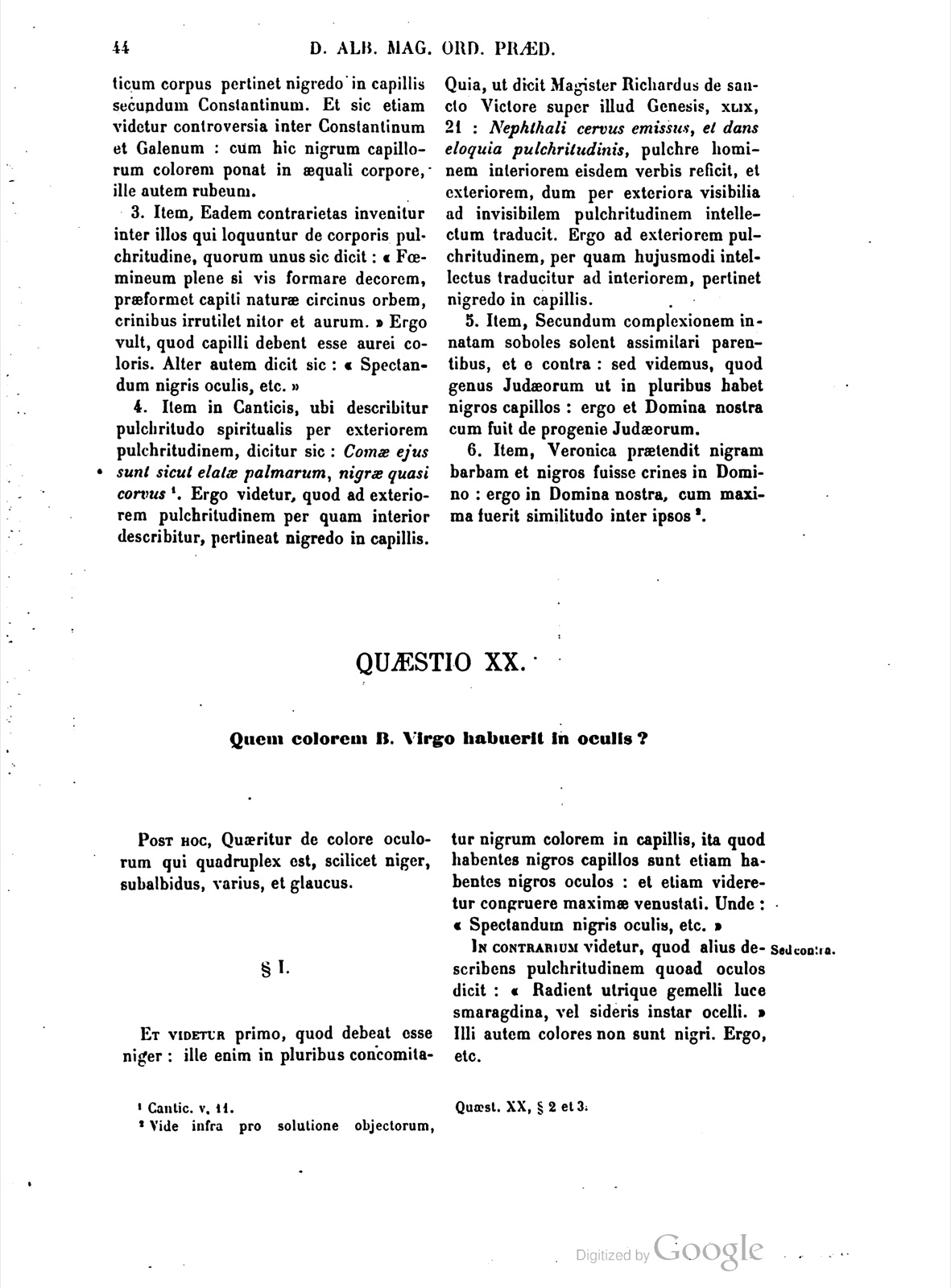
Quaestio XX. Quem colorem B. Virgo habuerit in oculis?
Post hoc, Quaeritur de colore oculorum qui quadruplex est, scilicet niger, subalbidus, varius, et glaucus.
§ I. Et videtur primo, quod debeat esse niger: ille enim in pluribus concomitatur nigrum colorem in capillis, ita quod habentes nigros capillos sunt etiam habentes nigros oculos: et etiam videretur congruere maximae venustati. Unde: «Spectandum nigris oculis, etc.» In contrarium videtur, quod alius describens pulchritudinem quoad oculos dicit: «Radient utrique gemelli luce smaragdina, vel sideris instar ocelli.» Illi autem colores non sunt nigri. Ergo, etc. Item, Nigredo oculorum, ut dicit Joannicius, provenit ex defectu spiritus visibilis, vel perturbatione ipsius, aut ex penuria crystallini humoris, aut quia plurimum recedit interius crystallinus humor, aut ex humore abundanti qui est similis albugini ovi, aut est ex perturbatione ipsius, aut ex abundantia qualitatis uvei humoris. Ergo cum iste color in oculis causetur maxime ex defectu eorum in quibus consistit oculi perfectio ad videndum, ut est spiritus visibilis et humor crystallinus, nullo modo iste color erit eucratici corporis. De glauco et aliis non fit quaestio: cum attestentur minus nobili complexioni.
§ II. Responsio. Ad hoc respondendum est, quod sex sunt colores cutis, ex albedine et rubedine compositus, niger, citrinus, glaucus, albus, et rubeus. Et solus ille qui est ex rubore et albedine compositus, ut dicit Joannicius, est ab aequalitate procedens: alii vero omnes ab inaequalitate. Primus est nobilissimus et corpori eucratico determinatus, et sic a Galeno in temperata complexione positus est, et simili modo a Constantino in Pantechne. Hunc igitur concedimus in corpore beatissimae Virginis exstitisse.
Question XX. What color the blessed Virgin had in her eyes.
After this inquiry is made about the color of the eyes, which is fourfold, namely black, whitish, various, and glaucous.
§ I. And first it seems that it ought to be black, for in most cases that color accompanies black color in the hairs, so that those having black hairs also have black eyes, and it would also seem to be fitting for the greatest loveliness. Hence: "One must look with black eyes, etc." To the contrary it seems that another, describing beauty as to the eyes, says: "Let each twin eye shine with emerald light, or like a star." But those colors are not black. Therefore, etc. Likewise, blackness of the eyes, as Joannicius says, comes from a defect of visible spirit, or disturbance of it, or from lack of crystalline humor, or because the crystalline humor recedes very much inwardly, or from abundant humor that is like the white of an egg, or from disturbance of it, or from an abundance of the quality of the uveal humor. Therefore since that color in the eyes is caused especially by a defect of those things in which the perfection of the eye for seeing consists, such as visible spirit and crystalline humor, in no way will that color belong to a well-tempered body. No question is made about glaucous and the others, since they attest to a less noble complexion.
§ II. Response. To this one must respond that there are six colors of skin: one composed from whiteness and redness, black, citrine, glaucous, white, and red. And only that one which is composed from redness and whiteness, as Joannicius says, proceeds from equality; all the others from inequality. The first is the noblest and determined for a well-tempered body, and thus it has been placed by Galen in a temperate complexion, and similarly by Constantine in the Pantechne. Therefore we concede that this existed in the body of the most blessed Virgin.
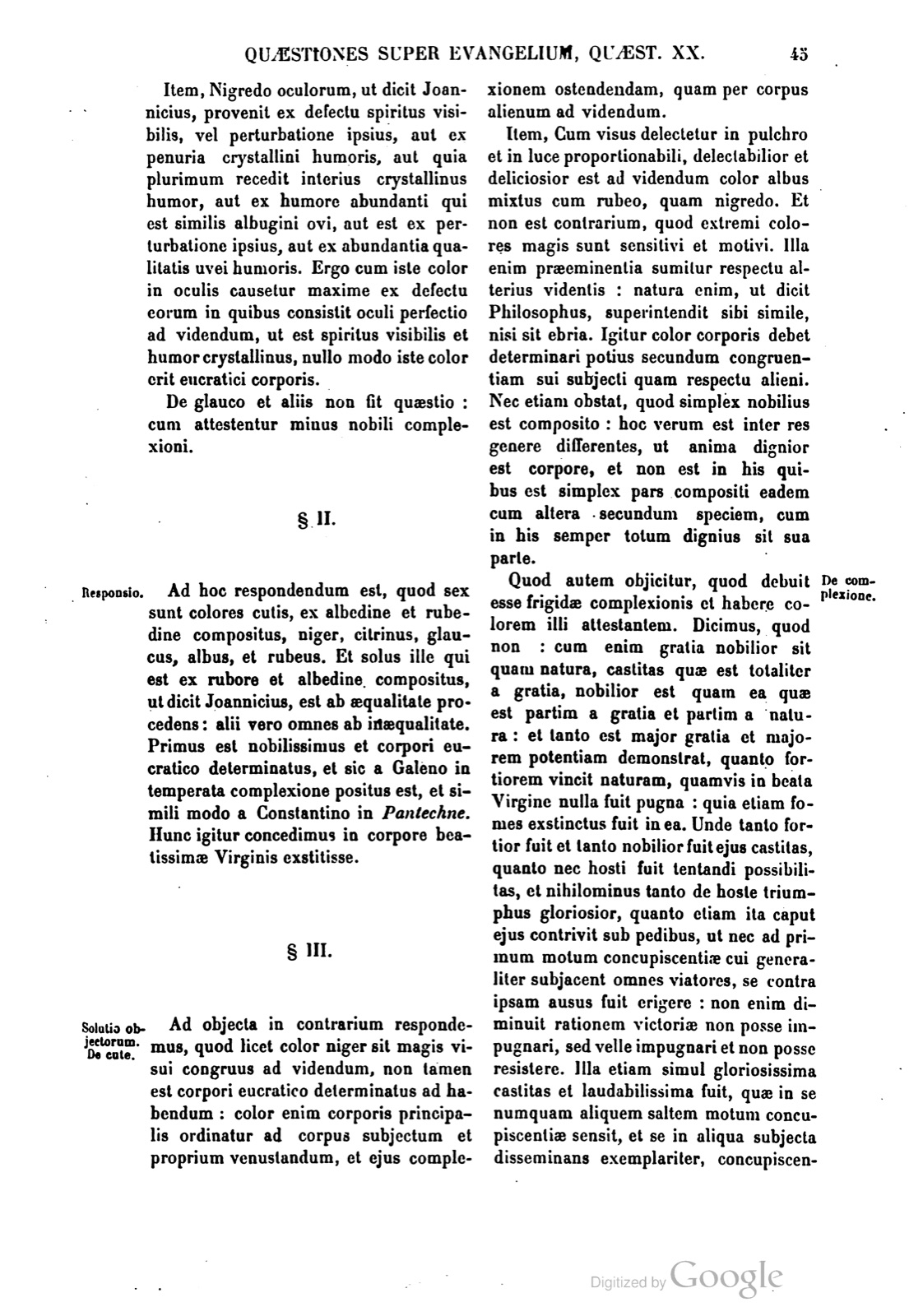
§ III. Solutio objectorum. Ad objecta in contrarium respondemus, quod licet color niger sit magis visui congruus ad videndum, non tamen est corpori eucratico determinatus ad habendum: color enim corporis principalis ordinatur ad corpus subjectum et proprium venustandum, et ejus complexionem ostendendam, quam per corpus alienum ad videndum. Item, Cum visus delectetur in pulchro et in luce proportionabili, delectabilior et deliciosior est ad videndum color albus mixtus cum rubeo, quam nigredo. Et non est contrarium, quod extremi colores magis sunt sensitivi et motivi. Illa enim praeeminentia sumitur respectu alterius videntis: natura enim, ut dicit Philosophus, superintendit sibi simile, nisi sit ebria. Igitur color corporis debet determinari potius secundum congruentiam sui subjecti quam respectu alieni. Nec etiam obstat, quod simplex nobilius est composito: hoc verum est inter res genere differentes, ut anima dignior est corpore, et non est in his quibus est simplex pars compositi eadem cum altera secundum speciem, cum in his semper totum dignius sit sua parte.
De complexione. Quod autem objicitur, quod debuit esse frigidae complexionis et habere colorem illi attestantem. Dicimus, quod non: cum enim gratia nobilior sit quam natura, castitas quae est totaliter a gratia, nobilior est quam ea quae est partim a gratia et partim a natura: et tanto est major gratia et majorem potentiam demonstrat, quanto fortiorem vincit naturam, quamvis in beata Virgine nulla fuit pugna: quia etiam fomes exstinctus fuit in ea. Unde tanto fortior fuit et tanto nobilior fuit ejus castitas, quanto nec hosti fuit tentandi possibilitas, et nihilominus tanto de hoste triumphus gloriosior, quanto etiam ita caput ejus contrivit sub pedibus, ut nec ad primum motum concupiscentiae cui generaliter subjacent omnes viatores, se contra ipsam ausus fuit erigere: non enim diminuit rationem victoriae non posse impugnari, sed velle impugnari et non posse resistere. Illa etiam simul gloriosissima castitas et laudabilissima fuit, quae in se numquam aliquem saltem motum concupiscentiae sensit, et se in aliqua subjecta disseminans exemplariter, concupiscentiam a multis cordibus et corporibus profugavit.
De colore capillorum. Ad illud quod objicitur de colore capillorum, dicimus quod color in capillis immediatam signat dispositionem cerebri. Unde optimus color in capillis, debet determinari secundum optimam cerebri complexionem: optima autem cerebri complexio determinatur secundum duos modos. Uno modo est cerebrum optime complexionatum, quando est optime ordinatum ad actionem naturalis virtutis, ita quod operationes cerebri maxime ordinantur secundum qualitates ad operationes cordis, et hepatis, et stomachi, et aliorum membrorum principalium. Et secundum hoc cerebrum debet esse calidum et humidum. Et hoc modo capilli talis cerebri in infantibus sunt subfulvi, in pueris vero subflavi, in perfectis vero flavi, sicut dicit Galenus in Techne auctoritate supra posita: «Nam si eucraticum, etc.» Et secundum hunc modum loquebatur qui dixit: «Crinibus irrutilet, etc.» Et secundum hanc legem procedunt rationes pro illa parte.
§ III. Solution of the objections. To the objections to the contrary we respond that although the color black is more fitting to sight for seeing, nevertheless it is not determined for a well-tempered body to have. For the principal color of the body is ordered more to making beautiful its subject and proper body, and to showing its complexion, than to seeing through another body. Likewise, since sight delights in the beautiful and in proportionable light, a white color mixed with red is more delightful and more pleasant to see than blackness. And it is not contrary that extreme colors are more sensitive and motive. For that preeminence is taken with respect to another seeing thing; for nature, as the Philosopher says, attends to what is like itself, unless it is drunk. Therefore the color of a body ought to be determined according to the fittingness of its own subject rather than with respect to something alien. Nor also does it stand in the way that the simple is nobler than the composite. This is true among things differing in genus, as the soul is worthier than the body; but it is not true in those things in which the simple is one part of the composite, the same with the other according to species, since in such things the whole is always worthier than its part.
Concerning complexion. As to what is objected, that she ought to have been of cold complexion and to have a color attesting to it, we say no. For since grace is nobler than nature, chastity that is totally from grace is nobler than that which is partly from grace and partly from nature; and the greater the grace is and the greater power it demonstrates, the stronger the nature that it conquers, although in the blessed Virgin there was no struggle, because even the tinder was extinguished in her. Hence her chastity was so much stronger and so much nobler, inasmuch as the enemy did not even have the possibility of tempting; and nevertheless the triumph over the enemy was so much more glorious, inasmuch as she so crushed his head beneath her feet that he did not dare to raise himself against her even toward the first motion of concupiscence, to which generally all wayfarers are subject. For not to be able to be attacked does not diminish the account of victory, but to wish to attack and not be able to resist does. Also that chastity was at once most glorious and most praiseworthy, which in itself never felt even any motion of concupiscence, and, by scattering itself exemplarily in some subjects, drove concupiscence from many hearts and bodies.
Concerning the color of hair. To that which is objected about the color of hair, we say that color in the hair immediately signifies the disposition of the brain. Hence the best color in hairs ought to be determined according to the best complexion of the brain. But the best complexion of the brain is determined in two ways. In one way the brain is best complexioned when it is best ordered to the action of the natural power, so that the operations of the brain are especially ordered according to qualities to the operations of the heart, liver, stomach, and other principal members. And according to this the brain ought to be warm and humid. In this way the hairs of such a brain in infants are somewhat tawny, in boys somewhat blond, and in those who are mature blond, as Galen says in the Techne in the authority set down above: "For if well-tempered, etc." And according to this mode the one who said, "Let the hair glow red, etc.," was speaking. And according to this law the arguments for that side proceed.
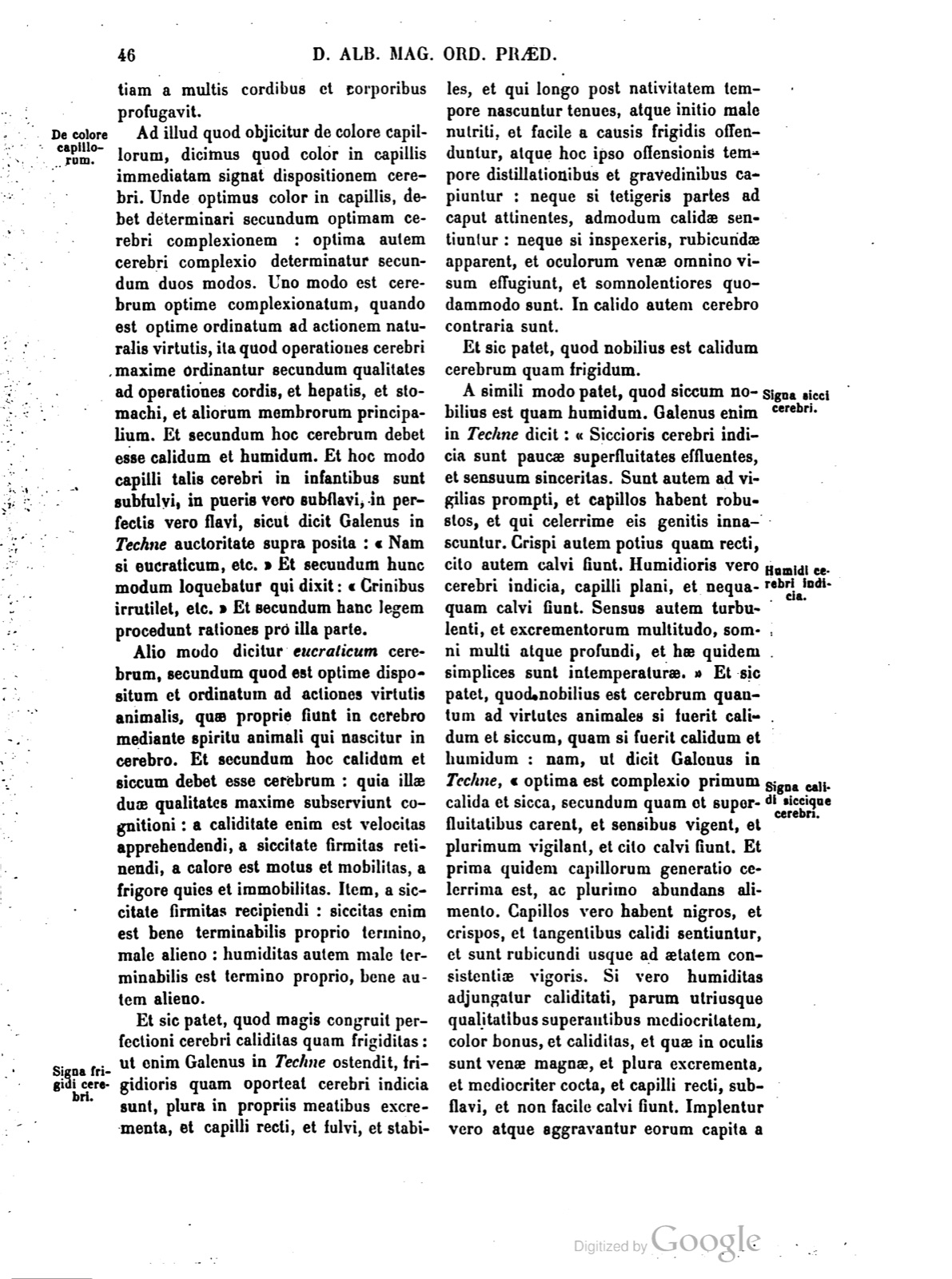
Alio modo dicitur eucraticum cerebrum, secundum quod est optime dispositum et ordinatum ad actiones virtutis animalis, quae proprie fiunt in cerebro mediante spiritu animali qui nascitur in cerebro. Et secundum hoc calidum et siccum debet esse cerebrum: quia illae duae qualitates maxime subserviunt cognitioni: a caliditate enim est velocitas apprehendendi, a siccitate firmitas retinendi, a calore est motus et mobilitas, a frigore quies et immobilitas. Item, a siccitate firmitas recipiendi: siccitas enim est bene terminabilis proprio termino, male alieno: humiditas autem male terminabilis est termino proprio, bene autem alieno. Et sic patet, quod magis congruit perfectioni cerebri caliditas quam frigiditas: ut enim Galenus in Techne ostendit, frigidioris quam oporteat cerebri indicia sunt, plura in propriis meatibus excrementa, et capilli recti, et fulvi, et stabiles, et qui longo post nativitatem tempore nascuntur tenues, atque initio male nutriti, et facile a causis frigidis offenduntur, atque hoc ipso offensionis tempore distillationibus et gravedinibus capiuntur: neque si tetigeris partes ad caput attinentes, admodum calidae sentiuntur: neque si inspexeris, rubicundae apparent, et oculorum venae omnino visum effugiunt, et somnolentiores quodammodo sunt. In calido autem cerebro contraria sunt. Et sic patet, quod nobilius est calidum cerebrum quam frigidum.
Signa sicci cerebri. A simili modo patet, quod siccum nobilius est quam humidum. Galenus enim in Techne dicit: «Siccioris cerebri indicia sunt paucae superfluitates effluentes, et sensuum sinceritas. Sunt autem ad vigilias prompti, et capillos habent robustos, et qui celerrime eis genitis innascuntur. Crispi autem potius quam recti, cito autem calvi fiunt. Humidioris vero cerebri indicia, capilli plani, et nequaquam calvi fiunt. Sensus autem turbulenti, et excrementorum multitudo, somni multi atque profundi, et hae quidem simplices sunt intemperaturae.» Et sic patet, quod nobilius est cerebrum quantum ad virtutes animales si fuerit calidum et siccum, quam si fuerit calidum et humidum: nam, ut dicit Galenus in Techne, «optima est complexio primum calida et sicca, secundum quam et superfluitatibus carent, et sensibus vigent, et plurimum vigilant, et cito calvi fiunt. Et prima quidem capillorum generatio celerrima est, ac plurimo abundans alimento. Capillos vero habent nigros, et crispos, et tangentibus calidi sentiuntur, et sunt rubicundi usque ad aetatem consistentiae vigoris. Si vero humiditas adjungatur caliditati, parum utriusque qualitatibus superantibus mediocritatem, color bonus, et caliditas, et quae in oculis sunt venae magnae, et plura excrementa, et mediocriter cocta, et capilli recti, subflavi, et non facile calvi fiunt. Implentur vero atque aggravantur eorum capita a calidis.» Et infra: «Auster vero semper eis adversatur, atque optime in Aquilone se habent: non tamen diu vigilare possunt, et cum se ad somnum converterint, simul gravi somno tentantur, et vigilant, et somnia habent imaginationibus plena, visus eis turbulenti, neque satis sensibus vigent.» Et sic patet ex conjunctione inaequalitatum, quod optima complexio cerebri quantum ad virtutes animales est calidum et siccum. Et cerebro sic se habenti debentur capilli nigri. Et hoc est quod dicit Constantinus in Pantechne in superioribus.
In another way a brain is called well-tempered insofar as it is best disposed and ordered to the actions of the animal power, which properly occur in the brain through the mediation of the animal spirit that is born in the brain. And according to this the brain ought to be warm and dry, because those two qualities especially serve knowledge: from heat comes speed of apprehending, from dryness firmness of retaining; from heat comes motion and mobility, from cold rest and immobility. Likewise, from dryness comes firmness of receiving; for dryness is well terminable by its own boundary, badly by another's, but humidity is badly terminable by its own boundary and well by another's. And thus it is clear that heat is more fitting for the perfection of the brain than coldness. For, as Galen shows in the Techne, the signs of a brain colder than it ought to be are more excrements in the proper passages, straight and tawny and stable hairs, hairs that are born thin a long time after birth, nourished badly at the beginning, and easily harmed by cold causes; and at that very time of harm they are seized by distillations and heavinesses. Nor if you touch the parts pertaining to the head do they feel very warm, nor if you inspect them do they appear ruddy, and the veins of the eyes utterly escape sight, and they are in a certain way sleepier. But in a warm brain the contrary things are present. And thus it is clear that a warm brain is nobler than a cold one.
Signs of a dry brain. In a similar way it is clear that dry is nobler than humid. For Galen in the Techne says: "The signs of a drier brain are few superfluities flowing out and sincerity of the senses. They are prompt for vigils, and they have robust hairs, and hairs that grow upon them very quickly when they have been born. They are curly rather than straight, but they quickly become bald. But the signs of a more humid brain are flat hairs, and they never become bald. The senses are turbulent, and there is a multitude of excrements, many and deep sleeps; and these indeed are simple intemperaments." And thus it is clear that the brain is nobler as to the animal powers if it is warm and dry than if it is warm and humid. For, as Galen says in the Techne, "The best complexion is first warm and dry; according to it they both lack superfluities and flourish in the senses, and they keep watch very much, and quickly become bald. And indeed the first generation of hairs is very swift and abounding in very much nourishment. But they have black and curly hairs, and they feel warm to those touching them, and they are ruddy up to the age of the consistency of vigor. But if humidity is joined to heat, with the qualities of each surpassing mediocrity a little, there is good color, and heat, and large veins in the eyes, and more excrements, moderately cooked, and straight hairs, somewhat blond, and they do not easily become bald. Their heads are filled and weighed down by warm things." And below: "The south wind is always adverse to them, and they are best in the north wind; nevertheless they cannot keep vigil for long, and when they turn themselves to sleep, at once they are assailed by heavy sleep, and they are wakeful, and they have dreams full of imaginings, their sights are turbulent, and they do not flourish enough in the senses." And thus it is clear from the conjunction of inequalities that the best complexion of the brain as to the animal powers is warm and dry. And to a brain having itself thus black hairs are owed. And this is what Constantine says above in the Pantechne.
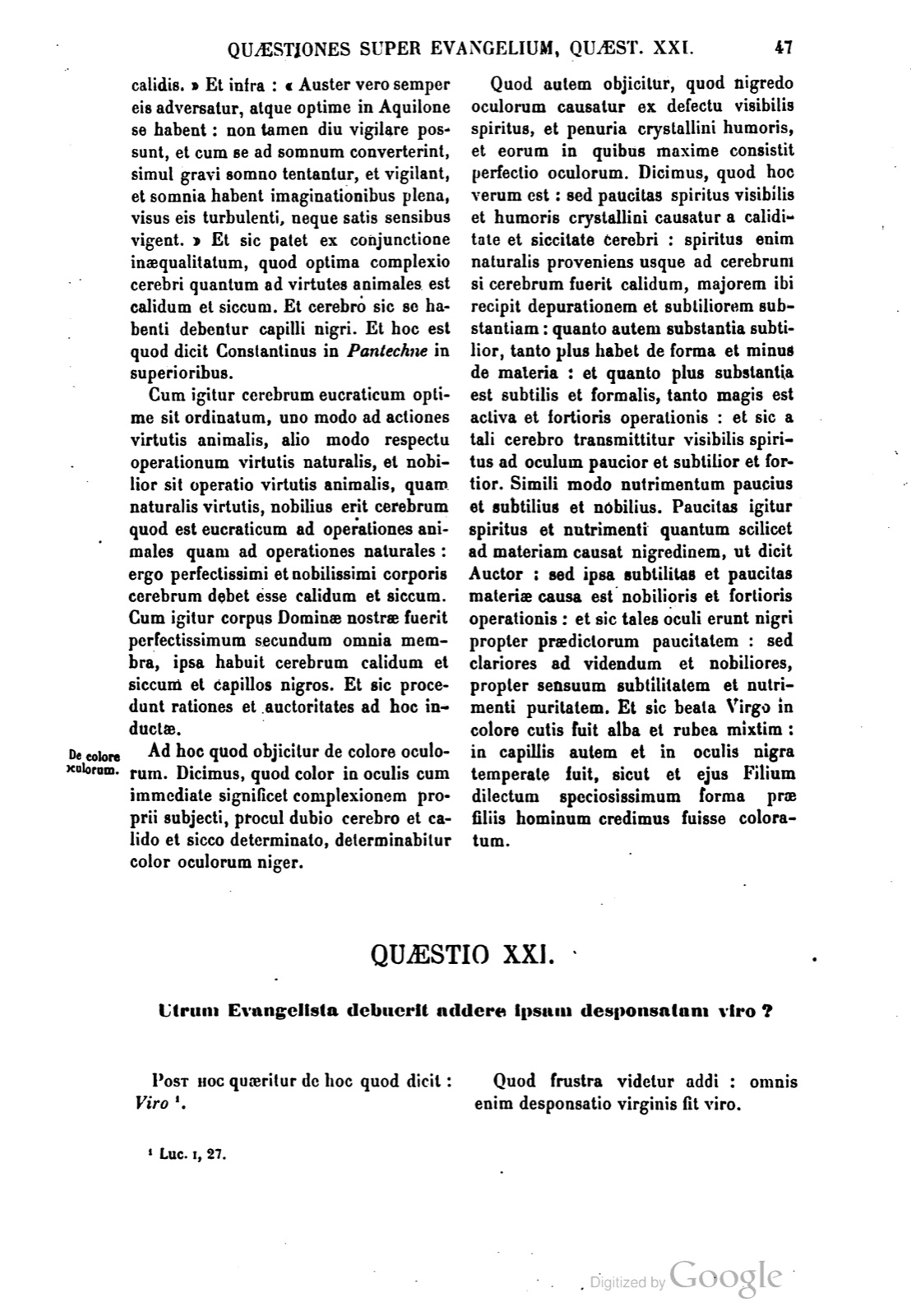
Cum igitur cerebrum eucraticum optime sit ordinatum, uno modo ad actiones virtutis animalis, alio modo respectu operationum virtutis naturalis, et nobilior sit operatio virtutis animalis, quam naturalis virtutis, nobilius erit cerebrum quod est eucraticum ad operationes animales quam ad operationes naturales: ergo perfectissimi et nobilissimi corporis cerebrum debet esse calidum et siccum. Cum igitur corpus Dominae nostrae fuerit perfectissimum secundum omnia membra, ipsa habuit cerebrum calidum et siccum et capillos nigros. Et sic procedunt rationes et auctoritates ad hoc inductae.
De colore oculorum. Ad hoc quod objicitur de colore oculorum. Dicimus, quod color in oculis cum immediate significet complexionem proprii subjecti, procul dubio cerebro et calido et sicco determinato, determinabitur color oculorum niger. Quod autem objicitur, quod nigredo oculorum causatur ex defectu visibilis spiritus, et penuria crystallini humoris, et eorum in quibus maxime consistit perfectio oculorum. Dicimus, quod hoc verum est: sed paucitas spiritus visibilis et humoris crystallini causatur a caliditate et siccitate cerebri: spiritus enim naturalis proveniens usque ad cerebrum si cerebrum fuerit calidum, majorem ibi recipit depurationem et subtiliorem substantiam: quanto autem substantia subtilior, tanto plus habet de forma et minus de materia: et quanto plus substantia est subtilis et formalis, tanto magis est activa et fortioris operationis: et sic a tali cerebro transmittitur visibilis spiritus ad oculum paucior et subtilior et fortior. Simili modo nutrimentum paucius et subtilius et nobilius. Paucitas igitur spiritus et nutrimenti quantum scilicet ad materiam causat nigredinem, ut dicit Auctor: sed ipsa subtilitas et paucitas materiae causa est nobilioris et fortioris operationis: et sic tales oculi erunt nigri propter praedictorum paucitatem: sed clariores ad videndum et nobiliores, propter sensuum subtilitatem et nutrimenti puritatem. Et sic beata Virgo in colore cutis fuit alba et rubea mixtim: in capillis autem et in oculis nigra temperate fuit, sicut et ejus Filium dilectum speciosissimum forma prae filiis hominum credimus fuisse coloratum.
Since, therefore, a well-tempered brain is best ordered in one way to the actions of the animal power, and in another way with respect to the operations of the natural power, and the operation of the animal power is nobler than that of the natural power, that brain which is well-tempered for animal operations will be nobler than one well-tempered for natural operations. Therefore the brain of the most perfect and noblest body ought to be warm and dry. Since, therefore, the body of our Lady was most perfect according to all members, she had a warm and dry brain and black hair. And thus the reasons and authorities introduced for this proceed.
Concerning the color of the eyes. To what is objected about the color of the eyes, we say that since color in the eyes immediately signifies the complexion of its proper subject, without doubt, when the brain is determined as warm and dry, the color of the eyes will be determined as black. But as to what is objected, that blackness of the eyes is caused from a defect of visible spirit and lack of crystalline humor, and of those things in which the perfection of the eyes especially consists, we say that this is true; but the smallness of visible spirit and crystalline humor is caused by heat and dryness of the brain. For natural spirit arriving all the way to the brain, if the brain is warm, receives there greater purification and a subtler substance. But the subtler the substance, the more it has of form and the less of matter; and the more a substance is subtle and formal, the more active it is and of stronger operation. And thus from such a brain there is transmitted to the eye a visible spirit that is fewer, subtler, and stronger. In a similar way, nourishment is fewer and subtler and nobler. Therefore the smallness of spirit and nourishment, namely as to matter, causes blackness, as the Author says; but that very subtlety and smallness of matter is the cause of a nobler and stronger operation. And thus such eyes will be black on account of the smallness of the aforesaid things, but clearer for seeing and nobler on account of the subtlety of the senses and the purity of nourishment. And thus the blessed Virgin in color of skin was white and red in mixture; but in hair and eyes she was temperately black, as we believe also her beloved Son, most beautiful in form above the sons of men, to have been colored.
If a page does not appear, its photograph has not been uploaded yet.