Works › The Mariale: Questions on “Missus est”
Volume 37 · pp. 49–50
Question XXII conclusion and Question XXIII
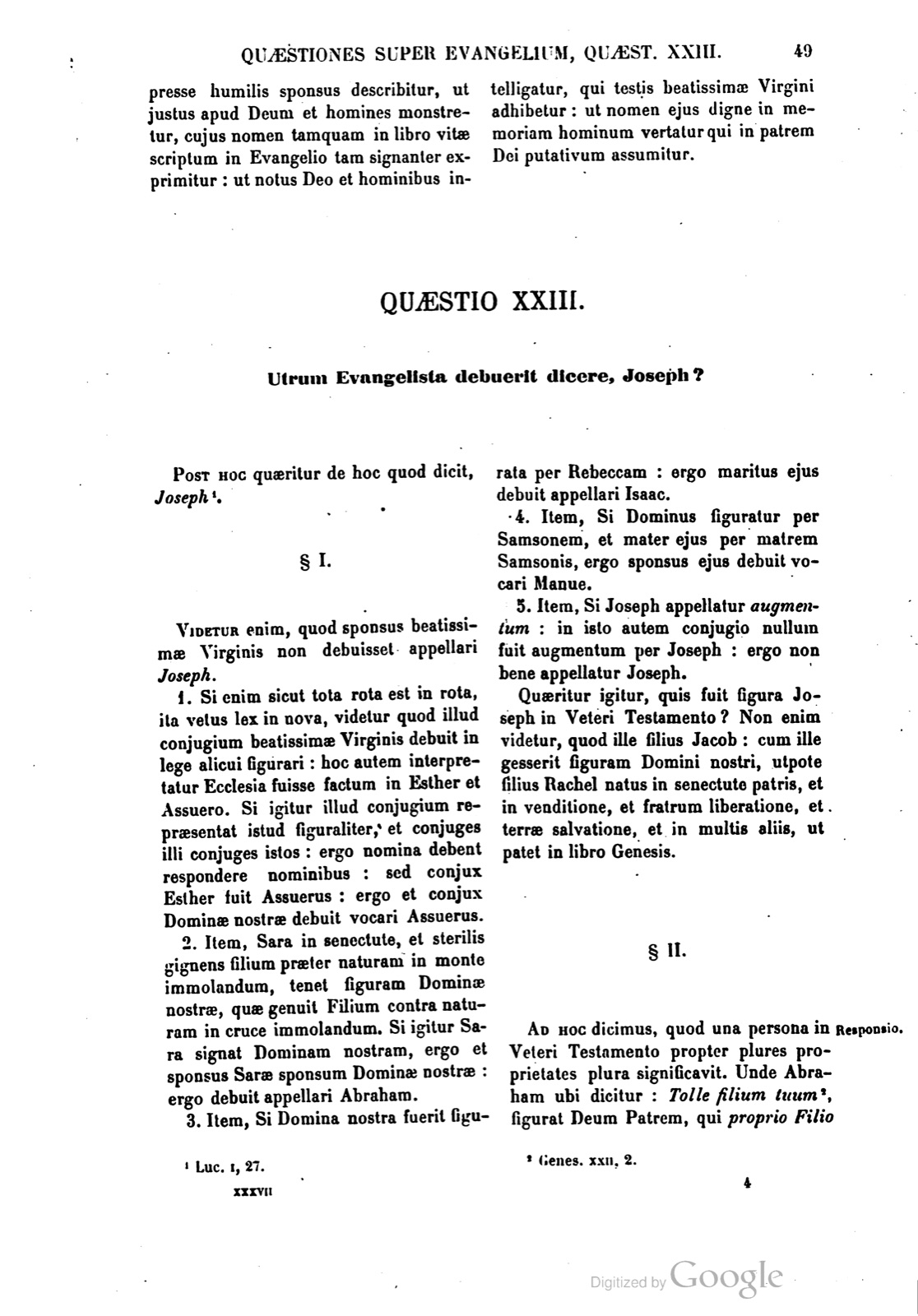
humilis sponsus describitur, ut justus apud Deum et homines monstretur, cujus nomen tamquam in libro vitae scriptum in Evangelio tam signanter exprimitur: ut notus Deo et hominibus intelligatur, qui testis beatissimae Virgini adhibetur: ut nomen ejus digne in memoriam hominum vertatur qui in patrem Dei putativum assumitur.
QUAESTIO XXIII. Utrum Evangelista debuerit dicere, Joseph?
Post hoc quaeritur de hoc quod dicit, Joseph 1.
§ I. Videtur enim, quod sponsus beatissimae Virginis non debuisset appellari Joseph. 1. Si enim sicut tota rota est in rota, ita vetus lex in nova, videtur quod illud conjugium beatissimae Virginis debuit in lege alicui figurari: hoc autem interpretatur Ecclesia fuisse factum in Esther et Assuero. Si igitur illud conjugium repraesentat istud figuraliter, et conjuges illi conjuges istos: ergo nomina debent respondere nominibus: sed conjux Esther fuit Assuerus: ergo et conjux Dominae nostrae debuit vocari Assuerus.
2. Item, Sara in senectute, et sterilis gignens filium praeter naturam in monte immolandum, tenet figuram Dominae nostrae, quae genuit Filium contra naturam in cruce immolandum. Si igitur Sara signat Dominam nostram, ergo et sponsus Sarae sponsum Dominae nostrae: ergo debuit appellari Abraham.
3. Item, Si Domina nostra fuerit figurata per Rebeccam: ergo maritus ejus debuit appellari Isaac.
4. Item, Si Dominus figuratur per Samsonem, et mater ejus per matrem Samsonis, ergo sponsus ejus debuit vocari Manue.
5. Item, Si Joseph appellatur augmentum: in isto autem conjugio nullum fuit augmentum per Joseph: ergo non bene appellatur Joseph.
Quaeritur igitur, quis fuit figura Joseph in Veteri Testamento? Non enim videtur, quod ille filius Jacob: cum ille gesserit figuram Domini nostri, utpote filius Rachel natus in senectute patris, et in venditione, et fratrum liberatione, et terrae salvatione, et in multis aliis, ut patet in libro Genesis.
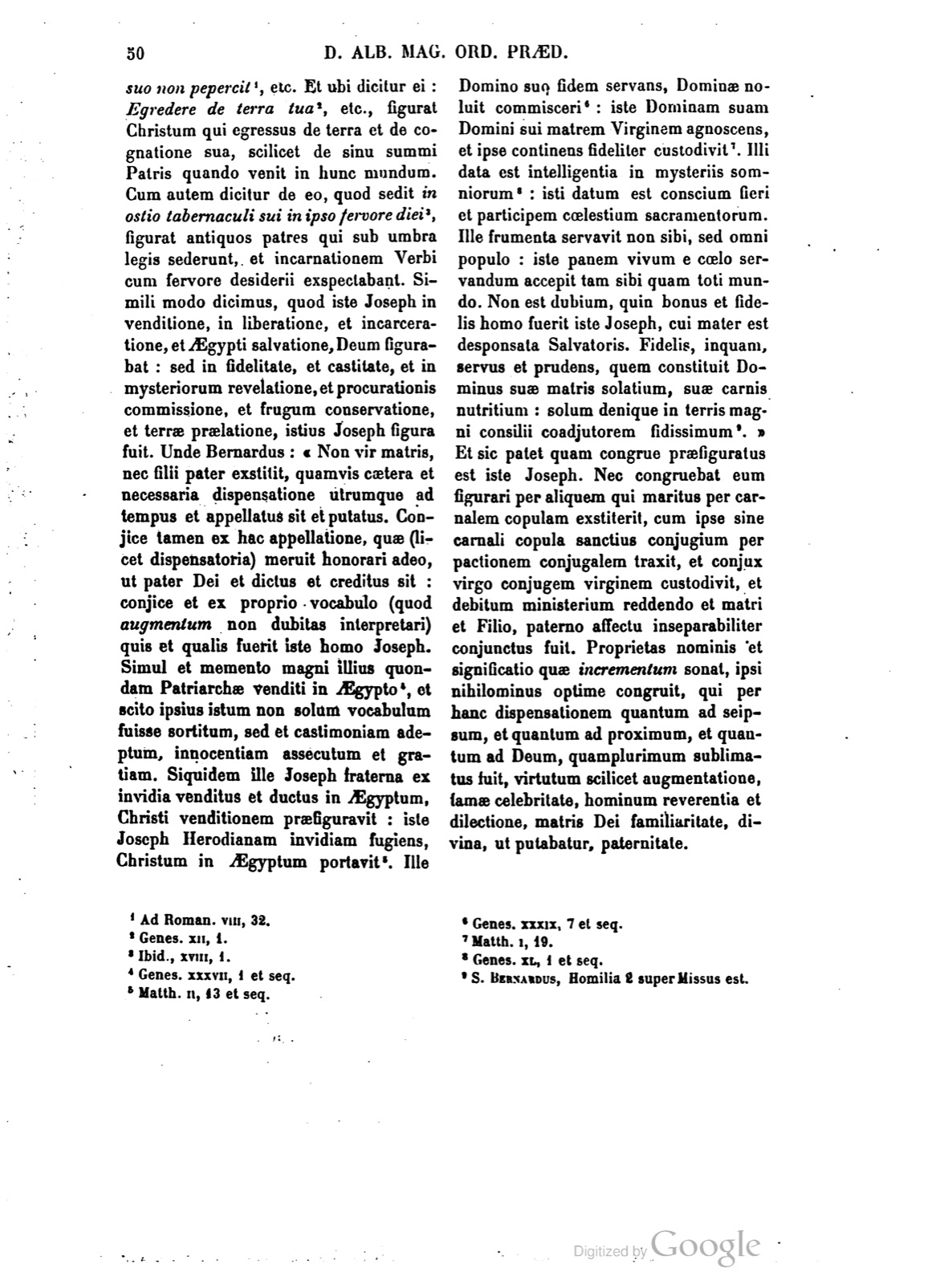
§ II. Ad hoc dicimus, quod una persona in Veteri Testamento propter plures proprietates plura significavit. Unde Abraham ubi dicitur: Tolle filium tuum 2, figurat Deum Patrem, qui proprio Filio suo non pepercit 3, etc. Et ubi dicitur ei: Egredere de terra tua 4, etc., figurat Christum qui egressus de terra et de cognatione sua, scilicet de sinu summi Patris quando venit in hunc mundum. Cum autem dicitur de eo, quod sedit in ostio tabernaculi sui in ipso fervore diei 5, figurat antiquos patres qui sub umbra legis sederunt, et incarnationem Verbi cum fervore desiderii exspectabant. Simili modo dicimus, quod iste Joseph in venditione, in liberatione, et incarceratione, et Aegypti salvatione, Deum figurabat: sed in fidelitate, et castitate, et in mysteriorum revelatione, et procurationis commissione, et frugum conservatione, et terrae praelatione, istius Joseph figura fuit. Unde Bernardus: «Non vir matris, nec filii pater exstitit, quamvis caetera et necessaria dispensatione utrumque ad tempus et appellatus sit et putatus. Conjice tamen ex hac appellatione, quae (licet dispensatoria) meruit honorari adeo, ut pater Dei et dictus et creditus sit: conjice et ex proprio vocabulo (quod augmentum non dubitas interpretari) quis et qualis fuerit iste homo Joseph. Simul et memento magni illius quondam Patriarchae venditi in Aegypto 6, et scito ipsius istum non solum vocabulum fuisse sortitum, sed et castimoniam adeptum, innocentiam assecutum et gratiam. Siquidem ille Joseph fraterna ex invidia venditus et ductus in Aegyptum, Christi venditionem praefiguravit: iste Joseph Herodianam invidiam fugiens, Christum in Aegyptum portavit 7. Ille Domino suo fidem servans, Dominae noluit commisceri 8: iste Dominam suam Domini sui matrem Virginem agnoscens, et ipse continens fideliter custodivit 9. Illi data est intelligentia in mysteriis somniorum 10: isti datum est conscium fieri et participem coelestium sacramentorum. Ille frumenta servavit non sibi, sed omni populo: iste panem vivum e coelo servandum accepit tam sibi quam toti mundo. Non est dubium, quin bonus et fidelis homo fuerit iste Joseph, cui mater est desponsata Salvatoris. Fidelis, inquam, servus et prudens, quem constituit Dominus suae matris solatium, suae carnis nutritium: solum denique in terris magni consilii coadjutorem fidissimum 11.» Et sic patet quam congrue praefiguratus est iste Joseph. Nec congruebat eum figurari per aliquem qui maritus per carnalem copulam exstiterit, cum ipse sine carnali copula sanctius conjugium per pactionem conjugalem traxit, et conjux virgo conjugem virginem custodivit, et debitum ministerium reddendo et matri et Filio, paterno affectu inseparabiliter conjunctus fuit. Proprietas nominis et significatio quae incrementum sonat, ipsi nihilominus optime congruit, qui per hanc dispensationem quantum ad seipsum, et quantum ad proximum, et quantum ad Deum, quamplurimum sublimatus fuit, virtutum scilicet augmentatione, famae celebritate, hominum reverentia et dilectione, matris Dei familiaritate, divina, ut putabatur, paternitate.
humble is described, so that he may be shown just before God and men, whose name, as if written in the book of life, is expressed so significantly in the Gospel: so that he may be understood as known to God and to men, who is applied as witness to the most blessed Virgin; so that his name may worthily be turned into the memory of men, he who is assumed as the putative father of God.
QUESTION XXIII. Whether the Evangelist ought to have said Joseph?
After this inquiry is made concerning what he says, Joseph 1.
§ I. For it seems that the spouse of the most blessed Virgin ought not to have been called Joseph. 1. For if, as the whole wheel is in the wheel, so the old law is in the new, it seems that that marriage of the most blessed Virgin ought to have been figured somewhere in the law; but the Church interprets this as having been done in Esther and Ahasuerus. Therefore if that marriage represents this one figuratively, and those spouses these spouses, then names ought to correspond to names; but the spouse of Esther was Ahasuerus; therefore the spouse of our Lady ought also to have been called Ahasuerus.
2. Likewise, Sarah, bearing a son in old age and barren, beyond nature, to be sacrificed on a mountain, holds the figure of our Lady, who bore a Son contrary to nature to be sacrificed on the cross. Therefore if Sarah signifies our Lady, then also the spouse of Sarah signifies the spouse of our Lady; therefore he ought to have been called Abraham.
3. Likewise, if our Lady was figured by Rebecca, then her husband ought to have been called Isaac.
4. Likewise, if the Lord is figured by Samson, and his mother by the mother of Samson, then her spouse ought to have been called Manoah.
5. Likewise, if Joseph is interpreted increase, but in that marriage there was no increase through Joseph, therefore he is not well called Joseph.
Therefore it is asked who was the figure of Joseph in the Old Testament. For it does not seem that it was that son of Jacob, since he bore the figure of our Lord, as the son of Rachel born in the old age of his father, and in his being sold, and in the liberation of his brothers, and in the salvation of the land, and in many other things, as is clear in the book of Genesis.
§ II. To this we say that one person in the Old Testament signified several things because of several properties. Hence Abraham, where it is said, Take your son 2, figures God the Father, who did not spare his own Son 3, etc. And where it is said to him, Go forth from your land 4, etc., he figures Christ, who went forth from his land and from his kindred, that is, from the bosom of the highest Father, when he came into this world. But when it is said of him that he sat in the entrance of his tent in the very heat of the day 5, he figures the ancient fathers, who sat beneath the shadow of the law and awaited the incarnation of the Word with the heat of desire. In a similar way we say that that Joseph, in selling, in liberation, in imprisonment, and in the salvation of Egypt, figured God; but in fidelity, chastity, revelation of mysteries, the commission of care, conservation of grain, and governance of the land, he was the figure of this Joseph. Hence Bernard says: "He existed neither as husband of the mother nor father of the son, although by the rest and by necessary dispensation he was for a time both called and thought each. Conjecture, however, from this appellation, which, although dispensatory, merited to be honored so greatly that he was both called and believed father of God; conjecture also from his own name, which you do not doubt is interpreted increase, who and what sort of man this Joseph was. At the same time remember that great Patriarch once sold into Egypt 6, and know that this man obtained not only his name, but also attained chastity, innocence, and grace. Indeed, that Joseph, sold by fraternal envy and led into Egypt, prefigured the selling of Christ; this Joseph, fleeing Herodian envy, carried Christ into Egypt 7. The former, keeping faith with his lord, refused to be joined to his lady 8; this one, recognizing his Lady as the Virgin mother of his Lord, himself also, continent, faithfully guarded her 9. To the former was given understanding in the mysteries of dreams 10; to this one it was given to become conscious and participant of heavenly sacraments. The former preserved grain not for himself but for the whole people; this one received the living bread from heaven to be kept both for himself and for the whole world. There is no doubt that this Joseph was a good and faithful man, to whom the mother of the Savior was betrothed: faithful, I say, a prudent servant, whom the Lord constituted the solace of his mother, the nurturer of his flesh, and finally the only most faithful helper on earth of the great counsel 11." And thus it is clear how fittingly this Joseph was prefigured. Nor was it fitting that he be figured by someone who was a husband through carnal union, since he, without carnal union, drew a holier marriage by the marriage pact, and as a virgin spouse guarded a virgin spouse, and by rendering due service to both mother and Son, was inseparably joined by paternal affection. The property of the name and the signification that sounds of increase likewise fit him very well, since through this dispensation he was raised up very greatly with respect to himself, to his neighbor, and to God, namely by increase of virtues, celebrity of reputation, reverence and love of men, familiarity with the mother of God, and divine paternity, as it was thought.
Notes
- Luke 1:27. (Luc. I, 27.) ↩
- Genesis 22:2. (Genes. XXII, 2.) ↩
- To the Romans 8:32. (Ad Roman. VIII, 32.) ↩
- Genesis 12:1. (Genes. XII, 1.) ↩
- The same, 18:1. (Ibid., XVIII, 1.) ↩
- Genesis 37:1 and following. (Genes. XXXVII, 1 et seq.) ↩
- Matthew 2:13 and following. (Matth. II, 13 et seq.) ↩
- Genesis 39:7 and following. (Genes. XXXIX, 7 et seq.) ↩
- Matthew 1:19. (Matth. I, 19.) ↩
- Genesis 40:1 and following. (Genes. XL, 1 et seq.) ↩
- St. Bernard, Homily 2 on Missus est. (S. Bernardus, Homilia 2 super Missus est.) ↩
If a page does not appear, its photograph has not been uploaded yet.