Works › The Mariale: Questions on “Missus est”
Volume 37 · pp. 39–40
Questions XVI-XVII
A marker with ≈ is an approximate page boundary, placed by measure of the text; the page photographs remain the authority. In the paired views, clicking a page marker brings that page into view.
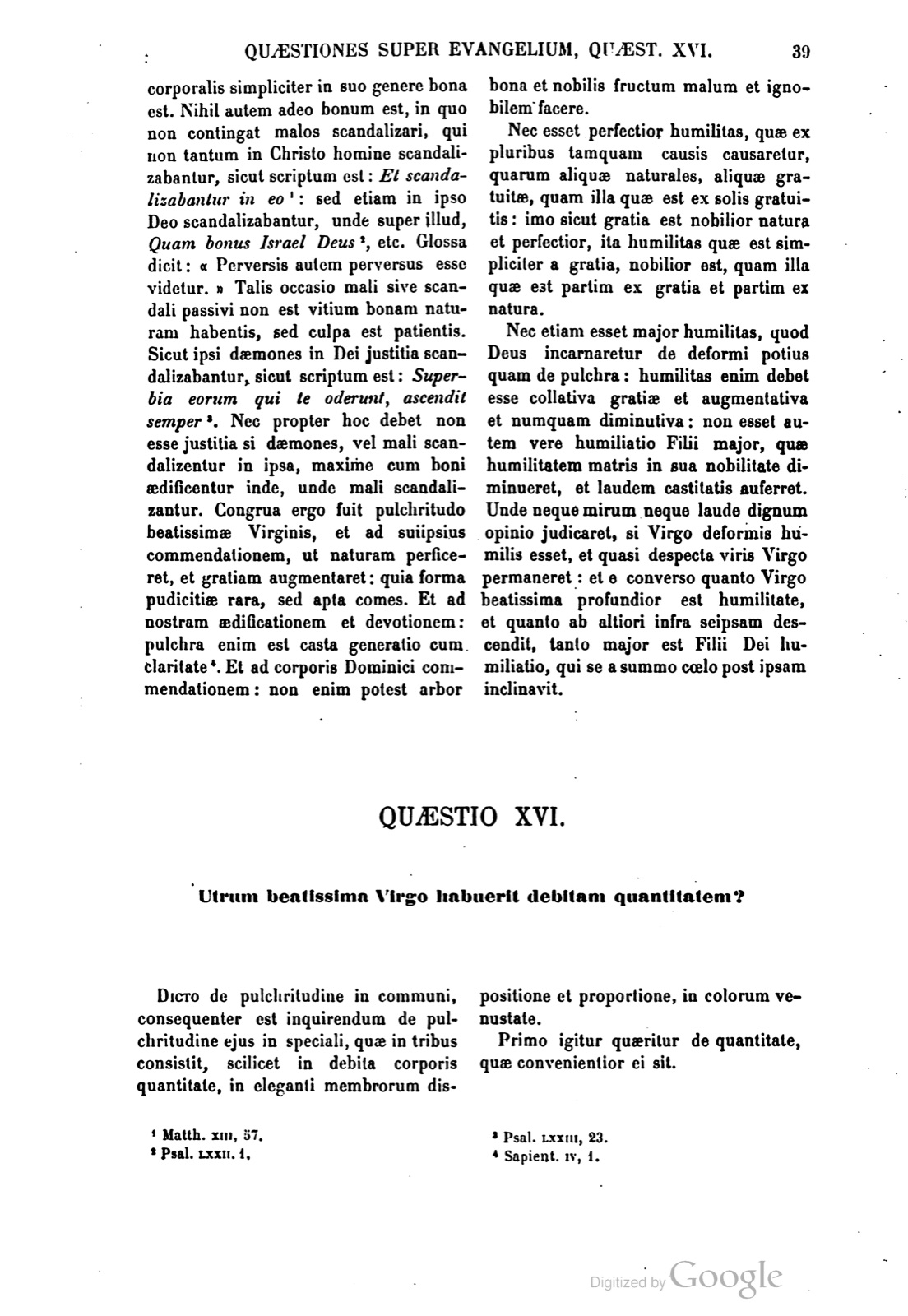
Quaestio XVI. Utrum beatissima Virgo habuerit debitam quantitatem?
Dicto de pulchritudine in communi, consequenter est inquirendum de pulchritudine ejus in speciali, quae in tribus consistit, scilicet in debita corporis quantitate, in eleganti membrorum dispositione et proportione, in colorum venustate. Primo igitur quaeritur de quantitate, quae convenientior ei sit.
§ I. Et probari potest a quantitate corporis sui Filii, quod tamquam perfectissimum in omnibus naturalibus debitissimam habuit quantitatem: corpus enim filii formatur a corpore generantis, ita quod de tali tale, et de tanto tantum, nisi error aut impotentia impediat, aut per viam accidentis, aut aliquo modo aliter fiat: sed naturaliter et regulariter magnus magnum generat, et parvus parvum, et tantus tantum: ergo si corpus Domini in summo habuit quantitatem debitam viro congruentem, ergo et mater sua habuit in summo quantitatem feminae congruentem.
§ II. Responsio. Quod concedimus et credimus esse verum, idem de qualitate dicentes: modi enim qualitatis corporis sunt quinque, crassities nimia, carnositas, extenuata macies, synthesis, et aequalitas. Pinguedo causatur ex frigiditate et humiditate, carnositas ex caliditate et humiditate, extenuata macies ex caliditate et siccitate, synthesis ex frigiditate et siccitate, aequalitas ex omnium humorum aequali complexione, cujus aequalitatis credimus corpus beatissimae Virginis exstitisse.
Question XVI. Whether the most blessed Virgin had due quantity.
Having spoken about beauty in common, consequently one must inquire about her beauty in particular, which consists in three things: namely, in due quantity of body, in elegant arrangement and proportion of members, and in loveliness of colors. First, therefore, the inquiry is about quantity, which is more fitting for her.
§ I. And it can be proved from the quantity of the body of her Son that, as the most perfect in all natural things, she had the most due quantity. For the body of a son is formed from the body of the one generating, so that from such comes such, and from so much comes so much, unless error or impotence impedes, or it happens by way of accident, or in some other way. But naturally and regularly the great generates the great, and the small the small, and such an amount such an amount. Therefore if the body of the Lord had in the highest degree the due quantity fitting a man, then his mother too had in the highest degree the quantity fitting a woman.
§ II. Response. This we concede and believe to be true, saying the same about quality. For the modes of bodily quality are five: excessive thickness, fleshiness, attenuated thinness, synthesis, and equality. Fatness is caused from coldness and humidity, fleshiness from heat and humidity, attenuated thinness from heat and dryness, synthesis from coldness and dryness, and equality from the equal complexion of all the humors. We believe that the body of the most blessed Virgin existed in this equality.
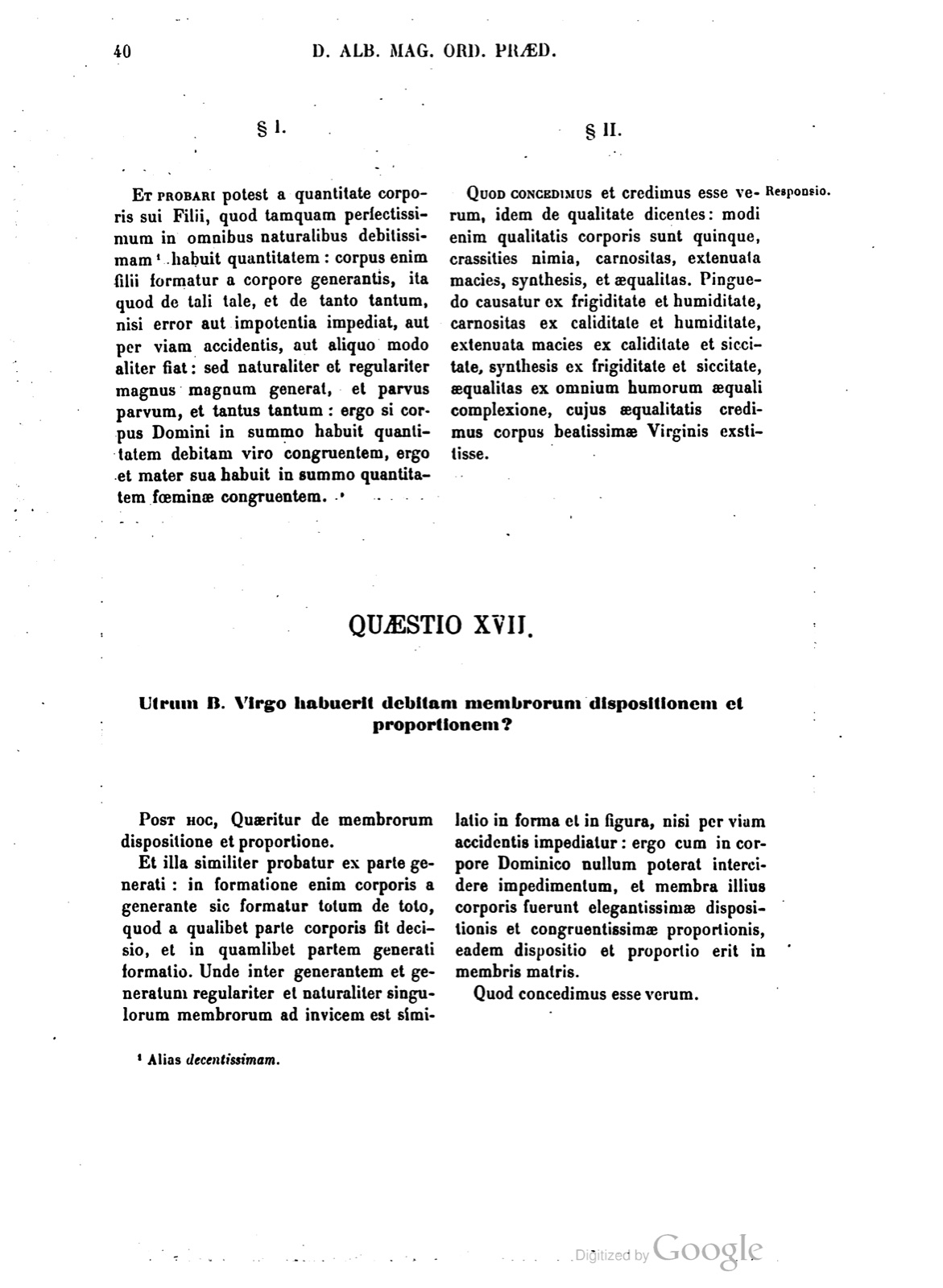
Quaestio XVII. Utrum B. Virgo habuerit debitam membrorum dispositionem et proportionem?
Post hoc, Quaeritur de membrorum dispositione et proportione. Et illa similiter probatur ex parte generati: in formatione enim corporis a generante sic formatur totum de toto, quod a qualibet parte corporis fit decisio, et in quamlibet partem generati formatio. Unde inter generantem et generatum regulariter et naturaliter singulorum membrorum ad invicem est simulatio in forma et in figura, nisi per viam accidentis impediatur: ergo cum in corpore Dominico nullum poterat intercidere impedimentum, et membra illius corporis fuerunt elegantissimae dispositionis et congruentissimae proportionis, eadem dispositio et proportio erit in membris matris. Quod concedimus esse verum 1.
Question XVII. Whether the blessed Virgin had due arrangement and proportion of members.
After this inquiry is made about the arrangement and proportion of members. And this likewise is proved from the side of the one generated: for in the formation of a body by the generator, the whole is so formed from the whole that from each part of the body there is a cutting off, and formation into each part of the one generated. Hence between the one generating and the one generated, regularly and naturally there is likeness of individual members to one another in form and figure, unless it is impeded by way of accident. Therefore, since in the Lord's body no impediment could intervene, and the members of that body were of the most elegant arrangement and most fitting proportion, the same arrangement and proportion will be in the members of the mother. This we concede to be true 1.
Notes
- Another reading: most becoming. (Alias decentissimam.) ↩
If a page does not appear, its photograph has not been uploaded yet.